Flushing of the Ear Canal
After the class of disease and the type of infection are determined, the next step is to sedate or anesthetize the animal so that a thorough flushing and suctioning of the ear canal can be done.
It is imperative that exudates and dried medications that have accumulated in the ear canal be removed so that the canal epithelium itself can be evaluated. Good visualization of the ear canal after flushing helps to ensure that the vertical and horizontal canals are clean and free of debris (Figure 8-4). The efficacy of otic medications is enhanced when they are applied directly onto the cleaned epithelial surface.Care must be taken in the selection of a flushing agent because so many ear cleaners contain materials that are potentially ototoxic when the eardrum is not intact (see Chapter 17). Prior to using an ear cleaner, the veterinarian should read the label to see whether it can be used when the eardrum is damaged. Many manufacturers are now placing a warning about this issue on their labels.
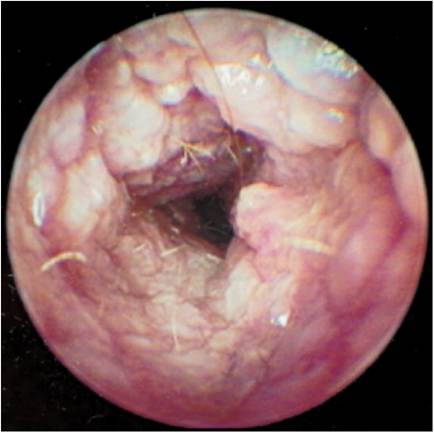
Figure 8-4
Chronic otitis externa is characterized by permanent pathologic changes to the glands and the epithelium. Epithelial proliferation, cerumen gland hyperplasia, and fibrosis result in an uneven surface contour. This photo was taken after the ear canal was cleaned and dried.
Mechanical Ear Cleaning
When the ear canal is full of liquid exudates such as pus, warmed saline or warmed, very dilute povidone-iodine solutions (not iodine scrub, which contains detergents) are safe flushing materials to use. Many types of high-pressure irrigation systems are available that can be used to loosen the exudates, but the pressures in such instruments can be very high, necessitating extra caution to avoid rupturing the eardrum. Many of these new irrigation instruments have controls to adjust the flush pressure.
Ear curettes, designed to remove debris firmly attached to the epithelium, are useful for scraping the ear canal to dislodge large pieces of wax and epithelial shreds. Curettes are also useful for harvesting cells for cytologic evaluation when a tumor mass is suspected.After the external ear canal is flushed, it is cleaned with a catheter attached to suction. With good visualization, small pieces of wax, epithelial flakes, and foreign material can be removed. Flushing and suctioning may need to be repeated several times to ensure that the ear canal is thoroughly cleaned.
Cotton-tipped applicators should never be used to clean ears! When a cottontipped applicator is pushed into an ear canal full of exudates, the exudate is pushed farther toward the eardrum, making cleaning more difficult and possibly rupturing a weakened eardrum. Cotton swabs are also very irritating to a friable epithelium, and their use may result in painful abrasion or ulceration of the canal epithelium.
Chemical Cleaning
After it is established that there is an eardrum present, ceruminous exudates can be emulsified by using ceruminolytics. Most of these agents are detergents, which require an aqueous medium to function. Many combination ear cleaners contain dioctyl sodium sulfosuccinate (DSS) as a wax remover. Detergents can be very irritating to ulcerated ears, and they should not be used in ulcerated ear canals. In addition, most detergent ear cleaners are ototoxic.
Only after the ear canal has been cleaned and dried can a determination of the integrity of the eardrum be made. Unfortunately, severely stenotic ear canals often prevent adequate visualization of the eardrum through the otoscope.