Introduction
The Mycobacterium tuberculosis complex (MCT) comprises a diverse collection of mycobacterial species that evolved from a common ancestral human pathogen of African origin (Wirth et al.
2008). While these organisms are over 99% genetically similar, their clonal evolution has, to a large extent, occurred through genomic deletions, and these genetic regions of difference (RDs) can be used to distinguish between lineages, strains, and species (Brosch et al. 2002; Huard et al. 2006; Warren et al. 2006). Notably, the lineage characterized by the deletion of RD9 is the only MTC clade to have given rise to strains that became permanently established in animal hosts (Huard et al. 2006; Smith et al. 2006). Many of these strains are strongly associated with specific host species and have been named after them. However, it is currently unclear if these pathogens have undergone evolutionary host adaptation or if their distinct genetic and phenotypic characteristics have arisen as a result of genetic drift following their ecological isolation within separate niches (Hershberg et al. 2008; Pepperell et al. 2013; Smith et al. 2006).S. D. C. Parsons (*) ∙ M. A. Miller
DST-NRF Centre of Excellence for Biomedical Tuberculosis Research, Division of Molecular Biology and Human Genetics, Faculty of Medicine and Health Sciences, Stellenbosch University, Cape Town, South Africa
SAMRC Centre for TB Research, Division of Molecular Biology and Human Genetics, Faculty of Medicine and Health Sciences, Stellenbosch University, Cape Town, South Africa e-mail: sparsons@sun.ac.za; miller@sun.ac.za
P. D. van Helden
Division of Molecular Biology and Human Genetics, Faculty of Medicine and Health Sciences, South African MRC Centre for TB Research, DST NRF Centre of Excellence for Biomedical Tuberculosis Research, Stellenbosch University, Tygerberg, South Africa e-mail: pvh@sun.ac.za
© Springer Nature Switzerland AG 2019 73
A. B.
Dibaba et al. (eds.), Tuberculosis in Animals: An African Perspective, https://doi.org/10.1007/978-3-030-18690-6_6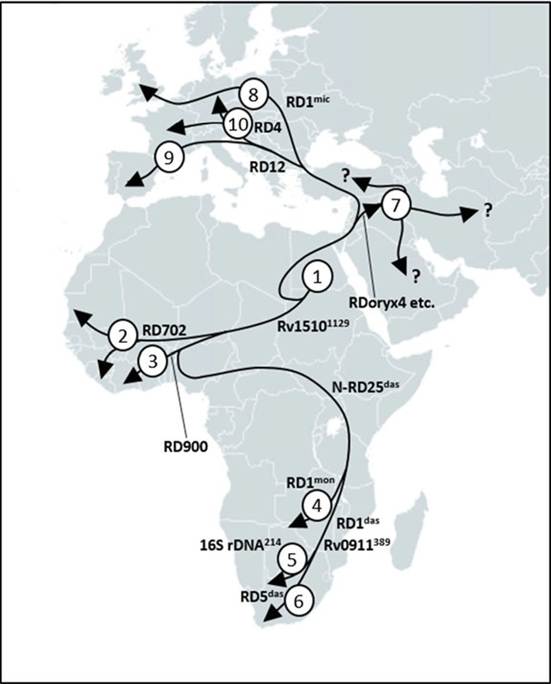
Fig. 6.1 Proposed geographic spread of the RD9-deleted clade of the Mycobacterium tuberculosis complex (MTC). Genetic regions of difference and single nucleotide polymorphisms, which characterize the molecular evolution of this lineage, are indicated. (1) Ancestral MTBC strain with deletions of RD7, RD8, RD9, and RD10, (2) M. africanum, (3) the chimpanzee bacillus, (4) M. mungi, (5) M. suricattae, (6) the dassie bacillus, (7) M. orygis, (8) M. microti, (9) M. bovis, (10) M. caprae
The RD9-deleted clade has given rise to two distinct sub-lineages (Fig. 6.1). The first includes species that are primarily found in Europe and Asia, and includes M. orygis, which has been isolated from antelopes, cattle, and humans (van Ingen et al. 2012); M. caprae, which principally infects goats (Aranaz 2003); and M. microti, which infects voles (Microtus agrestis) and other rodents, and llamas (Lama glama) (Cavanagh et al. 2002; Oevermann et al. 2004). The best-known member of this sub-lineage is M. bovis that is reviewed elsewhere in this book. The second sub-lineage of the RD9-deleted clade evolved in Africa and is the focus of this chapter.
6.2