Introduction
Geographically, Ghana (within latitude 4o440 N and 11o 11' N and 3o 11' W and 1° 11' E) is bordered on the east by the Republic of Togo, to the north by Burkina Faso (formerly Upper Volta), and to the west by Cote d’Ivoire.
The Gulf of Guinea lies south of the country, forming a coastline of 550 km (Fig. 15.1). According to the 2012 population census report, Ghana harbors 24,658,823 humans (Ghana Statistical Service 2012), while reports from the Ministry of Agriculture indicate that the cattle, sheep, and goat populations in that same year were 1,543,000, 4,019,000, and 5,435,000, respectively (Ministry of Agriculture 2012). The most common cattle breed in the country is the West African Shorthorn (WASH) (Teye and Sunkwa2010) that includes all small, non-humped cattle, generally black and white but sometimes fawn and white (Karbo et al. 2004). The WASH is an indigenous, tough breed of cattle and thickset with short, fine-boned limbs. This breed accounts for about half of the cattle in the country, and is followed numerically by the Sanga, which is a cross between the WASH and large-humped Zebu cattle, and then the Zebu breed (Hutchinson 1962). There are currently no pure, exotic dairy cattle in the country. Most of the about 500 crossbred dairy cattle in the country were bred by artificial insemination with imported semen (Gushiegu District Report 2006).
In the majority of cases, cattle are owned by ethnic groups of farmers or families or even by a whole village. Traditionally, most farmers in Northern Ghana rear cattle for socioreligious reasons, and they are used in ritual events. Two additional factors based on tradition and customs, namely, the prestige of the herd and its value as a self-sustaining investment, are of great importance in sustaining cattle farming in the region (Veterinary Services Directorate 2010).
D. Yeboah-Manu (*) ∙ A. Asante-Poku
Noguchi Memorial Institute for Medical Research, University of Ghana, Legon, Ghana e-mail: dyeboah-manu@noguchi.ug.edu.gh; aasante-poku@noguchi.ug.edu.gh
© Springer Nature Switzerland AG 2019
A. B. Dibaba et al. (eds.), Tuberculosis in Animals: An African Perspective, https://doi.org/10.1007/978-3-030-18690-6_15
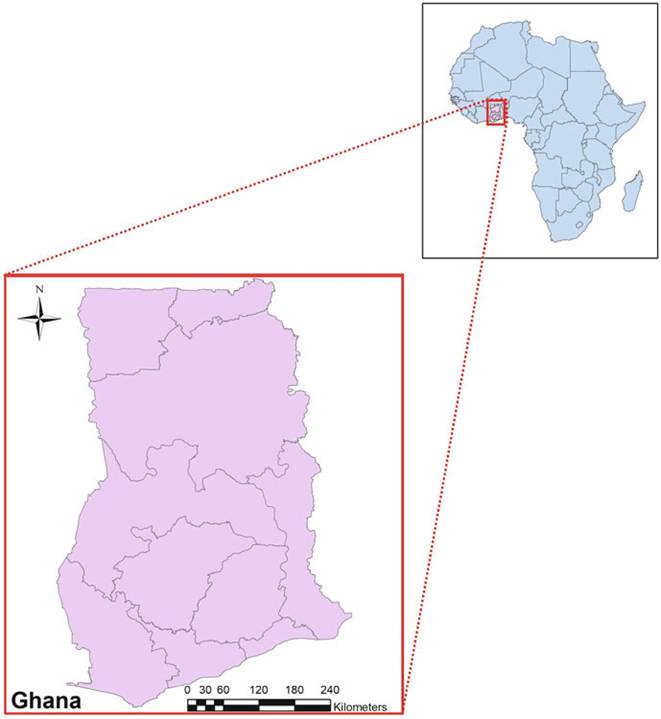
Fig. 15.1 Map of Ghana zoomed from its location on West Africa
Similar to other countries in Africa, human tuberculosis is an important public health problem in Ghana. With 9 million recorded cases and 1.5 million deaths globally in 2013, tuberculosis (TB) in humans is the leading cause of adult death by a single infectious disease. In 1995, the number of cases of human tuberculosis in Africa accounted for 16% of the global burden, and it has now increased to about 30% even though the number of people in Africa constitutes only 11% of the global population (WHO 2014). Furthermore, about 70% of individuals co-infected with both HIV and TB, live in sub-Saharan Africa (Corbett et al. 2006).
A group of Gram-positive bacteria, the Mycobacterium tuberculosis complex (MTC), causes tuberculosis in various species. The MTC comprises various species and sub-species (Comas and Gagneux 2011; Corbett et al. 2003; Brosch et al. 2002;
Cagneux and Small 2008; Garnier et al. 2003; Frota et al. 2004; Cousins et al. 2003). In Africa, Mycobacterium tuberculosis and M. africanum are the main causative agents of TB in humans (hereafter referred to as “human MTC”). Of the other members of the MTC, M. bovis is primarily a pathogen of cattle (bovine MTC); M. microti is a pathogen of voles (Frota et al. 2004; Wells 1937, 1946; Cavanagh et al. 2002); and M. caprae is a pathogen of goats (Aranaz et al. 1999). Other members of the group include M. mungi (the mongoose pathogen) (Alexander et al. 2010), M. orygis, a pathogen of antelopes (van Ingen et al. 2012), and M. pinnipedii, a pathogen of seals and sea lions (Cousins et al. 2003). Contrary to many of the species contained in the group, M. bovis is not host-specific and displays a wide host range (Gibson et al. 2004) and can infect a range of mammals including humans. With the semi-high HIV prevalence of 1.9% in Ghana, which translates to close to 500,000 PLHIV (Corbett et al. 2006), BTB represents a significant zoonotic risk.
15.2