Introduction
Malawi, with a population of 15 million people, shares borders with three southern Africa countries: Tanzania to the north, Mozambique to the south, and Zambia to the west. It is divided into eight agro-ecological zones referred to as agricultural development divisions (ADDs).
There are 28 agricultural administrative offices (District Agriculture Offices) distributed throughout Malawi with a number of sub-district offices known as extension planning areas (EPAs) located in each of the districts (Fig. 16.1).Malawi has an agriculture-based economy that provides employment to about 80% of the national workforce and generates over 80% of the country’s foreign exchange earnings. The livestock sector generates about 11% of the Gross Domestic Product (GDP) and about 36% of the value of all agricultural products. The dairy sector consists of a small, commercial, market-oriented segment owning 3.4% of the cattle in the country, and a smallholder, subsistence-farming segment that mainly provides produce for home consumption, and a small surplus of products that are sold on the open market. Currently, there are too few commercial milk processors in Malawi, and those present operate below their capacity due to different factors, including poor road networks, and the lack of cooling and storage facilities.
Because of their low milk yield (2-3 l per day), most Malawian cattle (zebus) are not kept solely for dairying (Tebug et al. 2012) but they also provide an additional income through: provision of manure, provision of animal traction, and by serving as
P. E. C. Njoka (EI)
Ministry of Agriculture, Irrigation and Water Development, Department of Animal Health and
Livestock Development, Lilongwe, Malawi
A. B. Dibaba
Department of Pathobiology, College of Veterinary Medicine, Tuskegee University, Tuskegee, AL, USA
e-mail: adibaba@tuskegee.edu
© Springer Nature Switzerland AG 2019 351
A. B. Dibaba et al. (eds.), Tuberculosis in Animals: An African Perspective, https://doi.org/10.1007/978-3-030-18690-6_16
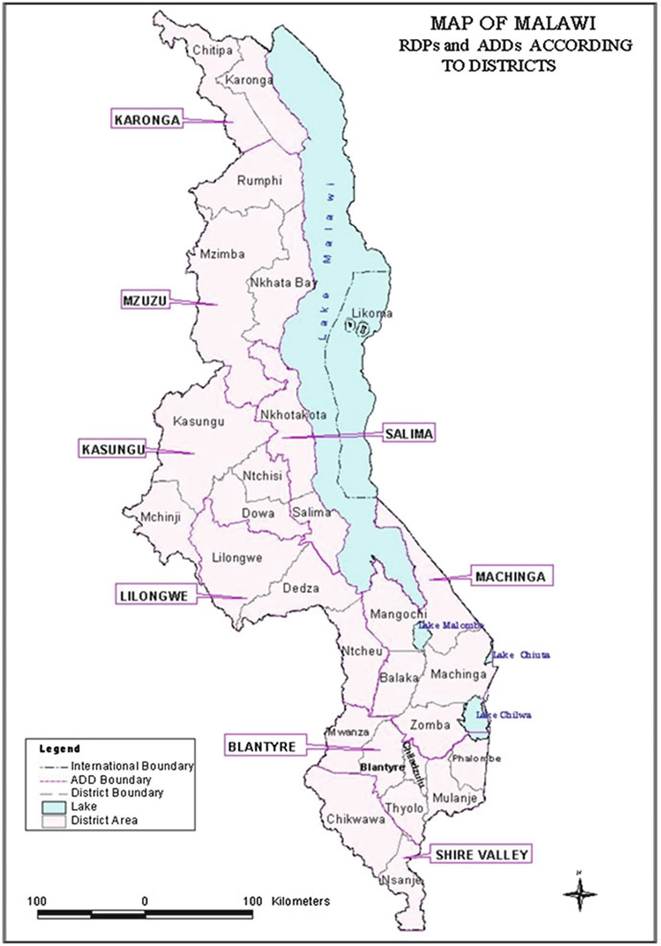
Fig. 16.1 Map of Malawi showing ADDs, District Agriculture Offices, and Extension Planning Areas
social security. In addition to the estimated 1.4 million cattle, there are also 6.3 million goats, 3.5 million pigs, 270,000 sheep, and 7.4 million chickens in Malawi.
16.2