LEUKOCYTES INVOLVED
Several basic types of leukocytes (leuko: white, cyte: cell) work together to carry out the primary functions of the immune system. Among mammals these include neutrophils, eosinophils, basophils, lymphocytes, and macrophages (and their immature form, monocytes) (Fig.
2.1) (Clough and Roth 1998); birds lack neutrophils, but have heterophils instead (Davison et al. 2008). Stem cells in the host continually replicate, and their progeny gradually differentiate through several series of divisions to produce these various leukocytes, as well as erythrocytes and platelets.Leukocytes can be distinguished both by their structures and by their functions. For example, some leukocytes have irregular, lobu- lated nuclei with several nuclear segments connected by strands of chromatin; these cells are called polymorphonuclear (poly: many, morpho: shaped, nucleus) leukocytes and include basophils, eosinophils, as well as neutrophils in mammals and heterophils in birds. All of these polymorphonuclear leukocytes also have distinct granules in their cytoplasms and collectively may be called granulocytes. The color of these granules after staining with hematoxylin and eosin dyes has given rise to their names. Basophil granules are stained a deep blue by the basic hematoxylin dye, eosinophils granules are stained a red color by the acidic eosin dyes, and neutrophils granules are stained weakly by both the basic and acidic dyes. In contrast, lymphocytes, monocytes, and macrophages lack the distinct intracellular granules and have round or kidney-shaped nuclei (Fig. 2.1).
Leukocytes also can be classified by their functions. Phagocytes (phago: eating, cyto: cell) are leukocytes active in ingesting foreign material. Phagocytes include monocytes, macrophages, neutrophils, heterophils, and eosinophils.
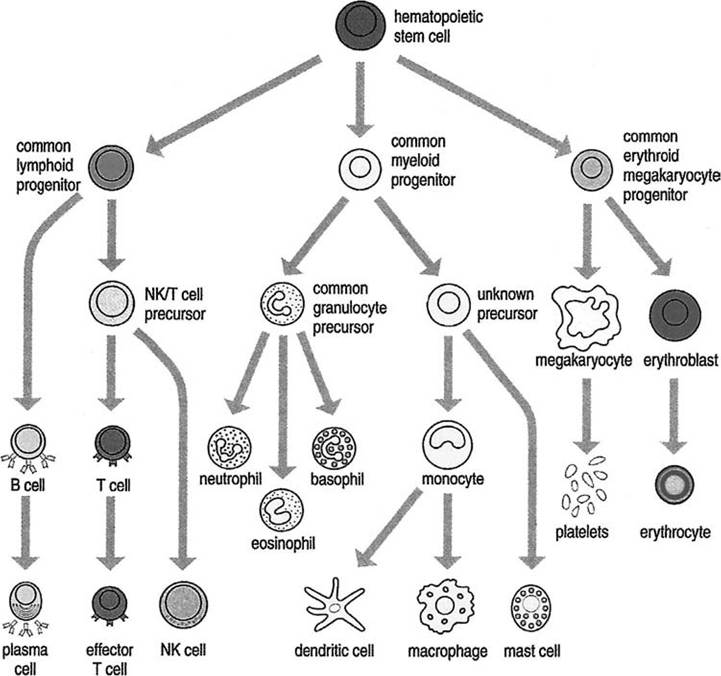
FIGURE 2.1 Relationships of various types of blood cells among mammals (Copyright 2009, from The Immune System, by Parham. Reproduced by permission of Garland Science/Taylor & Francis Books, LLC).
Among mammals, neutrophils, monocytes, eosinophils, and basophils, along with heterophils in birds, generally are included as part of the innate immune system.
In contrast, most lymphocytes are part of the acquired immune system and circulate between the blood and lymphoid tissues in search of the specific antigens and/or target cells such as cancer cells or host cells containing intracellular parasites (Clough and Roth 1998); these are the B-lymphocytes and T-lymphocytes. However, one additional lymphocyte, the natural killer (NK) lymphocyte, is part of the innate immune system rather than the acquired immune system. It recognizes and kills abnormal cells such as tumor- or virus-infected cells without any previous exposure to them (Clough and Roth 1998, Tizard 2004).