SALMONELLA INFECTIONS IN WILD BIRDS
PAUL HOLMES
Animal Health and Veterinary Laboratories Agency Diseases of Wildlife Scheme (AHVLA DoWS), Great Britain Wildlife Disease Surveillance Partnership, Shrewsbury, UK
Salmonellosis in wild birds, or avian paratyphoid, is an infectious disease caused by bacteria belonging to the genus Salmonella, which, following ingestion, can cause septicaemia and death or subclinical infection.
EPIDEMIOLOGY
Salmonella infection in wild birds has been widely reported throughout Europe, including Norway, Spain, Sweden, Germany, the UK, Czech Republic, Croatia, Switzerland and Denmark1-1). Descriptions of outbreaks of salmonellosis causing mortality, particularly in passerines, have been published from several countries, including Norway, the UK and Sweden.
Reports of infection are recorded in a wide variety of wild bird species in Europe. Many of these species may be simply carrying the organism in their intestine without showing any signs of clinical disease, but a few species are particularly susceptible to disease. Studies have reported rates of Salmonella detection from: i) surveys of live birds that have been caught and cloacal swabs or faeces cultured; or ii) results of salmonella isolation from dead birds that have died from systemic salmonellosis. Although there are over 2,300 serovars of Salmonella, only a small number typically cause severe systemic disease, and these serotypes are often associated with only a few wild species. Salmonella Typhimurium is the predominate serovar associated with mortality in wild birds.
As the infection is acquired orally, the feeding ecology of the bird species is a key factor that influences the potential of species to become infected. Birds that share their environment with human activities, e.g. in sewage works and refuse dumps, are more likely to carry Salmonella.
Gulls (Larus spp.) in particular are associated with Salmonella carriage in these situations. Surveys in gulls illustrate varying prevalences of Salmonella in faeces or faecal swabs, e.g. 9.2% of 2,985 herring gulls (Larus argentatus) at a refuse tip in the Clyde, Scotland, and 2.7% of 1,047 black-headed gulls (Larus ridibundus) in Central Park, Malmo, Sweden. In these surveys the gulls appeared healthy and the range of serotypes reflected the local environmental contamination. Gulls have also occasionally been reported to have clinical salmonellosis(2).Waterbirds that feed on vegetable matter appear to have a lower prevalence. However, several reports of infection in a range of waterbirds, including teal (Anas crecca), tufted duck (Aythya fuligula), pochard (Aythya ferina), mute swans ( Cygnus olor) and Canada geese (Branta canadensis), have been associated with water contaminated with sewage.
Raptors may acquire Salmonella through the consumption of infected prey or carrion, and 4.19% of 310 raptor faecal samples in a survey in Spain were positive for Sa l- monella. Sampling of raptor faeces can reveal a variety of different serotypes reflecting a range of different prey sources.
Several species of the Passerine family are recognized as particularly susceptible to Salmonella infection and disease. Outbreaks of disease in birds that visit garden feeding stations have been recorded for many years. There are geographical differences in the species most commonly affected. In the UK, greenfinches ( Carduelis chloris), house sparrows (Passer domesticus) and chaffinches (Fringilla coelebs) are the species most frequently affected. In one survey between 1997 and 2000 in Scotland, of 97 dead birds at garden feeding stations with salmonellosis, there were 89 greenfinches, 4 house sparrows, 1 goldfinch ( Car- duelis carduelis) and 1 great tit (Parus major)(3). This is in contrast to Norway, where between 1999 and 2000, the bullfinch ( Pyrrhula pyrrhula) was the commonest species affected, followed by the siskin ( Carduelis spinus), common redpoll ( Carduelis flammea) and greenfinch1-4).
Other species can become infected in these situations, including great tit, blue tit (Parus caeruleus), starling (Sturnus vulgaris), hawfinch ( Coccothraustes coccothraustes) and robin (Erithacus rubecula), but disease in these is much less frequently recorded. Tits, for example, often collect food from hanging feeders and fly to a distant perch to eat it, whereas finches may stay at the feeder for longer or feed on the ground below a feeder, resulting in potentially prolonged exposure to contaminated material, often over extended periods of time. Little is known about species differences in resistance, but it appears that different strains of S. Typhimurium are associated with different groups of birds, with definitive types (DT) 56/variant and DT 40 frequently isolated from finches and sparrows, whereas DT 41 and 95 are frequent in gulls and DT 99 in feral pigeons (Columba livia).
Differences in mortality may be due to the strain of Salmonella present, the species susceptibility to the circulating organism, the local occurrence of the species (redpolls have a circumpolar distribution), the density of the population visiting the garden, the intensity of provisioning and the level of environmental contamination with Salmonella.
Experimental infections in chickens have shown that older birds are less susceptible to the lethal effects of Salmonella. Age-related effects in wild birds are less well understood. Age-related differences in Salmonella carriage have been described in herring gulls (Larus argentatus) in England, and black-headed gulls (Larus ridibundus) in Sweden with higher carriage rates in first-year birds and juveniles. In the herring gulls, this was thought to be because of age- related feeding behaviour, with the juveniles feeding at sewage outflows. Several mortality studies report no sex predispositions, but an increased mortality rate in male greenfinches has been described.
Salmonellosis in passerines occurs mostly in the winter months.
In a survey of wild birds submitted to a Scottish laboratory1-2) between 1995 and 2003, most cases in greenfinches and chaffinches were diagnosed between January and March, and in house sparrows between October and March. Reports from Norway display a similar pattern, with a marked seasonality in passerines but no apparent seasonality in a range of other species affected. Most isolations were made between January and April, with a distinct peak in February and March, affecting mostly bullfinches, greenfinches, siskins and redpolls. A similar seasonality has been reported in Sweden and Germany and elsewhere in the UK.This apparent seasonality may be biased because in the winter months the birds tend to congregate at feeding stations, and this is the time of year when most effort is put into observations by the public. Information is therefore sparse about the causes of death in the birds when they are more dispersed in the summer months.
I nfected birds contaminate the environment through excretion of Salmonella in the faeces. In passerines this is important where large numbers of birds congregate at bird feeding stations. Healthy carriers are thought to be the major source of fatal infections and 2% of cloacal swabs from 1,990 healthy passerines were positive for Salmonella in a Norwegian survey. The primary carrier species are the same as the species commonly affected. A variety of species can become infected, but disease predominates in the species with a high carriage rate. Infected birds themselves can be the source of infection for other animals, either through being eaten by predators such as cats (Felis domes- ticus), foxes (Vulpes vulpes) and raptors, or through contamination of the domesticated animal (e.g. farm) and human environment.
Other groups of birds may acquire Salmonella through exposure to an environment not contaminated directly by bird faeces but from other sources such as human sewage. Disease is less common and infection may be of short duration, suggesting that birds infected in this way have a limited role in perpetuating the infection in their group.
Transmission is by the faecal-oral route, and the source will depend upon the food that the bird is eating and the level of environmental contamination.
In passerines, healthy carriers are considered to be the major source of infection for other wild birds. Disease occurs at feeding stations, where contamination of the feeding environment may facilitate transmission between birds. Regular sampling of faeces from bird tables and underneath feeders indicates that S. Typhimurium can survive long term in the environment at some sites and that the bacteria can survive for weeks in the environment.
It is significant that there has been a large increase in the feeding of birds in gardens since the middle of last century. In the UK it has been estimated that 60,000 tons of peanuts and seeds were sold for wild birds in 2003, with 67% of households regularly feeding birds.
It has also been found in one study that the number of a certain species of bird (house sparrows) may be more important, in relation to the presence of environmental contamination, than the total number of birds visiting the feeding station(5).
PATHOGENESIS, PATHOLOGY AND IMMUNITY
The route of infection is by oral ingestion. The infectious dose for wild birds is not known but is likely to vary due to species susceptibility and serotype of Salmonella. Oral doses of 109 S. Typhimurium have been found to be lethal for 20% of 3-day-old broiler chicks.
Research into the pathogenesis of Salmonella infection and disease in experimental animals and chickens has revealed the key features of the establishment of infection and development of disease. The critical stages are entry into the intestinal tract, colonization and invasion of the intestinal mucosa, dissemination throughout the body to a variety of organ sites and survival and replication in host tissue, principally macrophages.
After oral ingestion and colonization of the intestinal tract, the success of the adherence of the organisms to the intestinal epithelial cells and subsequent invasion is dependent upon a number of virulence factors.
Several genes have been identified that are thought to be associated with virulence. The information for these virulence factors is often encoded in clusters of genes on chromosomes known as salmonella pathogenicity islands. Some virulence genes may also be located on plasmids (which are transmissible extrachromsomal DNA elements) that have been associated with bacterial pathogenicity. Knowledge of these attributes allows for detailed study of isolates for epidemiological investigations1-6).Although in chickens the epithelial cells of the caecae and ileo-caecal junctions are often sites of invasion by Salmonella, it has been suggested that, because of the severe lesions in the crop and oesophagus seen in passerines, these may be the predilection sites for bacterial invasion in this group of birds (Figure 31.1).
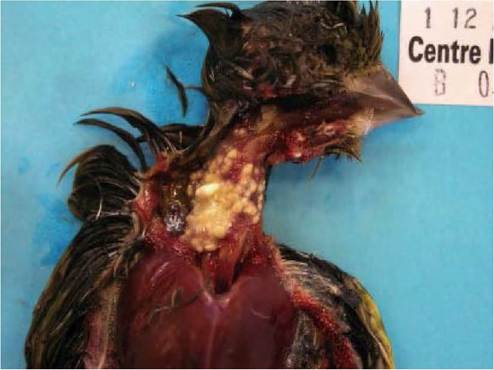
FIGURE 31.1 Necrotic lesions in the crop of a greenfinch due to Salmonella Typhimurium (Crown copyright 2010).
Once invasion has occurred, the salmonella organisms are able to survive and replicate within the macrophages, where they are relatively sheltered from attack by the bird’s immune defences. Although the exact mechanism of Salmonella invasion is not fully understood, it is thought that the bacteria are carried by cells of the reticulo-endothelial system to systemic sites.
Disease associated with salmonellosis occurs principally in passerines infected with S. Typhimurium, and several large surveys of birds found dead give a good indication of the main gross lesions. The predominant lesions are found in the crop and oesophagus with multiple, often coalescing, yellow nodules on the mucosa (Figure 31.1). Other organs can also be affected. There are species differences in the sites and extent of the lesions, and regional variations in the species affected, which may be due to the sero or phage type present or varying abundance of the target species.
I n Norway, gross findings have been described in 94 small passerines that had died with septicaemic salmonellosis at 87 private feeding sites(4). Eighty-four per cent had poor body condition, 78% necrosis of the crop/oesophagus and 73% enlarged spleen. Scattered foci of necrosis were present on the surface of the liver in 53% of cases, spleen 46%, proventriculus 13% and intestine 5.3%. Similar signs are reported elsewhere, but the species affected may be different. The necrotic lesions in the crop mucosa, which can be up to 4 mm in diameter, may be visible from the serosal surface and can protrude into the lumen, sometimes partially obstructing the oesophagus. Fragments of food material, e.g. peanut, can be adhered to the necrotic tissue. Peri-hepatitis may be present, and the enlargement of the spleen can be dramatic.
The gross lesions are not pathognomonic and must be differentiated from other causes of ingluvitis and septicaemia — for example, trichomoniosis.
Lesions in the other major orders of birds are less common, but purulent arthritis, peritonitis, pneumonia and focal liver necrosis are seen in affected feral pigeons, and purulent arthritis, pneumonia, peri-hepatitis and nephritis are seen in gulls.
Histopathological lesions in the crop and oesophagus consist of severe necrosis, which can affect the entire mucosa and submucosa and underlying lamina muscularis. Large necrotic masses are present surrounded by mixed inflammatory cells, heterophils and mononuclear inflammatory cells, and large amounts of Gram-negative bacteria. Lesions in other areas of the gastrointestinal tract can be similar but less severe. Lesions in liver and spleen consist of severe necrosis with accumulations of inflammatory cells and occasional multinucleated giant cells. Tissues from some carcases can reveal microscopic findings of acute necrosis in organs that appear grossly normal, indicating that the infection can be acute or peracute.
Multiplication of the bacteria in the body leads to severe endotoxaemina. Salmonella have lipopolysaccharides in their cell walls that are potent endotoxins, which are released when the bacteria die. They result in a severe inflammatory response with activation of a variety of chemical mediators, which can result in septic shock. Although antibody production in chickens can be used as an aid to diagnosis, this has not been evaluated for diagnosis in wild birds.
Little is known about the recovery of wild birds from clinical salmonellosis, as most diagnosed cases are examined following death. In fatal cases the overwhelming infection, severe inflammatory response and septic shock, leads to irreversible multiple organ failure.
CLINICAL SIGNS AND TREATMENT
Sick birds are rarely seen, and it is therefore difficult to assess the length of clinical disease and progression of clinical signs. Where signs have been described they are typically from cases in passerines associated with garden feeding stations, where there is regular observation. Affected birds are often only seen for a few hours before death, but some may survive for over 24 hours. There is a rapid deterioration in the bird’s condition, with a reluctance to fly when approached, eyes tending to close, disorientation, lethargy and ruffled or fluffed-up feathers, before it collapses and dies. Intense thirst and difficulty in swallowing may be seen, and affected birds frequently stay close to feeders or water baths, trying to feed until just before death. Blindness has been described, associated with replacement of the eyeball with inspissated pus.
The clinical signs are not specific for salmonellosis and could be seen with a variety of diseases of wild birds.
Salmonellosis in birds can be treated with antibiotics after appropriate antibiotic sensitivity testing. Treatment of birds in the wild is usually not undertaken, as it is not possible to target only the diseased birds and ensure that therapeutic doses are administered to the birds. Consumption of inappropriate doses can lead to selection of antibiotic-resistant bacteria. If diseased wild birds are caught, the disease has usually progressed to such an extent that treatment is not indicated and euthanasia is more appropriate. The zoonotic potential of Salmonella also means that treatment of individuals is generally not undertaken. However, severely ill birds presenting to a rehabilitation facility may undergo an intense period of supportive care in an attempt to save the bird. This would include fluid therapy, supportive nutrition and antimicrobial therapy. First-line agents commonly used for these cases include amoxicillin/clavulanate or enrofloxacin. This treatment is often instigated without a diagnosis.
DIAGNOSIS
Diagnosis requires isolation of the organism from birds with typical clinical signs and gross and or histopathological lesions. Bacterial cultures are made (in a biosafety level 2 laboratory) from affected organs, typically intestine, liver and spleen. A variety of bacteriological cultural techniques are used for detecting Salmonella in biological samples, depending on the source of the sample, the reason for the sampling and local diagnostic laboratory preferences. Most involve selective enrichment broths, and growth on selective and differential solid media. Samples in which the Sa lmonella organisms may be in a desiccated state may need pre-enrichment in buffered peptone water. Enrichment media, such as selenite or tetrathionate broth, promotes the growth of Salmonella and inhibits other faecal flora. Enriched samples are subsequently plated on salmonella-selective media, such as xylose lysine desoxycholate (XLD) or brilliant green agar. Incubation is typically at 37°C for 24—48 hours. When suspect Salmonella colonies are present, serological and biochemical tests are used to confirm the presence of Sa lmonella to the sero- group level. Serotypes are identified on the basis of their antigenic structure based upon their O (somatic) and H (flagellar) antigens detected by agglutination tests. They are classified according to the Kauffmann-White scheme.
There are several further methods used to identify differences in individual isolates that assist with epidemiological investigations1-7). Phage typing is a technique based upon the sensitivity of a particular isolate to a series of bacteriophages at appropriate dilutions. Different biovars of Typhimurium are susceptible to different series of bacteriophages, and it is possible to identify over 300 different definitive types (DT) after phage typing. This is generally carried out at reference laboratories.
Pulsed-field gel electrophoresis (PFGE) is a method used to separate fragments of DNA. These fragments from different isolates can be compared to reveal the genetic relationships between organisms. DNA-based typing methods, such as PGFE, can be highly discriminatory and useful for short- term outbreak investigations and longterm surveillance of Salmonella epidemiology. Antibiotic sensitivity profiling results are also used for comparison of isolates.
Screening of populations can be undertaken following live capture of birds and culturing of faecal or cloacal swabs or washings. Faecal samples can be collected from bird roosts or other flocking sites and culture for Salmonella can be also be undertaken from bird carcases found dead or culled.
Principal components analysis of biometric data has been used to assist in monitoring for salmonella in greenfinch, and a low fat and low body weight could be useful indictors of Salmonella-positive greenfinch.
MANAGEMENT, CONTROL AND REGULATIONS
Disease in wild birds largely occurs in association with garden feeding stations. Advice regarding minimizing disease risks associated with this provisioning is to clean and disinfect bird feeders (and water baths) and feeding sites regularly, use several feeding sites in any one garden and rotate between these feeding areas. These measures are intended to try to reduce the build- up of contaminated faeces in any one area. There are other factors to consider, including the design of feeders (easy to clean), the location of the feeders (avoiding overhanging branches) the frequency of supply of the food and the amount of food provided. In the event of an outbreak of disease, continuing to provide food may attract infected birds and spread infection, but conversely stopping food provision could encourage infected birds to disperse to other feeding stations. If naturally occurring food and water supplies are locally available it may be best to stop, or reduce, feeding in order to try to prevent large numbers of birds visiting potentially infected properties. The value of adopting these control measures has yet to be confirmed.
Wild birds should be prevented from having access to human food preparation areas, domestic animal feed stores and domestic animal housing.
There are no EU regulations covering Salmonella infection in wild birds, although there are several directives aimed at domestic poultry.
PUBLIC HEALTH CONCERN
The majority of Salmonella serovars are zoonotic or potentially zoonotic, and wild birds may be a source of infection for humans and domestic animals. In humans salmonellosis varies from a self-limiting gastroenteritis to septicaemia, and subclinical infection can also occur. The main route of infection is oral and therefore can occur as a result of eating or smoking with hands contaminated with Salmonella or from eating contaminated food.
Examples where this may occur include handling infected birds or their immediate environment, which is contaminated with faeces, handling contaminated garden bird feeding equipment, eating food that has been contaminated with bird faeces or from contact with other animals that have been infected by wild birds, e.g. domestic cats.
There are several well-documented outbreaks of disease in humans, which have strong epidemiological links to wild birds. In one outbreak in Norway, 349 people were confirmed infected with S. Typhimurium at the same time of year, January to April, as fatal salmonellosis in wild passerines. Detailed epidemiological investigations revealed links to wild birds, and the risks of infection in people included drinking untreated water, having direct contact with wild birds or their droppings and eating snow, sand or soil.
House sparrows have been implicated in an outbreak of S. Typhimurium PT (phage type) 160 gastroenteritis in people in a British hospital, associated with suspected faecal contamination in the kitchens.
Comparison, using PFGE, of 142 isolates from a variety of Norwegian wildlife concluded that passerines constitute an important source of infection for humans, but strains from gulls and pigeons were much less significant. Different conclusions were made following molecular studies on 32 Salmonella isolates from passerines in northern England(6). Twenty-nine S. Typhimurium isolates were found to be closely related, and some appeared to be clonal, but all the isolates tested lacked the sopE gene. This gene has been associated with some human disease outbreaks due to S. Typhimurium and so it was considered that the 29 isolates may not have represented a large zoonotic risk.
SIGNIFICANCE AND IMPLICATIONS FOR ANIMAL HEALTH
Salmonella excreted by wild birds can cause disease, or infection, in farmed or pet animals and can result in the spread of antibiotic-resistant organisms, sometimes across country borders via migration. Wild and domestic mammals, particularly carnivores, can become infected through ingestion of infected birds.
As wild birds have considerable mobility, they have the potential to spread Salmonella widely to farmed animals. In a study in the Czech Republic, examinations on one farm found S. Typhimurium PT 104 in cloacal swabs from 7 out of 30 house sparrows and 1 serin (Serinus serinus) and in 21 out of 64 clinically ill calves.
Foxes and domestic cats are susceptible to Sa lmonella infection when they eat infected bird carcasses. Fourteen out of 215 (6.5%) foxes shot in Norway were found to be carrying Salmonella, and nine of these isolates were S. Typhimurium, with the identical PFGE profile to that found causing outbreaks of mortality in passerines in the winter.
Enteric disease occurs in domestic cats associated with a history of eating dead wild birds or the isolation of wild bird strains, e.g. S. Typhimurium DT 40 or 56. These can then be a source of infection for humans.
The role of the disease in wild bird population dynamics is less clear. Local mortality at feeding stations can appear dramatic, with outbreaks lasting up to 4 months with multiple deaths. Although there is speculation that this could be a contributing factor to population declines, this has yet to be proven for salmonella infection.