There Is No Governmentwide Assessment of the Veterinarian Workforce
No effort is being made to assess the sufficiency of the veterinarian workforce governmentwide. This is problematic because the majority (67 percent) of the 24 component agencies and other federal entities that employ veterinarians told us they have concerns about their veterinarian capabilities.
OPM has not conducted a governmentwide effort to address current and future veterinarian shortages identified by component agencies, as it has done for other professions, and efforts by the Congress to address the national shortage have thus far had minimal impact.Sixteen of the 24 component agencies and other entities employing veterinarians reported concerns about their veterinarian workforce (see table 1). For example, several agencies reported that they lack veterinarian expertise required to fully meet agency responsibilities, such as addressing wildlife disease outbreaks.
Table 1. Agency Concerns about Sufficiency of the Federal Veterinarian Workforce
| Department | Component agency/other federal entity | Examples of concerns reported by component agency/other federal entity |
| Department of Agriculture | Animal and Plant Health Inspection Service | Thirty percent of its veterinarians will be eligible to retire by the end of fiscal year 2011, and it may be diffi-cult to maintain enough veterinarians with expertise in pathology and fore-ign animal disease in the future. Res-ponsibilities have also increased in recent years, raising concerns that there will not be sufficient veteran-arian capacity if multiple emergen-cies occur at once. |
| Food Safety and Inspection Service | Veterinarian workforce falls short of agency goal by 15 percent due, in part, to unpleasant environment, grueling work, and low salary. | |
| Agricultural Research Service | Veterinarian workforce falls short of agency goal by 12 percent. There is a limited number of qualified veterinarians and agency salaries are not competitive with private sector. |
Table 1. (Continued)
| Department | Component agency/other federal entity | Examples of concerns reported by component agency/other federal entity |
| Cooperative State Research, Education, and Extension Service | One of the four veterinarian positions is vacant, stressing the agency’s ability to oversee funds for a national network of laboratories that diagnose and track animal diseases. | |
| Department of Defense | Army | Veterinary reserve corps falls short by 12 percent. Also, the number of active-duty veterinarian positions has remained relatively static despite increasing demands across the Army’s mission, including in medical |
| intelligence, food safety and defense, agricultural reconstruction efforts in Iraq and Afghanistan, and emerging zoonotic diseases. | ||
| Air Force | Not enough veterinarians choose to join the Air Force because of the service commitment, and the salary is not competitive. Air Force officials are concerned they might not be able to fully meet the agency’s public health mission, which includes ensuring food safety and tracking infectious diseases on Air Force bases. | |
| Department of Health and Human Services | Food and Drug Administration | No concerns reported. |
| National Institutes of Health | Agency faces challenges recruiting veterinarians that specialize in labor-atory animal medicine and veterinary pathology, who make up the majority of veterinary positions at the agency. Both specialities are reporting signi-fycant shortages that are not forecast to improve for at least 10 years, whi-ch will hinder the agency’s ability to recruit qualified veterinarians. | |
| Centers for Disease Control and Prevention | Veterinarian expertise in agriculture and animal health contribute signify-cantly to human health programs and could be enhanced. |
Table 1. (Continued
| Department | Component agency/other federal entity | Examples of concerns reported by component agency/other federal entity |
| Office of the Assistant Secretary for Preparedness and Response | The Office reported that more than two fulltime veterinarians are needed to help develop effective response programs to public health emergencies. Department officials did not support this statement, but said that veterinarians are integral to its response strategy and their continued engagement is essential. | |
| Department of Veterans Affairs | Office of Research and Development | No concerns reported. |
| Department of the Interior | U.S. Geological Survey | Salaries are not competitive with the private sector. The agency faces difficulty hiring veterinarians to address wildlife diseases, including those that kill many animals in a single local outbreak. |
| U.S. Fish and Wildlife Service | Agency has too few veterinarians to monitor diseases in wildlife, nationally and internationally. | |
| National Park Service | Agency has too few veterinarians to address wildlife diseases and survey outbreaks in the vast park system of 84 million acres. | |
| Department of Homeland Security | Office of Health Affairs | Agency has too few veterinarians to effectively develop the capabilities to respond to catastrophic food, agriculture, and veterinary events. |
| Directorate for Science and Technology | No concerns reported. | |
| Directorate for National Protection and Programs | No concerns reported. | |
| Smithsonian | National Zoo | Salaries are not competitive; Ameri-can Veterinary Medical Association-specialty boarded status is necessary to perform responsibilities, but com-pensation for this additional training is not available; too few veterinarians to fully conduct agency wildlife health and surveillance studies. |
| Environmental Protection Agency | No concerns reported. |
Table 1.
(Continued)| Department | Component agency/other federal entity | Examples of concerns reported by component agency/other federal entity |
| U.S. Agency for International Development | Bureaus for Economic Growth, Agriculture and Trade; for Global Health; and for Africa | No concerns reported. |
| Department of Commerce | National Oceanic and Atmospheric Administration | Too few veterinarians available to investigate major or multiple outb-reaks, or single events that kill many animals, when they occur in marine animals. |
| National Aeronautics and Space Administration | Office of the Chief Health and Medical Officer | No concerns reported. |
| Department of Energy | Lawrence Livermore National Laboratory | There is a limited number of veteri-narians with the expertise to develop models and conduct analyses to identify the resources agencies will need to respond to animal disease outbreaks, among other things. |
| Department of Justice | Federal Bureau of Investigation | No concerns reported. |
Source: Agency survey responses and interviews.
These current challenges are likely to worsen because a large number of federal veterinarians are eligible to retire in the near future. These retirements would exacerbate the veterinarian shortage and possibly increase interagency competition. Our analysis found that 697 veterinarians at FSIS, APHIS, ARS, Army, and FDA—27 percent of the combined veterinarian workforce of these agencies—are eligible to retire over the next 3 years. As the shortage grows, agencies across the federal government may experience a situation similar to the competition between FSIS and APHIS, and agencies with higher salaries for veterinarians are likely to gain an advantage.
As figure 3 illustrates, mean veterinarian base salaries vary widely across agencies, from just under $70,000 at Interior’s National Park Service to just about $122,000 at DHS's Office of Health Affairs. Salaries for individual veterinarians range from $35,000 for those in the residency program at the National Zoo to $205,000 for the highest paid veterinarian at NIH.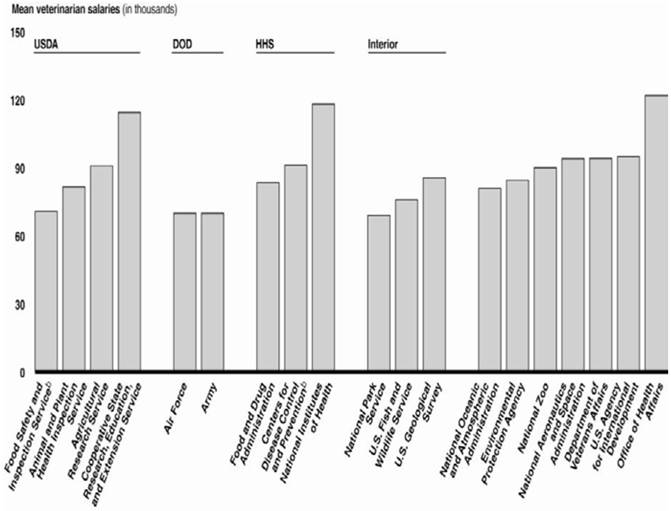
Component SqencyifePeraI entity1
Source: GAO analysis of agency data.
Note: Salaries do not include locality pay and stipends. In addition, we do not display mean salary for those agencies with fewer than four veterinarians due to the small number of employees represented. This includes the Departments of Energy and Justice; HHS's Office of the Assistant Secretary for Preparedness and Response; and DHS's Directorate for National Protection and Programs. In addition, DHS's Science and Technology was unable to provide base salary information in time for this report and, therefore, is not included.
a We relied on officials from these federal entities to identify mean salaries of all veterinarians employed, including civil and military service employees, contractors, and other, regardless of job title. Because data are means reported by agencies, we could not assess the underlying distribution for outliers or skewness.
b This does not include the salaries of the United States Public Health Service Commissioned Corps veterinarians stationed at these agencies. The Commissioned Corps is a uniformed service that belongs to HHS but fills public health leadership and service roles at several federal agencies.
Figure 3. Mean Veterinarian Base Salaries at 19 Component Agencies or Federal Entities in Fiscal Year 2008
Some agencies, such as those within HHS and the Department of Veterans Affairs, can augment base salaries for veterinarians using special statutory authorities.7 Agencies can use these authorities to hire veterinarians when standard hiring practices, including the use of recruitment incentives, are impracticable, less effective, or have been exhausted.
In addition, DOD can provide all of its veterinarians with a $100 per month stipend, as well as up to an additional $5,000 per year of special pay if they have met the education and training standards of an American Veterinary Medical Association-recognized specialty college.8 There is no similar authority for USDA veterinarians.OPM's mission is to ensure the federal government has an effective civilian workforce, but it has not conducted a governmentwide effort to address current and potential veterinarian shortages, as it has done for other professions. For certain professions, OPM has initiated governmentwide direct-hire authority, which allows expediting hiring during a time of critical need or a severe shortage of candidates. For example, in 2003, OPM authorized departments to immediately hire doctors, nurses, and other types of medical professionals without following prescribed competitive procedures. OPM officials told us their agency issued this authority based in part on department and agency concerns. OPM can also hold interagency forums to discuss workforce concerns but has not done so for veterinarians. According to OPM officials, interagency forums are open to all senior human capital representatives from all departments, including USDA and HHS. The forums provide an opportunity to discuss concerns, exchange ideas, and explore solutions to governmentwide staffing issues. OPM officials told us that no department has requested a discussion about veterinarian workforce concerns. Further, officials told us that the agency will facilitate a governmentwide solution, such as an interagency forum, if the departments demonstrate that a shortage exists. Our prior work has identified the need for OPM to use its leadership position to provide assistance to departments and agencies efforts to recruit and retain a capable and committed workforce.9
OPM officials told us the agency has taken some steps that could improve veterinarian recruitment and retention. During the course of our review, OPM created a Personnel Action Team to determine whether a governmentwide direct-hire authority should be granted for all veterinarians. OPM did not provide further details other than to state that a decision is expected in early 2009. In addition, OPM recently changed the federal classification of veterinarians. OPM raised the entry grade level for newly hired veterinarians from GS-9 to GS-11 and expanded the description of the federal veterinarian occupation to include areas of specialization, such as toxicology and pathology. OPM officials believe this will help attract more veterinarians into federal service. Agency officials also told us that they meet periodically with departments to ensure occupation classifications meet department needs. This was the first change of the veterinarian classification in over 20 years and was initiated at USDA's request.
The Congress has taken steps that address the broader, national veterinarian shortage, but its efforts thus far have had minimal impact. The National Veterinary Medical Services Act enacted in 2003, directs the Secretary of Agriculture to carry out a program to help veterinarians repay their school loans when they agree to work in areas of need. Although USDA is responsible for implementing the act, it has been delayed in doing so. USDA's Undersecretary for Research, Education, and Economics testified before the Congress that this was because the Cooperative State Research, Education, and Extension Service (CSREES)—the USDA agency in charge of implementation—does not have experience with complex loan repayment programs. The Congress provided initial funding for the act in fiscal year 2006. In August 2008, CSREES began holding public hearings to solicit stakeholder input. Officials from USDA and veterinary associations told us that the $1.8 million allocated thus far for the program is insufficient and would have minimal impact on the shortage. With veterinary student debt averaging $106,000 upon graduation, $1.8 million would cover about 17 students with loans. Moreover, the program targets veterinarians who already have their degree and may not have the skill set the federal government is seeking. To be effective, officials from professional veterinary associations told us, the program would have to provide guarantees and target students early in veterinary school. The Congress also enacted the Higher Education Opportunity Act in August 2008, which has provisions intended to increase the number of veterinarians in the workforce through a competitive grant program that can increase capacity at veterinary colleges. According to the American Veterinary Medical Association, however, these grants will be capped at $500,000 per school, which will not be enough to increase capacity to meet veterinarian demands.
End Notes
1 See GAO, Older Workers: Federal Agencies Face Challenges, But Have Opportunities to Hire
and Retain Experienced Employees, GAO-08-630T (Washington, D.C.: April 30, 2008).
2 GAO, Homeland Security: Much Is Being Done to Protect Agriculture from a Terrorist Attack,
but Important Challenges Remain, GAO-05-214 (Washington, D.C.: Mar. 8, 2005).
3 USDA, Office of Inspector General, Great Plains Region, Audit Report: Evaluation of FSIS
Management Controls Over Pre-Slaughter Activities, 24601-0007-KC (Washington, D.C.: November 2008).
4 GAO, Humane Methods of Slaughter Act: USDA Has Addressed Some Problems but Still Faces
Enforcement Challenges, GAO-04-247 (Washington, D.C.: Jan. 30, 2004).
5 FDA Science Board, Subcommittee on Science and Technology, FDA Science and Mission at
Risk, a special report prepared at the request of the Food and Drug Administration (November 2007).
6 See GAO-04-39; GAO-03-914.
7 E.g. 38 U.S.C. § 7405; 42 U.S.C. § 209(f).
8 37 U.S.C. § 303.
9 See GAO-08-762T.
More on the topic There Is No Governmentwide Assessment of the Veterinarian Workforce:
- Four of Five Agencies Have Identified Existing and Potential Veterinarian Shortages
- Departments Have Done Little to Assess the Sufficiency of Their Veterinarian Workforces across Their Component Agencies
- Chapter 4 Efforts to Identify the Veterinarian Workforce Needed during a Pandemic and Large-Scale Animal Disease Outbreak Are Insufficient
- United States Government Accountability Office
- An Infeasible Assumption and Limited Information Hinder Veterinarian Workforce Planning Efforts for a Catastrophic Outbreak of Foot-and-Mouth Disease
- Chapter 10 Appendix II: Scope and Methodology
- Chapter 8 Agency Comments and Our Evaluation