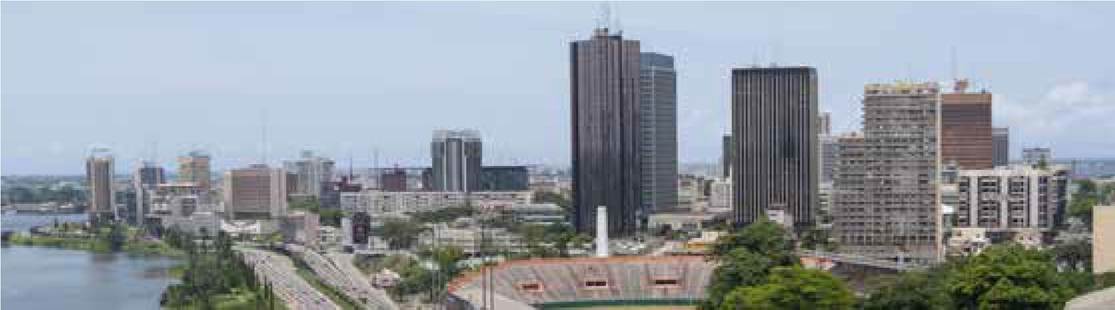
Cδte d'Ivoire
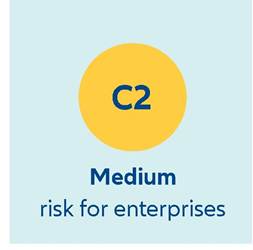
Cocoa, oil, gold, football and debt - everything grows, will it last?
| GDP | USD70.0bn (World ranking 82) |
| Population | 28.2mn (World ranking 52) |
| Form of state | Presidential republic |
| Head of government | Alassane Ouattara (President) |
| Next elections | 2025, Presidential |
Strengths & weaknesses
Economic overview
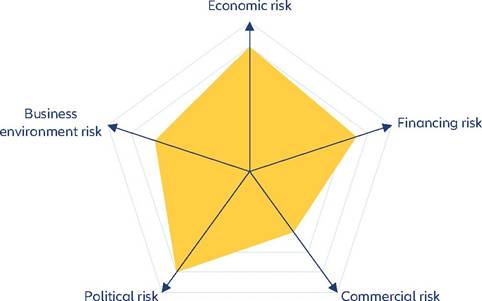
Buoyant opportunities amid early signs of overheating
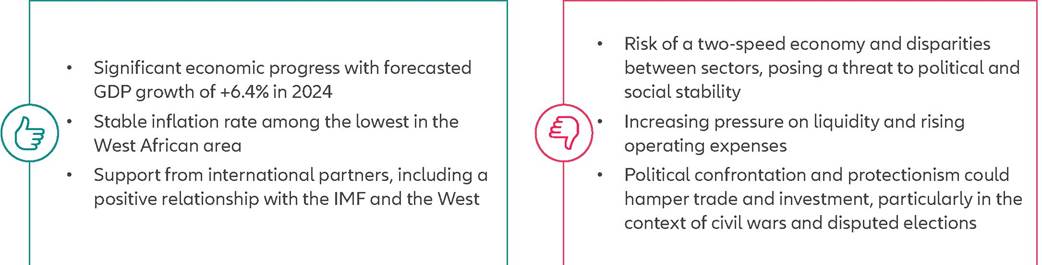
Cδte d'Ivoire has made significant economic progress, with GDP growth forecast at +6.4% in 2024, at a similar pace than
2023.
The inflation rate remains among the lowest in the West African area and we expect it to remain stable at 3% in2024. Average oil production was about 24 000 barrels per day (bpd) in 2021 and is expected to surpass 200 000bpd by
2025. equivalent to more than USD5.5bn on an annual basis. However, the economic upturn has been driven by exports, particularly cocoa, other commodities and infrastructure investment, revealing disparities vis-a-vis the economy's other sectors and the risk of a two-speed economy looms as a major threat to political and social stability.
The fiscal profile remains manageable, albeit with increasing pressure on liquidity. Capital expenditure increased as a result of faster work on infrastructure projects, mostly related to the hosting of the African Football Cup but also university and school construction projects. Operating expenses increased because of government initiatives to mitigate the economic impact of the cost-of-living crisis by assisting the energy, bakery and transportation industries.
Interest payments increased as well in 2023, which have been attributed to Eurobond payments as well as greater domestic debt payments.Support from international partners remains stable
A positive relationship with the IMF and the West is key to acting proactively to contain volatility and maintain rapid financial support in case of need. In April 2023, Cote d'Ivoire received USD3.5bn after a short negotiation with the IMF, above its initial request for USD2.6bn. The agreement is expected to last for 40 months after approval. The sum given to Cote d'Ivoire is greater than the USD3bn that Ghana, the world's second-largest cocoa exporter and an economy comparable by size to that of Cote d'Ivoire, managed to receive in December 2022 when in full debt distress. Increased support came in also thanks to resilient indicators, as the debt-to-GDP ratio is estimated to have reached 56% in 2023, i.e., below the 60% threshold. Cote d'Ivoire is now expected to implement the structural reforms outlined in its National Development Plan 2021-2025.
Political confrontation and protectionism could hamper trade and investment
Following the decision by neighboring Burkina Faso to halt military assistance from France, troops deployed in the country have been partially relocated to Cote d'Ivoire, which is positioned to become a major player in the regional fight against insurgents and benefit from enhanced protection at sea in the fight against illegal fishing, drug trafficking and piracy.
The most recent civil war was fought in 2011 for four months after a controversial presidential election in which the then-opposition candidate, current President Ouattara, was declared the winner by the electoral commission. This was not followed by an orderly transfer of power, as the Constitutional Council invalidated the results and declared the outgoing president elected. French military support was provided to Ouattara to achieve victory. The previous civil war (20022007) also began after a disputed presidential election, which remains the greatest point of tension in the country.
The next round of the presidential election is expected in 2025. The ruling party won 123 of the 201 municipalities and 25 of the 30 regions in the local election of September 2023. President Ouattara's dominance was further consolidated a few weeks later, when his party won 56 of the Ivorian Senate's 64 seats.Resource protection and management are also coming to the fore. There is a desire to gain more control over natural resources and boost local processing. Policy and contract changes are unlikely to be drastic, although stricter local content requirements, requests for larger production shares and increased taxation and/or regulation are anticipated in the short-to medium-term. Cocoa importers have been under increasing pressure to give guaranteed cocoa prices for the government to determine a farmgate price that encourages smallholders to continue cultivating cocoa rather than switching to other commodities. Cote d'Ivoire and neighboring Ghana launched the Sustainable Cocoa Initiative in 2018; the two nations account for two-thirds of global production. One major goal has been to require firms to pay farmers a Living Income Differential (LID) premium. Cote d'Ivoire has threatened to withdraw from sustainability efforts and has named corporations that it believes are attempting to dodge the LID. The government imposed a new “country premium” in July 2022 and issued an ultimatum in November 2022 to enterprises accused of failing to pay these fees. Following that, it agreed to give companies more time to meet its demands, indicating a reluctance to impose strict enforcement. Premium demands are anticipated to increase if Cameroon and Nigeria join the Sustainable Cocoa Initiative after lengthy talks. Their inclusion would increase the group's share of global supply to around 75%, giving them more bargaining power as the dominant source of supply.
Since 2021, the government has also attempted to allocate at least 20% of national production to Ivorian exporters. However, most indigenous businesses do not have enough funding to deal with significant fluctuations in cocoa prices, which has hampered this endeavor. Poor crop yields in the major harvest season between October 2022 and March 2023 prompted smaller local producers to warn of supply contract-default risks due to a lack of adequate stockpiles. Against this backdrop of domestic weakness, the international corporations that dominate the Ivorian market are unlikely to see a reduction in their share of beans for export in the immediate future.