Crisis-based transition and family-business organization’s growth in 5 Indonesian middle-large family-business organizations
S. Dwikardana & A. Teressia
Parahyangan Catholic University, Bandung, Indonesia
ABSTRACT: The existence of the family-business in today’s business competition is an interesting phenomenon to study particularly their ability to survive in the global economic downturn and making large contributions to the economic recovery in many emerging market countries including Indonesia.
They have been impressively growing by making smart and effective business decisions during the crisis so that they are able to compete in business. Greiner’s thesis states an organization will go through six stages of growth based on age, size and evolution coupled with specific crisis in each phase, organizations will survive if they can overcome the crisis and evolve to the next stage. The family-businesses examined in this study facing crisis which, in contrast to Greiner’s assumptions, is not in accordance with the age and scale of the business. The second growth phase, which is growth through direction with specific autonomy crisis, is the longest phase in the family-businesses under studied. This study expected to provide new insights about the management of family businesses so that further study can develop new theories that are more adequate for Indonesian context.1 INTRODUCTION
The growth and development of organizations has been an area of interest for organizational theorists for decades (Lester 2008). Many organizational scholars have proposed models to classify the lifecycle of organizations (Adizes 1979, Churchill & Lewis 1983, Quinn & Cameron 1983) and most of them agree on the fundamental assumption that organization in general are born, grow, and develop, and possibly die or restore themselves (Mintzberg 1984, Kimberly & Miles 1980), while Greiner (1972) propose a five-stage model, to which he later added a sixth phase, whereby ability to overcome embedded problem in each stage as a basis for subsequent changes in the organization.
On the contrary, there are still limited studies on the growth and development of family-businesses. Family-business organization have specific characteristics, that can be distinguished from non-family business, in which these peculiarities are valuable for their survival and sustainability. Sindhuja (2009) defines family business as company managed by members from a single dominant family group, the management consists of the main family members, and the executives of the company are held by family members.
The survival of the family-business in today’s business competition and the global economic downturn is an interesting phenomenon to observe. Survey of PwC Survey (2014) showed at the end of 2013, the family-businesses in Indonesia grew well, even higher than the world average and is predicted to continue to strengthen until the next 10 years. This means there are unique characteristics of family-business that make it able to survive in the current economic situation. In-depth interviews conducted by SWA Magazine to 10 top management from family-businesses can identify the strengths and weaknesses of family-businesses (Singapurwoko 2013), namely:
Table 1 shows that the growth of the family-business in terms of age and development of the business
Table 1. Strength and weaknesses of family-business.
| STRENGTH | % | WEAKNESSES | % |
| Strong (long term) vision | 80 | Potential conflict | 66.7 |
| There are family values to guide and unite | 80 | Lack of planning | 44.4 |
| The strong feeling of belonging among the family members | 70 | Lack of management system | 44.4 |
| Easy to communicate and can be done informally | 70 | Only rely on the family figures | 11.1 |
| Easy to control | 60 | Hesitation in the family | 11.1 |
| Easily in early detection of family members’ capability | 50 | Personal emotions involved in job decision | 11.1 |
| Lean and agile bureaucracy | 30 | Hard to control family members | 11.1 |
| Understand every family member’s interest | 10 | Centralist tendency | 11.1 |
scale is not always followed by maturity of management practices, whereas organizations go through some phases as born, growing, maturity and death like every living organism.
Greiner six-stage model employed the need to solve a particular problem inherent during each stage as a basis for subsequent changes in the organization. Greiner’s assumption says that companies will evolve in accordance with the growth of age, the development of the scale, level of maturity of management practices, and the crisis that will be faced in each phase (Mulder 2013).Only a few reviews on different aspects of family businesses’ distinctiveness have been carried out in the last decade. However, these studies mostly focused on specific topics including financial performance, corporate governance or internationalization, but did not identify whether the theory of Greiner Model is relevant to the practice of familybusinesses in Indonesia (Harms 2014).
2 RESEARCH METHOD
This study uses a qualitative case study method, aimed at understanding the phenomenon of family business in Indonesia. This study specifically explores and understands the objects which are 5 companies with their 500 respondents from managerial level. A case study research aims to reveal the unique characteristics contained in the case under study. The case itself is the cause of the research and become the object of research, therefore everything related to the case, including the case, activities, functions, history, physical condition of the case, and various other matters relating and influencing the case must be examined, so that the purpose of explaining and understanding the case can be achieved comprehensively.
The data analysis technique used in this study is interactive analysis, namely: data collection is done at the company’s location by conducting interviews, focus group discussions, observation and documentation; whereas data reduction is done by determining cases in 5 family-businesses; then triangulation of data is obtained from various sources to draw conclusions.
This study has limitation of not being able to generalize the findings since it is done qualitatively and pay attention to the 5 family- businesses with their 500 managers as respondents and only analyze their dynamics of growth, development, and crisis which might not be the most determinant factors influencing the success as well as failure of the family-business in Indonesia.
3 RESULTS
This section will discuss how the strengths and weaknesses of family business in Indonesia are mapped in the Greiner’s model; whether the assumptions about the phase and crisis in Greiner’s model are in line with the development of the family business; whether the results of previous studies stating that there is no relationship between the age of the company and maturity management practices are also evident in the family business in Indonesia.
Characteristics in all the companies studied and the uniqueness of family-businesses are the strong (long term) vision of the founder, family values as a guidance, and centralist tendency, while other characteristics of the table above are not always found in family-business management practices.
The strengths and weaknesses of the family-business from the results of the SWA Magazine survey show most family-business in Indonesia are in phases 2 or 3, and they face a crisis of leadership and autonomy according to Greiner Theory. The same phase of growth and development was obtained from this study, namely phases 2 and 3, but the crisis faced was different, namely the control crisis. The discussion of the growth and development of family businesses in Indonesia in this study can be described as follows:
3.1 Phase 1. Growththroughcreativity
In this phase, the owner has a full role in managing the company, with a primary focus on creating products, markets, and communicating (both with employees and with customers) informally. The greater business complexity makes it difficult for owners to manage their own businesses and cannot make decisions quickly so that the crisis that occurs in this phase is leadership. The theory of this phase is in accordance with the practice in family-business at the early age and small scale so it is not found in this study.
3.2 Phase 2. Growth through direction
In this phase, professional managers begin to be employed to help manage the company. Functional organizational structure, work standardization, and accounting management are carried out to facilitate the owner in controlling.
Communication starts formally following the hierarchy in the organizational structure, but important decisions are still made by the owner so that professional managers feel they do not have sufficient autonomy and the crisis faced is autonomy. From the findings of this study, the second phase is the longest phase of a family-business, where professional managers are only given authority on routine aspects of daily management. Decisions that are considered important are still carried out by top management (here the owner) so that turnover and dissatisfaction rates from professional managers are high, in this research is a distribution company 30 years old but the owner still makes operational decisions, for example in the recruitment process and selection for staff level.Table 2. Firms vs. character strengths and weaknesses of family-business.
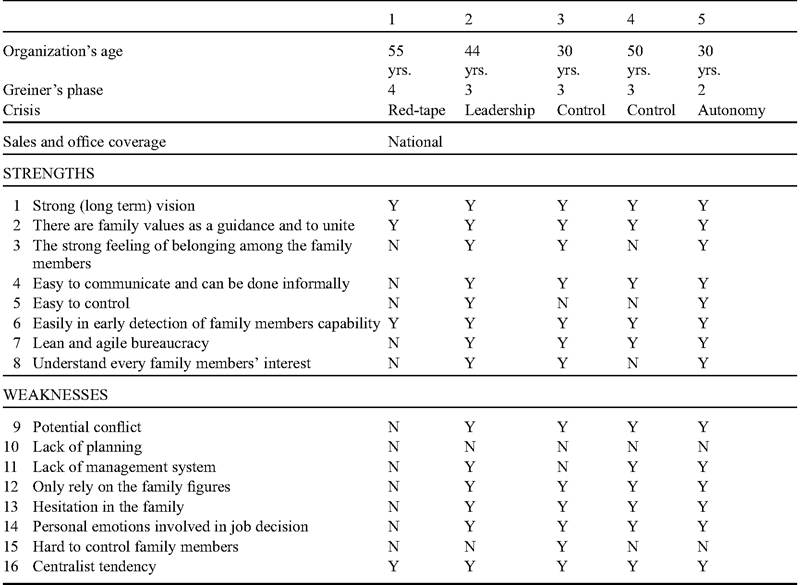
(Y: yes; N: no)
3.3 Phase 3. Growth through delegation
To overcome the crisis in the second phase, the owner is committed to making numerous changes in the third phase, especially to delegate tasks and communicate according to the hierarchy in the organizational structure. Managers have the responsibility and authority to make decisions at the department level so that each manager focuses on achieving his department’s targets. This condition encouraged the emergence of a crisis of control because the owners only evaluated the department’s performance from the available reports. From the research conducted, this third phase is a phase that determines management maturity in family-businesses. If the owner feels there are managers who can be trusted then the system, standardization of work, and hierarchy made can be run properly. Examples are distribution company and education services company that have department managers who are considered loyal and have good engagement with the company. Conversely, when the owner does not believe in the existing professional managers, the decision making at the department level remains intervened by the owner so that a family-business is found in the third phase but still faces a crisis of autonomy even though the system and standardization of work are available.
3.4 Phase 4. Growth through coordination
From the research conducted, the readiness of the next generation is an important factor for family-business to achieve this phase, where the next generation has the ambition to develop the company to become more professional, awareness of the importance of compliance with rules, development of human resources, and the importance of getting ISO as a recognition of the company. This phase will also be achieved by family-businesses that are affiliated with external parties (for example foreign investors) who are mature in their management, in this study it is found in a distribution company affiliated with Japanese companies that are required to have a mature management system. The business process of the company is translated into Standard Operating Procedures to regulate coordination between departments so that the existing departments do not go in different directions. Formal planning is the basis for the implementation of the company’s operational activities, the activities of each department are communicated at a meeting so that all parties are informed and documented to be accountable. Many rules are made to ensure coordination, efficiency and work effectiveness and costs. Compliance with government regulations and awareness of the importance of developing human resources is increasing because the complexity of companies requires more competent employees. Regulations and SOPs are the basis for carrying out work so that these changes are perceived as a bureaucracy in the company and slow down the decision making process. 4 out 5 family-businesses in this study stated they were not ready to be in this phase because there were no future generations who could carry out modern management practices, also because they wanted to reduce internal risks. Commitment to compliance with rules and employee development is considered one of the inhibiting factors in responding to changes quickly and accurately.
3.3 Phase 5. Growth through collaboration
Organizations that are in this phase are no longer using a rigid system. The matrix organizational structure that emphasizes cross functional task teams is the strength of the organization already in this phase. Simple monitoring mechanisms and real time information systems are needed to respond to changes or complaints quickly. The large-scale family-businesses examined in this study have not arrived at this stage.
3.4 Phase 6. Growth through alliances
Generally, organizations that are in this phase find it difficult to experience significant internal growth so that alliances with other companies are needed, through mergers, networks or collaboration so the challenge that must be faced is an identity crisis.
From the above discussion, flexibility in internal management is considered the main factor that can be controlled to be competitive in the market for family companies. For example, when the selling price of a product is no longer competitive with an increase in raw materials that cannot be controlled by the owner, the expenditure of human resources will be adjusted so that prices in the market can be re-competitive. Whereas when internal management practices are standardized it will be difficult to make policy changes quickly so that most family-businesses are in the second and third phases.
4 CONCLUSION
This study shows not all the strengths owned by family companies can be utilized to encourage growth and development. More professional management practices are started when there are several reasons, e.g. company need to develop information technology, the next generations have an open-minded, companies are required to have ISO, investment in large quantities that need to be controlled properly, there are investors who demand more professional management practices. To answer the research question, it is evident that family-business that tend to prioritize informal management have made themselves able to compete in the business and make decisions more quickly and precisely. This fact simultaneously denies Greiner’s assumption that all companies will evolve in their management practices in accordance with the growth of age and scale of the company.
REFERENCES
Adizes, I. 1979. Organizational passages: diagnosing and treating life cycle problems in organizations. Organizational Dynamics 8(1): 3-24.
Churchill, N. & Lewis, V. 1983. The five stages of small business growth. Harvard Business Review 61(3): 30-50.
Greiner, L. 1972. Evolution and revolution as organizations grow. Harvard Business Review 50(4): 37-46.
Harms, H. 2014. Review of Family Business Definitions: Cluster Approach and Implications of Heterogeneous Application for Family Business Research. International Journal of Financial Studies 2: 280-314.
Kimberly, J. & Miles, R. 1980. The Organizational Life Cycle. San Francisco: Jossey-Bass Publishers.
Lester, D.L., Parnell, J.A., Crandall, W.R., & Meneffe, M. L. 2008. Organizational Life Cycle and Performance among SMEs. International Journal of Commerce and Management 18(4): 313-330.
Mintzberg, H. 1984. Power and organization life cycles. Academy of Management Review 9: 207-224.
Mulder, P. 2013. Greiner Growth Model. [Online]. Retrieved from https://www.toolshero.com/strategy/grei ner-growth-model/ Accessed on 2018- 09-14.
Singapurwoko, A. 2003. Indonesian Family Business vs. Non-Family Business Enterprises: Which has Better Performance?. International Journal of Business and Commerce 2(5): 35-43.
PwC Survey. 2014. Family Business Survey Findings for Indonesia. [Online]. Retrieved from https://www.pwc.com/ id/en/publications/assets/Family-Business-Survey-2014- Country-Report-Indonesia.pdf Accessed on 2018- 09-14.
Quinn, R. & Cameron, K. 1983. Organizational life cycles and shifting criteria of effectiveness: some preliminary evidence. Management Science 29(1): 33-41.
Sindhuja, P.N. 2009. Performance and Value Creation: Family Managed Business Versus Non-Family Managed Business. Journal of Business Strategy. VI(3): 66-80.