Global Public Goods
Global public goods are goods whose benefits and costs extend across countries and generations; that is, global public goods are goods in which political and geographical boundaries disappear (Sava§an 2012).
At the same time, these goods bring along passing down of external cost or benefit from one generation to the other. When evaluated from this point of view, “intergenerational externality” and “cross-country externality” are the most important features of global public goods (Sandler 2011).When talking about a public good or GPG, we are actually talking about an economic term and this economic term has two main characteristics. The first one is non-excludability from consumption which means that the good can also be used by those who do not pay or it is impossible to prevent its consumption. The second one is non-rivalry in consumption; that is, for any production level, the marginal cost of delivery of the goods to an additional consumer is zero. In both cases, the price mechanism does not work properly in finding the balance between supply and demand. Among the most widely-known examples are law and order, defense and lighthouses. Public goods released on the free market face the problem of inadequate presentation, largely because of non-excludability and non-rivalry. Therefore, governments must take additional measures to finance, subsidize and present them, or they must make the presentations themselves. This is a public responsibility area that is accepted by even the most liberal thinkers.
On the other hand, when discussing GPGs' issue, broad-based and multi-sectoral discussions were typically held. For example, environmental, information, international security, peace and trade agreements are the subject of these broadperspective discussions, while discussions on healthcare GPGs mostly focus on medical technologies (Kaul et al.
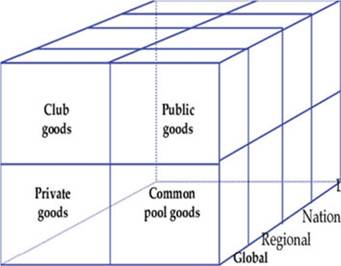
2003).We need to distinguish global and non-global public goods. Our global understanding here is not only geographical, i.e., rather than being local, national or regional, it also covers both countries and generations. In other words, it is actually multi-dimensional as it has a sociological and temporal dimension along with its geographical dimension. If a public good would only benefit one country or region, it would be a national or regional public good, not a global one. Similarly, NATO’s security services and alliances for the Western bloc countries during the Cold War are club goods, not GPGs. Again, when a multilateral investment guarantee agreement only benefits private international investors per se, it would be a worldwide club good and probably a private good. Contrarily, a poverty reduction program for sub-Saharan Africa, preventing conflict and contributing to international peace by addressing the needs of local people potentially, has international consequences, and reducing environmental damage and improving global health conditions is a GPG. Again conversely, donations to disaster victims are redistribution of private goods voluntarily from one owner to another, and they are mainly motivated by empathy not with global concerns. Private transfers and public goods procurement are not morally or ethically different. They only have different technical features. In other words, the non-excludability and non-rivalry in their consumption distinguish GPGs from private goods. These are the properties that should be considered in the classification of public goods as global or non-global or as GPGs and private goods (Kaul etal. 1999a, b) (Fig. 1.1).
The publicness level of the public goods that differ geographically and politically in the publicness cube appears to also differ among themselves. In other words, regardless of the spreading level of costs and benefits geographically and politically, each good and service (global, national, local, etc.) may show different characteristics according to a competition and exclusion factor (Afikgoz 2011).
If we start with private goods, they are usually traded in the markets, and buyers and sellers trade through the price mechanism. If they jointly decide on a price, they transfer ownership or use of the good (or service). Therefore, private goods are excludable and rivalrous in consumption as their ownership is clearly defined. For example, bread, car and ice cream are private goods. Public goods have the
Fig. 1.1 Publicity cube and global public goods. Source (Smith 2004; Afikgoz 2011, p. 229) opposite features. It is not possible to exclude people from consumption and there is no competition in their consumption. Street signs, traffic lights or fresh air are examples of public goods. Even if a large number of people look at it, the street sign will not wear out and it will be nearly impossible, costly and inefficient to limit its use to just one or a few people and to prohibit other people from looking at it.
The question of who provides public goods is also important. They are ready for everyone to use, right after their delivery. Therefore, overuse problems arise. In the absence of some kind of collective action mechanism, they risk inadequate provision. Oppositely, without collective action, public bads, namely pollution, noise, street crime, risky bank lending, etc., would be over-provided (Kaul 2000).
Global public goods are public goods whose benefits and costs extend across borders, generations and population groups. For example, if international social peace is achieved, everyone can benefit from this. This also applies to wellfunctioning international markets. Likewise, when global climate change is prevented, widespread intergenerational and geographical benefits will be provided, although people around the world can benefit in different manners. Likewise, civil aviation, postal services and telecommunications have similar features.
Most of the time, governments take action to facilitate the collective action required to prevent over-production of public bads or under-provision of public goods.
There is no such an institution at international level. However, if GPGs correspond to national needs and self-interest, countries are able to conclude agreement on coordinated action. The main difficulty is to encourage countries not to let public bads extend across their borders and transform from national public bads into global public bads. This requires cooperation and cohesion between cross-border policies (Kaul 2000).Therefore, when talking about a commodity, it is important to recognize that not all people give the same value to it. Poor people, who cannot bear the expense of traveling, may not place maximum value on international passport regime. Yet, traders may prefer global health endangerment to free trade as they wish their products find new markets (Drager and Beaglehole 2001). Others may put the control of international terrorism or stability of international financial markets at the highest rank. Thus, when an agenda is established for GPGs, equitably taking into account the priorities of different population groups is important (Kaul 2000).
Civil society and business actors make contribution to delivery of public goods, including GPGs, from human rights to technical norms. In fact, these actors have highlighted the importance of balancing the globalization of private activities with that of public goods. State actors appear to make limited contribution, maybe because nation states are defined differently at regional level. In order to maximize their contribution, GPGs should be closely linked to national interests (Kaul 2000). It is also necessary to take into account the need for stronger international platforms where state actors as well as non-state, transnational actors can discuss how to balance private goods with public goods. Such balance will contribute to people’s wellbeing. Public goods, including GPGs, are essential even for the wealthiest person. International markets cannot operate in the absence of provision of such goods.
Property rights, legal institutions, educated people, absence of epidemics, peace and security are necessary for efficient functioning (Thorsteinsdottir et al. 2003).
1.3