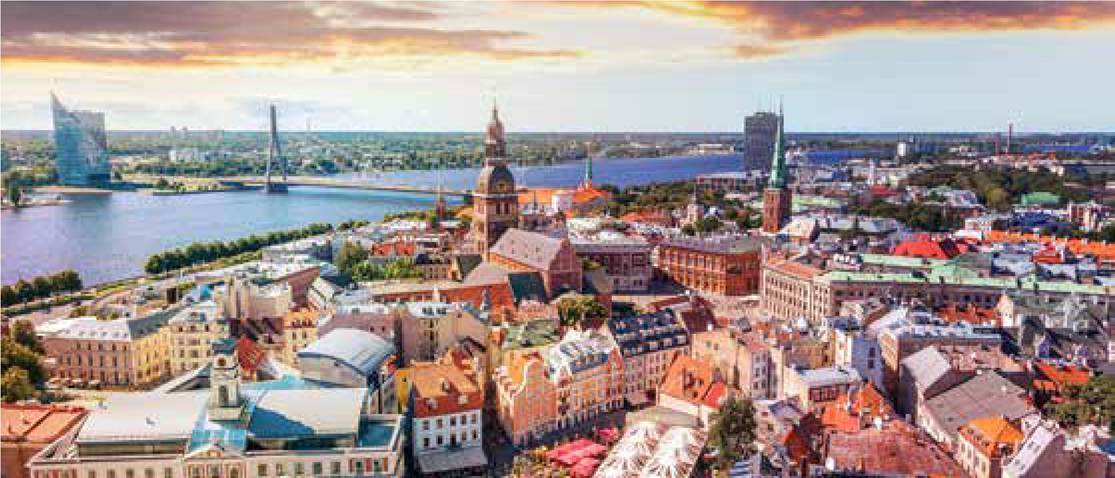
Latvia
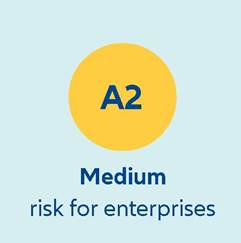
Modest recovery in 2024
| GDP | USD41.2bn (World ranking 98) |
| Population | 1.9mn (World ranking 150) |
| Form of state | Parliamentary Republic |
| Head of government | Evika Silina (PM) |
| Next elections | 2026, Legislative |
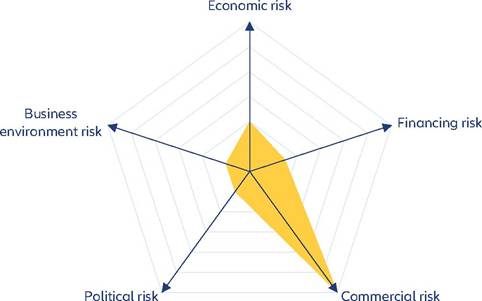
Strengths & weaknesses
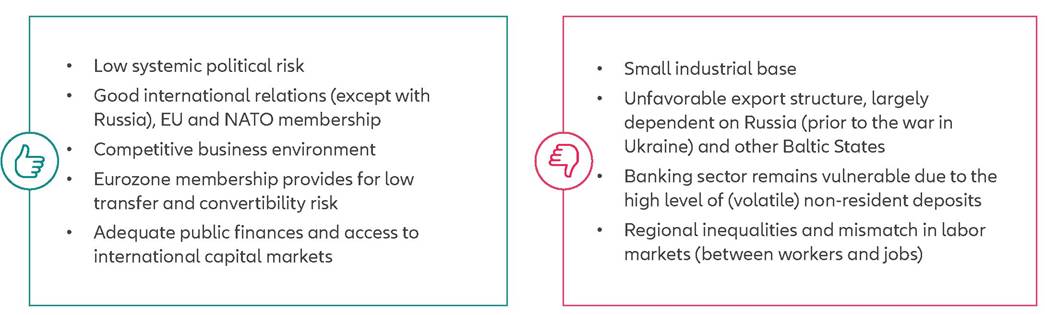
Economic overview
Growth to remain weak, inflation back to normal
Latvia's economic prospects have significantly deteriorated as a result of the war in Ukraine.
This is mostly due to the country's geographic proximity to Russia and its significant (pre-war) trade relations (accounting for 7% of Latvia's exports, 9% of its imports and, notably, 100% of its natural gas imports). Following a strong post-Covid-19 recovery with +6.7% real GDP growth in 2021, economic activity in Latvia slowed down markedly in 2022 and moved into recession in 2023 amid surging inflation, rising interest rates, weakening external demand and deteriorating business confidence. Additionally, the sharp economic slowdown in Western Europe weighed on trade in Latvia. Going forward, government fiscal stimulus and EU funding inflows as well as a gradual rebound in external demand should support a moderate recovery in Latvia in 2024-2025. We forecast full- year real GDP to expand by approximately +1.5% in 2024 and +2.5% in 2025.Inflationary pressures have subsided for now but upside risks remain on the cards in 2024-2025. Consumer-price inflation began to rise in mid-2021 and surged to well over 20% y/y in the second half of 2022 and early 2023, driven by soaring energy and food prices as well as interrupted supply chains.
It decelerated then rapidly to single digits by June and as low as just 0.6% y/y by end-2023, thanks to base effects, monetary tightening by the ECB and slowing domestic demand. Looking ahead, these effects are likely to fade and headline inflation is forecast to pick up somewhat to the range of 2-3% y/y in2024-2025. Upside risks to this forecast include a renewed energy price shock, potential supply disruptions or tightening labor markets. Meanwhile, Eurozone membership provides for moderate transfer and convertibility risk in Latvia.
Deteriorated but manageable public and external finances
Latvia's public finances should remain manageable despite strong fiscal stimulus measures taken in 2020-2021 to mitigate the economic impact of the Covid-19 crisis and renewed, albeit more moderate, stimulus to mitigate the impact of the economic downturn in 2022-2023. The government posted annual fiscal deficits of -4.5% of GDP in 2020, -7.3% in 2021 and -4.6% in 2022 and we forecast shortfalls to the tune of -3.5% in 2023-2024. This should keep public debt above 40% of GDP until 2025 at least. However, this will still be moderate compared to peers or the Eurozone average.
Latvia's current account balance shifted to sizeable annual deficits of -4% to -5% of GDP in 2021-2022, since imports in value terms increased much more strongly than exports as a result of the sharply increased prices for imported energy and food. Owing to softening domestic (import) demand and moderating energy prices, the current account shortfall is estimated to have narrowed somewhat in 2023. Looking ahead, we expect the annual deficit to decline further to around -2.5% in 2024. Financing the deficits should not cause problems over the forecast horizon, thanks to solid net FDI inflows (covering around one half of the shortfalls) and Latvia's Eurozone membership. A major weakness in Latvia remains the relatively high level of external debt. This is a legacy from earlier huge current account deficits in the 2000s.
However, the external debt-to-GDP ratio has continued to shrink from its record high of 147% of GDP in 2016 to an estimated 93% in 2023. We expect this positive trend to continue gradually in the next two years.Strong business environment and moderate political risk
The Latvian business environment is generally strong.
The World Bank Institute's annual Worldwide Governance Indicators surveys suggest that the regulatory and legal frameworks are generally business-friendly while a certain level of corruption is still perceived as present. The Heritage Foundation's Index of Economic Freedom 2023 survey assigns Latvia rank 17 out of more than 180 economies, an improvement from rank 30 two years ago. The country scores well with regard to property rights, judicial effectiveness, tax burden, trade freedom and investment freedom while there remains some room for improvement in terms of government integrity and labor freedom. Meanwhile, our proprietary Environmental Sustainability Index ranks Latvia 31st out of 210 economies, reflecting strengths in energy use and CO2 emissions per GDP, water stress and general vulnerability to climate change, though there are still moderate weaknesses in renewable-electricity output and the recycling rate.
Overall systemic political risk has deteriorated somewhat from a previously low level because geopolitical risk in the region has increased with the war in Ukraine. Latvia is a well- established democracy and has good international relations - except with Russia - reflected in its EU, OECD and NATO membership. However, there is a risk that social and cultural push-back is emerging from the sizeable Russian-speaking minority in Latvia.