New Socialization and Setting the Agenda on Twitter
In the past 15 years of social media, the peak period is after 2010 (Bozkurt 2018). Tagging, making headers, replies, rejections, likes, even emojis... Each of them offers its users the opportunity to express themselves.
Shared contents, likes and the notes make the user experience a different feeling in terms of both being popular and cared for. Sharing a photo from another page or even with your own picture, including someone else’s post on their page or replies, enables users to produce content. The social media soon turns into a self-published newspaper. With the content and posts it produces, issues that will constitute the agenda can be put forward.In addition to following celebrities, following the topics and the agenda gains importance in social media environments (Ceyhan 2019). With their comments, acceptance and objection, the social media shows that the masses express themselves and are happy to express themselves; it even turns into an environment where they can be heard and socialize through social media. Especially, the impetus the technology has gained by in mobile phones is an important factor in obtaining these opportunities easily.
It is more appropriate to consider social media as “new socialization tools” rather than “alternative channels”. The new socialization is transforming from becoming a follower by reading the agenda to becoming a part of the agenda. Their instant reactions, comments, two lines of articles in the headers and even expressions allow users to reproduce the agenda together. The opportunities offered by digital media with audio and video in reaching target audiences also increase the effectiveness of social media. Selecting the target audience, advertising opportunities, gain factor and instant uploading of content are effective in increasing usability. Even a sharing of a public official or even the president in the middle of the night instantly awakens the social media accounts and thousands of comments and discussions may continue till dawn.
There is only a media difference between looking again and again at the content shared by a person, checking the likes and comments, stating it numerically and interpreting the reactions to an event he/she describes in a community. Moreover, social media environments offer the opportunity to reach thousands of people (Btqakqt 2019).
The fact that Twitter mainly contains written and visual content in social media and its ease of use has been effective in its being a widely used social media tool. The most popular artist or athlete can also use it, and the most authorized persons of the state can use it; ordinary citizens can also get the opportunity to express themselves in this environment. Especially recently, it has become a social media tool that both politics and public executives frequently use and give messages. Twitter’s power and influence are in its widespread use.
According to statistics in October 2020, Turkey was among the countries where people spend the most time on social media in the world, with an average of above 3 h per day. October 2020 figures revealed that the number of users on Twitter is 13.5 million in Turkey. In this regard, it seems possible to reach meaningful data from Twitter posts of Turkish users.
Being on the agenda and setting the agenda have become the dream of every political, art and sports man. The most common means of the saying by famous film producer Andy Warhol, “Everyone will be famous one day for 15 min”, who drew attention to this “visible” feeling in all people, are social media environments. It doesn’t surprise anyone to see a new quote, a picture or a short video go viral every day, even if for a moment. Therefore, it would be a great loss not to take advantage of Twitter’s agenda and agenda-setting features. It is an important means of “reaching the masses” for those who carry out public relations work, communicators and of course advertisers (Fig. 13.1).
Especially after the adoption of Public Financial Management and Control Law No.
5018 in 2003, public institutions have created their own websites and opened social media accounts connected to them, as a requirement of the law. Thus, institutions also carry out the task of informing the public through their websites and social media accounts. Public institutions consider this as a transparency tool. Twitter draws attention with its increasing number of users in this process. Many contents are shared both to give information and to set the agenda. Reducing the voting age and age of candidacy to 18 is important in attracting the attention of the young population.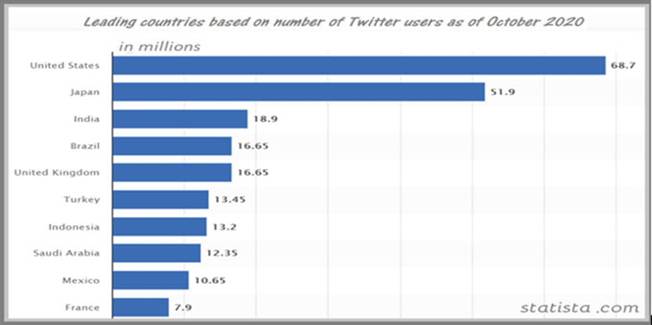
Fig. 13.1 Number of active twitter users. Source Created by the author using the data on website “Statista”
For this purpose, it is normal for official institutions and organizations to show more interest in this field in order to win young people, even if it is for informative purposes.
The subject of this study is examining, by means of selected headers, Twitter messages on curfews, in the last month, introduced due to the Coronavirus cases detected in Turkey. Based on these Twitter posts between 1 May 2020 and 31 May 2020, a “big data analysis” was performed in Twitter users’ posts on issues related to the agenda and pandemic. The size of the data analysed consists of approximately 20 million shares and 110 GB of data. The terms used in the posts of Twitter users and the interactions (RT, likes, comments, quotes, retweets) received by the tweets in a period of 31 days were examined.
13.3