The Issue of Knowledge Sharing of Models and Policy Effectiveness
Information available to the private sector and the government can differ, involving not only the actions of the agents and their nature but also the working of the entire economic system.[120] Our interest here is not on the whole issue of the information available to the various agents but only on a specific part of it, involving the information that the private sector can get through government announcements (forward guidance) about the model and its policy intentions.
There are two extreme ways of modelling the information possessed by the private sector in a condition of uncertainty. The assumption of REs is a way to solve the problem of asymmetric information (Grossman 1981). It ensures that the private sector knows how the economy works and/or the preference function of government. Learning is an alternative tool to deal with the issue, finally converging, possibly slowly, to RE solutions under certain conditions.[121] We choose an intermediate one, consisting in announcements by the government, which may or may not be trusted by the private sector. This is indeed a simpler way than the alternative of learning from the policymakers’ actions but also a way to avoid the opposite assumption of full REs of the model and the intentions of the government.More specifically, policymakers can provide their private information (also in terms of projections) to the private sector about the parameters and errors of the model as well as its future actions. Obviously, the private sector should gain from this if two assumptions are made: the policymaker has better knowledge about the workings of the economy and his or her announced actions are credible. Both assumptions are debatable, but conditions under which they - in particular, the latter - are met can be easily satisfied.
In a game between the two sectors of the economy, where the reaction function of private agents is expressed in terms of REs, whereas that of the government may be the object of forward guidance, the model of the economy can be as follows:
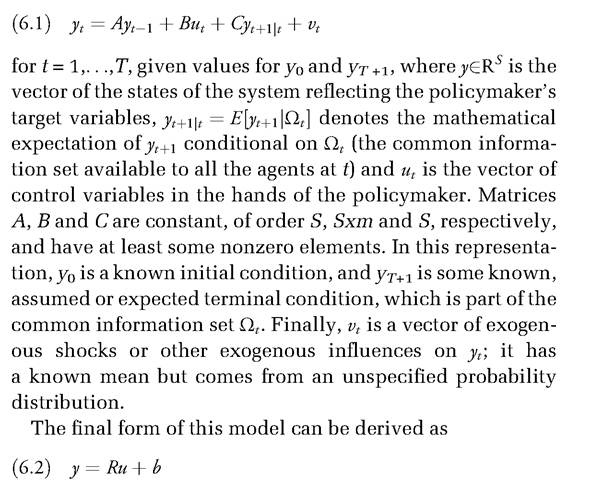
where R and b are appropriate values of the parameters in (6.1).
We can use this model for a number of applications. In particular, the effects of forward guidance in terms of pursuit of the policymaker’s goals can be assessed. In other words, the contribution of forward guidance to narrowing the gap between the government’s target values and the expected outcomes can be calculated in both its deterministic and stochastic parts.Converting model (6.2) to a ‘matching deviations from desired targets' format, we have

The additive error term can be decomposed into deterministic and stochastic components: 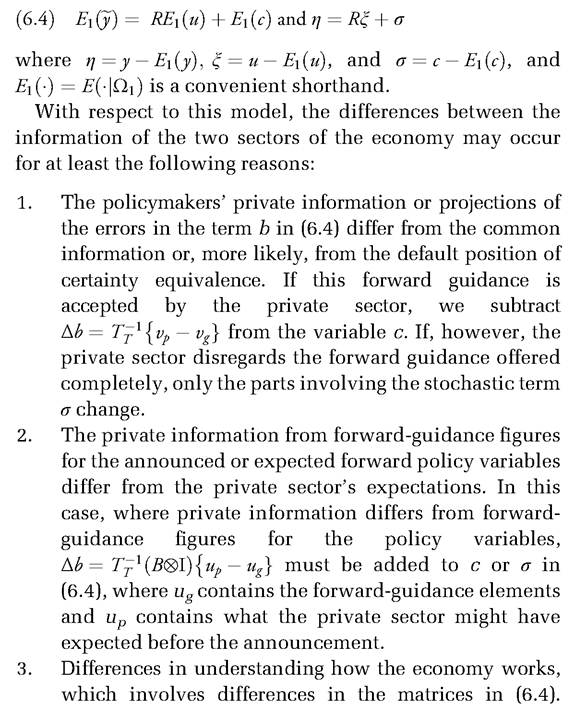
In this case, if forward guidance is offered on that point, Δb = {Rf — Rg}ug from c and/or σ must be subtracted in (6.4).