AN ASSERTIVE WORLDVIEW
Was expansion aided by the way empire builders perceived the world and the place of human beings in it? Were psychological and cultural factors widely shared by Europeans conducive to global dominance? People’s worldviews doubtless influence their will to act in specific situations.
The will to act is a component of power. And empires are products and expressions of power. But how can one ever know the worldviews or motives of persons separated from us by time, societal setting, and subtle differences in assumptions about reality? From what is known about prominent empire builders one can infer that their motives and their understandings of what they were doing varied greatly. Are generalizations about their states of mind more liable to mislead than enlighten?If one can identify broad perspectives that underlie and encompass the wide range of motives operating at the personal level, the risks of making unsupportable, overgeneralized claims are reduced. If there is evidence from phases i and 3 of worldviews compatible with expansion; if these worldviews were more prevalent in European society during the past five centuries than in premodern times; and if they were more prevalent in Europe than in other societies that might have formed overseas empires but did not, then a causally meaningful cultural factor is at work.
Widely shared among empire builders was the view that life was most meaningful when actively engaged, for the dual purpose of understanding the world and changing it. I term this assertive stance the explore-control-utilize syndrome (see chapter 2). Its first component was exploration: the practice of leaving familiar settings to learn about unfamiliar and often unknown places. In taking this initiative, explorers implicitly affirmed the importance of other places and people. For if there were no reason to fill gaps of knowledge about them there would be no grounds for leaving home.
Exploration affirmed the importance of curiosity and the value of satisfying it. Turning the unknown into the better known was for many a desirable goal in its own right. But if curiosity, once satisfied, could be the means to other ends, so much the better.The second component was control. Empire builders wanted to possess distant places and people. Possession might result from subduing others through force, but it was perceived as more than sheer coercive superiority. It had a legal and normative dimension as well, linked to deeply engrained notions of property. The European state, which ensured private property rights in its domestic domain, felt itself entitled to exercise collective property rights abroad.
The third component was utilization, the realization of imagined potential. Europeans expressed activism not only by going out to create empires but also by what they did with what they claimed to possess. A recurring pattern was the deliberate, systematic attempt to transform the social structure, economy, culture, and physical environment of other places. These invaders were perpetually restless, dissatisfied with what they found, and anxious to put it to more effective or efficient use. The principal though not exclusive beneficiary of the transformation project was themselves. Cortes’s remark to the first messengers sent by Moctezuma sums up the insatiable appetites impelling so many Europeans in his day and afterward. After being presented fabulous gifts of gold he asked in apparent indignation, “And is this all?”20
The forms these multiple transformations took differed in phase i and phase 3, if only because industrialization enormously increased Europe’s capacity to alter physical landscapes and social and psychological patterns. But the dream of radical change was there from the early years. Within hours of Columbus’s first landfall in what turned out to be the New World, he mused in his journal about what could be done with the land and people he had just claimed on behalf of King Ferdinand and Queen Isabella:
I went this morning, that I might be able to give an account of all to Your Highnesses and also say where a fort could be built.
I saw a piece of land, which is formed like an island although it is not one, on which there were six houses; it could be converted into an island in two days, although I do not see that it is necessary to do so, for these people are very unskilled in arms, as Your Highnesses will see from the seven whom I caused to be taken in order to carry them off that they might learn our language and return. However, when Your Highnesses so command, they can all be carried off to Castile or held captive in the island itself, since with fifty men they would be all kept in subjection and forced to do whatever we wished.21Columbus and the millions of Europeans crossing the oceans after him had a profoundly teleological conception of the world. Their task was to bridge the gap between the realities they experienced and their idealized versions of reality by reshaping what they found to become what it could and should be. This perspective is well illustrated in Sir Walter Raleigh’s widely read account of his quest in the jungles of Guiana for the mythical golden city of Manoa (1596). Raleigh spelled out the tempting possibilities if only England possessed the land: “To conclude, Guiana is a countrey that hath yet her Maydenhead, never sacked, turned, nor wrought, the face of the earth hath not beene torne, nor the vertue and salt of the soyle spent by manurance [cultivation], the graves have not beene opened for golde, the mines not broken with sledges, nor their Images puld down out of their temples.”22
Writing of merchants, whalers, settlers, missionaries, soldiers, and administrators who came to the Marquesas Islands from the eighteenth century onward, Greg Dening concludes, “There were very few outsiders who came to [this island chain] who did not want to remake it.”23 The same could be said of many other parts of the world.
Europeans were hardly unique in wanting to control physical and human environments. What made them distinctive, from phase i onward, was their reliance on exploration to gain political control and then to put available resources to use in new ways.
The cumulative and interactive effects of the syndrome’s three components were extraordinarily empowering. The link between exploration and control was well expressed by the chronicler of Prince Henry’s expeditions, Gomes Eanes de Zurara, who wrote of captains of caravels sailing for Cape Verde saying, “Great is the desire of our Senhor the Infante to learn something of the Land of the Negroes, especially of the Nile; let us then go forth to conquer until we have found the Earthly Paradise.”24 A similar link was referred to in phase 3 by the French geographer La Ronciere de Noury: “Providence has dictated to us the obligation to know the world and to conquer it.”25 Cecil Rhodes took this self-designated obligation to its logical conclusion. “Expansion is everything,” said the great imperialist. But then, writes Hannah Arendt, he “fell into despair, for every night he saw overhead ‘these stars... these vast worlds which we can never reach. I would annex the planets if I could.’ ”26The link between control and utilization was expressed in British colonial secretary Joseph Chamberlain’s oft-cited reference to the world’s tropical areas as “undeveloped estates.” Implicit in this phrase is the view that humans enjoy the privilege but also bear the moral responsibility of turning the potential of their physical surroundings into something useful to themselves or others. Non-Europeans, in this view, have abdicated that responsibility. For eons they moved lightly across the land or squatted upon it, letting its abundant resources lie unused. In striking contrast—so the argument goes—Europeans have shown the capacity and will to realize nature’s untapped potential. They therefore have the right to take possession of land others failed to utilize, transforming it into a productive estate. In Lockean terms, Europeans have progressed far beyond a State of Nature. They are entitled to take whatever they want from those who remain in that primitive condition or not far removed from it.
In effect, Europeans have use rights to vast portions of the globe.From phase 1 onward this argument was advanced by settlers to justify seizing land from indigenous occupants, expelling “useless” non-European peoples, and forcibly mobilizing their labor. “That which lies common, and hath never beene replenished or subdued is free to any that possesse and improve it.”27 These words by the Puritan leader John Winthrop summarized the doctrine of vacuum domicilium, according to which undeveloped land occupied by people could be deemed uninhabited, hence rightfully seized. A phase 3 example comes from Sir Charles Eliot, high commissioner for the East African Protectorate (Kenya) from 1901 to 1904. Eliot wrote in 1905, “We must assist Europeans to develop the fine land the Protectorate contains, and must not allow nomadic tribes to monopolize huge areas of which they can make no real use.”28
Does the explore-control-utilize syndrome distinguish phase 1 from prephase 1 Europe? To be sure, there is no precise break in modes of consciousness from one century to another, and thinking of 1415 or any other date as a decisive turning point in all aspects of European life, especially subjective ones, is unwarranted. Yet there is a shift in mentality between the closest prephase 1 equivalent to imperialism—the Crusades—and empires described in this book. The military expeditions west Europeans launched between 1096 and 1291 had a control objective: wresting possession of Jerusalem and the tomb of Christ from Muslim rulers. But control was in the hands of soldiers on the spot or of military/religious orders—notably Knights of Malta and Templars—not sovereign states administering conquered areas from afar. And the Crusaders’ travels did not qualify as exploration. Warriors left Europe not for places whose location and potential were unknown, but for well-known lands perceived to be the religious center of the world. The Crusaders’ interest in conquest was unmediated by curiosity about other people, and control was not as prominently linked to utilization as in later empires.
The principal artifacts crusading armies left in the Levant were fortified castles, designed to hold conquered territory against implacable foes. Crusaders had neither the means nor the desire to transform the Levant’s economic, social, and cultural landscape. Control was decoupled from exploration and utilization. Motivations driving the Crusades were less complex and synergistic than in the empire-building projects—which may explain why the earlier outwardfacing ventures failed while those from phase 1 onward fared much better.Were Europeans more likely to exhibit the explore-control-utilize syndrome than other peoples? A majority of the world’s great explorers of seas, continents, and polar regions was bom in western Europe.29 Travel to distant places was socially understood and accepted in Europe, often conferring fame. This social role had institutional backing, most expeditions being financed by government officials or scientific societies or both. Government sponsorship greatly increased the likelihood that knowledge generated from exploration would be followed by political claims in newly discovered areas.
In most other societies, by contrast, the explorer role did not emerge, and scientific societies designed to learn about unknown places were not formed. The Islamic world had a tradition of travel accounts by Abu al-Idrisi, Ibn Hawqal, Abu al- Hasan al-Masudi, and the incomparable Ibn Battuta (1304-77), at more than seventy thousand miles the greatest explorer of all time. But these men generally confined themselves to areas inhabited by fellow Muslims. A recent account of Ibn Battuta’s travels notes that “almost everywhere [he] went he lived in the company of other Muslims, men and women who shared not merely his doctrinal beliefs and religious rituals, but his moral values, his social ideals, his everyday manners.”30 The compulsion to visit places and people manifestly foreign—a prominent motivation among many European travelers—apparently was much less strong among their Muslim counterparts. Moreover, Ibn Battuta and his predecessors traveled on their own, covering expenses through their own initiatives. Lack of institutional support meant that the knowledge they generated did not lead to expansionist claims by rulers of Muslim states.
The closest Chinese parallel is Cheng Ho, whose expeditions were officially sponsored and reached lands of which the Ming court had been at most dimly aware. But the Chinese admiral was a historical anomaly, not a contributor to an ongoing, socially acknowledged tradition of exploration. Whatever he learned had no policy impact once his sponsors lost interest in convincing foreign potentates of China’s greatness. Even when the court was interested, its goal was not to assert power through military and administrative means but to enhance status and encourage trade through symbolic govemment-to-govemment tribute relations. Thus, in the exceptional Chinese instance when exploration was valued, formal control was not, at least in the way Europeans understood and practiced it.
Exploration from the Islamic world and China was on the decline when west Europeans began to reach outward. Ibn Battuta and Cheng Ho were the last of their kind rather than pioneers inspiring successors to build on their findings. The contrast with the cumulative acquisition and wide dispersal of knowledge from European exploration is clear.
Links between control and utilization were also less evident in the great nonEuropean overland empires. The tendency was for rulers to extract resources from the populace without trying to change what their subjects produced or how they produced it. The idea of remaking the natural environment and rearranging the way people lived so as to realize a vision of a more perfect order of things did not figure prominently in the thinking of non-European elites.
One reason the explore-control-utilize syndrome could emerge is that exploration and utilization become more highly valued in a particular era, hence more readily linked to control objectives, which can be assumed to be fairly constant over time. That phase 1 Europeans placed a higher priority than their predecessors on exploring the world and putting new knowledge to practical use is demonstrated in the domains of science and technology. Advances in theoretical and experimental science and the impact of scientific thinking on everyday life accelerated during the Renaissance, about the time the early explorations took place. Like imperialism, the ascendant scientific worldview set modern Europe apart from its premodern predecessor. Over time it increasingly set European societies apart from non-European ones. According to this way of thinking human beings are not simply immersed in Nature; they are in some sense distanced or alienated from Nature. The key to scientific knowledge is systematic observation, which assumes some distance between observer and observed yet posits that this distance can be traversed through careful observation. Another mental distancing operation involves distinguishing between Nature as what is apprehended by the senses and Nature as what lies behind signals the senses convey. The essence of Nature in this latter manifestation is conveyed by comprehensive, unchanging, abstract laws, typically expressed in mathematical form.31
Having postulated various kinds of distance between the observing mind and Nature, the modern scientific enterprise tries to reduce that distance as much as possible through systematic exploration. This may involve traveling to places the scientist wants to reach or devising sophisticated instruments to observe distant or very small objects. Scientific exploration probes beyond the empirically observable level to reveal or “dis-cover” natural laws. These laws subsume a confusing array of sensory data under patterns that are at once comprehensive and comprehensible.
Knowledge obtained from scientific exploration has long been considered instrinsically desirable by its practitioners. Yet there has been a strong tendency in modern European society to view basic knowledge in instrumental, utilitarian terms. Technological innovation has flourished, bringing closer to fulfillment Nature’s imagined potential to enhance human well-being. Since the Renaissance a series of research and development cycles may be observed in which basic knowledge stimulated technological advances, which in turn permitted further exploration at the more fundamental theoretical level.
That Europe began to project political power outward at about the time its innovations in scientific thinking and technological application were accelerating is not a coincidence. New levels of activism in these two domains, from early in phase i and continuing through succeeding centuries, reflect a close, mutually supportive linkage among exploration, control, and utilization. Imperial expansion and scien- tific/technological innovation share an underlying logic because both are derived from the same syndrome of attitudes.
Interaction between these separate yet similar domains was synergistic and mutually reinforcing. Explorers of seas and continents accumulated a vast amount of information that enriched basic and applied scientific work at home. Their early findings may have fostered qualities of mind essential for scientific advance. Germain Arciniegas argues that because ancient classical and medieval Christian scholars were unaware of the New World, its discovery increased skepticism about the claims of received wisdom from whatever source and led Europeans to ask more insistently whether statements about the world were supported by evidence. Maritime exploration having paid rich and unexpected dividends, scholars were emboldened to apply its unabashedly empiricist approach to other endeavors as well.32
Some revenues extracted from the colonies were invested in scientific research and development at home. The quest for natural laws in turn unearthed knowledge leading to breakthroughs in transport and communication, which made it easier for Europeans to conquer other people. Sometimes geographical exploration combined imperial and scientific motives. Back of Captain Cook’s first voyage to the South Pacific in 1768, for instance, lay the geostrategic goal of finding a southern continent to which Britain might lay claim. Accompanying Cook was the young naturalist Joseph Banks, who won a well-deserved reputation for his careful observation and impressive collection of flora and fauna. Banks became first director of the famed botanical garden at Kew, outside London, and was president of the Royal Society for forty years.33 The network of botanical gardens connecting metropoles and colonies further illustrates the fusion of imperial and scientific enterprises. Botanists at Kew, the Jardin d’Essai Colonial in Paris, and government-sponsored gardens in Buitenzorg (Dutch East Indies), Calcutta, Peradiniya (Ceylon), Singapore, Libreville (Gabon), Saigon, and elsewhere collected and classified specimens. Much of the botanists’ work was then put to commercial use. Cinchona, rubber, and sugarcane were transplanted from continent to continent and stimulated economic development far from their places of origin.34
In retrospect, advances in knowledge leading to the gunned ship of early phase 1 were not accidental or isolated. They were the opening rounds in a series of advances that progressively enlarged the technology gap between Europeans and others. By phase 3, when the gap had become a chasm, Europeans saw their scientific and technological accomplishments as evidence of their across-the-board superiority over others. Empire was explained as a manifestation of that superiority and justified as a way to civilize materially less advanced cultures. A growing capacity to understand and manipulate the physical world thus reinforced the will to dominate the human world (see table 8.1).35
A society with the will to explore, control, and utilize its environment is well positioned to conquer societies less inclined to think in this way. If in addition the more assertive society can call upon a steady stream of advances in science and technology while others cannot, its prospects for political dominance are even better. From the fifteenth century western Europe linked control vertically to exploration
TABLE 8.1.
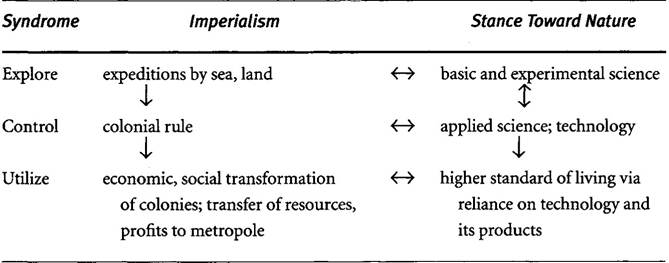
and utilization and laterally to advances in the exploration, control, and utilization of Nature. The combination was hard to resist.