CHAPTER 6 From Bedpans to Bulldogs: Lottie: Gallipoli Nurse and the Pitfalls of Presenting War to the Young*
Sara Buttsworth
Upon visiting the Auckland War Memorial Museum for the first time, I was struck by what I found in the bookshop. Gazing out at me, framed by a starched white veil, was Lottie: Gallipoli Nurse,"1 and not far from her on the shelf was the jowled grin of Caesar the Anzac Dog,1 looking hopefully down at a wounded soldier.
Both these books have direct connections to the museum. Charlotte Le Gallais' story (Lottie") and photograph along with photographs and diary extracts pertaining to her brothers Owen and Leddra have prominence in the main museum exhibit on the Great War, while Caesar's collar can be viewed in different places depending on display space. The impact of these books, however, is not only due to their connections to the “real” in the museum but also as part of a growing body of picture books aimed at New Zealand children from ages seven through 14 that re-present and reconstruct First World War mythologies. Initially, I experienced pleasant surprise at the visible visual representation of women in wartime that is superficially presented by Lottie: Gallipoli Nurse. In retrospect, what should not have astonished me was the ways in which this publication, connected to a place of popular memory and memorial, upheld the combat-centric ideology of ANZAC (an acronym for the Australian and New Zealand Army Corps).The First World War still dominates the memorial landscape of New Zealand, and the battles in which New Zealand soldiers took part are considered by many to be the nation's “baptism by fire.” ANZAC fought under British Command in the First World War and is largely associated with the failed Gallipoli campaign of 1915. “ANZAC,” the acronym, was used to specify the army corps but is now used to symbolize military heroism in Australia and New Zealand from that conflict right up to the present.
It also has common usage with reference to sporting events between teams from the two countries, particularly rugby, rugby league, and cricket. Whatever the endeavor, the heroism of ANZAC is always masculine and combatant, and the focus of the legend is that heroism rather than the historical intricacies of the context or legacies of the Great War. The “tall bronzed ANZAC” dominates the way in which the First World War is remembered and has until recently left very little room for examinations of New Zealand society and the frictions that continued between different sectors because, or in spite, of the war. There has been little room for the discussion of noncombatant participants in the war, particularly women, in the public discourses of memory and memorialization.ANZAC Day memorial services and ceremonies are held on 25 April every year to commemorate the bravery of New Zealand soldiers and the severe casualties they suffered during the many futile battles of the First World War but especially at Gallipoli. The government and many of New Zealand's people greeted the First World War as an opportunity for the fledgling nation to prove itself on the international stage. In all, 18,166 New Zealand soldiers lost their lives, and there were over 55,000 casualties throughout the duration of the conflict.3 The “great adventure” became both a cause for national mourning and a focus of national pride. The treatment of the defeat at Gallipoli by New Zealand media and later historians formed a pattern where devastating losses were deemed a testament to the bravery and skill of New Zealand soldiers, who suffered at the hands of an incompetent leadership and insurmountable odds. The battle for Passchendaele in France in 1917 saw larger losses of life of New Zealand soldiers than the debacle at Gallipoli two years earlier, but it is recounted in similar ways: a place where New Zealanders proved their worth against impossible odds and a deficient (British) general staff.
These battles are by no means the only places New Zealand soldiers fought in the First World War, but they are the most prominently remembered in the late twentieth and early twenty-first centuries.New Zealand's war culture focuses almost exclusively on the combat soldier, a telescoped vision that has come at the expense of broader local, national, and international historical contexts. It represents vignettes of the battlefield almost as if they were the whole and only tenable picture of war. The focus on combatants in the field is exemplified in recent public debates over which battles were more important to New Zealand—as a nation— with body counts a key indicator of significance. The ninetieth anniversary of the Battle of Passchendaele in 2007, for example, put this focus on casualties as an indication of valor firmly in the spotlight when historian Glyn Harper, echoed by Prime Minister Helen Clark, called for this battle to be recognized in the same way as Gallipoli was, because more New Zealanders died at Passchendaele.4 This kind of attention does not broaden the focus of historical or cultural inquiry away from the traditional images of war as a male pursuit (or something similar); it merely relocates it from the sand and flies of Turkey to the mud and trenches of France. New Zealand participants in this conflict who did not, or were not allowed to, take up arms and the small but vocal minorities who for diverse reasons opposed the war remain indistinct in the public image of the war. On ANZAC Day “lest we forget” only really applies to combatant soldiers.
Mythologies of war are often presented as if they are self-explanatory and as sites that resist rather than invite questioning. Historian Deborah Montgomerie has articulated many of the problems in dealing with New Zealand histories of the First World War as hinging on the replication of mythology by written histories. In reconnoitering the state of New Zealand's histories and historiography of war, Montgomerie points out that “war, we are told, brought us to self-consciousness as a nation, but the details of the process...
remain indistinct.”5 The centrality of the carnage and defeat at Gallipoli in 1915 dominates that national “self-consciousness” and continues to function as "memento mori, heroic folk tale and political parable.”6 Similarly, the children's picture books under scrutiny in this chapter form a part of a broader ANZAC tradition that in Australia and New Zealand is frequently treated as sacred and hermetic. However, just as this is not true of the mythologies from which they draw their inspiration, these texts to a large extent cannot and do not operate holistically unto themselves. They are really only comprehensible within the broader framework of ANZAC mythology and broader stories about the First World War.From within her starched white veil, Lottie: Gallipoli Nurse looks out to an audience of young people who do not have a living connection to the war that was to end all wars. Almost a century after the First World War began, a small but significant number of New Zealand picture books centering on that conflict have been published. The production of such texts raises questions both about and beyond their immediate subject matter and invites an evaluation of the presentation of a martial mythology to a peacetime, noncombatant, and young audience. How can, or should, war be presented for and to children? And to what end? What is the relationship of these texts to broader discourses on war and childhood? Lottie invites all of these questions and raises particular issues relating to narratives of war and the representation of gender. As a story that focuses on the experiences of a female nurse within a tradition that has little room for women's stories in both broader war narratives and the narrower scope of ANZAC mythology, Lottie has the potential to play an important role.
A book about a nurse and a noncombatant is unusual in the New Zealand canon of historical literature about the First World War. I was initially intrigued and delighted to find what appeared to be such an unusual text, which I hoped might attempt to deal with a story too long overshadowed by mythologies of the heroic and doomed soldier.
However, in spite of the fascinating story of Charlotte Le Gallais upon which the book is based and its promising title, Lottie: Gallipoli Nurse continues the sanctification of the combatant soldier and in subtle ways makes its own main character an understudy in her own performance. Lottie represents a lost opportunity, reinforcing rather than challenging the socially acceptable ideas and tropes about the war and the role of New Zealanders in it.While Lottie's noncombatant status is unusual in New Zealand historiography, within the parameters of books aimed at children, however, she lines up with an array of different personalities that includes a number of animals—the dog in Caesar the Anzac Dog, the bantam of The Bantam and the Soldier, the donkey of The Donkey Man—but no other women. What a close examination of this text reveals is that in spite of first appearances, in both the broader context of historical literature and ANZAC mythology and the narrower scope of children's picture books, Lottie's presence is far from unproblematic in terms of narrative, visual, and historical representation. The problems posed by Lottie: Gallipoli Nurse require an interdisciplinary, intertextual, and intratextual approach. Charlotte Le Gallais was an independent professional woman who sailed vast distances to “do her bit” during the Great War. While obviously no text is an island, the contrasts between the life of Le Gallais and how it is represented in Lottie as well as the book's reliance on some prior knowledge and acceptance of the mythologies of the First World War are striking.
In New Zealand since the late 1990s, a number of picture books dealing with the First World War have been published for New Zealand young people. The Bantam and the Soldier, one of the best known, seems to have begun the trend in 1996.7 In 1997, it won the prestigious New Zealand Post Book Awards' Children's Book of the Year. That same year, John Lockyer's Harry and the Anzac PoppyA was published, followed in 1998 by Lottie·.
Gallipoli Nurse. In conjunction with Chris Pugsley, a well-known historian of New Zealand and war, Lockyer was then involved in the production of The Anzacs at Gallipoli, a factual (rather than fictional or pseudofictional) account of the Gallipoli campaign, which was published in 1999.9 Caesar the Anzac Dog by Patricia Stroud and Glyn Harper's The Donkey Man followed in 2003 and 2004, respectively.10 Furthermore, Jennifer Beck, the author of The Bantam and the Soldier, has most recently collaborated with Lindy Fisher in the writing and illustrating of A Present from the Past, which indirectly looks at the role of the Red Cross and nursing during the First World War through the interesting trope of gift boxes acting as receptacles of memory and memorabilia.11 There have been repeated calls for children and young adults to be taught more about the First World War in New Zealand, with an emphasis on New Zealand's military history and its connection to “nation-building.”12 This focus on the First World War in the public culture of New Zealand was a part of the impetus for the publication of all these picture-book texts, including Lottie: Gallipoli Nurse.Lottie is based on the experiences of Charlotte Le Gallais, who was one of 14 New Zealand nurses who sailed to Gallipoli on board the hospital ship Maheno in July 191513 and one of 550 nurses who served with the New Zealand Expeditionary Forces throughout the duration of the First World War.14 Le Gallais was practicing as a registered nurse at Auckland hospital when the war broke out. In her early thirties and engaged to be married, Le Gallais enlisted in the New Zealand Army Nursing Service (NZANS) in 1915.15 She served on the Maheno as it picked up wounded soldiers from the beaches of Gallipoli and ferried them to a hospital on the island of Lemnos. She visited Malta and spent some time in England as well. On her return to New Zealand, she married her fiance Charles Gardner (who had spent the war years in New Zealand), and subsequently had two children. She died in 1956. Charlotte Le Gallais had four brothers, two of whom served in the New Zealand Expeditionary Forces during the war. Leddra fought in the Gallipoli campaign and was killed on 23 July 1915. Owen fought in France and returned home in very poor health as a result of his years of active service. Lottie: Gallipoli Nurse centralizes the relationship between Charlotte and Leddra and emphasizes Charlotte's concern for her brother's well-being and desperation for news of him. Perhaps in the interests of simplicity, Lockyer makes no reference to Owen, the other brothers, or the fiance to whom Charlotte confided the details of her wartime service in letters.
Lottie: Gallipoli Nurse is, according to the author, John Lockyer, a “story based on letters Lottie and Leddie sent home and the war diary of John Duder, an officer based on the Maheno.”16 These materials are mentioned by Lockyer in a kind of afterword, in which he briefly provides information of the fatal Gallipoli campaign, including numbers of casualties, and a brief description of Charlotte Le Gallais who “was a nurse on the Maheno... eager to go to Gallipoli to care for the men but also to meet up with her brother Ledra [sic] (who had left New Zealand on a troop ship a few weeks before her). Sadly they never met. Ledra [sic] was killed at Gallipoli on 23 July 1915.”17 The accessibility and completeness of the archival material upon which Lottie is based was quite possibly a reason Lockyer chose Charlotte Le Gallais as the subject for his book.18 In which case, it seems rather a pity that more was not done with the excellent materials Lockyer had available to him to turn what he labeled a work of “faction” into something more true to Charlotte’s war experiences.19 Much like the stories of old soldiers, the details of who Lottie was and what her life was like outside her military service are omitted so that war takes center stage. This tends to make her appear rather one dimensional, especially when considered in conjunction with the depiction of her war service purely as a result of her feelings of duty and love for her brother, the soldier.
The importance of Lockyer’s Lottie lies in its use as a public text to represent and explore the lives of New Zealanders in the war. Significantly, Le Gallais’ story opens up the possibility of investigating experiences that have largely been marginalized by traditional histories of New Zealand in the First World War—those of the noncombatant, but particularly female, population. Both a museum exhibit utilizing the Le Gallais family archive and Lottie attempt to go some way toward rectifying the absence of the small but important NZANS in the narration and memorializing of the First World War. The connection between Charlotte as a nurse and Lottie as a character is so important to the Auckland War Memorial Museum that on ANZAC Day in 2007 and 2008 an actor dressed as Lottie told Lottie’s story in the vicinity of the exhibits that display the story of the combatant and noncombatant Le Gallais’. The sale of Lottie in the museum bookshop forged a further tangible connection between this “work of faction” and the materials upon which it is based. A blurring between the historical person and the fictional character has resulted. She has become, quite literally, a character narrating war directly to a young audience. Whether this means that the experiences of Charlotte Le Gallais and other women like her are read as fictional and, therefore, are undermined or that the audience views Lottie as a “real” person, lending historical weight to a book that has been deliberately fictionalized, is a confusion worth pondering.
This conflation of “real” and “fictional” has occurred partly as a consequence of the relationship between this picture book and the opportunities it provides for opening up the subject of the First World War for young people. Attempts to make this story relevant and comprehensible to a contemporary young audience have often been at the expense of being true to the source material and historical accuracy. There has been an assumption that young readers will have a vague familiarity with the myths of the First World War and the importance of Gallipoli to New Zealand. Lockyer's Lottie can only be understood in relation to the broader contexts of war, gender, and ANZAC mythologies within which it was created and is read. Without careful explanation and interpretation, this book cannot illuminate the experience of war for its peacetime readers, relying as it does on the preexisting dominant narratives of the ANZAC legend. What it does not invite is a complex appreciation of stories that must be histori- cized, moving as they do from their original context and source material a century ago to their re-presentation in a much different time and place and to a much different audience. The contexts of Charlotte Le Gallais' story and its adaptations, therefore, shift uncomfortably between archive, exhibit, picture book, and classroom and are further blurred by the inter- play—and lack of it—between the written word and pictorial content (discussed below). As Antoine De Baecque would have said, Lottie is not only intertextual but also “intercontextual.”20
The use of the term “faction” implies a “based on a true story” approach with some details changed or tailored to suit a younger audience and the contemporary expectations of an educational text. Lockyer's written text utilizes archival material in many places word for word, which, in combination with the exhibits of photographs and letters in the war memorial museum, lends this picture book its authenticity and authority. Other picture-book texts, The Bantam and the Soldier, for example, employ photographs or depictions of memorabilia from the period as a means of “providing depth” or anchoring a narrative that is being constructed long after firsthand memory has receded.21 Lottie does the exact opposite. Its illustrations, as we will see, lend most of the fictional aspects of this work of “faction” while anchoring its text in the “known” and “available.” This is both a strength and a failing.
The closeness of the text to the archival material in places masks some of the omissions made by Lockyer to make this work “suitable” for children in the late twentieth century. The ugly side of war in general is not absent from Lottie. Debates on the exposure of children to violence through the media are too numerous to be discussed here, and the exposure of children to “gratuitous” violence continues to be a hot topic in many circles. The depiction of “real” or historical violence is, however, a necessary part of making sure that children are included in the endeavor to ensure war is not repeated. Exposure to depictions of real and imaginary violence, death, and destruction is inevitable for most children, even in a peaceful nation like New Zealand. In Western culture, violence and war go hand in hand. Lockyer takes pains to ensure that the difficulty of dealing with the dreadful wounds, disease, and piles of dead bodies is a part of Lottie's story.22 He also replicates the uncertainty of a soldier's life, repeating Leddra's written comment to his father in a letter prior to his death:
I never thought I would be a soldier but now I am one I am determined to be a good one, to do my duty to the best of my ability. If I have bad luck, well, I suppose it has to be.23
Interestingly, there is no manifestation here of the part of the ANZAC myth that assumes that Australian and New Zealand men were natural soldiers.24 Rather, Leddra (and Lockyer by repeating him) hints at the doubts the former school teacher had, and this is an attempt to reassure both himself and his family that he can be a soldier and do his best for king and country.
While references to violence and death are not omitted in Lottie, the ugliness of early-twentieth-century racism and imperialism is missing. The Le Gallais correspondence is peppered with disparaging references to the “noisy” “natives” in Kandy and the “Arabs” in Egypt with all the arrogance and misunderstanding of a white middle-class female citizen of a far-flung corner of the British Empire. The contexts of empire and its inherent racism, which are such a central part of understanding New Zealand's participation in the First World War, are absent from the picture book that, instead, fits neatly into a contemporary discourse about the waste and destruction of the First World War and the reluctant heroism of those who fought in it. In this way, Lottie dovetails nicely with the contemporary international canon of children's literature about the First World War in which these themes are also largely missing.25 The repulsiveness of death in the trenches represented in Lottie reinforces the futility of war. However, it does not help to explain why the war was fought nor does it illuminate the ongoing significance of the First World War to an audience whose knowledge of it is limited.
The “factional” elements in Lottie are further complicated by the book's proposed educational aim, partly as a result of the truth effect it carries through its status as a book “based on fact” and that is educational in intent. Lottie deviates from its original archival base in a number of ways. Lockyer may well have made some of these changes to elicit sympathy or promote understanding from his young late-twentieth-century audience, but the deviations potentially place the educational impact in jeopardy. This is perhaps best illustrated by what may seem as a minor alteration in the characterization of the Maheno’s mascot, a bulldog named Jock, as a Scottish terrier. Perhaps, a Scottish terrier can be perceived as friendlier than a bulldog in the eyes of children already immersed in a culture that prizes visual appeal. Or maybe the author considered that the name Jock could only belong to a Scottish terrier, and the illustrator followed suit. Nevertheless, the alteration is fundamental, particularly as Jock plays a much larger role in Lottie than he does in the archival material. He is centralized in the book's narrative as Charlotte's source of comfort when she learns about her brother's death. The prominence of an animal is not uncommon in literature for children about war. Animals are often used as a means to soften the content and make it more accessible. Many animals are depicted in the other books mentioned above, and they also feature in children's literature throughout Western culture.26 The centrality of an animal like Jock in Lottie helps to illustrate an ethic of caring and builds a bridge to experiences of grief young people may have had with regard to either a beloved pet or a family member.
However, the transformation of Jock from bulldog to cuddly terrier also serves to represent gender in a traditional way. It leads to the depiction of a young girl confiding in a small faithful pet rather than the portrayal of a mature woman who has no direct relationship with the ship's mascot at all and instead has close friendships with other women and a keen interest in medicine and professional care. The trans-dog-rification of Jock to elicit sympathy comes at the expense of historical accuracy and the possibility of telling a different kind of story about women and war (see figure 6.1).
More significant than the change in breed of Jock is that Lottie bonds with a dog in the book but is separated from her nursing comrades and the soldiers and sailors on board the Maheno. The depiction of her relationship with Jock is in keeping with ideas about young women, nursing, and an ethic of caring that are not far removed from late-nineteenth- and early-twentieth-century ideas about why nursing was an appropriate profession for women. Nursing was an extension of ideas and ideals about women's role in the home and broader society. However, perhaps more importantly, the portrayal of her relationship with a dog sets her apart from the other women around her rather than forging connections between them. She is isolated, a not unusual tactic in the representation of women in unconventional situations.27 This lack of identification with a community of other women and a history of professionalism is particularly important when considering that Lottie has appeared and been reprinted in an era considered by some to be “postfeminist.” In the postfeminist era, only individual action matters, and the legacies of feminism are frequently belittled or trivialized, which is particularly true in the popular culture in which the intended young audience of this text is immersed.28 In this context, the relationship of a young woman and a dog becomes much more important than Lottie's experiences as a nurse or her interaction with other nurses.
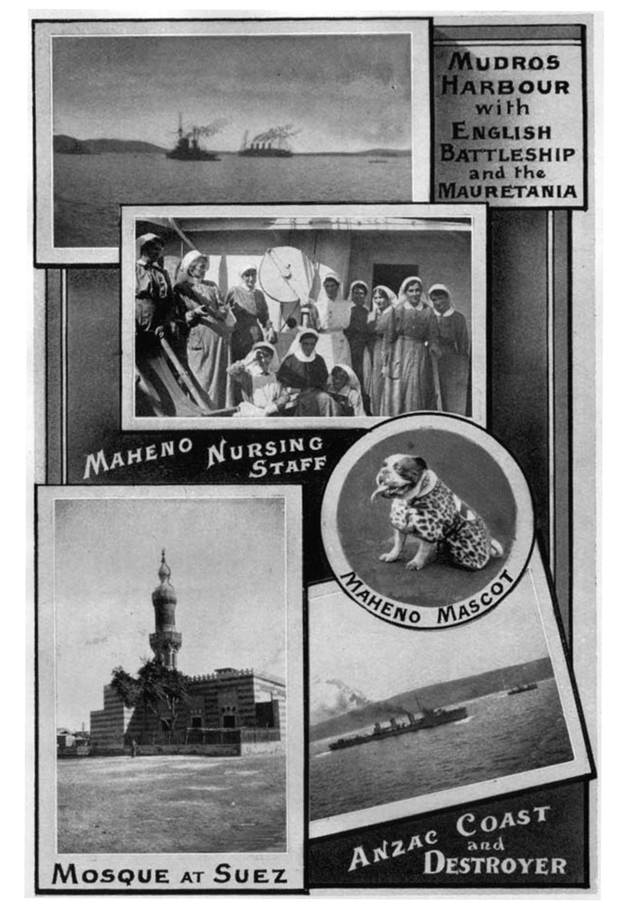
Figure 6.1 Official postcard of the hospital ship Maheno. Depicted are New Zealand nurses on deck in uniform and Jock the bulldog, the ship’s mascot. In Lottie: Gallipoli Nurse, Jock is depicted as a Scottish terrier.
Source: The New Zealand Hospital Ship ’Maheno": First Voyage July 1915, to January 1916. Christchurch, 1916, p. 43.
Interestingly, Jock only receives passing mention in the actual letters of Charlotte Le Gallais. The source in which he is far more prominent is the official diary kept by John Duder, first officer aboard the Maheno and the other main source for Lockyer's book.29 So, in the transposition of archival material to pictorial “faction,” the “fine big bulldog,” which was a close companion of a male ship's officer, became a small Scottie dog, a source of comfort to a pining girl. This change of breed and relationship with the dog is significant when considering the representation of gender to a modern audience and the conflict of the necessity of the portrayal of war with the imperative of dulling the harshness of its realities.
The complexities of any text are deepened when they target a young audience, accompanied as they are by the social expectations that imbue childhood. Texts for children about sacrosanct subjects such as war, death, or national heritage can receive close scrutiny from a (adult) society that fears that the text may interfere in the formation of that child's worldview or, worse, damage his or her “innocence.” And once a text is accepted as child appropriate, regardless of its subject matter, it can attain its own sacrosanct status. Criticism or challenging of such texts is paramount to undermining the memories of childhood that the child is cultivating (or the nostalgia and memories of childhood that adults may have). In many respects, therefore, “acceptable,” and even more so, “notable” texts become untouchable and their representations of the past (even if they are fictional or factional) become a sacred “reality.” Such texts are as much part of the grand narratives on which they are founded as they are cultivators of the myths that underpin them.30 So too the national mythologies of war— details about casualties and battle tactics—are often subject to close scrutiny, while the grand narratives that contain them can be considered so sacred as to be indestructible. In the late twentieth century, this book about a young woman yearning for her brother does far less to disrupt or even question the ANZAC tradition than a picture book about conscription, the treatment of conscientious objectors, deserters, prisoners of war, or the racism faced by the Maori battalion might have. While Lottie is unique in its subject matter, it reinforces rather than questions the preexisting ideas its audience (both children and adults) has.
Despite the promise of Lottie's steadfast gaze on the cover and the centrality of her position as “Gallipoli Nurse” in the title, this picture book concentrates much more on the absent brother, Leddie, than on the experiences of nurses during the First World War. In making Lottie the narrator of her brother's story rather than of her own history and centralizing the search for Leddie instead of the experiences of a group of professional women working under extraordinary circumstances, Lottie: Gallipoli Nurse functions as a part of the canon of ANZAC mythology. It does not tell a new story or invite a refashioning of the legend. In contrast, The Bantam and the Soldier subtly shifts the legend of ANZAC to tell the story of the loneliness of being a soldier in France and infers that the much-touted ideas of “mateship” were not universal. It also portrays combatants in a gentle light rather than one of grand heroism. The Bantam and the Soldier is also significant in that it attends to the continuities in the soldier's life and his return to the farm rather than living on in memory as one of the fallen. The focus on France is also important as it moves away from the centrality of the Gallipoli campaign. While The Bantam and the Soldier moves away from more traditional narrations of the First World War, it has also been the recipient of prestigious awards, perhaps indicating that, certainly in literary circles, it is important that different kinds of stories are considered. Unlike Lottie though, The Bantam and the Soldier does not carry with it the weight of archival connections or present the conflation of fact and fiction. The Bantam and the Soldier really stands alone in its movement away from traditional depictions of ANZAC mythology.
Lockyer's earlier work Harry and the Anzac Poppy also centers on France and has a peripheral view to the suffering of those left at home, but this view is not extended, and the conventional stories associated with New Zealand and the First World War continue.31 Harry, set as it is in 1917 with a married soldier on the Western front in Europe its main protagonist, could have opened up the possibility of discussing complex issues like conscription and particularly the conscription of married men in New Zealand in 1917. Instead, this is merely a device through which to introduce a child. The story is structured around a young boy reading old letters his grandmother received from her father during the war. The introduction of not one but two children's perspectives was perhaps a means of bridging the century's divide between characters and intended audience. It certainly allowed the explanation of certain things like what “shells” were—no, not “egg shells,” but bombs.32 The focus on Harry as the main character rather than on his grandmother reinforces the generational aspects of ANZAC mythology that it is something that can be passed from father to son—the heirs of a masculine combatant tradition.
Where Lottie differs from The Bantam and the Soldier is in its lack of an active voice. Lottie reinforces traditional ideas about women and war— as the ones waiting for things to happen to their men, even if that waiting is not separated from the war zone by geography. This feminine narrative is not one of action or independence but one of sorrow and inactivity. The challenges of nursing in the early twentieth century are sidelined for a more conventional story in which the absence and death of a beloved brother take the spotlight. The complex motivations of a young professional woman receive little attention, and instead, the implication of Lottie is that the eponymous protagonist enlists to be close to her brother.33 This may be a part of a device to gain the sympathy of young readers. It is not uncommon for close sibling relationships to be portrayed in children’s literature, particularly when children or teenagers find themselves without adult protection.34 However, Lockyer overuses this trope considerably. There is only one page in the entire book where a direct mention of hope or fear or sorrow regarding Leddie is absent, and even here, Lottie’s enquiries about Gallipoli infer the search for her brother.35 Leddra is present even in the discussion of nurses dying on a torpedoed ship or of the wonders of Egypt. The combatant who becomes a casualty is omnipresent in a story that is ostensibly about his noncombatant sister. This sidelining of the book’s supposed main character is even more obvious in the afterword, which provides the reader with some cursory background to the Gallipoli campaign but not of the NZANS. Instead of providing some basic statistics on how many women served, Lockyer repeats the casualty statistics pertaining to the soldiers who lost their lives. The nurses who lost their lives are not mentioned, nor is the struggle New Zealand nurses faced to be allowed to serve their country in the first place. Despite the appearance of a different kind of narrative promised by the book’s cover picture and title, they act as little more than a trompe l’oeil for a book reiterating martial masculine endeavor and the primacy of the roar of battle.
In a culture that values the minutiae of military history, another important change in the written text is the author’s conflation of the well-known (in New Zealand) sinking of the Marquette, where ten nurses died, with the fate of another ship that had nothing to do with the NZANS, The Royal George. This confusion may have arisen as a result of Duder mentioning the torpedoing of a ship named The Royal George in his diary entry of 4 August 1915.36 However, the sinking of the Marquette is a reasonably familiar incident to many New Zealanders, partly as a result of the deaths of some of the nurses on board. The Marquette was actually sunk on 23 October, and Charlotte Le Gallais mentions the incident in her letter of 17 November 1915.37 A simple recognition of the dates would have avoided this conflation and confusion. It may, of course, have been a part of the author’s “factionalisation.” However, it highlights some of the real problems in using “faction” to educate children about history. In teaching the First World War to secondary school students aged between 12 and 15 in New Zealand, Lottie is frequently pointed to as a suitable learning resource. The New Zealand social studies curriculum available online through Unitec, for example, has a module called “Gallipoli Webquest,” and Lottie is one of the recommended print resources as are the entirely fictional Harry and the Anzac Poppy and Ken Catran's Letters from the Coffin Trenches.39 Nowhere on the website is there a guide to dealing with the differences between archival material, works written as scholarly history, and works intended as either “faction” or fiction. Lottie’s status as an educational resource surely requires it to represent factual accuracy as much as any other historical work, particularly if student and teacher resources do not problematize the different kinds of materials in use.39
The confusion this book presents has been further complicated by a historian of nursing using Lottie: Gallipoli Nurse as a reliable historical source. Anna Rogers, who has written a very important and, in all other respects, well-researched book on New Zealand army nursing, has been a victim of the “truth effect” of this work of “faction.” Rather than sourcing archival material, she replicates the “factional” by citing Lockyer's incorrect description of the sinking of the Royal George in addition to her discussion of the actual sinking of the Marquette.40 In a culture of war stories where the tiniest details are endlessly discussed and examined by military historians,41 this kind of intertextual blurring between archive and picture book cannot but hinder the attempt to reflect accurately on the diverse experiences of women and war, let alone on Charlotte Le Gallais' real life.42
Where the blurring between fact and fiction is most problematic in Lottie, however, is in its pictorial content. Illustrator Alan Barnett's pictorial text undermines the historical place of women and war in so many ways. While Lottie's concerned and somewhat sorrowful appearance on the book's cover is arresting and the sadness of her story is reinforced through the use of blurred watercolor and a single cross at the base of which poppies grow, throughout the book the images often appear too modern and anachronistic. They certainly work to undermine the story of Le Gallais as a brave and independent woman. Instead, they replicate stereotypes about women and war.43 The close connection to a “real” story and the ready accessibility of images about women, the First World War, and especially Charlotte Le Gallais herself invite questions as to why an illustrator would deviate so much from available historical material. Lottie is portrayed as if she were in her late teens or early twenties, despite her actual age being in her early thirties. This may be an attempt to invite empathy from a young audience. As Peter Jachimiak has pointed out in his analysis of the British comic Charley’s War, constructions of boyhood assist in bridging the generation gap in telling historical tales to a modern teenage audience.44 Relying on tropes of girlhood rather than maturity in the depiction of women does not work in the same way, partly because there is not the same kind of seamlessness built into histories of women's participation in war as there is about boys becoming men through soldiering. The youthful characterization of Lottie also falls into the perpetual trap of portraying women as girls in need of protection and hinders the portrayal of nurses as experienced professionals, and thereby, further marginalizing their importance and contribution.
Throughout the book, the pictures are stylistically late twentieth century and often portray the nurses without giving any indication of the rigid discipline they adhered to. Nurses were only allowed to be out of uniform “after dinner,” and they would certainly not have appeared on deck of the ship during a public occasion without wearing their capes and veils—quite unlike illustrator Alan Barnett's portrayal of the Maheno leaving Wellington where one nurse is standing on deck out of uniform and without a veil.45 Photographs from the time of nurses on the decks of hospital ships still show them in veils and capes (see figure 6.1).46 It would also have been highly unusual for the kind of free and easy mixing between nurses and men, soldiers, and hospital staff alike that is indicated in many of Lottie’s pictures. Nurses were often segregated from soldiers and closely supervised in social situations, like the dances and fancy dress parades that took place on board the Maheno. It is also extremely unlikely that any nurse would have appeared on deck, regardless of the circumstances, with her hair unbound. Regulations pertaining to the professional appearance of nurses were strictly adhered to and helped to maintain the separation of nursing staff from the men.47
The separation of female nurses from male soldiers would have been extremely important for a nation that was reluctant to send its nurses to the battlefronts and was anxious about the virtue and sexual morality of soldiers, nurses, and civilians. The intimacy of the jobs required of nurses rendered their position precarious in terms of what was acceptable for a woman to know, see, and do at the turn of the twentieth century. This did not prevent the idolization of nurses as angels of mercy or their sexualization in the imaginations of men. There is a long history of the sexualization of the nursing profession that continues into the present.48 No studies specific to New Zealand have been conducted, but it is safe to assume that some of the sexual stereotypes of nurses are as much a part of New Zealand attitudes as they are of Australian or British cultures. Katie Holmes, in her discussion of Australian nurses during the First World War, states that these women are separated from the legends of Australian heroism in war because, while they were necessary, they posed a potential sexual distraction and because their presence was a reminder of the fragility of the male body and its helplessness when wounded.49 The imagery of nursing is complicated, drawing as it does on notions of sacrifice and devotion, while the sexual threat these women might pose if their veils were ever removed went largely unspoken but not forgotten in Australian and British traditions.50 The sexualization of nursing as a profession is still present in society, with the “naughty nurse” a staple of pornographic and popular culture.
Barnett taps into the sexualized stereotypes of nursing by depicting Lottie and her colleagues as young and carefree in their dress and interaction with male medical and military personnel. Even if the youthfulness of the nurses is an acceptable device to assist in telling Le Gallais' story to children, the sexualization of these women is more difficult to reconcile. The determination, discipline, and hard work of the NZANS nurses are not replicated in Barnett's representations of them, with flowing locks, whose behavior is far less professional than it is titillating. On one page, Lottie is depicted looking straight at the reader in a most suggestive manner while she stands in a storage room with a doctor who appears to be in a laughing and flirtatious conversation with her.51 The familiarity of the conversation supposedly references the social interaction mentioned in the written text on the adjoining page but more immediately taps into discourses of femininity and loose sexual morality.52 In a similar way, the wholesome fun of devising fancy dress costumes described in Le Gallais' correspondence and referenced by Lockyer is depicted by Barnett in an anachronistic way that has little to do with the descriptions in the written text.53 Instead of doctors “dressed up as nurses” and a nurse using sheets, boxes, and electric torches to depict the Maheno as described by Le Gallais, Barnett has the passengers socializing with painted faces and polished costumes that would look more at home in a book about Studio 54, the famed 1970s New York nightclub. Rather than a “fancy dress parade,” as described in Le Gallais' letters and the official Maheno booklet published in 1916,54 the book pictorially presents what looks like close fraternization at a party—public familiarities that would not only have been frowned upon but are highly unlikely to have occurred.
No doubt Lottie can be read as a “story book” where the basic story can be understood without direct reference to the pictures that accompany the written text.55 However, as Christina Desai points out, “illustrations undoubtedly color readers' reactions to the story. Art and text are inextricably linked to create meaning that could not be communicated in any other way.”56 If the purpose of this book is to inform young people about lives and events a century ago—it can be assumed that this audience has little background knowledge of this history—then surely the illustrations of such an educational text should reflect its subject matter? The pictures should certainly not be treated with the attitude that they are “just pictures” for what is “only” a children's book. This undermines both the respect that the audience of the story deserves and the respect supposed to be owed to the significance of the First World War. A big difficulty for scholars, critics, and writers of texts aimed at young audiences is that while children’s literature is deemed an essential part of the formation of a child’s worldview, it is often, contradictorily, also not treated as “real” literature precisely because it is aimed at children. The impulse to censor the images children are exposed to often competes with the idea that children are not mature enough to grasp the complicated language of images or see the connections between different kinds of representations. It is important not to underestimate the capacity of children to read images and text. If children continue to be exposed to books that depict women in a frivolous and sexualized way, even if they do not understand exactly that this is what has occurred, then the contributions of women will continue to be marginalized in the public imagination.
This is not to say there are no picture books where authors, artists, and illustrators have collaborated and the written and pictorial texts appear to be telling a different story. For example, the subtle signs in Tony Kushner and Maurice Sendak’s recent Brundibar, which, while telling the story of two young children trying to get milk for their sick mother, also allegorizes the experiences of Jewish children at the Theresienstadt concentration camp.57 But in the case of Lottie, it is not unreasonable to expect the “faction” to be closer to the available archival pictorial material and widespread knowledge of images from the period than the “fictional” pictorial representation posited here. Lottie is, after all, presented by the publisher, author, and educational institutions as historical rather than allegorical in both form and function. The lack of care taken with these illustrations detracts from the importance of telling noncombatant stories and the role of the nurses who worked so hard under the most appalling conditions. Whether intentional or not, the work of these women has been trivialized here, just as it was in 1916 when the bulk of their activities were largely absent from the official Maheno souvenir publication.58
Children’s literature about war from the late twentieth and early twenty- first centuries often functions with two aims in mind: a commemorative “lest we forget” function and an education function so that the atrocities of the past may never happen again.59 This is particularly true of Holocaust narratives, but the picture books centering on New Zealand and the First World War operate in similar ways. The phrase “lest we forget” alone is extremely problematic. What is remembered in New Zealand is more often a mythology—what supposedly happened—than a real understanding of a century-old war, its participants, and its legacies. This mythology is extended through memorialization in the classroom with wreaths and poppies on ANZAC Day but with little or no explanation of their symbolism.
It is further heightened by the use of fictional and “factional” texts written and published in the late twentieth and early twenty-first centuries without an appropriate contextual explanation of the kinds of texts that they are and the past they represent. This is a part of the trend that is evident in a school curriculum that teaches the poetry of Wilfred Owen and Siegfried Sassoon as if it was representative of every soldier's experiences. Just as learning the “legend” supplants learning the problems of early twentieth-century history, many of the Great War's participants who were not combatants, even when they were casualties, like the nurses who died on the Marquette, are marginalized. The books aimed at young people in New Zealand are often a part of this pattern of active forgetting. The fragmented stories conveyed in commemorations, school curricula, and, of course, picture books must be more confusing than illuminating to children, who in general have no direct experience of war and for whom this war is beyond living and spoken memory.
The exclusion of women's experiences from war narratives, in general, and ANZAC mythologies, in particular, has been well commented on both in Australia and in New Zealand. On the surface, the publication of Lottie: Gallipoli Nurse represents a step in the right direction in filling some of these lacunae. However, it must be questioned whether this was the intent when it is a soldier who is the real main character of the book and not a nurse at all. The fragmentary, intertexually dependent Lottie: Gallipoli Nurse acquires its meaning from the weight of its archival origins, connections to museum exhibits, and the national mythologies of ANZAC. Without the archival material on display in the museum, Lottie may very well have no contextual anchor at all. If the framework of Charlotte Le Gallais' story is dismantled, the book merely reiterates the cliches and body counts that are a part of ANZAC mythology but not that of a nuanced history of New Zealand at war. The focus on the Gallipoli rather than Nurse part of its title and its conflation of the fictional Lottie with the real Charlotte Le Gallais through word and image only widen the distance between memorializing and understanding the past. If contexts are misunderstood or misaligned and skewed toward soldiers even in the narratives of those who did not, or could not, fight, how can future wars be prevented? How can we prevent the noncombatant children of today from becoming the combatant soldiers of tomorrow if the stories they are presented with replicate rather than interrogate these mythologies? How can the understanding of alternative narratives be fostered when the texts being offered to children contain factual inaccuracies and illustrations that trivialize their subject matter? I fear that the production of such texts form part of the vision blurred through tears that is the public memorialization of a war that is never remembered in its entirety but which refuses to be forgotten.
Notes
* The research for this article was conducted with financial assistance from the New Zealand Federation of Graduate Women, Auckland Branch.
1. John Lockyer and Alan Barnett (illustrator), Lottie: Gallipoli Nurse. Auckland, 1998 (2003).
2. Patricia Stroud, Caesar the Anzac Dog. Auckland, 2003.
3. Jock Phillips, Nicholas Boyack, and E. P. Malone, “Introduction,” in Jock Phillips, Nicholas Boyack, E.P Malone, eds., The Great Adventure: New Zealand Soldiers Describe the First World War. Wellington, 1988, p. 1.
4. For example, Martin Kay, “PM Wants More Prominence Given to Passchendaele,” The Dominion Post. 5 October 2007, http://www.dominion.co.nz/4225960a6479. html. Accessed November 2007.
5. Deborah Montgomerie, “Reconnaissance: Twentieth Century New Zealand War History at Century’s Turn,” New Zealand Journal of History. 37, 1, 2003, p. 62.
6. Ibid., 74.
7. Jennifer Beck and Robyn Belton, The Bantam and the Soldier. Auckland, 1996.
8. John Lockyer, Harry and the Anzac Poppy. Auckland, 1997.
9. Chris Pugsley and John Lockyer, The Anzacs at Gallipoli. Auckland, 1999 (2003).
10. Stroud, Caesar the Anzac Dog; Glyn Harper and Bruce Potter, The Donkey Man. Auckland, 2004.
11. Jennifer Beck and Lindy Fisher, A Present from the Past (Auckland, 2006).
12. For example, the historian Glyn Harper has recently called for more military history to be taught in schools. Glyn Harper, interview by Kerry Woodham, NewsTalkZB, 30 September 2007.
13. The New Zealand Hospital Ship “Maheno”: First Voyage July 1915, to January 1916. Christchurch, 1916, p. 59. Charlotte Le Gallais’ correspondence says she was one of ten staff nurses to sail on the Maheno, but the publication above, published in 1916, lists her name as one of 14. It is possible that four more nurses were added to this contingent between Charlotte sending her letter to Leddra on 7 July 1915 and the ship sailing on 11 July.
14. See Sherayl Kendall and David Corbett, New Zealand Military Nursing: A History of the Royal New Zealand Nursing Corps Boer War to Present Day. Auckland, 1990.
15. Le Gallais Family. Papers. Auckland War Memorial Museum Library. MS 95/11, Folder 1 (AWMM).
16. Lockyer and Barnett, Lottie, p. 32.
17. Ibid. There has been an editorial mistake here further confusing this work of “faction” in the misspelling of Leddra Le Gallais’ name— it should be Leddra not Ledra.
18. The completeness of the Le Gallais family archive is one of the reasons why Charlotte, Leddra, and Owen (but most particularly Charlotte) have such a prominent presence in the Auckland War Memorial Museum exhibit on the First World War. The museum file note says, “The collection will have immediate display use—it will probably form the focus for a segment of the World War I Gallery.” Le Gallais Papers—Justification (Peter Hughes). Le Gallais Family. Papers. AWMM, MS 95/11.
19. Lockyer referred to Lottie as a work of “faction” in a personal communication with me, 30 March 2005.
20. Antoine de Baecque, The Body Politic: The Corporeal Metaphor in Revolutionary France 1770—1800. Stanford, 1997, p. 16.
21. Peter Hughes Jachimiak, “‘Woolly Bears and Toffee Apples’: History, Memory and Masculinity in Charley’s Ward The Lion and the Unicorn. 31, 2007, p. 166.
22. Lockyer and Barnett, Lottie, p. 16.
23. Ibid., p. 9.
24. For example, A. A. Grace wrote in The New Zealand Herald on 1 August 1914: “The average New Zealander... especially the young New Zealander who lives in the country is half a soldier before he is enrolled. He is physically strong, intellectually keen, anxious to be led through being what he is, he will not brook being driven a single inch. Quick to learn his drill, easily adapted to the conditions of life in camp since camping usually is his pastime and very loyal to his leaders when those leaders know their job.” Cited by Christopher Pugsley, On the Fringe of Hell: New Zealanders and Military Discipline in the First World War. Auckland, 1991, p. 9.
25. For Canadian and Australian examples, see Linda Cranfield and Janet Wilson (illustrator), In Flanders Fields: The Story of the Poem by John McRae. Toronto, 1996; Norman Jorgensen and Brian Harrison Lever, In Flanders Fields. Vancouver, 2003. Also, Kate Agnew and Geoff Fox, Children at War: From the First World War to the Gulf. London and New York, 2001.
26. For example, Michael Morpurgo, War Horse. Kingswood, 1982; Carol Fox, “What the Children’s Literature of War is Telling Children,” Reading. November 1999, pp. 128-129.
27. There is a long tradition of representing women who find themselves in unconventional situations as exceptional or different from other women, and this is present in media depictions, historical writing, and popular culture. See Sara Buttsworth, Body Count: Gender and Soldier Identity in Australia and the United States. Saarbrücken, Germany, 2007, especially chap. 5. Also see, Linda Grant De Pauw, Battle Cries and Lullabies: Women in War from Prehistory to the Present. Oklahoma, 1988. Feminist scholars have also commented on the lack of depiction of collective action, identity, or agency in discussions about women: Moira Gatens, “Corporeal Representation in/and the Body Politic,” in K. Conboy, N. Medina, S. Stanbury, eds., Writing on the Body: Female Embodiment and Feminist Theory. New York, 1997, pp. 80-89.
28. Angela McRobbie, “Notes on Postfeminism and Popular Culture: Bridget Jones and the New Gender Regime,” in Anita Harris, ed., All About the Girl: Culture, Power and Identity. London and New York, 2004, pp. 3-14.
29. Papers of John Duder, AWMM, MS 1160.
30. See, for example, Elizabeth Bell, Lynda Haas, and Laura Sells, eds., From Mouse to Mermaid: The Politics of Film, Gender and Culture. Bloomington and Indianapolis, 1995, pp. 4—6. David Rosen and Ismee Tames both discuss the problems of the construction of “childhood innocence” in their chapters in this volume.
31. The conflation of ANZAC, which primarily evokes an association with Gallipoli, and the poppy, which is associated with the battles in France, are interesting but not out of step with the ways in which the First World War is memorialized in New Zealand. Artificial red poppies are sold in New Zealand on ANZAC Day, whereas in Britain and Australia they are sold on “Poppy Day” (Armistice Day) on 11 November.
32. Lockyer, Harry and the Anzac Poppy, p. 12.
33. Julie Wheelwright, Amazons and Military Maids. London and San Francisco, 1994; De Pauw, Battle Cries and Lullabies.
34. With regard to young adult literature and the Second World War, see Ian Seraillier, The Silver Sword. London, 1956; Judith Kerr, When Hitler Stole Pink Rabbit. London, 1971.
35. Lockyer and Barnett, Lottie, p. 13.
36. Duder, Diary entry, 4 August 1915.
37. Charlotte Le Gallais, letter, 17 November 1915.
38. New Zealand Ministry of Education and Unitec, Gallipoli Webquest, Social Studies online. http://socialstudies.unitecnology.ac.nz/gallipoli_webquest/index. htm. Accessed November 2007; K. Catran, Letters from the Coffin Trenches. Auckland, 2002.
39. Anna Rogers, While You're Away: New Zealand Nurses at War 1899—1948. Auckland, 2003, pp. 77, 82.
40. Rogers discusses the sinking of the Marquette in chapter 6 of her book. She then cites the Royal George sinking as described by Lockyer in a later chapter (Rogers, While You’re Away, p. 166).
41. For a recent example of this, see Gary Sheffield, “Britain and the Empire at War 1914—1918: Reflections on a Forgotten Victory,” in John Crawford and Ian McGibbon, eds., New Zealand’s Great War: New Zealand, the Allies and the First World War. Auckland, 2006, pp. 30—68.
42. Christina Twomey, “Australian Nurse POWs: Gender, War and Captivity,” Australian Historical Studies. 124, 2004, pp. 255—274.
43. The anachronisms and inaccuracies do not only apply to the nurses. On page 22 in a picture, of what I assume is a nurse about to take a tourist ride on a camel near the pyramids, is someone swinging a golf club. While I cannot say with complete certainty that people did not play golf in the desert in 1915, this seems extremely incongruous, as does the depiction of the woman I assume to be a nurse wearing blue rather than a uniform. And it adds nothing to the telling of the story of Charlotte Le Gallais.
44. Jachimiak, “Woolly Bears and Toffee Apples,” p. 169.
45. Lockyer and Barnett, Lottie, p. 4.
46. Kendall and Corbett, New Zealand Military Nursing, p. 60.
47. Ibid., chap. 6.
48. Terry Ferns and Irena Chojnacka, “Angels and Swingers, Matrons and Sinners: Nursing Stereotypes,” British Journal of Nursing. 14, 2005, pp. 1028—1033.
49. Katie Holmes, “Day Mothers and Night Sisters: World War I Nurses and Sexuality,” in Joy Damousi, Marilyn Lake, eds., Gender and War: Australians at War in the Twentieth Century. Cambridge, 1995, pp. 43—59.
50. For a discussion of this in English literature, see Catherine Judd, Bedside Seductions: Nursing and the Victorian Imagination 1830—1880. New York, 1998.
51. Lockyer and Barnett, Lottie, p. 7.
52. Lockyer’s depiction of Lottie writing in a diary, rather than writing to a fiance, may have indirectly assisted in the portrayal of a chaste and dedicated young woman. This is, however, undermined by Barnett’s pictorial textualizations of Lottie and her fellow nurses.
53. Ibid., pp. 10-11.
54. The New Zealand Hospital Ship, p. 14.
55. Christina M. Desai, “Weaving Words and Pictures: Allen Say and the Art of Illustration,” The Lion and the Unicorn. 28, 2004, p. 408.
56. Ibid., p. 408.
57. Tony Kushner and Maurice Sendak (illustrator), Brundibar. New York, 2003.
58. The New Zealand Hospital Ship, pp. 22-25 has a detailed discussion of the supervision of wards on the ship and the nurses are not mentioned once.
59. Kate Agnew and Geoff Fox, Children at War: From the First World War to the Gulf. London and New York, 2001, especially p. 138.