Cold War/Hot Peace
The greatest and most fortunate of many ironies in the history of peace between 1945 and 1989 is that the two superpowers involved not once entered into armed conflict with one another directly in fear of nuclear war.
Deterrence, as we have seen, is the oldest and crudest means of avoiding war, yet there seemed to be no other choice as modern societies became “aware that the ‘old’ problem of survival reappears as the imperatives of peace.”1 The US, a major power since the century’s start, reemerged as one after the Second World War by reinforcing its position as the world’s largest economy and introducing the world to atomic bombs. The USSR, a relatively weakened power at the turn of century and US ally during the Second World War, reversed both positions at the start of the Cold War between them by its politico-economic prowess and becoming the world’s second nuclear nation a few years after the first. US imperatives were based in the peace traditions of liberal capitalism, those of the USSR in socialist traditions, and both developed nuclear arsenals to back them in a balance of power that brought the world to the brink of annihilation. This dichotomy was antithetical to yet formative of renewed multi-pronged approaches to world peace pioneered by the League of Nations in new conditions by new participants, contrasted below.The term “hot peace” has recently been used to describe the resurgence of using military force to end armed conflicts after the Cold War.2 As used in here, however, the term refers to individual, social and collective efforts to prevent the Cold War from becoming hot or, in other words, to avoid a nuclear World War Three, which in fact they did. But how did they? Economic diplomacy was perhaps the primary non-military way for each superpower to attract and retain states into its sphere of influence without giving the other a reason for war.
The US Marshall Plan, extending the lend-lease policy of supplying Allies in the Second World War, provided billions of dollars to rebuild Western Europe and stop Soviet advances there. The USSR established a Council for Mutual Economic Assistance (COMECON) to do likewise in Eastern Europe. An early climax of conflicting Cold War economic diplomacies came in 1948, when the USSR blockaded western parts of Berlin; the US airlifted supplies until the blockade was lifted a year later. By the 1950s President Truman’s Point Four Program provided know-how, funds and equipment to developing nations worldwide (i.e., so they could develop into aligned countries), forming the grounds of the later US Peace Corps; the COMECON began doing the same. Containment policies for keeping external status quos intact and internal ones inviolable were embodied in the Berlin Wall, built by the USSR in 1961 to stem East-to-West migrations. Yet without the military organizations and technologies to support them it is doubtful the superpowers would have agreed to disagree.Also originating with the Cold War were the North Atlantic Treaty Organization (NATO) and the Warsaw Pact Organization (WPO). As collective defense alliances based on coordinated armed forces, they politically formed decisive and divisive blocs in the UN, and militarily maintained the balance of power that ultimately checked the superpowers. NATO was created in 1949 by Western European and North American countries to counter threats of Soviet expansion in Europe. In 1955, the USSR and its Eastern European allies created the WPO to counter NATO on similar principles. In accordance with the Truman Doctrine of limiting communism’s spread, with force if necessary, NATO considered an attack on one member as an attack against all, as did the WPO. No such attack ever occurred, no armed operation against the other took place, and their drills pushed rather than crossed the precipice. However, unlike NATO, WPO forces were put into action twice in accordance with Premier Brezhnev’s Doctrine of keeping Soviet satellite states lockstep with the USSR, with force if necessary.
The first was to suppress the Hungarian Revolution (1956), instigated by the USSR’s refusal to allow withdrawal from the WPO, turning peaceful protests violent. The second was to suppress Czechoslovakia’s liberalization movement (1968). In this case, widespread non-violent resistance to and non-cooperation with WPO forces led to withdrawal, though repressive measures followed. In each case, some WPO members refused to supply troops and Soviet troops were the majority, indicating an effective high-level opposition which NATO members never showed. Ironically, NATO and WPO troops worked together in several UN peacekeeping missions. The WPO was disbanded after the USSR’s collapse and its members have since joined NATO, still struggling to redefine its purpose.As economic diplomacies were backed by these military organizations, the latter were backed by the arms races upon which their success was predicated. Nuclear deterrence, the most costly and potentially deadly war strategy ever practiced, paradoxically was also among the most effective peace strategies ever implemented. As soon as Soviets developed nuclear weapons (1949), they reciprocated the US policy of “massive retaliation” should they attack anywhere outside their sphere. Vacant notions of “first strike” and “second strike” capabilities came into vogue by the 1960s when US Secretary of State Robert McNamara put forth the theory of and put into practice Mutually Assured Destruction (MAD) in a nuclear war scenario, by which each superpower continued to increase first-strike destructive capabilities so as to make a second strike by the other impossible. Based on the premise of an interminable nuclear proliferation, the deterrent in these strategies was their elimination of the possibility of winning a nuclear war for either side because the only possible outcome could be total annihilation. Nuclear deterrence blurred the line between war and peace strategies at great costs but priceless benefits. MADness can be discerned in the development of missiles called “Peacekeepers” capable of carrying a dozen warheads multiple times stronger than the original atomic bomb.
Sanity can be discerned in a small group of scientists who, while MADness was in the making, countered that eliminating not multiplying nuclear weapons is the only way to assure peace. In so doing, they propelled later worldwide anti-nuclear movements, turning them and themselves into peacemakers.Albert Einstein and Leo Szilard, whose work on particle physics made nuclear weapons feasible, founded the Emergency Committee of Atomic Scientists shortly after the first ones were deployed. Its eight members publicized the total annihilation made possible by nuclear war, drew attention to peaceful purposes for which atomic energy could be used, and promoted world peace as the only guarantee that nuclear weapons are never be deployed again in lectures, radio talks, and popular and academic publications. In four years of existence, the Committee effectively got anti-nuclear movements rolling. In 1955, two anti-nuclear statements were signed by prominent scientists and intellectuals. One was a Manifesto penned by Russell and seconded by Einstein days before he died, in which they and nine other renowned academicians affirmed that because of the advent of nuclear weapons, and to prevent the need for keeping hot peace cold,
We have to learn to think in a new way. We have to learn to ask ourselves, not what steps can be taken to give military victory to whatever group we prefer, for there no longer are such steps; the question we have to ask ourselves is: what steps can be taken to prevent a military contest of which the issue must be disastrous to all parties?3
Recognizing that doing so “will demand distasteful limitations of national sovereignty,” they called on governments to publicly renounce violence and legally commit themselves to peaceful conflict resolution methods, highlighting the role scientists could play. The Manifesto called for a conference of scientists crossing Cold War lines, first held in 1957 at its sponsor’s hometown of Pugwash in eastern Canada.
The ongoing Pugwash Conferences on Science and World Affairs have informed several UN nuclear-related treaties, have over forty global branches and received the Nobel Peace Prize fifty years after the first deployment of atomic bombs.Days after the Manifesto, fifty-two renowned scientists met in Mainau, Germany, to sign a Declaration highlighting long-lasting repercussive dangers of nuclear weapons even aside from their destructivity. Acknowledging “perhaps peace is being preserved precisely by the fear of these weapons,” they asserted that “all nations must come to the decision to renounce force as a final resort. If they are not prepared to do this, they will cease to exist.”4 The Declaration, widely covered in newspapers and on television worldwide, was a sharp nail in the coffin of nuclear hazard disbelievers. An American chemist, Committee member and signatory of the Manifesto as well as the Declaration, Linus Pauling, went on to publish No More War! (1957), in which he described in detail what the Declaration only hinted at, to show that “it is the development of great nuclear weapons that requires that war be given up, for all time. The forces that can destroy the world must not be used.”5 The popularity of the book and the subsequent petition circulated by Pauling, signed by 2000 American scientists, led to the first resolution in the US Congress to halt nuclear testing. Pauling’s petition then circulated internationally and, with over 9000 signatures, was presented to the UN in 1958. The scientist-as-peacemaker approach has been adopted by other professional groups, from teachers to lawyers, who use their expertise and influence as weapons against the wars and injustices that make peace impossible.
MADness may have prevented, and scientist sanity steered public opinion against, direct attacks between the two superpowers, but did not prevent “proxy” wars within and between their potential or actual satellite states. The Greek Civil War (1946-49), acid test of this new take on an old kind of conflict, was like others ideologically supported by the visions of world peace the superpowers had to offer: the US, global capitalism based on independent democratic states; the USSR, global communism based on centrally coordinated socialist states.
Within proxy states, economic diplomacy and military aid made a bigger difference than ideologies of world peace, though without openly adhering to one neither would have been received. While these ideologies became stale rhetorics of peace and were often sufficient within the superpowers to start proxy wars, they just as often proved insufficient in sustaining them. As costs in lives and resources increased, public support decreased. In the US, for which data is available, 20 percent of people asked in a poll disagreed with the Korean War (1950-53) when it started. When Dwight Eisenhower won the Presidency on a “peace ticket” in 1953, disagreement was up to nearly 40 percent. After negotiations broke down, he threatened nuclear war, and an armistice lasting to this day, but not officially peace, was reached. Public opinion polls not only reflected the civilian disagreement with the war, but also helped change politicians’ proxy war into peace policies. A periodic poll started in 1965 shows that 24 percent of respondents believed that sending troops into the Vietnam was a mistake and 64 percent did not. By 1973, when the Paris Peace Accord ending US involvement was signed, these figures had nearly reversed.6 What MADness and sanity did help do, however, was to prevent hot proxy wars from escalating into direct cold war.A considerable force in shifting US public opinion was that peace became part of its popular culture and thereby disseminated around the world, which it arguably never had before. In 1965, a consortium of antiwar and pro-peace groups issued a “Declaration of Conscience against the War in Vietnam” signed by 6000 people, in protest at the proxy wars for hot peace, part of which reads:
We hereby declare our conscientious refusal to cooperate with the U. S. government in the prosecution of the war in Vietnam... We shall encourage the development of other nonviolent acts, including acts which involve civil disobedience, in order to stop the flow of American soldiers and munitions to Vietnam.7
Boxing champion Muhammad Ali became a conscientious objector on Islamic grounds, for which he lost his title and was banned from the sport for three years. Draft-dodging by leaving the country, declaring an inability to serve or objecting soon reached epidemic proportions. After testifying in Congress, a group of former soldiers returned the war medals they had received and formed Vietnam Veterans Against the War. But it was students who transformed relatively marginal anti-war, pro-peace activism into a nationwide movement, remaking universities into the peace hubs they were in Europe centuries before.
At the University of California, Berkeley, students burned their draft cards, and others across the country began doing the same. Professors and students at the University of Michigan, Ann Arbor, held teach-ins to debate the war and what to do about it, a mixed model combining education and protest that also spread quickly. Within a year after many relatively small campus demonstrations, the first of several large anti-war marches took place in Washington, inspiring similar events around the country and world, including Rome, Paris and London. The largest of these occurred in Washington in 1967, where over 100,000 demonstrators marched from the Lincoln Memorial to the Pentagon, novelized by Norman Mailer in The Armies of the Night. The term “flower power” came into vogue after these protesters shot petal canons on the Pentagon. The New York Review of Books published linguist Noam Chomsky’s “The Responsibility of Intellectuals,” in which he critiqued their complacency, shooting him to the forefront of the anti-war movement along with historian Howard Zinn, whose Vietnam: The Logic of Withdrawal was a rallying cry. In the course of their collaborative and separate careers as academics as well as peace and social justice activists, Chomsky and Zinn have distinguished between non-violent resistance aimed at stopping violent policies or regimes, and peace-oriented dissent aimed at exposing them as such, having admirably practiced both.
In the late 1960s and early 1970s, many mass protests were held near the Haight Ashbury neighborhood in San Francisco, which became a center of the “hippie” youth movement, today’s “baby boomers.” Combining anti-war protests with displays of free love (sex without marriage), drug use, drinking and music (mostly folk, rock and jazz), they confirmed that the cause of peace is part of America’s purpose, chanting the well-known slogans “make love not war,” “draft beer not boys,” and “fighting for peace is like fucking for virginity.” Bob Dylan’s “Blowin’ in the Wind” (1963), John Lennon’s “Give Peace a Chance” (1969) and “Imagine” (1971), Black Sabbath’s “War Pigs” (1970), and Cat Stevens’ “Peace Train” (1971) became peace anthems. At concerts and while marching, hippies often held up their middle finger and index in a “V,” the sign for Allied victory in the Second World War and now one of peace worldwide. However, hippies’ radical stances and demonstrations on several issues at once tended to dilute their anti-war and pro-peace messages and alienate those who did not share their other views. Generations since have yet to make such a concerted call to action, maybe because they have seen their parents back-step, maybe because their governments have stopped giving reasons for hope.
After the end of the Korean War and before Vietnam, the superpowers entered into what is known as a detente, from the French for “relaxation,” of Cold War political tensions. USSR Premier Nikita Khrushchev and US President John F. Kennedy improved relations, encouraged disarmament and promoted peace initiatives, turning the ongoing arms race into a short race for peace. In 1959, Khrushchev gave a speech at the UN suggesting peace through disarmament, and the next day a Declaration of the Soviet Government on General and Complete Disarmament was filed, which opened the way to an agreement on the use and testing of nuclear weapons in Antarctica. A Disarmament Administration was created within the US Department of State and, with its Soviet counterpart, presented a Joint Statement of Agreed Principles for Disarmament Negotiations, in which they agreed to “multilateral negotiations on disarmament and to call upon other States to cooperate in reaching early agreement on general and complete disarmament in a peaceful world.”8 Kennedy then gave a speech at the UN in which he famously pronounced “Mankind must put an end to war - or war will put an end to mankind.”9 On his suggestion, negotiations resulting in the Treaty Banning Nuclear Weapon Tests began, broken by both sides within years of it taking effect. In 1962, the USSR put forth a plan for UN consideration calling for complete disarmament, and a month later the US presented a rival plan. Close to reaching a final agreement, negotiations were derailed by the Cuban Missile Crisis, ending the detente and halting concerted political efforts towards disarmament.
During these races for and against war, a “space race” was taking place with implications for the history of peace literally beyond this world. The USSR wowed the world with Sputnik, the first earth-orbiting satellite, in 1957. Stunned, the US revamped its space exploration program, and the next year launched the satellite Explorer. When the Soviets sent the first human into orbit (1961), the US pledged to send one to the moon by the decade’s end. Several dozen satellites and moon probes later, the Outer Space Treaty (1967) was signed by the US, USSR and other states, prohibiting all weapons in Earth’s orbit, their installation on the moon, any other celestial body and in outer space while exclusively limiting the use of outer space for peaceful purposes. In this light, Neil Armstrong’s statement as he became the first human to walk on the moon takes on new meaning: “One small step for a man, one giant leap for mankind.”10 Humanity thus established extraterrestrial peace before peace on earth, although it did not last long. Inextricable from the military enterprises of both superpowers, notably in espionage and long-range missiles, competitive space exploration was also a peaceful alternative to the arms race with powerful propaganda value. When tactical nuclear weapons and interception capabilities emerged in the 1970s, the deterrence equation changed. “Acceptable losses” and nuclear weapons falling into the hands of “rogues states” became concerns, inciting President Ronald Reagan’s Strategic Defense Initiative (1983) from space, popularly known as Star Wars. New initiatives for extraterrestrial peace such as the International Space Station have since emerged, but the Orwellian motto of the US Strategic Air Command remained “Peace is Our Profession.”
Exposing the limits of this professionalized peace, extolling peace as a way of life and its absence as the way to death, were activists who extended and refined organized peace movement strategies and Gandhian Satyagraha tactics, combining them with Pugwash urgency. Towards the end of his presidency, Eisenhower stated that
the people in the long run are going to do more to promote peace than our government. Indeed, I think that people want peace so much that one of these days government better get out of the way and let them have it.11
Anti-nuclear movements since the end of the Second World War make his point clear by pointing to the plain but powerful principle that only by efforts of individuals and groups can peace and the world with it be passed on to future generations because in the atomic age without peace there can be no world and without a world there can be no peace. Ironically, then, the logic that led to the use of atomic weapons to secure victory and peace in the Second World War was the same used to safeguard the world and peace from atomic weapons. With the proliferation of nuclear capabilities, for the first time since the origin of our species, survival of the peaceful applied equally to individuals and groups as to humanity as a whole. Actualizations of this bio-genetic and cultural imperative could not have been accomplished without deterrence and detente, but they would not have taken the forms that they did without two concurrent types of anti-nuclear movements.
One was non-violent direct action, which like the other is explicable by way of examples. In the 1950s Dorothy Day and the Catholic Workers in New York refused to participate in civil defense drills aimed at preparing citizens for nuclear war, which by the logistical impossibility of the task may have simply served to inflame fear. They were popularly demonized for their civil disobedience, but in so being ignited anti-nuclear activists already incited by the scientists-as-peacemakers’ informational campaigns. The next year, a pioneering anti-nuclear group as much about individual consciences as collective consciousness was formed by longtime peace activist A. J. Muste, a former Navy Commander turned Quaker named Albert Bigelow and others. Their Committee for Non-Violent Action (CNVA) established the basic patterns of peace activism still in place today, holding non-stop protest vigils and being purposefully arrested for trespassing or obstructing traffic by sit-ins at nuclear-related government facilities across the US. In the 1960s, the CNVA organized two cross-continental Walks for Peace, bringing the issue of nuclear arms reduction door-to-door. A CNVA activist and University of Chicago student founded the Student Peace Union, which became one of the largest groups of its kind. Bigelow’s publicity-stunt sea voyage into a nuclear test site in the Pacific inspired another group in to carry out similar stunts, which became Greenpeace, today the largest environmental activist group in the world, and its campaigns later successfully pressured the superpowers to withdraw atomic weapons from their surface ships. Always the nonconformist, Russell started a non-violent direct action group called the Committee of 100, which with their thousands of supporters held disruptive demonstrations at the War Office in London for which many were arrested, ironically, for breaching the peace. The value of non-violent direct action when the forces against which it is immediately addressed are exponentially greater lies more in making a point than making a difference. However, when non-violent direct actions reach critical mass, the point becomes the difference.
Other anti-nuclear activists focused their efforts on nuclear power, as did farmers in West Germany who prostrated before bulldozers to prevent the construction of a nuclear power plant, only to be water-cannoned away by police, but returning with larger numbers secured a judicial ruling against its construction. Similar peaceful obstructions occurred at the construction sites of nuclear power plants in the US. More than a thousand members of the Clamshell Alliance were imprisoned for so protesting in the 1970s, using their captivity to network and train members in new non-violent direct action techniques, such as working in small, autonomous, consensus-based affinity groups to respond to confrontations with authorities, reducing risks of mass violence breaking out. Two plants were proscribed by state legislatures when Clams attracted national media attention. The anti-nuclear power Abalone Alliance put forth a Nonviolence Code adopted by many non-violent direct action groups, prescribing openness and friendliness, abstention from physical and verbal violence, respect for property, abstinence from intoxicants while on duty, and a commitment not to flee nor carry weapons of any kind.12 Christianity also resurged as a focal point for anti-nuclear activity as one US bishop convinced workers at a weapons assembly plant to quit on moral grounds, and another refused to pay half of his income taxes on the grounds that they were being used for war purposes, prompting many others to do the same. Direct action of questionable non-violence broke new grounds in the 1980s, when eight people broke into a Pennsylvania warhead facility, damaged specimens and poured blood over documents. A movie they inspired in turn led to similar plowshare action around the world, so-named after a sharp steel wedge used to cut loose top layers of soil. Their destruction of property and dubious intents were condemned by many peace activists, but none of the hundreds of ploughshare actions that have since been taken have been against individuals as they thereby lose their meaning.
The second type of anti-nuclear movement was mass action, the value of which lies in its awareness-raising mobilization and the political influence such mobilization makes for. In 1957, the National Committee for a Sane Nuclear Policy (SANE) was formed by distinguished civil rights, peace and health activists. SANE’s provocative anti-nuclear newspaper ads also increased its membership to 25,000 in a year. When a famous talk-show host formed a Hollywood chapter in 1960, celebrities as big as Marilyn Monroe flocked to SANE, the same year it began holding huge anti-nuclear rallies. In a matter of months, Eisenhower offered to stop nuclear testing if the USSR agreed to do the same, and did. An international SANE petition signed by philosophers and artists urged Kennedy to extend the moratorium, which he did. SANE lobbied in its Voter’s Peace Pledge Campaign (1966) by sponsoring candidates who committed to peace and with its support the US War Powers Resolution and Act (1973) was passed, limiting presidential war powers without Congress’ explicit support. In 1961, a SANE member formed a parallel group also aimed at empowering women, which decided that a single-day strike by women would be a practical way to start, set for November 1. Their slogan, “End the Arms Race, Not the Human Race,” soon gained national media attention, along with what has been referred to as their maternity-based appeal, calling on women to assure not only their children’s immediate safety, but also that they have a future to be safe in. An estimated 50,000 women participated in the worldwide Women’s Strike for Peace. Thereafter, the Un-American Activities Committee, a federal anti-communist body, called Strike leaders in for questioning, sardonically represented by a cartoonist asking whether they were un-American for being women or peace activists. The Clearing House on the Economics of Disarmament was established by them in 1963, which published seminal research. That year, the UN thanked the Strike for the pivotal role it played in the run-up to the Partial Test Ban Treaty. What SANE and the Strike show is that mass action moves the public, policies and before them its participants in the direction of peace.
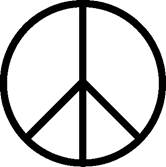
By this time, the British Campaign for Nuclear Disarmament (CND) had been staging mass action anti-nuclear demonstrations across England for years. The globally recognizable symbol of peace (see the following page) was designed for the CND to use in a protest march against nuclear weapons research. The symbol superimposes the semaphores of “N” and “D,” for Nuclear Disarmament: “N” is formed by holding two flags in an upside-down “V” and “D” by holding one flag pointed straight up and the other straight down. After the CND became a general anti-war advocacy group, as it is today, the European Nuclear Disarmament (END) led by E. P. Thompson held yearly international conventions on the topic. “We must protest if we are to survive,” he wrote, “Protest is the only realistic form of civil defense.”13 END ended with the Intermediate-Range Nuclear Forces Treaty (1987) between the
US and USSR that removed missiles from the region. Back in the US, the Nuclear Weapons Freeze Campaign was initiated in 1980 by Randall Forsberg, who received her PhD in defense policy from MIT then worked at the Stockholm International Peace Research Institute, the same year she started the Institute for Defense and Disarmament Studies in Cambridge, Massachusetts. The Freeze sought to achieve nuclear arms reductions by ballot initiatives through a network of affiliated grassroots groups, prompting local and states legislatures to pass Freeze resolutions. In 1986, SANE merged with the Freeze, which became Peace Action in 1993, with a much broader mandate and now over 100,000 members worldwide.
A successful synergy of non-violent direct and mass action came in West Germany. Anti-nuclear and environmental activists, united by the belief that a healthy peace is dependent on a healthy world, joined forces to form the world’s first Green Party, which gained nearly ten percent of the national vote in 1983 even while carrying non-cooperation campaigns against the government. One of its founders, Petra Kelly, put the Party’s mixed methods in this way:
When we talk of nonviolent opposition, we do not mean opposition to parliamentary democracy. We mean opposition from within parliamentary democracy. Nonviolent opposition in no way diminishes or undermines representative democracy, in fact it strengthens and stabilizes it. It is expressed in all kinds of local groups operating outside parliament, in work councils, and other self-governing bodies. Nonviolent opposition is one way, among others, of forming political opinion within that infrastructure. 14
As Kelly indicates, the German Green Party’s mass action sought to simultaneously change public policy and opinion from both inside and outside government, whereas SANE, the Strike, the CND, END and the Freeze sought to do the same solely from outside. Nonetheless, faced with the Freeze’s mass action, Reagan proposed a Strategic Arms Reduction Treaty (START), a two-phased deal between the US and USSR to reciprocally reduce warhead counts. START’s final implementation resulted in the removal of 80 percent of nuclear weapons in existence as of 2001. That these anti-nuclear movements took place in only one of the two superpowers’ sphere is neither purposeful nor without coincidence, but serves as a sign of the leeway they had compared to people in the other. While it is beyond the scope of this book to compare the actualities of peace within the superpowers and their spheres with their own peace ideals, it is within its range to suggest that in neither did the actualities match the ideals to different degrees.
Just as these anti-nuclear movements attest to how bottom-up approaches to bridging the gap between actualities and ideals could be effective, Mikhail Gorbachev’s career (b. 1931) attests to how top-down approaches can be likewise, and maybe even more so. After studying law at Moscow State University, he steadily rose in the Communist Party administration, holding posts ranging from Secretary of Agriculture to Youth Affairs. By the 1970s, he was an integral part of the powerful Communist Party Politburo and was selected by superiors as head delegate on diplomatic missions in the early 80s. Upon the death of his predecessor, for whom Gorbachev acted as Politburo liaison, he became the Premier of the USSR in 1985. He immediately began implementing reforms under the glasnost (“opening”) program, making government operations more transparent and lessening restrictions on civil liberties such freedoms of speech and press. He also announced an end to the arms race that had debilitated the Soviet economy and the abolition of nuclear weapons altogether. To this end, he met with Reagan in Geneva in 1985, pointedly asking why new nuclear weapons were being built when old ones never deployed. They met again in Iceland a year later and, for the first time in the Cold War, superpower leaders openly discussed disarmament together. Perhaps the Chernobyl nuclear power plant disaster a few months earlier reminded them of what was at stake.
In 1987, Gorbachev published Perestroika (“restructuring”), referring to Soviet domestic and foreign affairs. In theoretical terms, he explained: “We want peaceful competition between different social systems to develop unimpeded, to encourage mutually advantageous cooperation rather than confrontation and an arms race.”15 He proposed creating societies that are more peaceful, productive and integrated, not dogmatically based on one ideology, but by combining principles with proven results regardless of origin. Practicing Perestroika, he decreased military spending to revitalize the now-more decentralized economy, freed political prisoners, removed press restrictions, and met again with Reagan to discuss disarmament. Perestroika was admired abroad, but domestic opponents feared the reforms as too rapid or slow. In 1988, he announced that Soviet troops in Afghanistan, fighting there for a decade in a failed attempt to occupy, would be withdrawn. Speaking at the UN at that year’s end, he announced further overall reductions in the USSR’s standing army, particularly those stationed in Eastern Europe. Peaceful protests against repression in Hungary went undisrupted and led to multi-party elections. The ban on Poland’s Solidarity Party was lifted and its leader, Lech Walesa (Nobel Peace Prize, 1984, for keeping worker strikes against Soviet interference non-violent), became President. Gorbachev said that he would not block further reforms; other Eastern European and Central Asian countries followed suit. Revolutionary violence occurred, but as an exception not the rule. The dramatic destruction of the Berlin Wall in 1989, which for many worldwide symbolized the Cold War, signaled the beginning of its end. But the superpower dichotomy that changed what peace meant by changing how it could be made and maintained had always competed with another paradigm it also framed that, after the end of the Cold War and its hot peace, remains.