Conclusion
Our models were created to analyze past socio-economic processes, determine possible crisis factors and understand ecological and cultural changes in Central Europe in late Iron Age.
The immediate or gradual impact of the success rate in the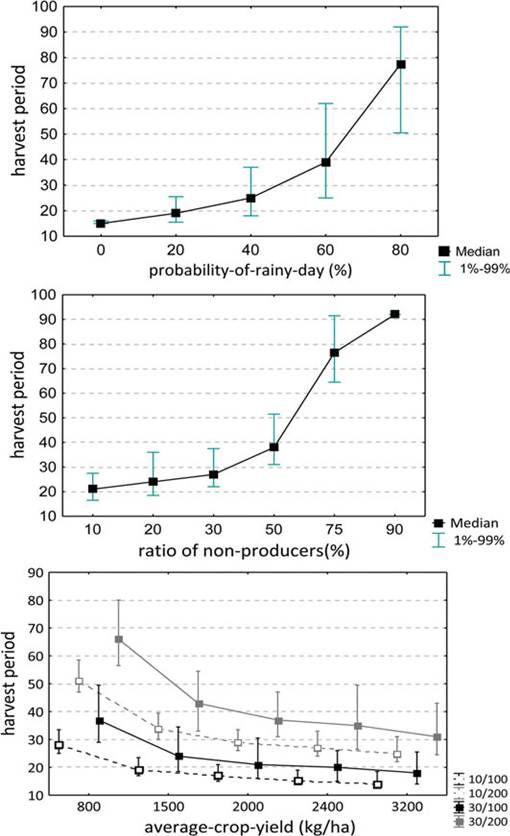
Fig. 12.7 Impact of bad weather, ratio of non-producers and average crop yield on the duration of the harvest process in days
food production and its potential influences on the economic and social processes were also addressed.
Results achieved can be discussed in the light of the framework of available data: according to the archaeological record, the settlement density in the late Iron Age in Central Europe increased over some time and then decreased again rapidly.
The population dynamics model provides realistic time series of energetic requirements, workforce availability and age distributions of population of the oppidum's agglomeration. The modelling results showed different outcomes of the economic strategies performed by either growing or declining population.
The limits of the land-use strategies returned from the baseline scenario, when the population was expected to react by adjusting their economic strategies, started acting around the population density being around 3000 especially due to the depletion of available hinterland area (i.e. available field, forest and pasture plots) within the predicted catchment.
However, according to the archaeological record the population started decreasing after 70-80 years (sudden decline, gradual decline and epidemic scenarios). With such a demographic profile, the oppidum's community could in fact practice all land-use strategies without any substantial problems apart from those imposed by natural harvest fluctuations due to weather, accidents (fire, deceasing of the livestock), and other socio-economic (raids, theft) factors.
In our models it has been proven by experiments that not all of the oppidum population had to be engaged in the agricultural work. There is an archaeological evidence of elite members, which, expectably, were not involved in the agricultural production. Increasing and/or decreasing amount of free time represents in fact the level of society's complexity and its changes reflect decline of this complexity connected to the loss of the production potential. The labor shortage may also point to the necessity of using the external supplies.
Our further research is focused on network analysis and network-based modelling of interactions between the oppidum and open village settlements and between individual settlements (i.e. food and raw resources circulation through social contacts). Network analysis (see e.g. Knappett 2013) is planned to be used for the interpretation of the archaeological data from the sites and for exploration of questions associated with cultural diffusion, settlement hierarchies and regional aspects.
Acknowledgments The support of the Czech Science Foundation under Grant P405/12/0926 “Social modelling as a tool for understanding Celtic society and cultural changes at the end of the Iron Age” is kindly acknowledged.