Conclusion The Pyramid of Peace: Past, Present and Future
Among the purposes of this book has been to challenge the notions that peace is solely the absence of war and that writing history is an exclusive privilege of the mightiest militarily.
Without the victories of peacemakers and the resourcefulness of the peaceful, I have tried to show, not only would there be no history to write, but there might not even be a world in which to write it. Learning from them, as the most successful have from those before, is perhaps the safest way to ensure that the only constraints to peace and peacemaking are those beyond our control. As mentioned in the introduction, the analytical narratives presented in the preceding chapters are meant less as guidelines than as signposts; the opposite applies to this conclusion. Its purpose is in no way to draw the world history of peace recounted and still unfolding through us to a close, but to reopen certain of its lessons in redoubled directly applicable ways.To recap and attempt to make a small contribution to pasts, presents and futures of peace, I present this Pyramid adapted from Abraham Maslow’s pyramid of human needs and motives, summarizing and prag- matizing some salient peace principles and practices already covered in more depth.1 Defining the Pyramid’s terms theoretically and by way of key historical examples will, I hope, not limit but rather inform the meanings and applications they may take on in different contexts. The structure, in which the levels below are supportive prerequisites for those above, is likewise not intended to limit their scopes or functions but to expose relationships and interdependencies that may be difficult to see outside of it. That the Pyramid is based on peace strategies with track records is indicative only insofar as they can transcend their original circumstances through constant re-qualifications within cultural contingencies and
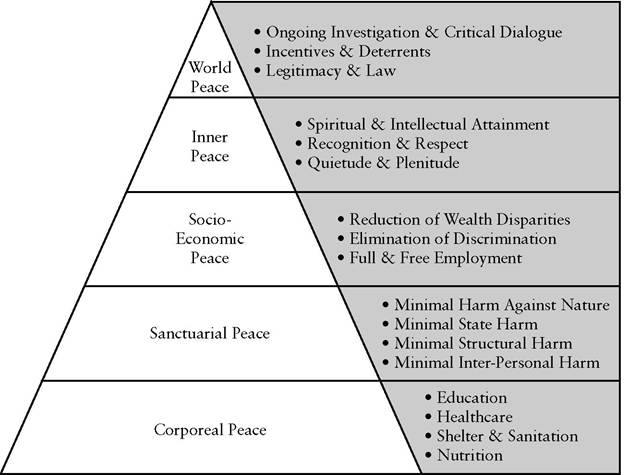
Pyramid of Peace Principles
diversities as evolving conditions and participants require.
The point is less to offer a definitive plan for world peace, of which there is no shortage, than to propose for ongoing debate and action an alternative framework in which it becomes additionally actualizable and sustainable.2Items linked to each level, like the levels themselves, are applicable in individual, social and collective ways demonstrated by the selected examples given. They are purposefully limited in number because a less suggestive, fuller exposition would require a separate book, which new generations could rewrite with levels, items and examples relevant to their times. Cumulatively, differences and similarities in version chains would thus provide prosperity with more and more complete historical guides to world peace, analyzable and implementable as experimental scientific models. World peace requirements discovered in or expressed through the Pyramid are intended to be pertinently holistic for humanity for now not forever, that is only as suitable to unaccounted-for idiosyncrasies. If not, such requirements can be catered to fit the needs of situations at hand, in which case the Pyramid and the lessons of the world history of peace it represents would stand amended. Conversely, they can be wantonly rejected outright and the Pyramid falls if it is not restructured by item, by level or from the ground up as necessary.
Climbing the Pyramid, so to speak, means actualizing each item of each level from the bottom up on a continual, progressive basis. Reaching any level except the top at any one place and time does not necessarily depend on it being reached everywhere by everyone, but surely would not hurt. Likewise, reaching any level once does not mean it will always be held, as the Pyramid embodies a static dynamism by which its structure can stay intact even if its levels and items are periodically unactualized, though each must be actualized before or in tandem with the next. Extents to which items and levels are actualizable individually, socially and/or collectively depend in large part on the specificity of the meanings attributed to them, which must perforce be substantiatedly general for our purposes here. The set of imperatives previously discussed are part of the Pyramid as binds that tie together its items and levels. On these premises and those set out below, the Pyramid is both a description of world peace and a way to achieve it.
More on the topic Conclusion The Pyramid of Peace: Past, Present and Future:
- Past, Present, and Future
- 1 Might and Right, Past and Present
- Present through the Past
- Past and present
- Competition theory past and present
- Hunting-and-Gathering in the Past Explains How We Have Survived Until the Present
- Contestation on inheritance jurisdiction in the past and present
- Chapter 1 Simulating the Past for Understanding the Present. A Critical Review
- The Future of the Past
- MARIOLOGY: PAST AND FUTURE A SUMMARY
- Plokhy Serhii. The Frontline: Essays on Ukraine’s Past and Present. Harvard Ukrainian Research Institute,2021. — 416 p., 2021