From gunboat diplomacy to the 'Good Neighbor' Policy
In the anti-interventionist atmosphere of the early 1920s the Republican administrations of the 1920s showed some interest in curbing the American military presence in Nicaragua, the Dominican Republic and Haiti.
The Harding (1921—23) and Coolidge (1923—29) administrations were concerned about the negative imperialist image of the United States that was feeding anti-Americanism throughout Latin America. Hence they tried to negotiate an orderly return of American troops from the Caribbean and, in 1924, the Dominican Republic became the first Caribbean nation to see the withdrawal of the marines (although the United States retained its control over the customs receivership of the former protectorate as a way of maintaining its influence). While a plan to bring back troops from Haiti was abandoned when it appeared that this would cause complete anarchy, the marines did leave Nicaragua in August 1925 after orderly national elections. The big stick of military intervention was seemingly being abandoned in favour of the soft stick of economic control.In 1926, however, the United States reverted to its interventionist pattern in the Caribbean. Some 4,500 marines returned to Nicaragua in the midst of a bloody civil war to aid Adolfo Diaz’s pro-American government in its defeat of Juan B. Sacasa’s Mexican-supported rebels. Amid widespread criticism President Coolidge’s special envoy, Henry Stimson, mediated the Truce of Tipitapa in 1927 leaving Diaz to head an interim coalition government until new elections were held (and supervised by the marines) in 1928. While the marines tried to maintain order and the State Department worked to promote the acceptance of democratic principles, one of Sacasa’s generals, Augusto Sandino, continued to wage guerrilla war against the Americans. Unable to catch Sandino — who quickly became a symbol of resistance against American imperialism throughout Latin America — the administration of Herbert Hoover (1929—33) began to withdraw the marines in 1931, with the last contingent leaving Nicaragua in 1933.
The following year Sandino was murdered after leaving a negotiating session with the American- supported Nicaraguan government. In 1936 the war-torn nation quickly succumbed to the military dictatorship of Anastasio Somoza, the head of the Nicaraguan National Guard (Guardia Nacional), whose family oligarchy would run the country until 1978.see Chapters 3 and 7
The Nicaraguan events were symptomatic of the realization in Washington that direct rule in the Caribbean nations created more problems for American interests than it solved. Sandino’s successful resistance and eventual murder also indicated that democracy could not be forced upon the Latin American countries and that overt American involvement in their internal affairs did little to support stability in the region. Furthermore, with the Japanese strengthening their position in East Asia and Nazi Germany making threatening noises in Europe, many American policy-makers now felt the need to secure American interests in the Western Hemisphere by supporting local strongmen, who often were, like Somoza, military men.
Indeed, even before Somoza had consolidated his rule over Nicaragua, the Dominican Republic had succumbed to the dictatorship of Raphael Trujillo. Since 1919 Trujillo had been close to the American military and after the marines withdrew in 1924 he played a major role in organizing the National Army under American tutelage. In 1930 he captured the presidency in a highly fraudulent election and, with the help of a strong and well-funded army, ruled the country with an iron grip and generous American support until his assassination in 1961.
In addition to Nicaragua and the Dominican Republic, the new ‘strongman’ policy found representatives in most countries in Central America and the Caribbean during the 1930s. In Cuba, for example, the United States ended up supporting Sergeant Fulgencio Batista who ruled Cuba from 1934, either as the president or from behind the scenes, until Fidel Castro’s revolution forced him to flee the country in 1959.
In Haiti, a nation the marines ran from 1915 to 1934, a succession of heavy-handed presidents were supported with generous loans even after President Franklin Roosevelt completed the withdrawal of American troops. Haiti’s national finances, however, remained under American control until 1947.It is perhaps ironic that such military dictators as Somoza, Trujillo and Batista were in the 1930s viewed as showcases of the so-called ‘Good Neighbor’ Policy that ‘the other Roosevelt’ — the first Democratic president since Wilson — proclaimed when he took over the White House in 1933. After all, as many American critics pointed out, it was hardly a great achievement of American foreign policy to be good neighbours with brutal rulers whose main accomplishment all too frequently was the ability to create vast personal fortunes while their countrymen lived in poverty. Raphael Trujillo, for one, amassed a fortune worth approximately $800 million while the Dominican Republic remained one of the poorest countries in Latin America. While dodging such embarrassing questions in public, Franklin Roosevelt’s private opinion captured the thinking of many. ‘He may be an S.O.B.,’ Roosevelt reportedly agreed when Trujillo visited the United States in 1939, ‘but’, he added, ‘he’s our S.O.B.’
It was a fitting indication of how the theory and practice of Franklin Roosevelt’s Latin American policy differed remarkably. Upon taking office Roosevelt had declared his intention to follow
the policy of the good neighbor — the neighbor who resolutely respects himself and, because he does so, respects the rights of others — the neighbor who respects his obligations and respects the sanctity of his agreements in and with a world of neighbors.
As the American experience in Haiti, the Dominican Republic, Nicaragua and elsewhere in Latin America during the 1930s shows, however, the Monroe Doctrine was far from dead, and the spirit of the Platt Amendment and the Roosevelt Corollary lived on.
What the Roosevelt administration — and some of its predecessors — discovered was that there were willing opportunists in various Latin American countries who could be used to protect American interests without the physical presence of the marines. Hence the Somozas, the Batistas and the Trujillos could be viewed as the latest representatives of America’s pervasive influence south of its border.see Map 6.1
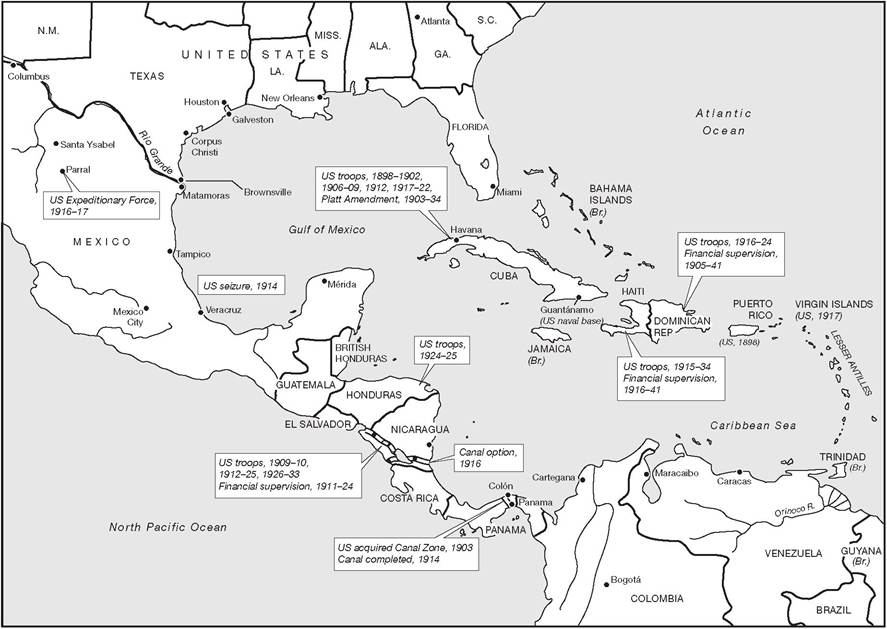
Map 6.1 US interventions in the Caribbean and Central America, 1898-1941
Source: After Paterson, Clifford and Hagan (1999)
One seeming exception to the indirect American dominance was the compromise reached with Mexico in the late 1930s. Following the American intervention in the 1910s, the most controversial issue that had plagued relations between the two countries was oil. The 1917 Mexican constitution effectively nationalized all mineral resources, including oil, which naturally alarmed companies such as Standard Oil. Only after extended negotiations in which the Mexican government agreed to recognize pre-1917 American property rights did the United States grant Mexico full diplomatic recognition in 1924. However, in 1938 the Mexican president, Lazaro Cardenas, nationalized all property held by foreign oil companies. Despite heavy lobbying from such companies as Standard Oil (which launched a major propaganda offensive in the United States branding Cardenas a communist), the Roosevelt administration did not revert to military intervention. Instead, after long negotiations, the United States in 1941 officially acknowledged Mexico's right to control its raw materials and the Mexican government agreed to pay restitution to those Americans whose property had been nationalized.
Mexico was in many ways a showcase of how far the United States had come from its earlier interventionist policies in Latin America. Indeed, it seemed that the ‘Good Neighbor' Policy had clearly marked a turning point for interAmerican relations.
And yet the change hardly came about merely because non-interventionism seemed to be the right and just approach to take. Behind it lay the troublesome developments in Asia and Europe that — come 7 December 1941 — significantly increased the importance of having good neighbours with plenty of raw materials.Debating the origins of American interventionism
Most historians would agree that the United States acted in an imperial manner towards Latin America. They disagree, though, on why this was the case. In broad terms, the explanations can be categorized into three groups, each stressing the preeminence of economic, security or ideological factors.
For those historians who emphasize economic considerations, the Monroe Doctrine and interventionism in Latin America are largely efforts to secure access to raw materials and markets to assure the growth of the American economy (for example, William A. Williams and Walter Lafeber). Others, like Lester D. Langley or David Healy, have stressed the primacy of national security considerations by pointing to American concerns over German expansionist designs. In the first decades of the twentieth century this new rivalry was particularly evident in the competition over the control of the Panama Canal and was heightened by the emphasis on naval power and the perceived need to establish bases to protect US interests. One should stress, though, that the two explanations often overlap: American economic interests were, often, perceived as central in national security strategy.
The third broad explanation for the growth and maintenance of US influence in Latin America stresses ideological factors. In this context, the debate and controversy - which extend throughout much of the history of American foreign policy - are about both the cause and impact of American policy. Originally, such historians as Samuel Bemis argued that the United States worked hard for the democratization of the Western Hemisphere; that much of American policy was driven by a missionary impulse; and, while the end results were not always what had been intended, the intentions were idealistic and well meaning.
Since the 1960s the 'democratization'school has been discredited. In explaining the persistent support for various dictatorial regimes, these historians point to the essentially racist outlook of much of American society and the assumption, held by many, that the people living in countries south of the United States were simply not ready for democracy. American dominance of the hemisphere was, thus, justified by asocial Darwinist outlook that placed the 'Latinos'below the 'Whites'and was, by and large, reflected in the nature of American society (see Michael Hunt, Ideology and American Foreign Policy, New Haven, CT, 1987).
In short, the debate over the nature of inter-American relations - and US foreign policy in the Western Hemisphere in particular - offers an array of explanations and theories that touch upon the essence of American foreign policy. Exploring the debate will improve one's understanding not only of the inter-American relationship but also of the American role in the world throughout the twentieth century.