From prehistoric times the Baltic Sea region has witnessed a closely connected settlement of different ethnic and linguistic communities, for example of Germanic, Slavonic, Baltic or Finno-Ugric origin.
These societies developed during the Middle Ages and the modern era into nations and states. In several cases (notably in Finland and the Baltic countries) state-building took place only in the twentieth century.
Moreover, due to the changing dominion exerted by different powers over the Baltic Sea, the political pertinence of the coastal areas shifted regularly. For many historians therefore, the history of the Baltic seems to be a history of warfare and struggle for dominion: between Poland and the Teutonic Order, among Denmark, Sweden and Poland; between Russia and Sweden.1 Those struggles and tensions produced enduring stereotypes. These ethnic stereotypes were - or still are - so effective that historians overlooked the fact that the Baltic Sea region was an area of cultural exchange. Here burgeoning communication by shipping, migration and integration of foreigners fostered the emergence of supra-national cultures in the Baltic Sea region; for example, the Viking culture, the culture of the Hanse, Netherlandisation and Sovietisation.2The political upheavals of 1989 with the fall of the Berlin Wall, the collapse of the Soviet Union and the independence of the Baltic States were far-reaching and stimulated a new perception of, and perspective on, the Baltic Sea region. And these changes gained momentum with the eastern enlargement of the European Union. The new situation stimulated
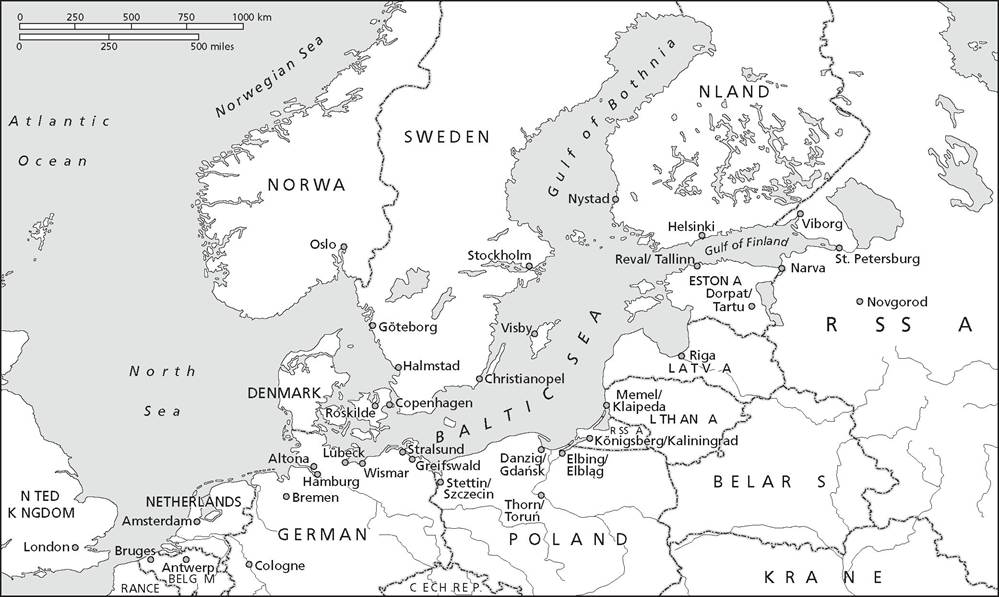
Map 8.1 The Baltic Sea
research as well.[614] Although historians from the countries of the Baltic Sea region have been writing from their different perspectives, a synthesis like Fernand Braudel’s concept of the Mediterranean has been demanded.[615] However, syntheses along Braudel’s model are limited, because they are dominated by the physical setting in which its inhabitants were forced to make a living. In the meantime, concepts of space and regions have developed. For example, regions are no longer viewed as natural entities but as the constructs of a multiplicity of actors. There is, then, not only an unchangeable physical setting of the ‘Baltic Sea’ that determines the region, but also people and powers interacting continuously to reinvent the Baltic Sea region. In this chapter I shall first focus on the different notions of the Baltic Sea region from the Middle Ages up to now. The central part of this essay will examine the Baltic Sea as trading region and cultural contact zone. In the conclusion I will focus on the relationships between the Baltic Sea and other seas and oceans.