Globalization: Peace at the End of History
Where have five millennia of peace history brought us? In a controversial essay entitled “The End of History?” published in 1989, American political scientist Francis Fukuyama stated:
What we may be witnessing is not just the end of the Cold War, or the passing of a particular period of post-war history, but the end of history as such: that is, the end point of mankind’s ideological evolution and the universalization of Western liberal democracy as the final form of human government.1
He also noted “the fact that ‘peace’ seems to be breaking out in many regions of the world,” but his lack of qualification of the quotation- marked term highlights his hesitation.
His argument, that Marx’s view of history as an ideological and actual class struggle leading inevitably towards war and peace has been superseded went far from unchallenged. French philosopher Jacques Derrida derided the idea, declaring “it must be cried out, at a time when some have the audacity to neo-evangelize in the name of the ideal of a liberal democracy that has finally realized itself as the ideal of human history: never have violence, inequality, exclusion, famine, and economic oppression affected as many human beings in the history of the earth and of humanity.”2 These provocative, antithetical perspectives are fruitful starting points for assessing both the presents the world history of peace has bequeathed upon humanity and aspects of its historical presents. What Fukuyama called the universalization of liberalism and Derrida a neo-evangelization in its name has, in a broader sense, been widely and no less contentiously discussed under the rubric of globalization - which by one of many definitions is “not something new,” but rather and more significantly “a deepening of the extent to which relations transcending geographical borders are now possible; the increased speed with which such relations are now taking place; and the consequences of such intensification of relations on political, economic and social levels.”3 The questions to be briefly raised here are to what extent has the current stage of globalization, in the process, deepened, increased and intensified peace and peacemaking or not.Politically, globalization has in fact increased the rate of democratization in former leftist and rightist autocratic regimes, which many scholars and activists see as giving rise to a worldwide “democratic peace.”4 While what the term means is debated, in general it refers to the notion that outright and structural as well as internal and external violence associated with autocracies diminishes after they become representative democracies. For example, once rife with domestic and regional strife during the 1970s and 80s, fermented by the US and USSR through what the US Navy called low-level “violent peace,” since their autocrats have been removed, military spending for use inside and outside the country as percentage of gross domestic product declined from 8.4 percent in 1989 to 1.3 percent in 1996 in Honduras and from 28.3 percent to 1.5 percent in Nicaragua.5 Critics, especially of the post-colonial persuasion, point to the plight of large numbers of disempowered individuals and groups they call subalterns who are still voiceless and suffer structural violence in all representative democracies today. Holding fast to non-violent principles of participatory democracy, they contend, can subvert existing sociopolitical boundaries and make the best of what globalization can do politically, or at least limit the worst economically.
From its supporters’ perspective, globalism has also made capitalism the most plausible solution to reduce, stop and prevent strife within states through development or modernization, and war between them along the lines discussed in Chapter 8, other than or in addition to democratization. Some take this argument to the point where the nation-state system itself may become obsolete. Thomas Friedman put forth the wry propositions that no two states with a McDonalds franchise have ever gone to war with another, and no two states part of a major global supply chain such as Dell computers ever will.6 The basis of the first proposition is that higher standards of living, somehow equated with fast food chains, decrease national appetites for war; the basis of the second is that the economic, particularly labor, benefits tied to being part of a major global supply chain vastly outweigh the risks of jeopardizing them by engaging in war.
In other words, peace is seen as both “a requisite for successful establishment of global capitalism” and as “a free-enterprise system serving buyers and sellers through market signals” that “cannot withstand the pervasiveintervention of government in wartime.”7 One world, many peaces then is to be achieved one economic market at a time.
Much of anti-globalist discourse and action is dominated by the equation “modernization = Westernization = capitalism = globalization = imperialism.”8 In this view, globalization is not a solution to contemporary problems of peace, but the problem itself, because of the
power of the rich world’s governments and their appointed institutions (the IMF, the World Bank, the World Trade Organization) to wage economic warfare and the power of the same governments, working through a different set of institutions (the UN security council, NATO) to send in the Bombers... the grotesque maldistribution of power which permits a few national governments to assert a global mandate.9
At one end of the spectrum, anti-globalists have countered globalism with localism: practices that lead to autonomy and peace along the lines of Proudhon’s mutualism. At the other end, the massive polycentric and open conferences of the World Social Forum (WSF) aims, as its “Call of Social Movements” states, at “Resistance to Neoliberalism, War and Militarism: For Peace and Social Justice.”10 First held in 2001 in Porto Alegre, Brazil, as a counter to the World Economic Forum, the WSF has grown into several yearly events around the globe attended by hundreds of thousands of activists. The term subaltern cosmopolitanism has been used to describe these diverse, non-violent, counter-hegemonic movements that seek to build upon differences rather than erase them, and challenge instead of accept the status quo.
Taking a long retrospective view on a smaller scale, parallels to today’s globalization can be drawn with the eras of Romanization, Sinicization and Arabization that occurred on regional levels.
In this case the transformation is generally seen as an Americanization, even if multi-way flows of cultural commodities and practices are ongoing. Taking a shorter view on a similar scale, the domination of the US in world politics and economics - despite its slips in the new millennium - is comparable to Britain’s in the imperial era. The periods in and/or after which these hegemonies occurred have, worthy or not, been associated with a “Pax,” and resistances to them have been violent and non-violent, effective or not. Although debates have already started, historians of the future will be in better positions to judge whether globalization does or does not correspond to a Pax Americana. But what can be painted in broad and preliminary strokes is what world peace may look like for its supporters and critics as of 2009 (see the table on the following page).With the Fukuyama-Derrida polemic and the facts behind them still unsettled, in 1993 Samuel Huntington put forth another theory that roiled academics and activists and has since been a major influence on the
Globalization and Alter-Globalization Perspectives on World Peace
Issue
Globalization
Alter-Globalization
Domestic Economy:
Domestic Politics:
Global Economy:
Global Politics:
Role of Global
Bodies:
Role of Regional
Bodies: Globalization in
History:
Equal Opportunity
Democracy
Limited Government
Competitive Free Trade
Economic Aid
Absolute State Sovereignty
Supervisory:
Promote Free Trade
Monitor Human Rights Forum for Discussion Formulation of Policy End and Ideal of History
Equal Distribution
Socialist Democracy Interventionist Government
Cooperative and
Coordinated Development Social Justice in/for all States Enforcement:
Protect Rich From Poor
Ensure Human Rights Decision-Making Forum Implementation of Policy Stage in History as Step in
the Wrong/Right Direction
rhetoric, if not the thinking, of foreign policymakers: “The great divisions among humankind and the dominating source of conflict will be cultural...
The clash of civilizations will dominate global politics. The fault lines between civilizations will be the battle lines of the future.”11 Globalization’s reformation of proximity is, in Huntington’s view, neither a benevolent opportunity for economic cooperation nor a hostile one for ideological expansion, but simply a predestined source of friction. The implication is that cultural groups must guard against both internal and external enemies, not only those who threaten their interests, but also those who just do not belong. Anyone who is not one of “us” is transformed from a potential into an actual threat to “our” peace. Two possible endgames of this clash-of-civilization theory are: one culture subsumes or supplants all others, or cultures somehow manage to peacefully coexist. In the first case, conflict is inevitable unless cultural groups cave in of their own volition, and even if it were accomplished non-violently, it is in no way “a formula for peace, as throughout history some of the most vicious wars have taken place within civilizations.”12 For how the second case can happen and be sustained, other schools of thought must be sought.A perspective poles apart in respect to peace prospects comes from the famed Frankfurt School of critical theory. “Peace,” wrote Theodor Adorno during the Cold War, “is the state of differentiation without domination, with the differentiated participating in each other,” which within the context of our discussion means that it is both possible and necessary for cultures to peacefully coexist and interact with one another.13 Taking this line of thought leaps further and making it more concrete, Jürgen
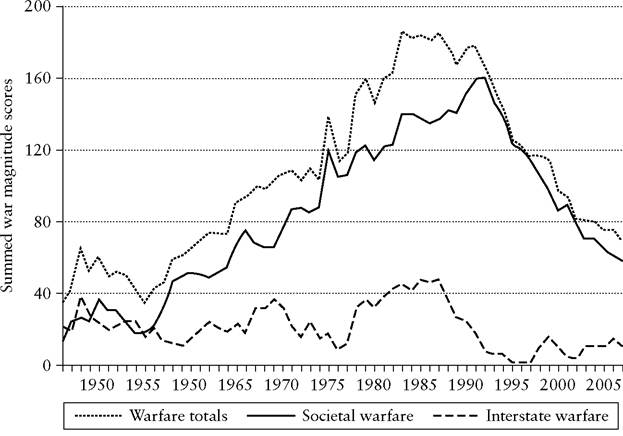
Global Trends in Armed Conflict, 1946-2006
Habermas has proposed that collaborative identities conducive to peace during globalization can, are and must be created within what he calls a “post-national” framework.
Over a decade before Huntington put forth his hypothesis, Habermas wrote that “new conflicts no longer arise in areas of material reproduction... new conflicts arise in areas of cultural reproduction, social integration, and socialization.”14 While conflicts over energy and water resources call their common view into question, where Habermas departs from Huntington in his post-Cold War theory is that he sees the dynamics of negotiating systems for democratic national and regional international institutions (such as the European and African Unions) and non-governmental bodies (such as professional associations and not-for-profit humanitarian organizations) as being inherently able to prevent, resolve or make obsolete violence of any kind through ongoing critical dialogue. But have they?Monty Marshall and his colleagues at the Center for Systemic Peace have been conducting quantitative-qualitative studies with some startling, some reinforcing and some inspiring results. Using extensive data from 126 countries, they have found that since 1991, the levels of both intra- and international warfare have declined dramatically, falling from their peaks at the end of the Cold War by over 60 percent, as the graph shows above. According to their studies, one in every three countries was engaged in armed conflict in 1991, dropping to less than 15 percent in 2006.15 In terms of the onset of new warfare, intra-national conflicts have outnumbered international ones in the same period, fluctuating between one and thirteen. Rates of intra-national onsets are near unchanged, while international rates have been cut in half. As of 2007, 24 states are directly affected by ongoing wars, half of which have lasted more than ten years. The three longest are Myanamr (60 years), India (56) and Israel (43). The studies also show that while poorer countries are more likely to be at war, the highest levels of warfare are not in the poorest countries, but those in the quintile just above because they have more means to engage in it. The researchers also note that the increase in displaced persons since the onset of the Cold War is due to the inability of countries in protracted wars to meet basic needs and a breakdown in distinction between combatants and civilians. However, one could add that in countries like the US, being at war is experientially dissociated from being in war for the vast majority of its residents, who are thereby made more complacent.
Another study, the Global Peace Index by the British financial journal The Economist’s Intelligence Unit and a large international team of peace researchers and statisticians, is the first to rank countries worldwide according to their peacefulness and its drivers. Using data from 121 states, the Index considers both internal factors such as crime, homicide and imprisonment rates and respect for human rights, and external ones such as arms sales and production and troop deployment. Norway, New Zealand, Denamrk, Ireland and Japan are the top five most peaceful states according to the study; Nigeria, Russia, Israel, Sudan and Iraq are at the bottom. Striking features are that both Japan and Russia are in the G-8, and that states with unquestionable twentieth-century war credentials like Ireland and Germany are near the top of the list. The US ranks 96th - just above Iran. The Index found that peace is correlated to high levels of incomes, schooling, regional integration and government transparency. Its President says the aim is to provide a “quantitative measure of peacefulness that is comparable over time,” hoping it “will inspire and influence world leaders and governments to further action.”16 What the Index depicts but does not sufficiently account for are violence, peace and peacemaking internal to new and established states that have been the result or cause of democratic-capitalist systems. Three emerging areas of peace research and practice that do are the management and resolution of ethnic, secessionist and post-autocratic conflicts, which are in most cases intertwined, but can be split for heuristic purposes and to expose a lack of foresight that has cost millions of lives.
While some academics have gone so far as to call battles on the scale of the world wars things of the past, few disagree that small-scale armed conflicts are and will be the norm. Since 1989, among the most prevalent of these have been ethnic, which have proven hard to resolve in part because they have such a diversity of causes. Racial, kinship, linguistic, religious, lifestyle and location characteristics have all been linked to ethnic conflicts from Rwanda and Burundi to Georgia and Azerbaijan. Common denominators include ascriptive and exclusivist, subjective and objective cultural traits defined or magnified at the whims of war leaders who manipulate them to mobilize sometimes already peaceful populations. Two dominant ways to deal with such conflicts by national and international bodies have been reducing or eliminating differences by forced migration, new borders, assimilation, genocide, etc., and/or by managing them through arbitration, third-party intervention such as the UN, reconciliation, incentives, etc.17 Obviously, some of these methods are as far from peaceful as possible, which underscores the urgent need for more creative thinking, critical dialogue and concerted action in this still gladiatorial arena.
The aims and bases of secessionist movements are usually clearer: the separation from one nation and the formation of another, based on predefined cultural, historical, ideological and/or geographic characteristics. In some cases, notably Czechoslovakia’s “Velvet Revolution” from the USSR and its “Velvet Divorce” into the Czech Republic and Slovakia, democratic and diplomatic reform through intra- and international systems has successfully met the needs of the parties involved with little violence. Vaclav Havel, the playwright and President of the unified state between these two events as well as the Czechs afterwards, asserted:
Without free, self-respecting, and autonomous citizens there can be no free and independent nations. Without internal peace, that is, peace among citizens and between the citizens and the state, there can be no guarantee of external peace.18
Another example is the Quiet Revolution in the French-language- dominated Canadian province of Quebec, which has unsuccessfully held two referendums on separation without resorting to state-sponsored violence, with intermittent talks on reconfiguring the confederation. However, there has also been no shortage of violence by secessionists and the states from which they wish to secede, particularly when population bases are split between two existing states: Kurds caught between Turkey and Iraq, and Basques between France and Spain, fit this model. Violence also erupts when existing states refuse to take the requests of the aspiring ones seriously, as between Chechens and Russia and potentially between China and Taiwan. In these cases, it is the neglect of established political processes rather than their absence, the inflexibility of participants in conjunction with their desperation, and the intricacies of reaching multi-lateral agreements - not their impossibility - which makes peace through succession or more autonomy difficult.
Post-autocratic violence, peace and peacemaking are very delicate topics because they are either ongoing or in the works, and they stir up deep-seated beliefs. Two recent cases, the former Yugoslavia and Iraq, are the most debated today, and the closest historical parallels in peace terms are ancient Sparta and Athens. The six federated republics of Yugoslavia, formed with the support of both the communist and capitalist blocs after the Second World War, were ruled with an iron fist by strongman Tito until his death in 1980. His oppressive peace - still the most liberal of any communist country during the Cold War - defines the term in modern times, stifling dissent and repressing rebels in the republics while providing for them. His contributions to the Non-Aligned Movement and strategic alliances outside NATO and the WPO run alongside these efforts. Tito’s twenty-two chosen replacements proved unable to do what he did. Many observers held that this inability was nonetheless a positive change, even when ethnic nationalists in the republics began “cleansing” (i.e., massacring) themselves of each other in the early 1990s under the direction of elected officials. In less than a decade, Tito’s unitive oppressive peace had disintegrated through democracy into divisive war, after which six new states emerged, aided by UN mediators and sanctions as well as NATO bombs, and Yugoslavia is no more. In this case, unpeaceful forces internal to the state were at work, in others it has also been those from outside.
Saddam Hussein’s regime began in 1979 when he assumed control of the Iraqi Ba’ath party. Once supported by Soviets, Iraq now received US aid against Iran’s new Islamic regime. Hussein used it to boost oil production as well as the army, which he used to contain Kurdish and Shiite rebels after UN-brokered peace with Iran, making his rule more oppressive than peaceful. After invading Kuwait in 1991, he rejected UN calls for withdrawal. A coalition led by the US quickly forced him to. He was not removed from power and continued to contain the internal revolts while refusing to adhere to peace terms like UN arms inspection, which led to more US bombings. After September 11, 2001, President George Bush declared war on terror, discussed below. Within a year this was extended to depose with NATO forces the elected Islamic Taliban party in Afghanistan, which the US supported against the USSR, and another to eliminate weapons of mass destruction never found, brushing aside UN and international opposition. The 2003 “Summer of Protest” included millions around the world, to no avail. Hussein was captured and killed, but the invading, predominantly Anglo-American forces have remained as haphazard occupiers. Conflicts between Shiites, Sunnis and Kurds that Hussein was able to contain have become a civil war protracted by outside interference. “The invaders came with a minutely detailed war plan,” which has since been changed several times, “but without a peace plan other than protecting oil and other critical facilities.”19 How the war in Iraq will ultimately be resolved will undoubtedly be a defining moment in the twenty-first-century history of peace.
As the peace metrics above show, the UN has made great strides towards the reduction of international conflicts, as its Charter mandates. But the sovereignty and veto issues discussed in Chapter 10, compounded by tactical non-payment of dues, has rendered UN performance in the face of intra-national conflicts poor, to be polite, and impotent in stopping or preventing non-sanctioned wars by the Big Five and their allied organizations. Declaring the year 2000 as one of a “Culture of Peace” was more a public relations measure than a practical act aimed at creating one. The fact that the number of UN peacekeeping missions since 1989, many geared towards intra-national peace though by invitation only, outnumbers the total of the fifty years before is an indication both of its willingness to meet these challenges and their enormities. The UN Peace-Building Commission, established in 2005, was a year later invested with a Peace-Building Fund aimed solely at “reconstruction, institution-building and sustainable development, in countries emerging from conflict” - in an advisory role.20 That NATO has taken up more peacekeeping than war-making missions in the same period also suggests that international bodies, even strictly military ones, have begun to realize that in incremental steps: conflict management leads to conflict resolution leads to peacemaking leads to peace-enforcement leads to peacekeeping leads to peace-building leads to peace.