Harmonies and Antinomies of Ancient China
Ancient China’s demographic diversity and geographical immensity made harmony and authority two necessary peace principles of its political systems from their earliest days, but also made them so difficult to implement.
Family and community were always and everywhere the bedrock of Ancient Chinese societies; it is only with the development of imperial political and administrative infrastructures that various peace-oriented codes came to compete for individual adherents as for social and collective control. The Records of the Grand Historian, attributed to second century BCE historiographer Sima Qian, and the Bamboo Annals, an anonymous chronicle of a slightly later date, present peace as central to the origins of Ancient China. Their historicity, like that of the records of early Rome, is questionable at best, and of less import than the ideas about peace they conveyed to those influenced by them. According to these works, the world was at first ruled by the Three Sovereigns, demigods who in their infinite insight presided over a period of universal harmony between all the cosmos’ constituents: the Heavenly Sovereign, the Earthly Sovereign, and the Human Sovereign. They not only ruled benevolently in their own realms but together kept a perfect balance between them.Among the gifts they gave to humanity were fire, fishing, agriculture and writing, the last two being of special relevance to the history of peace. Archaeologists date the first of these developments to c. 7000 BCE. The words for agriculture and rice cultivation are synonymous in old Chinese script, suggesting that rice was a long-time staple. More than other crops, cultivating rice in nutritional quantities for small or large societies required cooperation, coordination, social cohesion and hydrological expertise, which is why Confucius later wrote that “from agriculture social harmony and peace arise.”4 Thus, while warfare seems to permeate Ancient Chinese history, continuity in rice cultivation is a strong reminder that general populations not only needed peace to survive, but in large measure helped create, recreate and sustain it.
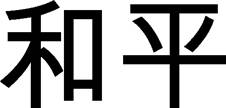
That rice spread throughout Asia and India before the times of the Ancient Greeks is also a sign that vast trading, political and other cooperative networks must have existed, although little about them is known. Chinese ideograms developed from inscriptions on bones used in wizards’ divinations for, among other purposes, war and peace. The modern Mandarin characters for social peace, the etymologies of which can be traced back to these times, are shown on the following page. The left character (he) on its own means: together with, harmony or union. The right one on its own (ping) means: flat, level, equal, to make the same score or to tie. The character for peace in another sense is an, meaning content, calm, still, quiet or to pacify, ideas as challenging to trace historically as their characters can be for foreigners to write.The time of the Three Sovereigns passed when the Five Emperors came to power halfway through the third millennium by Qian’s account. They were not demigods but sage kings who were patrons of medicine, music, calligraphy, astronomy and hydrology, all of which were practiced in and for peace. Armed conflicts occurred in this period, but the wisdom of the Five Emperors prevented as well as resolved them. Legends surrounding the Yellow Emperor, first of the Five and the mythical founder of the future Han Dynasty, relate that he used fog to fight aggressors, in which he found their leader with a special compass, sparing the soldiers. Early commentators claim that he limited warfare to achieve lasting victories and fostered peace to make his people prosperous and obedient. Emperor Shun, the last of the Five, is said to have met hostility from his family and subjects, yet continued to love and care for them until the day he died. Above all, later commentators considered the Five Emperors to be moral models for current heads of states. Later political treaties on the Yellow
Emperor’s rule prescribe that “Only in case of necessity will [sage rulers like him] undertake military actions,” as warfare harms the economy, making people discontent and reproachful of their rulers.5 However, these treaties also emphasize that a state without a strong army will not be able to survive.
Tradition has it that the Fifth Emperor abdicated in favor of his best civil servant, Yu. Succeeding where his father had failed, Yu had expertly diverted floods for years, saving many lives and livelihoods. As a Qing emperor three thousand years later paid homage:Since ancient times, the model for long-lasting peace has been essentially to ensure people’s livelihood. To achieve this is to have land reclaimed for farming so that surpluses are produced and income become inexhaustible.6
Yu ruled, if he did at all, roughly as the archaeological Erlitou culture arose. His successors, the Xia (c. 2205-1766) who may be more fiction than fact, were at the threshold of small warrior chiefdoms, becoming powerful palaces that could coordinate, if not yet control, others.
The Shang Dynasty (c. 1766-1122 BCE), China’s earliest historical one, took power by coup. Their palaces included courts and their many ministers and workmen. Wizards and warriors were thus slowly being replaced with bookkeepers and bureaucrats, by training and disposition less violent, though no less cunning. But citizen-soldiers who once did battle for themselves now became paid or conscripted armies who campaigned on their commanders’ behalf and behest. Before long, Shang capitals like Yin on the Yellow River became religious, administrative and political centers that could levy and expend taxes for the people’s welfare, but also for conquests near and far. As in Ancient India, if the duration and quality of peace increased with the size of Shang rulers’ dominions, so did the scale and intensity of warfare. With the Shang, natural spirit and ancestor propitiation developed into full-fledged systems of belief, from whom guidance, assistance and consolation were sought in peace and war alike through meditation and ritual. Sacrifices led by Shang rulers were made to the weather-god Di, without whose goodwill no enterprise could thrive, peaceful or otherwise. The labor and logistics required to produce the large number of bronze religious vessels found attest to the Shang’s technical sophistication and organization.
But few ties bound the traditional elite of distant regions together, and hardly any did the diverse conquered peoples to each other or to their rulers. This lack of social cohesion on a large scale led to the decline of Shang’s authority in making and maintaining peace, which the Zhou Dynasty (c. 1122-256) that overthrew the Shang sought to restore.The Zhou redefined statecraft and morality while revitalizing family relations during the longest and arguably the most illustrious reign in preImperial China. Historians divide the Zhou Dynasty into four overlapping periods with distinct cultural profiles. Three traits unite them: the Mandate of Heaven, the Fengjian system and the Zongfa, each having a complex relationship with contemporary and subsequent socio-political peace in China. The Mandate of Heaven was a belief that a ruler’s legitimacy derived directly from Tian, the god of heaven the Zhou restored from the Xia in place of the Shang’s Di. Tian showed support for rulers, called Sons of Heaven, by making their reigns peaceful and prosperous. Conversely, a lack of peace and prosperity was considered proof that Tian no longer supported his Son, so that another may rightfully take his place. Divinations thus began losing ground to rituals, a reliance on precedents and continued spirit and ancestral propitiations, all aimed at maintaining peace and prosperity through socio-political order, or at least its appearance. The Fengjian socio-political structure is often compared to European feudalism for its stratified conflations of property and people, at the top of which were Sons of Heaven. Below them were aristocrats of various ranks who received their fiefs by inheritance or as gifts for services rendered and were responsible for keeping them peaceful and productive. Below them were the masses who paid dues in labor, cash or kind; professionals like doctors, scribes and clerics were somewhere in between. Fengjian reciprocal obligations and mutual limitations of action, spheres which are today seen as precursors to the “ideology of peaceful coexistence” put forth by Confucius, are discussed below.7
The foundation of the Fengjian social structure was its lineage system, the Zongfa or clan law, governing all but the lowest classes: ranks, titles, professions and primary possessions were passed on to eldest sons, whose families and descendents were called main lineages, while those of younger sons, minor lineages.
The Zongfa entailed a jealously guarded exclusivity of ancestor worship, by which branches of the royal lineage reproduced legitimizing rites in their realms, and branches of aristocratic lineages did so within their clans. In time, the verticality of the Zongfa was supplemented with horizontal segmentations, so that the “principle of collective liability for punishment on the basis of households was the legal expression of a new institutional order.”8 Sanctions were not limited to individuals but could be collectively extended to family and clan; in the case of crimes by officials to superiors, subordinates or to those who had recommended them to office. Strict as they were, inter-class loyalty and social cohesion set in place by Mandate of Heaven, Fengjian sociopolitical structure and Zongfa were considerable improvements on the Shang, bolstering Zhou authority and legitimacy and so their ability to make and maintain peace, when they so chose. Until the early eighth century BCE, descendants of the Zhou’s first family, the Ji, ruled from their western capital on the Wei River, Hao, near modern Xi’an. During this first period, called the Western Zhou, the three preceding traits were still taking shape and gaining ground, and the rapid and extensive territorial annexations they made possible mark the first pinnacle of Zhou power. Following a war over the Mandate of Heaven, in which Hao and the western fiefs were captured by nomads, the Zhou capital was moved east to Luoyang in 771 by the remaining Ji, a self-made Son of Heaven and inaugurator of the Eastern Zhou period.Displaced from their stronghold, the Zhou now needed the support of local Fengjian lords and their fiefs more than ever before, which these were willing to give to keep intact the systems that also supported them. At this point the three traits became ubiquitous in, and synonymous with, Ancient Chinese civilization, and the Zhou reached their second apogee before their long decline. The Eastern Zhou period is subdivided into the Spring and Autumn Period and that of the Warring States.
The former gets its name from a chronicle attributed to Confucius, about one of these Fengjian states. At first the mutual support between the Ji and the ruling clans served its purpose of maintaining the peace and prosperity of the Fengjian system in the face of internal unrest and external threats. Aside from interstice wars between the Fengjian, inter-state diplomacy and law was often successful. Hundreds of treaties (meng) creating trading and defensive alliances between fiefs were ratified by Fengjian ambassadors representing their lords. A precise diplomatic vocabulary came into being, with specific words for ambassadorial meetings, friendly envoys sent by one fief to another and even trust-building hunting events for visiting officials. But major Fengjian lords became overlords themselves by interventions and annexations, and power-sharing with the Ji turned into a power struggle as fiefs grew into states. The Seven Warring States that fought ceaselessly for the next three centuries were the Qi, Chu, Yan, Han, Zhao, Wei and Qin, the last of which eventually reunited all of Ancient China by employing new philosophies and practices of peace to create its lasting Imperial form.The hostile environment of the Eastern Zhou period was the unnatural habitat of Chinese philosophy’s golden age, what Sinologists rhetorically call the Hundred Schools of Thought. The Hundred Schools of Peace these schools of thought spawned were direct or indirect responses to wars happening all around them, at least four of which ineradicably influenced the rest of Ancient Chinese history and the East as a whole. Not first but foremost among them was that of Confucius (c. 551-479 BCE), founder of the school that bears his name. Tradition tells he was the son of a destitute nobleman who was forced to flee to the Fengjian fief of Lu before it was subsumed by one of the Seven Warring States. Fascinated by ritual from an early age, he committed himself to studying his being in the world at fifteen, holding odd jobs till his twenties, when he married, had a son and became a Lu administrator, rising to Justice Minister by age fifty-three. But he soon resigned this position in protest at the Lu’s unjust policies, and travelled to neighboring states in search of a ruler who would take his advice. After several failed attempts, he returned to Lu, where he edited the Five Classics of Ancient Chinese literature. His teachings are collected in the Analects and Great Learning, posthumously assembled snippets of conversation and aphorisms. Far from proposing a systematic philosophy, he challenged his students to think for themselves, study the world around them, and respectfully reinterpret rather than reject tradition. If there is “single thread binding my way,” as he claimed, it is the enterprise of pacific harmony within and between individuals in society.9
As a moralist, Confucius focused on three traditional, interconnected concepts: li, mores or rites; yi, reciprocal respect; and ren, humane responsibility. From these stem the so-called Silver Rule he articulated: “What you do not wish for yourself, do not do to others.”10 Of crucial importance to his philosophy of peace was social order through loyalty and meritorious self-mastery, which, as we have seen, the Zhou initiated and Confucius, building on their principles, came closer than anyone to perfecting. For Confucius, loyalty comprises duties of children to parents and, analogously, the ruled to the ruler; meritorious self-mastery is an auto-limitation of rulers’ powers by the Mandate of Heaven and incentives for prescribed public service. Perhaps the clearest encapsulation of Confucius’ philosophical imperative for peace is to be found in the following passage, of which the reverse is also true:
When the world is investigated, knowledge is extended. When knowledge is extended, wills becomes sincere. When wills are sincere, hearts are redressed. When hearts are redressed, individuals are cultivated. When individuals are cultivated, families become harmonious.When families are harmonious, states becomes orderly. And when states are orderly, there is peace in the world.11
Confucius had only a small circle of students in his lifetime, but during the Warring States period his teachings were studied and debated by a growing number of intellectuals in high and low official positions, who like him were seeking a stable way out of war. One of these, Mencius (fl. fourth century BCE), codified Confucian thought and presented it to numerous Fengjian lords, some of whom began to apply it systematically early on. Mencius regarded those who engaged in war as being below beasts, proposing that they should be punished by the death they inflict on others. He also emphasized the concept of de or moral virtue as humanity’s innate and universal quality, innately non-violent but which can and usually is corrupted by unjust institutions. By the second Imperial Dynasty, the Han, Confucianism was synthesized with the preceding Qin’s Legalism and became official Imperial policy, remaining so in evolving forms until the early twentieth century CE, when nationalism, then communism displaced it. As Ancient China’s sphere of influence expanded, so did Confucianism, making it and Buddhism the two most widespread peaceful forces of the Ancient East and, geographically speaking, the world.
Unlike the early Confucian school, which held that social harmony came from within individuals, the Legalist school held that it came from outside them. After Mencius, the third great Confucian countered that de was neither innate nor universal but developed by self-cultivation, upbringing, education and lifelong discipline. His star student, Han Fei (c. 280-233), was a Han prince who used this theory in building a pragmatic political philosophy of peace that made law the formative and decisive force in shaping individual behavior and social norms. Apparently Han Fei stuttered, so he presented his ideas in elegant prose instead of at court. The cornerstone of his school of peace is the legal code, which he argued should be precise, publicly available and the final word on everything for everyone. In the words of a modern scholar, the Legalist’s law code was thus set up to be the “all-powerful instrument which makes it possible to guide everyone’s activity in the direction most favorable to the power of the state and the public peace.”12 Accordingly, the law itself is authority, not the individual who applies it, who from high to low is bound by it, motivated by its punishments for disobedience and rewards for compliance, the basis of Legalist morality. Legitimacy, peace and power, then, rest in legally prescribed and -delimited positions, not people who hold them. It was thus a ruler’s duty to heed his ministers’ advice and consider his people’s pleas just as much as it was for them to obey his commands. In practice, this tended to give rulers the upper hand. Legalism became Imperial policy with the Qin Emperors, whose chief minister Li Si (c. 280-208) competed intellectually and politically with Han Fei. Li Si bolstered state bureaucracy to administer the law and standardized as much as he could, including writing, money, weights, measures and the civil service testing system that lasted for three millennia. Though wondrous in stabilizing society after the chaotic Warring States period, his policies brought about a conformist culture that saw creativity and tradition as threats. After outlawing other schools of thought and peace, burning their books as well as historical records, and burying nearly five hundred Confucians alive, Li Si had Han Fei, who had joined the Qin court at the Emperor’s request, killed. This was the negative image of the Legalism Han Fei had hoped would bring peace and harmony to where there was recently the disarray of war, a misguided authoritarianism that brought down the Qin.
Daoism, in contrast to Legalism, was as much a system of religious beliefs as a body of thought, and as anti-authoritarian as Ancient Chinese philosophies of peace could be. Its origins are traced back to the Yellow Emperor, but its locution occurred with two foundational texts. The Dao De Ching is attributed to Laozi, an older contemporary of Confucius and Zhou bookkeeper before becoming an itinerant sage. The Ching, or book’s title, serves well as an introduction to the complexities of its pacific contents. Dao, usually translated as Way or Path, can be understood in three related senses: cosmic-supernatural, earthly-natural and human, uniting the universe, giving entities their identities and purposes, which can be revealed but never imposed. Essentially, Daoism aims at aligning individuals and society with the Dao, bringing about inner, social and collective harmony. In each of its three senses, Dao has strong associations with Yin-Yang, the balancing female/male, passive/active, receptive/cre- ative forces, and omnipresent energy, Ch’i. Communing with nature, paying homage to ancestors and spirits, meditating, health-enhancing activities such as Tai Chi Chuan, and the arrangement of space according to Feng Shui are all Daoist methods of achieving its inner peace (pu), physical and spiritual, by balancing Yin-Yang and allowing Ch’i to flow freely. They are still practiced today, increasingly in the West. Thus, a later Daoist text explains: “The correct Dao will cause no jeopardy... It is useful to individuals and it is also useful to the whole country. Attaining it, an individual will succeed. Attaining it, a country will be at peace. Attaining it, a small country will be able to defend its territory. Attaining it, a large country will be able to unify All-under-Heaven.”13
The De in the Dao De Ching, crossing inner strength and virtue, results from following the Dao. The central Daoist concept associated with De is wu-wei, literally non-action or non-interference, letting ourselves and the world be so that the Dao may take its course. The political implication of wu-wei, a kind of stoic anarchism, is that the optimal form of government is that which is least perceptible, or does the most by doing the least. Thus, “the kingdom is made one’s own only by freedom from action,” while “when opposing weapons are crossed, he who deplores the situation conquers.”14 It follows that not participating in, nor collaborating with, violent governments is the best way to resist them, and withdrawing from warlike cultures the best way to change them. The ideal Daoist society, then, is one in which individuals are free to follow the Dao as revealed to them, regardless of class or clan. This point is where Zhuangzi (fourth century BCE), an official of the Fengjian Meng, takes off in the book named after him, actually an evolving accretion of Daoist dialogues, narratives and essays. The Dao of the Zhuangzi is still universal, but takes on a less normative and more relativistic role. Pluralistically, we must find and follow our own dao within the Dao, upon which individual, social and collective peace and harmony depend. But wu-wei still plays a major part in the Zhuangzi:
The inaction of heaven is its purity; the inaction of earth is its peace. So the two inactions combine and all things are transformed and brought to birth... heaven and earth do nothing and there is nothing not done. Among men, who can get hold of this inaction?15
Traditional yet revolutionary, Daoism was so popular by the seventh century CE that T’ang Dynasty Emperors gave it official sanction and has, with a notable exception discussed below, been a strong peaceful undercurrent in Chinese culture since inception.
Confucianism, Legalism and Daoism developed during the heyday of Mohism, the most prominent school of peace of the Warring States period and the only major one not to survive it intact. Little is known about its fifth-century BCE founder, Mozi, other than that he may have been a Song official and was possibly a former slave or convict. Guided by the Mozi, its collected teachings, the Mohist School was the first in the Ancient China to actively promote open debate as a means to mitigate conflict and build consensus, and persuasion rather than law or tradition to establish moral standards. Mohists were committed to exploring and applying what they saw as the complementary principles of universal love and utilitarian order:
When everyone regards the states of others as one’s own, who will invade?... If everyone loves universally; states not attacking one another; houses not disturbing one another; thieves and robbers becoming extinct; emperor and ministers, fathers and sons, all being affectionate and filial - if all this comes to pass the world will be orderly. Therefore, how can the wise man who has charge of governing the empire fail to restrain hate and encourage love? So, when there is universal love in the world it will be orderly, and when there is mutual hate in the world it will be disorderly. This is why Mozi insisted on persuading people to love others.16
The flexible doctrines at the Mozi’s core are: only meritocratic government sustains stable socio- economic and political order by being a moral model for, and accountable to, the people by the Mandate of Heaven; aggression, particularly offensive war, is to be condemned and replaced with all-inclusive compassionate care; thrift, humility and altruism lead to prosperity; and, together, these principles bring about universal love, peace and harmony.
In these veins, Mohist advocated extending familial feelings beyond the family, a frugal lifestyle of no waste, and livelihoods of collective benefit such as agriculture, instead of harmful ones such as the military. They protested against the wars of the Fengjian states both in person and in writing, preventing them when they could and, when not, participated in making strong defenses (in which they became experts) the best offense. As the most vocal anti-war and pro-peace activists of their times, Mohists were at greatest odds with the Warring States, which, along with the Imperial Qin, suppressed them. Mozi’s influence was limited by his own radicalism, a lesson competing schools of peace were quick to learn and so better-equipped to overcome. As a whole, these Ancient Chinese schools confirm that times of widespread war can and have acted as catalysts of peace, both in thought and in action. Many of the merits of the long-lived Imperial system by which the Warring States were unified can be traced back to Confucianism, Legalism, Daoism and Mohism, and many of its faults to failures in either understanding or applying their pacific teachings, which were in time enhanced with those of an import, Buddhism. In the end, “Peace and unity were only possible if the political power could control and share the principal resources,” which the Hundred Schools of Peace could assist in but not guarantee.17
As mentioned, the Qin (or Chin) unified the WarringStates and others, and are for this reason considered China’s founders. Under Li Si’s Legalist principles, which endorsed the use of coercive force in unification, and backed by the latest in iron weaponry as well as military strategy like Sun Tzu’s Art of War, the Qin turned enemies into subjects with or without their consent, effectively ending divisive war by total war in 221 BCE. It was the Qin who initiated the transformation of the Fengjian into an Imperial system, intended to eliminate external threats as symbolized by their Great Wall, and quell internal strife by imposing peace and promoting prosperity from the top down and centre outwards. However, pacification complete, they did not change their ways and were therefore unable to maintain the oppressive peace they had made. A decade after Li Si’s persecutions began, revolts did away with the Qin. But the indispensability of their socio-political infrastructure is evident in its surviving the civil war that ensued between provincial families for its Mandate of Heaven. The Han were ultimately victorious, defeating the Qin in 202. By learning from mistakes of their predecessors, and being traditionalist innovators in their own right, they ruled for 400 years. Early on, the Han fused Confucianism with Legalism to form their official policy, diffusing this synthesis by diplomatic and military annexations that brought close to 60 million people and most of Asia under their direct control, an era sometimes referred to as the Pax Sinica. The Han achieved this by dividing territories into administrative districts owing allegiance and paying taxes to the Emperor in return for the protection, economic advantages, the rule of law and social order they received.
A sign of this more peaceful period is found in the name the Han gave to their capital: Chang’an, or Perpetual Peace. Another is a semantic shift of the word shih, which once referred to warrior elite and now to literates fit for civil service. Yet another is the policy of “peace and friendship” (he- ch’in) the Han adopted as part of their foreign policy, by which annexations were increasingly made by strategic marriages and diplomatic mission instead of force.18 For example, a popular story relates that Wang Chao-chun, a princess, was sent off to become the bride of a foreign tribal chieftain as part of a peace agreement, which succeeded. Gift-giving was also used as pre-emptive peacemaking, as no state “has ever made such an effort to supply its neighbors with presents, thus elevating the gift into a political tool.”19 Buddhism’s peaceful rise in China dates back to the Han’s opening of the famous Silk Road in the second century BCE. Traders and diplomats came into contact with the Yuezhi, a Central Asian tribe whom Ashoka’s missionaries converted. By the first century CE, their Kushan Empire was formed, whose rulers sponsored a Fourth Council to formalize the Mahayana tradition, which then slowly spread from the bottom up along the Silk Road to Perpetual Peace by being adapted to local cultures rather than challenging them. Acting on a dream, a Han Emperor sent delegates to Kushan; possibly as a consenting nod to the foreign religion’s growing native numbers, China’s first Buddhist temple was built upon their return. The Dharma was transposed into the language of the Dao, and was for a long time a folk religion disjointed from the gentry’s Confucian Legalism by its emphasis on individual enlightenment instead of service to the state.
The rise of merchant and bureaucratic classes, large landholders and mining magnates, coupled with floods, epidemics and costs of evermore distant annexations began to accentuate inequalities. By 200 CE, rebellions at the peripheries and centre of the Han Empire reached dangerous levels. Blending their brand of Daoism with this dissatisfaction, three brothers began a peasant movement called the Yellow Scarves, which they wore, soon half a million strong. They called their sect the Tai Ping (“Great Peace”), connoting a great age of equality and collective ownership. Paradoxically, and contrary to Daoist teachings, they tried to bring about their Great Peace by waging war against the Han. The Han’s generals and armies called upon to suppress such insurrections did so successfully. But in the process, they became more powerful than the Han Emperor himself, and brought about his imperial dynasty’s demise. Whirlwinds of warlords filled the Han power vacuum with local military dictatorships. These were consolidated into the Three Kingdoms, ruled by regional overlords whose iron fists barely fended off anarchy. Their infighting introduced the Six Dynasties (222-589), with capitals on the Yangtze River, which came to divide the northern land- backed powers from the southern naval ones, parallel to Sparta and Athens, and who like them more often than not competed violently for supremacy in the others’ territories and their own. Brief periods of harmony, usually at the start of new ruling dynasties, were followed by longer discordant ones as they disintegrated, paralleling the Qin’s fate. This cycle was driven by disunity and devastation due to internecine struggles and the invasions these invited, including those of the Mongols and Muslim Turks.
To counteract this threatening trend, a policy of Sinicization (Ancient Chinese equivalent of Romanization) was adopted, the idea being to align without friction the interests of those at the fringes of the Empire with its own.20 Soon-to-be rulers of bordering states were educated at the Imperial court before returning home, while colonies became designated outposts of Imperial culture as well as policy. Instead of peacefully bringing nonChinese into the Imperial fold, Sinicization often gave hostile outsiders knowledge necessary to take over parts of the Empire and eventually the whole. Towards the end of the Six Dynasties, the reverse of the Sinicization process also took place in that non-Chinese ways were widely adopted by Chinese peoples and their rulers. As bastardized forms of Daoism like the Great Peace became a threat to social order, the elite began to throw their weight behind Buddhism as a more peaceful alternative. During the north-south split, the more rigidly stratified and traditional south reactively resisted the imported religion, while the new and now foreign powers of the north blended it with existing ideologies to end turmoil by solidifying popular support. The north’s syncretic religious policy became the norm throughout China by the Six Dynasties’ end, while in India warring Hindu chiefdoms and kingdoms gradually extinguished Buddhism’s presence there. Ancient China was reunited by the short-lived Sui Dynasty (581-618) and flourished under the longer-lived T’ang (619-907). The first of these officialized Buddhism and, ironically, began its exportation as an integral part of Sinicization, such as to the nearby island satellite of what is now Japan.