Havoc
474-783 AH 1081-1381 CE
ASSAULT FROM THE WEST
Really, there were two catastrophes, one little, one big. The little one came from the west. At this time, the Muslim world knew as little of western Europe as Europeans later knew about the African interior.
To Muslims, everything between Byzantium and Andalusia was a more or less primeval forest inhabited by men so primitive they still ate pig flesh. When Muslims said “Christians,” they meant the Byzantine church or the various smaller churches operating in Muslim controlled territory. They knew that an advanced civilization had once flourished further west: a person could still make out traces of it in Italy and parts of the Mediterranean coast, which Muslims regularly raided; but it had crumbled during the Time of Ignorance, before Islam entered the world, and was now little more than a memory.This Muslim view was not far wrong. Europe had been in terrible shape for a long time. Under attack for centuries from Germanic tribes, from Huns, from Avars, from Magyars, from Muslims, from Norsemen and others, it had sunk to a level of bare subsistence. Almost everybody in Europe was a peasant. Almost every peasant did backbreaking labor from dawn to dark just to scratch up enough food to keep from starving and support a thin upper class of military aristocrats and clerics (and since clerics couldn’t marry, their ranks were replenished largely out of the military aristocracy.) Except for those few who went into the church, upper-class boys studied hardly anything except how to fight.
Sometime in the eleventh century, however, the consequences of various tiny technological innovations accumulated to a tipping point. These innovations were so subtle that they probably went all but unnoticed at the time. One was a modified, steel-tipped “heavy” plow that could cut through roots and, compared to the older models, dig a deeper furrow in the dense, wet soil of northern Europe.
The heavy plow enabled peasants to clear forests and extend their fields into areas previously considered unsuitable for farming. In effect, it gave peasants more land.A second invention was the horse collar, which was just a slight improvement of the yoke used to harness a beast of burden to a plow. The earlier version could be used only with oxen, due to its shape. If a horse were strapped to that yoke, the strap would press against the horses neck and choke off its air supply. At some point, some unknown innovator modified that yoke just enough to have it press against a horses shoulders and a lower spot on its neck. With this yoke, peasants could use horses instead of oxen to plow their fields, and since horses plow about fifty percent faster than oxen, they could till more land in the same amount of time.
A third innovation was three-field crop rotation. Farming the same plot of land year after year exhausts the soil, so farmers have to let their fields “rest” from time to time. But the stomach never rests, so European peasants customarily divided their land into two fields. Each year they planted crops in one field and let the other field lie fallow. The next year, they planted crops in the second field and let the first lie fallow.
Over the centuries, however, Europeans came to realize that a field didn’t have to rest every second year. It stayed just as fertile if it lay fallow one year out of three. Gradually, peasants started dividing their land into three plots, and planting two of them each year while letting one lie fallow. In effect, this gave peasants one-sixth more arable land each year.
What did these little changes add up to? Not much. They merely allowed peasants to produce a slight surplus from time to time. When they had a surplus, they took it to certain crossroads on designated days and traded with peasants who had a surplus of something else. As the goods they had access to grew more various and more abundant, they were able to borrow some time from the backbreaking business of sheer subsistence to make handcrafted items to trade, whatever they were good at.
Certain crossroads turned into more or less permanent market sites, which then developed into towns. Towns began to attract people who could work full time making things to sell for cash. Cash allowed some people to spend all their time going from market to market, just buying and selling. Money came back into use in Europe, and as money proliferated, the wealthiest Europeans acquired the means to travel.And where did they travel? Well, this being a world steeped in religion and religious superstition, they went to shrines in search of miracles. If they had limited means, they visited local shrines, but if they could afford better, they went to the great shrines in the Holy Lands. This was a long and dangerous journey for western Europeans, and without a universal currency the only way to pay for it was with gold or silver, which made such travelers prime targets for bandits; so pilgrims often formed groups, hired bodyguards, and organized communal expeditions to Palestine. There, they visited the places where Christ and his disciples had walked and worked and lived and died. They begged forgiveness of the Lord, got a leg up in the quest for heaven, bought charms to treat their physical ills, purchased some of the marvelous items to be had in the bazaars of the east, acquired relics and souvenirs for their relatives, and headed home to contemplate their life’s greatest adventure.
Then the Seljuk Turks wrested control of Palestine away from the tolerant Fatimids and the indolent Abbasids. As new converts, these Turks tended toward zealotry. They weren’t zealous about sobriety, modesty, charity, and the like, but they ceded second place to none when it came to expressing chauvinistic disdain toward followers of other religions, especially those from faraway and more-primitive lands.
Christian pilgrims began to find themselves treated rather shabbily in the Holy Lands. It wasn’t that they were beaten, tortured, or killed—nothing like that. It was more that they were subjected to constant little humiliations and harassments designed to make them feel second-class.
They found themselves at the end of every line. They needed special permission to get into their own shrines. Every little thing cost money; shopkeepers ignored them; officials treated them rudely; and petty indignities of every sort were piled upon them.When they got back to Europe, they had much to swear and gripe about, but they also had tales to tell about the opulence of the East: the gorgeous houses they had seen, the silk and satin even commoners wore, the fine foods, the spices, the perfumes, the gold, the gold... stories that stirred up both anger and envy.
The battle of Manzikert in 1071 CE, the one in which the Seljuk Turks crushed the Byzantines and took their emperor prisoner, came as stunning news. It also triggered a stream of messages from the Byzantines. The Byzantine emperors harangued the knights of the West to come to their aid in the name of Christian unity. The patriarch of Constantinople sent urgent messages to his diehard western rival, the pope, warning that if Constantinople fell, the heathen “Mohammedans” would stream right to Rome.
Meanwhile, with the European economy on the mend, the population was rising, but European customs had not kept pace in two crucial ways. First, productive labor was still considered unsuitable to the dignity of the noble born: their job was to own land and make war. Second, ancient custom still decreed that when a landowner died, his eldest son inherited the whole estate, leaving the younger sons to make their way as best they could. Ironically, this custom of “primogeniture” was only reinforced by an opposite process at the highest levels, the tendency of kings and princes to divide their realms among their sons, which fragmented kingdoms into ever-smaller units. France, for example, had dissolved into semisovereign units called counties and even smaller units ruled by really minor noblemen called castellans, whose nobility consisted of possessing one castle and whatever surrounding area it could dominate.
A castle could not be divided among several sons, and so at this level, the level where knights were generated, the custom of “eldest son inherits all” became pervasive.1Every generation therefore saw a larger pool of landless noblemen for whom there was no suitable occupation except war, and with the invasions sloping off, there wasn’t even enough war to go around. The Vikings, the last major wave of invaders, no longer posed a threat because, by the eleventh century they had crammed into Europe and settled down. “They” had become “us.” Even so, the system kept producing knights and more knights.
Enter the pilgrims, stage left, complaining of the indignities visited upon them by heathens in the Holy Lands. Finally, in 1095, Pope Urban II delivered a fiery open-air speech outside a French monastery called Claremont. There, he told an assembly of French, German, and Italian nobles that Christendom was in danger. He detailed the humiliations that Christian pilgrims had suffered in the Holy Lands and called upon men of faith to help their brethren expel the Turks from Jerusalem. Urban suggested that those who headed east should wear a cross-shaped red patch as a badge of their quest. The expedition was to be called a croisade, from croix, French for “cross,” and from this came the name historians give to this whole undertaking: the Crusades.
By focusing on Jerusalem, Urban linked the invasion of the east to pilgrimage, thus framing it as a religious act. Therefore, by the authority vested in him as pope, he decreed that anyone who went to Jerusalem to kill Muslims would receive partial remission of his sins.
One can only imagine how this must have struck those thousands of restless, rowdy, psychologically desperate European knights: “Go east, young man,” the pope was saying. “Unleash your true self as the awesome killing machine your society trained you to be, stuff your pockets with gold guilt-free, get the land you were born to own, and as a consequence of it all—get into heaven after you’re dead!”
When the first crusaders came trickling into the Muslim world, the locals had no idea who they were dealing with.
Early on, they assumed the interlopers to be Balkan mercenaries working for the emperor in Constantinople. The first Muslim ruler to encounter them was a Seljuk prince, Kilij Arslan, who ruled eastern Anatolia from the city of Nicaea, about three days’ journey from Constantinople. One day in the summer of 1096, Prince Arslan received information that a crowd of odd-looking warriors had entered his territory, odd because they were so poorly outfitted: a few did look like warriors, but the rest seemed like camp followers of some kind. Almost all wore a cross-shaped patch of red cloth sewn to their garments. Arslan had them followed and watched. He learned that these people called themselves the Franks; local Turks and Arabs called them al-Ifranj (“the Franj”). The interlopers openly proclaimed that they had come from a distant western land to kill Muslims and conquer Jerusalem, but first they intended to take possession of Nicaea. Arslan plotted out the route they seemed to be taking, laid an ambush, and smashed them like so many ants, killing many, capturing many more, and chasing the rest back into Byzantine lands. It was so easy that he gave them no more thought.He didn’t know that this “army” was merely the ragtag vanguard of a movement that would plague Muslims of the Mediterranean coast for another two centuries. While Urban had been speaking to the aristocracy up at the monastery, a vagabond named Peter the Hermit had been preaching the same message out on the streets. Urban had addressed nobles and knights, but presumably any Christian who went crusading could get the remission of sins the pope was offering, so Peter the Hermit was able to recruit from all classes—peasants, artisans, tradespeople, even women and children. His “army” left before the formal army could get organized, in part because his “army” didn’t feel much need to get organized. They were off to do God’s work; surely God would take care of the arrangements. It was these tens of thousands of cobblers, butchers, peasants and the like that Kilij Arslan succeeded in crushing.
The next year, when Kilij Arslan heard that more Franj were coming, he dismissed the threat with a shrug. But the Crusaders in this next wave were real knights and archers led by combat-hardened military commanders from a land where the combat never stopped. Arslan’s engagement with them came down to a battle of lightly clad mobile horseman firing arrows at the armored tanks that were the medieval knights of western Europe. The Turks picked off the Franj foot soldiers, but the knights formed defensive blocks that arrows could not penetrate and kept moving slowly, ponderously, and inexorably forward. They took Arslan’s city and sent him running to one of his relatives for refuge. The knights then split up, some heading inland toward Edessa, the rest heading down the Mediterranean coast toward Antioch.
The king of Antioch sent a desperate appeal to the king of Damascus, a man named Daquq. The king of Damascus wanted to help, but he was nervous about his brother Ridwan, the king of Aleppo, who would swoop in and grab Damascus if Daquq were to leave it. The ruler of Mosul agreed to help, but he got distracted fighting someone else along the way, and when he did arrive—late—he got into a fight with Daquq who had also finally arrived—late—and these two Muslim forces ended up going home without helping Antioch at all. From the Muslim side, this was the story of the early Crusades: a tragicomedy of internecine rivalry played out in city after city. When Antioch fell, the knights took vengeance for the city’s resistance with some indiscriminate killing, and then kept heading south, towards a city called Ma ara.
Knowing what had happened at Nicaea and Antioch, the Ma’arans were terrified. They too sent urgent messages to nearby cousins, begging for help, but their cousins were only too glad to see the wolves from the west batter Ma ara, each one hoping to absorb the city for himself once the Franj had blown by. So Ma ara had to face the Franj alone.
The Christian knights set siege to the city and reduced it to desperation— but in the process reduced themselves to desperation as well, because they ate every scrap of food in the vicinity and then commenced to starve. Obviously, no one was going to feed these invaders, and that was the problem with setting a long siege in a strange land.
At last Franj leaders sent a message into the city assuring the people of Mara that none of them would be harmed if they simply opened their gates and surrendered. The city notables decided to comply. But once the Crusaders made it into Ma ara, they did more than slaughter. They went on a frightening rampage that included boiling adult Muslims up for soup and skewering Muslim children on spits, grilling them over open fires, and eating them.
I know this sounds like horrible propaganda that the defeated Muslims might have concocted to slander the Crusaders, but reports of Crusader cannibalism in this instance come from Frankish as well as Arab sources. Frankish eyewitness Radulph of Caen, for example, reported on the boiling and grilling. Albert of Aix, also present at the conquest of Ma’ara, wrote, “Not only did our troops not shrink from eating dead Turks and Saracens; they also ate dogs!”2 What strikes me about this statement is the implication that eating dogs was worse than eating Turks, which makes me think that this Franj, at least, considered Turks a different species from himself.
Amazingly enough, even after this debacle, the Muslims could not unite. Examples abound. The ruler of Homs sent the Franj a gift of horses and offered them advice about what they might sack next (not Homs). The Sunni rulers of Tripoli invited the Franj to make common cause with them against the Shi’i. (Instead, the Franj conquered Tripoli.)
When the Crusaders first arrived, the Egyptian vizier al-Afdal sent a letter to the Byzantine emperor, congratulating him on the “reinforcements” and wishing the Crusaders every success! Egypt had long been locked in a struggle with both the Seljuks and the Abbasids, and al-Afdal really thought the newcomers would merely help his cause. It didn’t seem to dawn on him until too late that he himself might be in the line of pillage. After the Franj conquered Antioch, the Fatimid vizier wrote to them to ask if there was anything he could do to help. When the Franj moved against Tripoli, Afdal took advantage of the distraction to assert control of Jerusalem in the name of the Fatimid khalifa. He posted his own governor there and assured the Franj they were now welcome to visit Jerusalem anytime as honored pilgrims: they would have his protection. But the Franj wrote back to say they were not interested in protection but in Jerusalem, and they were coming “with lances raised.”3
The Franj marched through largely empty country, for their reputation had preceded them. Rural folks had fled at their approach, and small towns had emptied into larger cities with higher walls for protection. Jerusalem had some of the highest walls around, but after a forty-day siege, the Crusaders tried the same gambit they had run successfully at Ma’ara—open the gates, no one will be harmed, they told the citizens—and it worked here too.
Upon securing this city, the Franj indulged in an orgy of bloodletting so drastic it made all the previous carnage seem mild. One crusader, writing about the triumph, described piling up heads, hands, and feet in the streets. (He called it a “wonderful sight.”) He spoke of crusaders riding through heathen blood up to their knees and bridle reins.4 Edward Gibbon, the British historian who chronicled the fall of the Roman Empire, said the Crusaders killed seventy thousand people here over the course of two days. Of the city’s Muslims, virtually none survived.
The city’s Jewish denizens took refuge in their gigantic central synagogue, but while they were in there praying for deliverance, the Crusaders blockaded all the doors and windows and set fire to the building, burning up pretty much the entire Jewish community of Jerusalem in one fell swoop.
The city’s native Christians did not fare so well either. None of them belonged to the Church of Rome but to various Eastern churches such as the Greek, Armenian, Coptic, or Nestorian. The crusading Franj looked upon them as schismatics bordering on heresy, and since heretics were almost worse than heathens, they confiscated the property of these eastern Christians and sent them into exile.
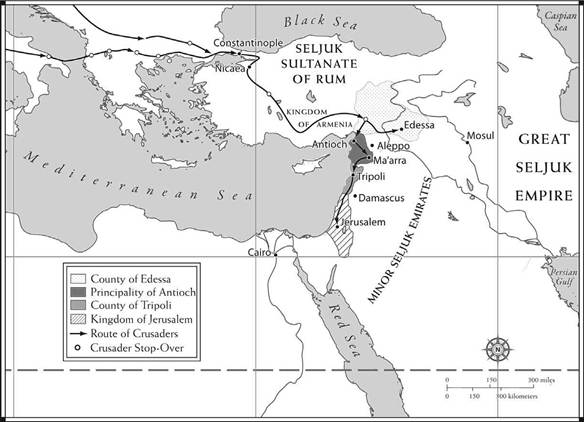
THE THEATER OF THE CRUSADES
The taking of Jerusalem marked the high-water mark of the Franj invasion. The victorious crusaders proclaimed Jerusalem a kingdom. It ranked the highest of the four small crusader states that took root in this area, the others being the principality of Antioch and the counties of Edessa and Tripoli.
Once these four crusader states had been established, a sort of deadlock developed, which ground on dismally for decades. The two sides continued to clash sporadically during these decades, and the Franj won some battles, but they also lost some battles. They pounded the Muslims, but also got pounded, and they quarreled with one another, just as the Muslims were doing among themselves. Sometimes they forged temporary alliances with some Muslim prince to gain an advantage against a rival Franj.
Strange alignments formed and died. In one battle Christian king Tancred of Antioch fought Muslim amir Jawali of Mosul. One third of Tancred’s force that day consisted of Turkish warriors on loan from the Muslim ruler of Aleppo, who was allied with the Assassins, who had links with the Crusaders. On the other side, about one third of Jawali s troops were Franj knights on loan from King Baldwin of Edessa, who had a rivalry going with Tan cred.5 And this was typical.
On the Muslim side, the absence of unity was breathtaking. It stemmed partly from the fact that the Muslims saw no ideological dimension to the violence, at first. They felt themselves under attack not as Muslims but as individuals, as cities, as mini states. They experienced the Franj as a horrible but meaningless catastrophe, like an earthquake or a swarm of snakes.
Its true that after the carnage at Jerusalem, a few preachers tried to arouse Muslim resistance by defining the invasion as a religious war. Several prominent jurists began delivering sermons in which they used the word jihad for the first time in ages, but their harangues fell flat with Muslim audiences. The word jihad merely seemed quaint, for it had fallen out of use centuries earlier, in part because of the rapid expansion of Islam, which had left the vast majority of Muslims living so far from any frontier that they had no enemy to fight in the name of jihad. That early sense of Islam against the world had long ago given way to a sense of Islam as the world. Most wars that anyone could remember hearing of had been fought for petty prizes such as territory, resources, or power. The few that could be cast as noble struggles about ideals were never about Islam versus something else, but only about whose Islam was the real Islam.
Given the turmoil of the Muslim world, perhaps some disunity was inevitable: when the Franj dropped into this snake pit, fractious Muslims simply incorporated them into their ongoing dramas. Not all the disunity was spontaneous, however. The Assassins were busy behind the scenes, sowing turmoil, and quite successfully.
Just before the Crusades began, Hassan Sabbah had established a second base of operations in Syria, run by a subsidiary master whom the Crusaders came to know as the Old Man of the Mountains. By the time the Crusades began, virtually everyone who wasn’t an Assassin hated the Assassins. Every power in the land was trying to hunt them down. The Assassins’ enemies included the Shi’i, the Sunnis, the Seljuk Turks, the Fatimid Egyptians, and the Abbasid khalifate. As it happened, the Crusaders were making war against the same gallery—the Shi’i, the Sunnis, the Seljuk Turks, the Fatimid Egyptians, and the Abbasid khalifate. The Assassins and Crusaders had the same set of enemies so, inevitably, they became de facto allies.
During the first century of the Franj invasions, every time the Muslims began moving toward unity, the Assassins murdered some key figure and triggered turmoil anew.
In 1113 CE the governor of Mosul called a conference of Muslim leaders to organize a unified campaign against the Franj. Just before the meetings began, however, a mendicant approached the governor on his way to the mosque, pretended to beg for alms, then suddenly plunged a knife in his chest. So much for the unity campaign.
In 1124, Assassin agents murdered the second most influential cleric preaching the new jihad. The next year, a group of supposed Sufis attacked and killed another such preacher, the most influential proponent of jihad, the first of this era to revive the call.
In 1126, the Assassins killed al-Borsoki, the powerful king of Aleppo and Mosul who, by uniting these two major cities, had forged the potential core of a united Muslim state in Syria. Borsoki had even taken the precaution of wearing armor under his clothes—he knew that Assassins were lurking about. But as fake Sufis attacked him, one of them cried, ‘Aim for his head!” They knew about his armor. Borsoki died of neck wounds. His son immediately took command and might have saved the nascent state, but Assassins killed him too, and four rival claimants to the throne plunged this part of Syria back into war.
Murders of this sort happened an astounding number of times during the early Crusades. Some of the murders were not proven to have been the work of the Assassins, but once the terrorist narrative had been reified, the terrorists didn’t need to commit all the terrorist acts. They could claim any murder that bore their stamp and use it to forward their cause. Apparently, they kept detailed records of their work, but because they were so very secretive, no outsiders had access to these records at the time, and when the cult was finally destroyed by the Mongols in 1256, it was destroyed so thoroughly its records were almost all erased from history. Therefore no one now knows how many of the murders attributed to Assassins were actually committed by them. Rumors and whispers tell us they cast a grim shadow over their times but we will never know the scope of their impact on the Crusades: the records are gone.
What finally turned the tide against the Franj was a series of Muslim leaders, each of whom was greater than the one before. The first of them was the Turkish general Zangi, who governed Mosul, then took Aleppo, and then absorbed many other cities into his domains until he could reasonably call himself the king of a united Syria. This was the first time in fifty years that a Muslim country larger than a single city and its environs had existed in the Levant (the region between Mesopotamia and Egypt).
Zangi’s troops revered him because he was the archetypal soldiers soldier. He lived as ruggedly as his men, ate what they ate, and put on no airs. He soon decided that Muslims had a single common enemy and began to organize a unified campaign against this enemy. First, he squeezed the weakness out of his machine: he eliminated flatterers from his court and courtesans from his armies. More important, he built a network of informers and propagandists throughout Syria that kept his governors in line.
In 1144, Zangi conquered Edessa, which made him a hero to the Muslim world. Edessa wasn’t the biggest city in the east, but it was the first sizable city the Muslims had taken back from the Franj, and with recapture of Edessa, one of the four “Crusader Kingdoms” ceased to exist. A wave of hope ran through the Levant. A wave of dismay and war fever swept western Europe, inspiring a group of monarchs to organize what turned out to be a dismally ineffectual Second Crusade.
Zangi supported preachers who promoted jihad because he saw jihad as an instrument for unifying the Muslims. Unfortunately Zangi could not very well put himself at the head of a new jihad because he was a hard- drinking, foulmouthed brawler; the very qualities that endeared him to his men offended many of the ulama. He did, however, create an anti-Franj movement that another more pious ruler could build into a real jihad.
His son and successor, Nuruddin, possessed the qualities his father had lacked. Though he shared his fathers martial energy, Nuruddin was polished, diplomatic, and devout. He called on Muslims to unite around one set of religious beliefs (Sunni Islam) and make jihad their central objective in life. He revived the image of the just and pious man who fought not for ego, not for wealth, nor for power, but for the community. In restoring to Muslims this sense of themselves as a single Umma, he gave them back their sense of destiny, nurturing a fervor for jihad that another, greater ruler could use to craft a real political victory.
This greater ruler turned out to be Salah al-Din Yusuf ibn Ayub, commonly known as Saladin, the nephew of one of Nuruddin’s top generals.
In 1163, Nuruddin sent Saladins uncle off to conquer Egypt, just to keep it out of Franj hands, and the general took along his nephew. The general succeeded in taking Egypt, and then promptly died, leaving Saladin in charge. Officially, Egypt still belonged to the Fatimid khalifa, but real power belonged to his vizier, and the Egyptian court gladly accepted Saladin as the new vizier, mostly because he was only twenty-nine years old, and the courtiers thought his youth and inexperience would make him their tool.
Saladin had indeed shown little hint of greatness while living in his uncle’s shadow. Retiring by nature and modest to a fault, he showed no inclination for war. As soon as he took charge of Egypt, Nuruddin told him to abolish the Fatimid dynasty, and the order distressed him. The Fatimid khalifa was a sickly twenty-year-old at this time, who didn’t really rule anything anyway. He was just a figurehead, and Saladin was loathe to hurt his feelings. He obeyed his orders, but he abolished the khalifate so quietly, the khalifa never even knew about it. One Friday, Saladin simply arranged for a citizen to get up in the mosque and recite a sermon in the name of the Abassid khalifa in Baghdad. No one protested and so the deed was done. The frail young khalifa soon expired of natural causes without learning that he was a private citizen and that his dynasty had ended. His death left Saladin as the sole ruler of Egypt.
Now came a series of nonencounters with his supposed boss. Nuruddin kept arranging meetings; Saladin kept making excuses not to be there: his father was sick, he himself was feeling under the weather—it was always something. In truth, he knew that if he met his master face-to-face, he would have to break with him, because he was already the bigger man, king of a more powerful country, and incipient leader of the Muslim cause, and he didn’t want to quarrel about it. So he maintained the fiction that he was Nuruddin’s subordinate until the older man passed away. Then, Saladin proclaimed himself king of Syria as well as Egypt. Some of Nuruddin’s followers cursed him then and called him a disloyal upstart and an arrogant young fool, but they were swimming against history. The Muslim savior had arrived.
He was a man of slight build, this Saladin. He had a pensive air and melancholy eyes, but when he smiled, he could light up a room. Charitable to the point of penury, he was humble with the humble, but majestic with men of might. No one could intimidate him, yet he never stooped to intimidating anyone over whom he had power. As a military leader, he was okay, but nothing special. His power ultimately lay in the fact that people simply adored him.
Saladin sometimes wept at sad news and often went out of his way to perform acts of hospitality and grace. A Franj woman once came to him devastated because bandits had kidnapped her daughter and she didn’t know where to turn for help. Saladin sent his soldiers out to look for the girl. They found her in the slave market, bought her, and brought her back to her mother, and the two went back to the Franj encampment.
In his personal habits Saladin was just as ascetic and demanding of himself as Nuruddin had been, but he was less demanding of others. He was religious but lacked a streak of dogmatism that had marred Nuruddin’s personality.
The Assassins tried hard to kill Saladin. Twice they penetrated right to his bedside while he was sleeping. Once they wounded him in the head but he was wearing a leather neck-guard and a metal helmet under his turban. After these two attempts, Saladin decided to smash the Assassins once and for all. He set siege to their fortress in Syria, but then—
Something happened. To this day, no one knows what. Some say that Sinon, the Syrian head of the Assassins, sent a letter to Saladins maternal uncle promising to have every member of the family killed unless the siege was lifted. The Assassins’ own sources say that in the middle of the night, after having surrounded himself with guards and every other possible precaution against assassination, Saladin woke up to see a shadow passing through his tent wall and to find a piece of paper pinned to his pillow bearing the message, “You are in our power.” That story is surely apocryphal, but the fact that people believed it gives an idea of the power the Assassins had acquired in the popular imagination. This time, however, the usual Assassin tactic backfired, for having tried and failed twice to kill him, the Assassins succeeded only in adding to the legend of Saladin’s invincibility.
Saladin moved carefully, letting his reputation unite his people and soften his enemies. He retook most of the Crusaders’ holdings bloodlessly through encirclement, economic pressure, and negotiation. In 1187, when he finally moved on Jerusalem, he began by sending in a proposal that the Franj relinquish this city peacefully as well. In exchange, Christians who wanted to leave could take their property and depart, Christians who wanted to stay could do so and practice their religion unmolested, Christian places of worship would be protected, and pilgrims would be welcome to come and go. The Franj indignantly rejected giving up Jerusalem, their main prize and the whole point of these Crusades, so Saladin encircled the city, took it by force, and then dealt with it as Khalifa Omar had done: no massacres, no plundering, and all prisoners set free upon payment of a ransom.
Despite the gentility of it, Saladins recapture of Jerusalem did fully reverse the gains of the First Crusade, arousing new consternation in Europe and leading the continents three most important monarchs to organize the famous Third Crusade. One was the German Frederick Barbarossa, who fell off his horse in a few inches of water and drowned on the way to the Holy Lands. One was French monarch Phillip II of France, who made it to the Holy Lands, took part in the conquest of the port of Acre, and then went home exhausted. That left only the English king Richard I, known to his countrymen as the Lionheart. Richard was a formidable warrior, but scarcely deserved the reputation he enjoyed back home as a paragon of chivalry. He broke promises lightly and did whatever it took to win battles. He and Saladin danced around each other for about a year, and Richard won the main battle they fought, but by the time he laid siege to Jerusalem in June of 1192, illness had reduced his strength and the heat had him panting. Saladin sympathetically sent him fresh fruit and cool snow and waited for Richard to realize that he didn’t have the men to retake Jerusalem. Finally, Richard agreed to terms with Saladin, which were roughly as follows: Muslims would keep Jerusalem but protect Christian places of worship, let Christians live in the city and practice their faith without harassment, and let Christian pilgrims come and go as they pleased. Richard then headed home, preceded by the news that he had won a sort of victory at Jerusalem: he had forced Saladin to be nice. In fact, he had secured exactly the terms Saladin had offered from the start.
After this Third Crusade nothing of much significance happened, unless you count the Fourth Crusade of 1206 in which the Crusaders never even made it to the Holy Land because along the way they got preoccupied with conquering and sacking Constantinople and defiling its churches. By the mid-thirteenth century the whole crusading impulse had grown feeble in Europe and at last it just died away.
Historians traditionally count eight Crusades over the course of two hundred years, but really there was at least a trickle of crusaders arriving and leaving at any given time during those years. So its probably more accurate to say that the Crusades lasted about two hundred years, with eight periods during which the traffic swelled, usually because some monarch or coalition of monarchs organized a campaign. Over these two centuries, “crusading” simply became an ongoing activity for Europeans, with some families sending one or two sons off to the wars in every generation, these sons departing when they came of age, not when “the next crusade” was leaving.
The first wave of European knights took a handful of cities and established four quasi-permanent “Crusader kingdoms,” after which would-be crusaders from England or France or Germany always had a place to land and an army to join if they headed east. Some Christians of western European stock were of course born in these kingdoms and lived and died there, but many came east for a few years, did some fighting for the cause, acquired some booty if they were lucky, and went home. The Crusaders built impressive stone fortresses, but their sojourn in the east always had a temporary feel to it.
Some modern-day Islamist radicals (and a smattering of Western pundits) describe the Crusades as a great clash of civilizations foreshadowing the troubles of today. They trace the roots of modern Muslim rage to that era and those events. But reports from the Arab side don’t show Muslims of the time thinking this way, at least at the start. No one seemed to cast the wars as an epic struggle between Islam and Christendom—that was the story line the Crusaders saw. Instead of a clash between two civilizations, Muslims saw simply a calamity falling upon... civilization. For one thing, when they looked at the Franj, they saw no evidence of civilization. An Arab prince named Usamah ibn Munqidh described the Franks as being like “beasts, superior in courage and in fighting ardor, but in nothing else, just as animals are superior in strength and aggression.”6 The Crusaders so disgusted the Muslims that they came to appreciate the Byzantines by contrast. Once they understood the political and religious motives of the Crusaders, they made a distinction between “al Rum” (Rome—i.e., the Byzantines) and “al-Ifranj.” Instead of “the Crusades,” Muslims called this period of violence the Franj Wars.
In areas under attack, Muslims did, of course, feel threatened by the Franj, even horrified by them, but they didn’t see in these attacks any intellectual challenge to their ideas and beliefs. And although the Crusades were certainly a serious matter for Muslims living along the eastern Mediterranean coast, the Crusaders never penetrated deeply into the Muslim world. For example, no real army ever reached Mecca and Medina, only a small raiding party led by a renegade whom even other Franj regarded as a despicable rogue. The Crusaders never laid siege to Baghdad nor did they penetrate historic Persia. People in Khorasan and Bactria and the Indus Valley remained completely unaffected by the incursion and largely unaware of it.
What’s more, the Crusades stimulated no particular curiosity in the Muslim world about Western Europe. No one expended much energy wondering where these Franj had come from, or what their life was like back home, or what they believed. In the early 1300s, Rashid al-Din Fa- zlullah, a Jewish convert to Islam, wrote an epic Collection of All Histories, which included the history of China, India, the Turks, the Jews, the pre- Islamic Persians, Mohammed, the khalifas, and the Franj, but even at this late date, the part about the Franks was perfunctory and undocumented.7 In short, the Crusades brought virtually no European cultural viruses into the Islamic world. The influence ran almost entirely the other way.
And what flowed the other way? Well, the Crusaders opened up opportunities for European merchants in the Levant and Egypt. During the Franj wars, trade between western Europe and the Middle World increased. As a result, people in places like England, France, and Germany obtained exotic goods available in the East, products such as nutmeg, cloves, black pepper, and other spices, as well as silk, satin, and a fabric made from a wonderful plant called cotton.
European merchants, pilgrims, and Crusaders (the categories were not always distinct) returning to Europe reported on the riches of the Muslim world and told tales about even more distant lands, places such as India, and the near-mythic islands of “the Indies.” These stories aroused appetites in Europe that kept growing over the years and were to have tremendous consequences later on.
In the Middle World, however, just as the calamity of the Crusades was subsiding, a second and far more catastrophic assault broke out.
ASSAULT FROM THE EAST
The Mongols originated in the steppes of Central Asia, a vast treeless grassland with hard soil and few rivers. The landscape precluded agriculture but it was perfect for herding sheep and grazing horses, so the Mongols lived on mutton, milk, and cheese, burned dung for fuel, got drunk on fermented mares milk, and used oxen to pull their carts. They had no cities or permanent encampments but lived on the move, sleeping in felt huts called gers (known elsewhere as yurts), which they could easily dismantle and transport.
The Mongols were closely related to the Turks ethnically, linguistically, and culturally, and historians often group them together as the Turko- Mongol tribes. To the extent that they can be considered separately, however, the Turks generally lived further west and the Mongols further east. Where they overlapped, they intermingled somewhat.
Over the centuries a number of nomadic empires had formed and dissolved on the steppes, tribal confederacies that had no core principle of unity to hold them together. In the days of the Roman republic, a group of Turko-Mongol tribes called the Hsiung-nu congealed into a force so fearsome that the first emperor of a united China put about a million men to work building the Great Wall to keep them out. Once they couldn’t raid eastward, the Hsiung-nu turned west and by the time they got to Europe these steppe nomads were known as the Huns. Under Attila they swept all the way to Rome before they dissolved.
In the early days of Islam, a series of ill-defined Turkish confederacies dominated the steppes, but once they moved south they morphed into Muslim dynasties, such as the Ghaznavids and the Seljuks.
The Mongols had raided the Chinese world for many centuries, and a succession of Chinese dynasties had kept them in check by giving them subsidies to stay away, by pitting Mongol chieftains against one another, and by funding upstarts against established chieftains. In this way they had kept the Mongols divided, although truth to tell, the Mongols, like tribal nomads generally, didn’t need much outside help to stay divided.
Then around 560 AH (1165 CE) the brilliant and charismatic Temu- jin was born. History knows him as Chengez Khan (in the West, Genghis Khan), which means “universal ruler,” a title he did not take on until he was about forty years old.
Chengez’s father was a chieftain among the Mongols but was murdered when Chengez was nine. His supporters drifted away, and the family fell upon hard times. For several years, Chengez, his mother, and his younger siblings were forced to live on berries and small game, such as marmots and field mice. Even so his fathers killers felt they would be safer if the son never grew up, so they hunted him throughout his teenage years, and even captured him once, but the boy escaped and did grow up, and lived to make his fathers enemies sorry.
Along the way, he attracted a posse of close companions called nokars. In Persian-speaking lands, the word later came to mean “hired help,” but in Chengez’s day it meant “comrade in arms.” Significantly, Chengez’s nokars did not belong to any single clan or tribe. What held them together as a group was one man’s charisma, so Chengez had, in his nokars, the seeds of an organization that transcended tribal loyalty and eventually helped him unite the Mongols into a single nation under his rule.
In 607 AH (1211 CE), Chengez’s Mongols attacked China’s decrepit old Sung Empire and cut through it like a knife into warm cheese. Seven years later, in614(1218 CE), the Mongols entered the history of the Middle World.
What sort of world did they come upon? Well, after the Seljuks conquered the Muslim world, other Turkish tribes followed them, gnawing away at the earlier Turkish victors’ holdings, and carving out frontier kingdoms of their own. One such kingdom had just started to emerge in Tran- soxiana, and was looking very much like the next big thing in the region. It was the kingdom of the Khwarazm-Shahs. Their king Alaudin Mohammed considered himself quite the military mastermind, and in his arrogance decided to teach the Mongols a lesson. He started by intercepting 450 merchants traveling through his kingdom under Mongol protection. Accusing these poor merchants of spying for the Mongols, he had them killed and took their goods, but he quite deliberately let one man escape so that he would take news of the massacre back to Chengez. He was looking for trouble.
The Mongol lord sent three envoys west to demand reparations. It was probably the last time Chengez would show himself so forbearing. And now, Alaudin Mohammed made his really big mistake. He executed one of the envoys and sent the other two home with their beards plucked out. In this region, one could offer a man no more grievous insult than to pluck out his beard. Alaudin knew this full well, but he wanted to give offense, because he was spoiling for a fight—and he got one. In 615 AH (1219 CE) the great catastrophe began.
We often hear about the Mongol “hordes,” a word that evokes pictures of howling savages swarming over the horizon by the millions to overwhelm their victims with sheer numbers. In fact, horde is simply the Turkic word for “military camp.” The Mongols did not actually field incomparably huge armies. They won battles with strategy, ferocity, and, yes, technology. For example, when they attacked fortified cities, they employed sophisticated siege machinery acquired from the Chinese. They had “composite” bows made of several layers of wood glued together, which could shoot harder and further than the bows used in the “civilized” world. They fought on horseback, and their riding skills were such that some of their victims thought the Mongols were some new species of half-human, half-horse creature previously unknown to civilization. Their horses were hardy and fast but rather small, so a Mongol warrior could grip his horse with his legs, hang off on one side, and fire his arrows from under the horses belly, thus using the body of the beast itself as a shield. Mongols could ride their horses for days and nights on end, sleeping in the saddle and taking nourishment from veins they opened on their horses necks, so that after sacking one city they might suddenly appear at some distant other city so fast they seemed almost to have supernatural powers. Sometimes, the Mongols did bring along extra horses with dummies mounted on them to convey an impression of overwhelming numbers: it was just one more of their many military tricks.
In 615 AH (1219 CE) Alaudin Mohammed commanded far more troops than Chengez, but his immense army did him no good. Chengez smashed it and sent Alaudin fleeing for his life. Fragments of the Khwarazmi Turkish armies turned into gangs of thugs who rolled west, disrupting law and order, and even helped dislodge the last Crusaders from their fortresses, a foretaste of things to come. Chengez scorched Transoxi- ana, the lands on either side of the Oxus River and destroyed famous cities such as Bokhara, where the renaissance of Persian literature had begun two centuries earlier. He razed the legendary old city of Balkh, known to the ancients as “the Mother of Cities,” dumping its library into the Oxus River, hundreds of thousands of handwritten volumes swept away.
Then he marched on Khorasan and Persia, and here the Mongols attempted genocide. No other word really seems appropriate. Writing shortly after the events in question, the Muslim historian Sayfi Heravi said the Mongols killed 1,747,000 when they sacked the city of Naishapur, killing everything down to the cats and dogs. At the city of Herat, he put the toll at 1,600,000. Another Persian historian, Juzjani, claimed that 2,400,000 died in Herat. Obviously these number are inflated. Herat and Naishapur could not possibly have had anywhere near this number of inhabitants in the 1220s.8
Yet the numbers might not be quite as inflated as they may seem at first because when the Mongols came down upon the Islamic world, people fled from their depredations—they had to. The Mongols burned fields, destroyed crops, stripped peasants of their livelihood, and promoted tales of their murderous fury as a strategy of war. They intended for the news and fear of their deeds to travel fast and far so that subsequent cities they attacked would not put up any fight.
One city they attacked in northern Afghanistan was called—well, I don’t even know what it was called originally. Today, it’s called Shari Gholghola—the City of Shrieking, and all you see there now is a heap of rubble and mud and stones. So it’s quite possible that by the time the Mongols attacked any major city such as Herat, it was swollen by refugees from hundreds of miles around. It may be that when these cities finally fell, it wasn’t just their original population but the population of the entire region that perished.
No one could really know how many died. Surely no one actually went out to the battlefields and counted the dead. But even if these numbers aren’t really statistics, they function as impressions of scale, as expressions of how it felt to be alive in the shadow of such massacres, such horror. Nobody told any such stories about the Seljuks or the other earlier Turks. The Mongol invasion was clearly a disaster on a different scale.
Whatever the numbers were based on, there must have been some truth to them. Two histories completed around 658 AH (1260 CE), one in Baghdad, one in Delhi, gave almost exactly similar accounts of these
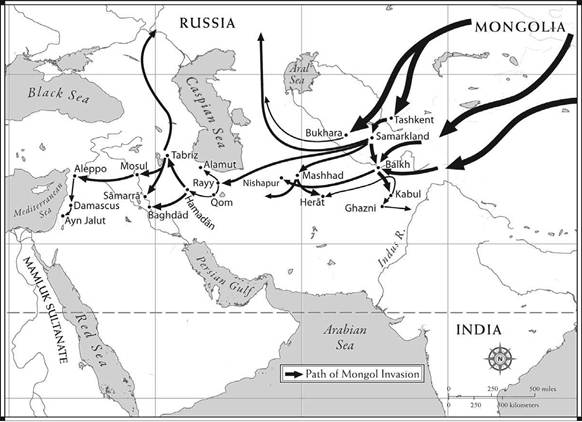
THE MONGOL INVASIONS OF THE ISLAMIC WORLD
horrors, roughly the same statistics for the casualties. The two historians could not have known each other, and they were writing more or less simultaneously, so neither one could have used the other as his source. Both then were recounting what was in the air, what people were saying from Delhi to Baghdad.
When the Mongols attacked Persia, they destroyed, among other things, the qanat, ancient underground canal works that were, to an agricultural society in a riverless land, life’s blood itself. Some of the qanats were destroyed outright and some filled up with sand and vanished just as surely as if they had been deliberately destroyed because no one was left to repair them. When the Arab geographer Yaqut al-Hamawi wrote a description of western Iran, northern Afghanistan, and the republics north of the Oxus River a few years before the Mongol invasion, he described a fertile, flourishing province. A few years after the invasion, it was a desert. It still is.
Chengez did not live to carry out all the destruction wrought by the Mongols. He died in 624 AH (1227 CE), but after his death his empire was divided among his various sons and grandsons, who continued the holocaust. The core of the Muslim world fell into the hands of Chengez’s grandson Hulagu, and since not all of this territory had been conquered yet, Hulagu took up where his grandfather had left off.
A curious footnote to the Mongol holocaust occurred in 653 AH (1256 CE), when Hulagu was passing through Persia. A Muslim jurist near Ala- mut complained to the Mongol khan that he had to wear armor under his clothes all the time for fear of the Assassins headquartered nearby. A short time later, two Fedayeen (suicidal Assassin agents) disguised as monks tried to kill Hulagu—and failed. They might as well have tried to pluck out the mans beard. The cult that could kill anyone met the army that could kill everyone. Hulagu took time out from his westward drive to storm Alamut. He then did to the Assassins what the Mongols had done and would do to many others: he destroyed them physically; he destroyed their stronghold; he destroyed their records, libraries, and papers—in that moment, the menace of the Assassins came to an end.9
After Hulagu had annihilated the Assassins, he marched on to Baghdad. There, he posted a threatening letter to the last Abassid khalifa, in which, according to the historian Rashid al-Din Fazlullah, he said, “The past is over. Destroy your ramparts, fill in your moats, turn the kingdom over to your son, and come to us.... If you do not heed our advice... get ready. When I lead my troops in wrath against Baghdad even if you hide in the sky or in the earth, I shall bring you down. I shall not leave one person alive in your realm, and I shall put your city and country to the torch. If you desire to have mercy on your ancient family’s heads, heed my advice.”
The Abbasid khalifate, however, had been showing signs of life recently, and an occasional khalifa had even bid for real power, at the head of actual troops. The khalifa in place at this moment was one of the cocky ones. In his pride, this khalifa wrote back to Hulagu: “Young man, you have just come of age and have expectations of living forever. You... think your command is absolute.... You come with strategy, troops, and lasso, but how are you going to capture a star? Does the prince not know that from the east to the west, from king to beggar, from old to young, all who are God-fearing and God worshipping are servants of this court and soldiers in my army? When I motion for all those who are dispersed to come together, I will deal first with Iran and then turn my attention to Turan, and I will put everything in its proper place.”10
The attack on Baghdad began on February 3, 1258. By February 20, Baghdad was not just conquered. It was pretty much gone. The Mongols had a proscription against shedding royal blood; it ran against their traditions; they just didn’t do that sort of thing. So they wrapped the khalifa and members of his family in carpets and kicked them to death. As for the citizens of Baghdad, Hulagu’s Mongols killed virtually every one of them. The only ambiguity about how many people the Mongols killed at Baghdad has to do with how many there were to kill. Muslim sources put the toll at eight hundred thousand. Hulagu himself was more modest. In a letter to the king of France, he claimed he had killed only two hundred thousand. Whichever the case might be, the city itself was burned down, for Hulagu kept his promises. All the libraries and schools and hospitals, all of the city’s archives and records, all the artifacts of civilization enshrined there, all the testimonials to the great surge of Islamic civilization in its golden age, perished utterly.
Only one power managed to hold the line against the Mongols and that was Egypt. No one else ever dealt the Mongols a straight-up military defeat, not here, not anywhere.
Saladin’s descendants still ruled this region when the Mongol onslaught began, but by 1253 they were exhibiting the typical ailments of aging dynasties: pampered weaklings occupied the throne and predatory rivals circled round it. One day the king died, leaving no obvious heir. His wife Shajar al-Durr briefly took over as sultan, but then the mamluks, that corps of elite slave soldiers, got together and chose one of their own number to marry the sultan, whereupon he became the de facto sultan.
Hulagu was destroying Baghdad right about then. When he finished, he started south, following the well-traveled route of conquerors. But Egypt’s greatest mamluk general, Zahir Baybars, confronted Hulagu at Ayn Jalut, which means “Goliath’s spring.” In biblical times, according to legends, David had defeated Goliath at this spot. Now, in 1260 GE, Baybars was the new David and Hulagu the new Goliath.11
David won again. (Incidentally, the Muslims used a new type of weapon in this battle: the hand cannon, or as we now call it, the gun. This might have been the first battle in which guns were used to any significant effect.)
Back in Cairo, meanwhile, Shajar al-Durr and her husband somehow killed each other in the bath—the sordid details remain murky. Baybars, covered with glory from his victory at Ayn Jalut, came marching into the confusion and took control, founding the so-called Mamluk dynasty.
A mamluk, as I mentioned, was a slave, usually Turkish, brought to the palace as a young boy and trained in all the military arts. Quite often in the history of the middle world, a mamluk had overthrown his master and launched a dynasty of his own. The one that Baybars founded, however, was different.
It wasn’t a true “dynasty” because the principle of succession wasn’t from father to son. Instead, each time a sultan died, his inner circle of most powerful mamluks chose one of their own number to be the new sultan. In the meantime, new mamluks kept rising through the ranks on merit, ascending into the circle of most-powerful mamluks, a position from which any of them might become the next sultan. Egypt, therefore, was not ruled by a family, but by a military corporation constantly refreshing its ranks with new mamluks. It was a meritocracy, and the system worked. Under the mamluks, Egypt became the leading nation in the Arab world, a status it has never really relinquished.
Although the Mongols conquered the Islamic world in a roaring flash, the Muslims ended up reconquering the Mongols, not by taking territories back through war, but by co-opting them through conversion. The first conversion occurred in 1257 CE, a khan named Berke. One of Hulagu’s successors, Tode Mongke, not only converted but declared himself a Sufi. After that the Mongol ruling house of Persia produced more rulers with Muslim names. In 1295, Mahmoud Ghazan inherited the Persian throne. He had been a Buddhist but converted to Shi’ite Islam, and his nobles soon converted as well; his descendants went on to rule Persia as the Muslim Il-Khan dynasty.
After his conversion, Ghazan told his Mongol nobles to let up on the locals. “I am not protecting the Persian peasantry,” he assured them. “If it is expedient, then let me pillage them all—there is no one with more power to do so than I. Let us rob them together! But—if you commit extortion against the peasants, take their oxen and seed, and cause their crops to be consumed—what will you do in the future? You must think, too, when you beat and torture their wives and children, that just as our wives and children are dear to our hearts, so are theirs to them. They are human beings, just as we are.”12 That doesn’t sound like something Hulagu or Chengez would have said. Ghazan’s words were one small sign that in the wake of the Mongol holocaust, Islam and civilization were going to come back to life after all.
More on the topic Havoc:
- Demonic wails, shouts and chants haunt the monastic literature of late- antique Egypt, wreaking havoc in the lives of monks.
- Narcissism in the DSM-5
- The OUN and Nazi Germany
- Perverse Armies of Luan
- Control Movements and Decisions
- East and South East Asian Piracy
- Concluding Remarks
- CONTENTS
- Boon Andrew. The Ethics and Conduct of Lawyers in England and Wales. Hart Publishing,1999. — 808 p., 1999
- Griffiths-Baker Janine. Serving Two Masters: Conflicts of Interest in the Modern Law Firm. Hart Publishing,2002. — 227 p., 2002
- Grisso T.. Evaluating Competencies: Forensic Assessments and Instruments. 2nd edition. — Springer,2002. — 564 p., 2002
- Luban David. Legal Ethics and Human Dignity. Cambridge University Press,2007. — 350 p., 2007
- Ayupova Z.K.. Theory of state and law: textbook. - Almaty: Kazakh University,2015. - 192 pages., 2015
- Allen Danielle, Benkler Yochai et al. (eds.). A Political Economy of Justice. The University of Chicago Press,2022. — 416 p., 2022
- Barnes Rudolph C.. Military Legitimacy: Might and Right in the New Millennium.Frank Cass,1996. — 198 p., 1996
- Bedner Adriaan (ed.).. Real Legal Certainty and its Relevance: Essays in Honor of Jan Michiel Otto. Leiden University Press,2018. — 261 p., 2018
- Fridson M., Alvarez F.. Financial Statement Analysis. John Wiley & Sons, Inc.,2002. — 413 p, 2002
- Banking, Finance, and Accounting: Concepts, Methodologies, Tools, and Applications. IGI Global,2014. — 1593 p., 2014