IMPACTS ON COLONIZED PEOPLES AND TERRITORIES
—European rule led to large-scale redistributions of the world’s peoples. The population of many colonies—and of their new-state successors—was far more racially and culturally diverse than in precolonial times.
Prior to the fifteenth century all or almost all inhabitants of a given continent could trace their ancestry to people from that continent. Formation of European empires made possible, and greatly facilitated, massive flows of people from continents of origin to other regions. Over a five-century period tens of millions of Europeans emigrated, substantial settler communities being established only in areas claimed by metropoles. Over a four-century period tens of millions of Africans were transported as slaves to plantation-based colonies in the Americas. In phase 3 Indians and Chinese migrated as indentured servants to colonies in Africa, Southeast Asia, the Indian Ocean, and the Caribbean.
These movements altered the demographic composition of many regions. Especially affected were areas in which diseases carried by newly arriving groups decimated indigenous peoples. The New World and Oceania were radically changed in this respect, Africa and Asia far less so.
To the extent that race denotes continental origin, European empires made race relations a persistently significant issue for the modem world. The multiracial character of many colonies profoundly affected the way social relations and political life were organized after independence. It was difficult for people visibly unlike each other as well as culturally diverse to feel part of the same country, with citizenship rights in common. In phase 2 states it was impossible for indigenous peoples and those of African descent to belong to the country in which they lived because people of European descent denied them basic political and legal rights. This exdusivist attitude to citizenship postponed until the twentieth century a serious commitment by most phase 2 states to incorporate non-European groups into national life.
In European countries religious, class, and regional cleavages have historically been sources of conflict. Not so with race. In sharp contrast, colonies were arenas of interracial contact and conflict from the moment the first Europeans arrived. Race relations was a contentious issue that could not be ignored and did not go away, particularly in territories with large settler populations.
By phase 5, however, metropoles were no longer insulated from the racial pluralization their presence and policies produced elsewhere. Whereas the state spread from Europe to the colonies, the plural society spread from the colonies to Europe. Since the end of World War II hundreds of thousands of people have migrated from newly independent countries to former metropoles. Extensive communities from the West Indies, India, and Pakistan now reside in Great Britain; likewise Algerians, Moroccans, Senegalese, and Malians in France, Zaireans in Belgium, and Indonesians in Holland. As “the empire strikes back” through these migrations, Britain and France above all have wrestled with problems arising from growing heterogeneity. Contemporary Europe has a great deal to learn from former colonies about how to manage the subtle tensions and overt conflicts experienced by multiracial societies.
—The racially based stratification system of the colonial era is a primary determinant of social relations today.
In European history struggles for equality occurred among people with the same racial background. These struggles were bitter at times. But they lacked the emotional intensity of comparable struggles in colonies and their independent successors, where race not only marked observable biological differences but also signified economic and status inequalities. Close links between difference and inequality produce an unusually durable stratification system. Once a racial category becomes a socioeconomic caste it is extremely difficult for those at the scale’s lower end to move up, and potentially explosive of social relations if they do.
In territories where settlers were preoccupied with maintaining racial purity, sexual anxieties and rivalries added fuel to an already combustible mix. Where settlers inherited the public sector at independence—as in phase 2 states and South Africa—non-Europeans found it even more difficult to raise their collective position because the power of government was used to reinforce colonial-era inequalities.—Colonial rule begat anticolonial nationalism and hence eventually undermined itself. But since virtually all nationalists wished to retain key aspects of the public sector Europeans put in place, many features of colonial government carried over to successor regimes. The territorially bounded, bureaucratic, sovereign state is the joint product of colonialism and nationalism, a dialectical synthesis of two apparently opposed forces.
Metropoles turned colonies into protostates by transferring many of their public sector institutions. Metropoles also spread the idea that a state was the most advanced political form devised by humanity. The one thing colonies lacked—sovereignty—was the one thing nationalists demanded. In effect, nationalists criticized not the fact of public sector transfer but its incompleteness, insisting on nothing less than full replication of the metropole’s status. At one level the demand for independence was a rejection of foreign rule. At another level it was a ringing affirmation of the structural and ideological form foreign rule took. The goal was to capture the protostate, not to dismantle or fundamentally rearrange it. Hence a paradox: The result of the nationalists’ success at terminating European global dominance was global diffusion of Europe’s governance model.
The spread of this model has produced a far more homogeneous pattern of political organization than would have existed in the absence of overseas empires. Five centuries ago many of the world’s peoples lived in stateless societies, small-scale chiefdoms, and self-governing cities.
These forms became increasingly rare as they were encompassed by colonial boundaries and their autonomy undercut by externally imposed bureaucracies. Today’s world is a collection of states; its peoples define themselves, among other things, as citizens of states? That this observation is now little more than a truism underlines the distance humanity has traveled in a few centuries, from many governance modes to one overwhelmingly predominant one.—The colonial origin of public sector institutions often reduces their effectiveness and legitimacy.
An imperial legacy in many parts of the world is a lack of fit between social structure and political institutions. Society has become more heterogeneous owing to demographic changes noted earlier. But public sector institutions have become more homogeneous, in the double sense that the same institutions govern citizens with diverse racial and cultural backgrounds within a country and that governing institutions in very different countries resemble each other. Where government has been shaped more by external forces than by its own society, rulers may not consider themselves accountable to those they rule, and citizens may regard government procedures and policies as illegitimate.
In countries where colonial administrators, judges, and police were harsh and unpopular, retention of the institutions that employed them can undermine legitimacy even when the offending foreigners have been replaced by local personnel. The perception that government is an alien force can last a long time. It can encourage pillage of public funds for private purposes, pillagers regarding the treasury as the possession not of the nation but of foreign exploiters who deserve to be robbed? This practice further lowers support for government by diverting resources officials might have devoted to the collective good.
—Whether a new state becomes democratic depends in large measure on whether colonywide representative institutions were in place and functioning effectively before independence.
While the presence of colonial legislatures cannot ensure democracy in later years, its absence appears to be a sufficient condition for maintenance of authoritarian rule.By their nature colonial regimes were authoritarian: bureaucracies carried out decisions made by foreigners who were unaccountable to local people. The top- down character of government was bequeathed to new states. The Nigerian historian Stephen Akintoye’s description of the African scene applies to other regions as well: “The isolation of the government from the governed, the refusal to tolerate opposition or criticisms, the fear of delegating authority, the branding of all virile opposition as treasonable action—all these were learned from Africa’s colonial masters by the Africans who took over African governments at independence.”5
The most effective counterweight to authoritarian rule after independence was an elected legislature capable of restraining the executive branch. If a legislature was in place at independence and had shown that it could influence decisions of colonial authorities, then it had a reasonable chance of survival. In this respect Britain’s possessions differed significantly from the rest. That the Westminster model should have been transferred to settlers is not surprising; that it was eventually transferred to occupation colonies at the insistence of nationalists is more so. But importing this particular foreign institution made sense because, unlike a bureaucracy, a legislature comes ready-made for rapid capture.
How long the Westminster model lasted after Britain left depended on many factors, including the personalities and values of political leaders. Jawaharlal Nehru was committed to a multiparty electoral system and open parliamentary debate. Kwame Nkrumah was not, and by the mid-1960s he had become a dictator eagerly fanning the flames of his own personality cult. The opposing strategies of the two men account in part for the diverging political trajectories of India and Ghana.
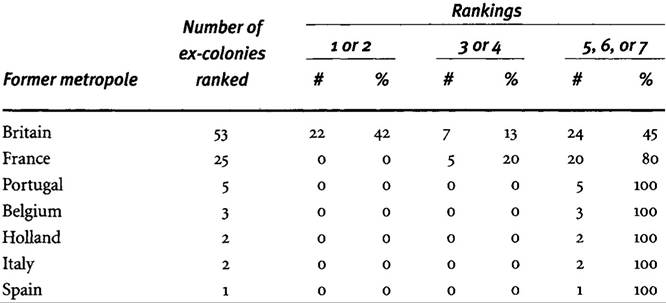
An effectively functioning colonial legislature does not guarantee competitive electoral systems, as the large number of undemocratic ex-British colonies in 1980 shows (table 16.1).But absence of such a legislature is virtually a sufficient condition for failure of competitive elections to take root. To confine discussion to the quarter century after independence, these two negative features are found in all phase 2 countries except the United States and in such phase 5 countries as Vietnam, Indonesia, Zaire, Algeria, and Angola. (Spain permitted settlers representative government at the local level but not in larger administrative units.)
Further support for the double negative hypothesis comes from an analysis of patterns in phase 5 new states. Freedom House’s annual survey Freedom in the World
TABLE 16.1.
POLITICAL RIGHTS IN PHASE 5 NEW STATES AS OF 1980
Source: Raymond Gastil, Freedom in the World (1980), tables 1,3, pp. 14-18.
ranks countries on a 1-7 scale according to political rights their citizens exercise. Countries rated 1 and 2 conduct regular competitive elections. Those rated 5 through 7 lack formal mechanisms for meaningful electoral choice and are typically governed by single parties or despots. Countries ranked 3 and 4 He between these extremes. In 1980 all former colonies of metropoles ruling in a clearly authoritarian manner— Portugal, Belgium, Holland, Italy, and Spain—scored in the 5-7 range. The same applies to all these countries as of 1990. Britain’s former colonies are about evenly divided between the 1,2 and 5,6,7 categories. The ratio improves to 22:18 if one excludes the six Arabian peninsular quasi colonies whose domestic affairs Britain never firmly controlled. France occupies an intermediate position, consistent with an intermediate pattern of representation in the Fourth Republic: colonies could send delegates to the Assemblee Nationale in Paris, though not until the late 1950s were territorial legislatures with any real authority established.
To know what leads new states toward or away from democracy, a starting point is to examine what kinds of representative institutions, if any, were established by former metropoles.
—Colonial administrative boundaries have proven unusually durable. With few exceptions they constituted territorial borders at independence, and they define the size and shape of the great majority of states today.
Among phase 2 countries the United States is a partial exception to this generalization. It is a postcolonial invention, both because the shift from confederation to a federal system did not occur until the late 1780s and because boundaries steadily expanded westward for decades after independence. But even here the old boundaries mattered, for it was the thirteen ex-colonies that debated and authorized the union’s formation and became its original constituents. As for other phase 2 states, Haiti and the Dominican Republic retain the border between French- and Spanish- ruled portions of Hispaniola. Brazil closely resembles the late phase 1 Portuguese viceroyalty. Boundaries of ex-Spanish states were drawn along familiar lines, in some instances replicating viceroyalties, in others captaincy-generals and audiendas.
The generalization fits phase 5 states. Major exceptions are in South Asia: the last-minute partition of India that produced Pakistan, followed in 1971 by secession of East Pakistan to become Bangladesh. Separate colonial units were consolidated when Cameroon, Somalia, and Malaysia were formed. But consolidation efforts such as the Guinea-Ghana Union, Mali Federation, and East African Federation lasted only a short time before the territorial units of colonial days reasserted themselves as separate states.
One reason for continuity is that a colony’s public sector was structured to administer the territory demarcated by its boundaries. Once the geographic and functional scope of their activities was fixed, bureaucrats found it convenient and in their interest to maintain the status quo. They also did what bureaucrats everywhere are famous for doing: fighting with skill, determination, and the resources at their disposal to protect their turf. With independence the personnel of central government agencies changed. But discontinuity in a bureaucracy’s staffing patterns was fully compatible with continuity in its geographic scope. If anything, people newly installed in government posts were determined to preserve inherited job descriptions. Central government employees generally favored keeping the independent state as it was, neither dividing it into smaller units nor merging with other states. Ambitious or idealistic politicians might on occasion call for such changes, but the collective weight of national bureaucracies was arrayed on the side of conservatism.
The most striking evidence of boundary continuity comes from sub-Saharan Africa. Here one would expect the greatest change in the number, size, and shape of postindependence states, because borders were externally imposed and in most cases bore no relationship to social and political realities on the ground. Independent African states might have fragmented into units based on ethno-linguistic identities. Or they might have joined to form larger entities, consistent with pan-African ideology and with the argument that existing states were far too small to be economically viable. Instead old patterns were maintained virtually intact into the 1990s. Secessionist movements in the Congo, Nigeria, and the Sudan failed. Rebels fought not in the name of ethnic autonomy but on behalf of multiethnic administrative units— Katanga, Nigeria’s Eastern Region (Biafra), Southern Sudan—whose boundaries had been arbitrarily set by Europeans. Had secession succeeded, the new boundaries would have been just as artificial and externally imposed as the old ones. Almost all efforts at supranational political integration also failed.
A plausible explanation is that civil and military bureaucracies, entrenched at independence, constituted a country’s most powerful domestic interest group. Rapid personnel growth immediately following independence gave these institutions additional clout.6 There was little political leaders could do when confronted by the preference of strategically placed groups for existing boundaries.
The experience of the first independence movement supports this argument in a reverse way. Of all the colonies Europeans formed, the thirteen in bna had perhaps the most rudimentary bureaucracies. The colonies thus lacked interest groups that might have pressed successfully for thirteen separate territories following England’s defeat at Yorktown. In these circumstances politicians had an unusually high level of freedom to experiment with new forms of government, including changes in boundaries. The least bureaucratized of Europe’s colonies generated the most far-reaching challenge to inherited institutions and boundaries.
—A substantial majority of new states retained the language of the former metropole when they conducted official business.
One would expect linguistic continuity in countries governed by people of European descent. Since independence English has been the sole language of central government in the United States and Australia, Spanish in Mexico and Argentina, Portuguese in Brazil. Countries with a dual-settler heritage retained both languages: Canada (English and French) and white-ruled South Africa (Afrikaans and English). Of greater interest is that many states ruled by non-European elites opted to retain the colonial language. These include Asian and African countries in which a substantial majority do not speak a European tongue. In about half of the more than eighty phase 5 states for which information is available, the only language accorded official status is that of the former metropole. In an additional sixteen countries it shares that status with an indigenous language.7
One reason for retaining the colonial language in a multilingual country is that it may be the only one known to everyone in the political and bureaucratic elite. And some ex-colonies are exceedingly multilingual: in fifteen more than a hundred languages are spoken.8 Another reason is that selecting a non-European alternative can prove contentious, alienating speakers of languages not chosen. That Arabic is the sole official language of the Sudan has long angered those in the three southern provinces, only about i percent of whom speak it. This grievance figures prominently in the civil war afflicting the country for most of the last four decades. The Indian government’s commitment to Hindi as a co-official language with English met tremendous resistance in southern regions, where Hindi was not commonly spoken. Mauritania’s adoption of Arabic in 1966 as a co-official language with French triggered riots by non-Arab speakers. Togo removed two indigenous languages shortly after independence and has kept only one—French—ever since.9
A consequence of retaining the colonial language in countries where most people do not speak it is that only a minority of the population is eligible for election or appointment to central government posts.10 This limits the pool of talent available to serve the public at home and abroad. And it raises the question posed of educated nationalists in an earlier period: whether leaders are so acculturated to Western ideas, values, and consumption patterns that they poorly represent the interests of people on whose behalf they speak.
—Colonial rule spread the idea that continuous economic development is possible and desirable.
The explore-control-utilize worldview impelled much European activity overseas and contributed hugely to colonial economic development. Europeans vastly increased the volume and range of marketable output. They did so by assembling a transformational package of available natural resources, a local and imported labor force, imported plants and animals, capital, new technologies, profit-driven organizations, and intercontinental trade networks.
Phase 2 settler nationalists shared this commitment to realize the economic potential of their environment—they were, after all, themselves bearers of European attitudes to distant frontiers. But non-European nationalists in phases 4 and 5 adopted the same stance. Their education, their awareness of economic and technological advances in other parts of the world, and their knowledge of wealthgenerating activities in their own territories led them to place high priority on development. Colonizers were criticized not for trying to stimulate growth but for imposing so many of its costs on the colonized population and allotting most of its benefits to themselves. If anything, twentieth-century nationalism had a more ambitious transformative agenda than its phase 2 predecessor. The greater the economic gap separating imperial centers from peripheries, the more pressing the need to catch up.
Industrialization was attractive to non-European nationalists because they felt the value added from factory production had been appropriated by metropoles and deliberately denied the colonies. The radical demand to bring heavy industry and hydroelectric power to new states was also conservative, in the sense that its goal was to emulate the most advanced countries’ experience. Just as nationalists embraced the European state as a political model while rejecting European control of the state, so they embraced European industrialization as an economic model while rejecting European appropriation of gains from mass-production technologies.
Japan’s and Russia’s launching of industrialization drives in phase 3 reinforced nationalists’ arguments that independence was a precondition for industrial development. Meiji and tsarist reformers took advantage of their countries’ sovereignty to promote rapid defensive modernization. Such policies could not be adopted in colonies because control over economic affairs lay in the hands of metropoles threatened by defensive modernization.
The explore-control-utilize syndrome was conducive to imperial expansion. Its diffusion to colonized peoples contributed to imperial decline. Diffusion also affected postcolonial relationships. Because colonized peoples became more like Europeans in adopting a developmental stance to Nature, the basis was laid for extensive international economic ties after political ties were severed. Phase 5 new states, like their phase 2 predecessors, wanted European capital and technology. The desired transfers were primarily through the private profit sector for phase 2 states (portfolio investment) and largely through the public sector (foreign aid) for phase 5 states. But behind different modes of transfer lay the fundamental similarity that transfer was taking place, and on terms both sides could live with. Ex-metropoles learned they could deal profitably with ex-colonies because ex-colonies wanted what was needed to catch up to them. The shared commitment to make nature useful moderated old antagonisms and made postcolonial relations more congenial and interdependent than might have been expected.
Cutting political ties with a metropole made it possible to arrange economic exchanges with numerous European countries. The independence of South American countries enabled British private interests to invest profitably in the continent’s mines, railroads, and utilities. Phase 5 states negotiated aid agreements with many European countries as well as with the two superpowers. As transnational European institutions developed, diplomats from new states negotiated with people representing the region and not simply its individual countries. Several rounds of negotiations between the European Economic Community and African, Caribbean, and Pacific states produced conventions governing trade, investment, and aid.11 In both decolonization phases the end of empire meant that Europe mattered more to excolonies even as ex-metropoles mattered less.
—Colonial-era patterns of extraction, production, transport, and trade carried on into independence. In general, this economic legacy was even more durable than the political one.
Earlier chapters noted the emergence of open colonial economies with high ratios of trade to gross domestic product and exports consisting mainly of unprocessed or semiprocessed primary products. When new-state elites had little interest in changing this arrangement, as in nineteenth-century Latin America, the fact that it continued should not be surprising. But even phase 5 nationalists committed to reversing inherited patterns found it difficult if not impossible to do so once they came to power. Earlier investments in mines, plantations, roads, railways, and port facilities constituted sunk costs that could be recovered and generate profits only if they continued to operate much as they had. New governments anxious to industrialize had to decide how to finance the heavy up-front costs of new factories and related infrastructure. Borrowing abroad was risky, especially if loans could not be repaid. High debt levels could lead not only to economic crisis as scarce resources were diverted to repayment but also to loss of sovereignty as lenders imposed macro- economic policy conditions on “structural adjustment” bailout packages. Foreign exchange generated through the existing export base had the advantage of preserving a semblance of policy autonomy. Thus, in order to change the composition of imports and domestic output many new states found they had little choice but to retain the composition of exports. A planned break with the past entailed unexpected continuity with the past. Only in rare instances was a phase 5 country able substantially to increase the manufactured component of exports within the first quarter century of independence.
New states generally avoided lowering the levels of external exposure they inherited. In rare cases such as Haiti and Burma small countries turned inward. India had a sufficiently large domestic market and industrial base to shift toward self- reliance after 1947. But these are exceptions. Most new states remained highly vulnerable to external economic trends. They benefited if terms of trade rose but lost out if terms declined, as happened over the long term for many countries. The elaborate multiyear plans announced with fanfare by phase 5 states were in effect efforts to hide, through largely symbolic rituals, inability to chart the economic future.
Once large-scale colonial operations like mines, plantations, and ranches were in place, there were strong economy-of-scale arguments to retain them after independence. It made little difference in this respect if ownership passed from private to public hands. Nationalization might be politically radical. But it was economically conservative, in the sense that new public sector owners only confirmed colonial-era patterns of commodity production. Returning to small-scale, localized, kin-based units of precolonial days was out of the question, at least for goods traded on the world market.
—Imperial rule helped Christianity become a world religion.
What I have termed Euro-Christianity spread with the dispersal of settler communities, and some version of it was adopted as the official faith of most phase 2 regimes. But it spread as well among non-Europeans in response to the work of missionaries. The sectoral autonomy of religious bodies and their calling to go out to all the world meant that they did not confine their work to areas incorporated into overseas empires. But it is in these areas that their campaigns were most successful over the long term, in large part because public sector resources and protection sustained missionary endeavors. Who governed the state affected how people worshiped. Euro-Christianity’s spread was hindered in noncolonized areas like Japan and China, where ruling elites saw its doctrine and its followers as political threats.
—For many intellectuals and other opinion leaders in new states, the struggle for psychological independence was more protracted and emotionally exhausting than the struggle for political independence. Images people held of themselves and their abilities continued to be affected by negative stereotypes derived from the colonial era.
The superiority complex was a legacy centuries of global dominance bequeathed to Europeans. The inferiority complex was a legacy with which many residents of colonies and ex-colonies have had to grapple. One response of people to being told repeatedly that they were inadequate was angrily to deny the charge. Resentment at being humiliated by colonial authority figures was salient in the discourse of nationalist movements. One sees it in the reaction of Spanish American creoles to the slights of peninsulares, and even more so in the rage non-Europeans expressed over racially based taunts and acts of discrimination.
In general, leaders of independence movements did not try to replace one superiority complex with another. They argued not that the colonial nation was morally, intellectually, or culturally better than the metropole but rather that it deserved to be treated as the equal of nations elsewhere. Phase 5 movements phrased the crusade for equality in universalistic terms. All human beings possessed certain rights, above all the right not to be treated as subhuman. Independence was the political manifestation of the fundamental claim to dignity, as well as a way of ensuring that the claim would not be violated again. In Nkrumah’s words, “It is only when people are politically free that other races can give them the respect that is due to them. It is impossible to talk of equality of races in any other terms. No people without a government of its own can expect to be treated on the same level as peoples of independent sovereign states.”12
Another response, found among non-Europeans who attended Western-style schools, was to concede that the colonizer’s civilization was superior but to insist that they be offered opportunities to become part of it through cultural assimilation. This approach internalized the inferiority complex at the collective level of indigenous culture while rejecting it at the individual level. In territories in which colonial rulers adopted assimilationist policies, postcolonial elites consisted primarily of individuals who had struggled to cross the cultural line—and succeeded. These people might use populist rhetoric on appropriate public occasions. But how plausible was their national leadership when they had devoted so much effort to rejecting the culture of their fellow citizens? Neither were they inclined to ask how indigenous ways of thinking and acting might resolve their country’s problems. Intent on modernization, they tended to regard traditional rulers, folk religions, herbalists and their remedies, old patterns of dress, traditional handicrafts and the like as relics of a primitive past that did not deserve to survive.
Another response among non-Europeans was to believe the claim that they were individually and collectively inferior. This was of course a deeply disturbing thought. Subconscious internalization of the inferiority complex was the most pernicious outcome of all.
The inferiority complex could coexist with other responses, including anger at the way one’s people were being humiliated and exploited. Frantz Fanon writes bitterly in The Wretched of the Earth of the evils of colonialism, urging the colonized to take up arms against their white oppressors. The same author, in Black Skin, White Masks, writes in tortured prose about the self-hatred he cannot escape because his whole social environment relentlessly conveys the message of black inferiority.
However they coped with accusations of inadequacy, non-Europeans had to devise coping mechanisms of some sort, which took time and emotional energy. The existential challenge of battling what the Indian cultural theorist Ashis Nandy calls “the intimate enemy: the loss of self” threatened to distract individuals from the challenge of making the most of their country’s newly won independence.13 Excitement about shaping a better future was less intense when demons from the past had to be exorcised.
Stephen Jay Gould eloquently describes the effects of doubting one’s competence and feeling ashamed of a group with whom one is identified. Gould’s words apply to more than colonial and postcolonial situations. But European overseas rule did more than anything else to shape the racial and cultural forms self-hatred takes in the modem world. “We only get to go through this world once, as far as we know,” Gould writes, “and if our lives are thwarted, if our hopes are derailed, if our dreams are made impossible by limitations imposed from without, but falsely identified as residing within us, then in a way that’s the greatest tragedy one can imagine. And millions—hundreds of millions—of human lives have been so blighted.”14