Introduction
The motivation for this model is to explore how the Canonical Theory Cioffi-Revilla (2005), implemented by a computational agent-based model (ABM Cioffi-Revilla 2014, pp. 287-301), generates sociopolitical phase transitions, whereby polities form and dissolve as people migrate to larger, more complex communities.
This process of settlement and abandonment exists in the archaeological record of the Zambezi Plateau in present-day Zimbabwe (Fig. 13.1). The process of site abandonment is significant for two reasons: (1) it is key to understanding how the earliest polities in Sub-Saharan Africa originated (“politogenesis”) and why they dissolved; and (2) the abandonment and subsequent condition of the Great Zimbabwe polity site is highly significant for ancient and modern Southern African history Fontein (2006, p. 771).The walled enclosure of Great Zimbabwe supported a capital city for approximately 200 years, from 1275 CE to 1450 CE, based on the presence and absence of imported Chinese ceramics in the archeological record Huffman and Vogel (1991, p. 68). Chinese blue-on-white porcelain, diagnostic of long-distance trade, is not found at Great Zimbabwe after 1450, but it is found at other important centers in Zimbabwe before and after this date. It is important to note that Collett, et al. disagree with Huffman on this point, due to the presence of a large blue-on-white porcelain piece from the Ming Dynasty (1488-1505 CE) that is possibly related to Great Zimbabwe Collett et al. (1992, p. 157). However, Collett, et al. still use the term “abandoned” in reference to Great Zimbabwe Collett et al. (1992, p. 140) (Fig. 13.2).
G. Bogle (El) · C. Cioffi-Revilla
George Mason University, Fairfax, VA 22030, USA e-mail: gbogle@gmu.edu
C. Cioffi-Revilla
e-mail: ccioffi@gmu.edu © Springer International Publishing Switzerland 2016
J.A.
Barcelo and F. Del Castillo (eds.), Simulating Prehistoric and Ancient Worlds,Computational Social Sciences, DOI 10.1007/978-3-319-31481-5_13
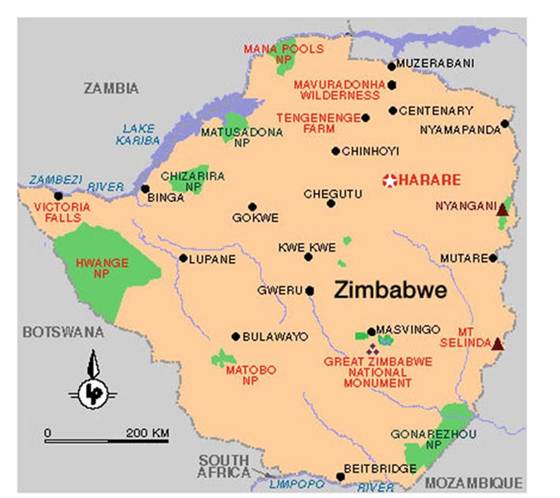
Fig. 13.1 Map of Zimbabwe. Source http://www.alightforzimbabwe.org
Great Zimbabwe was not the first or only significant polity in the Zambezi Plateau. Pikirayi notes that prior to Great Zimbabwe, Mapungubwe “attained regional prominence during the thirteenth century, managing the resources of a territory that was equivalent to a state in both political and economic terms” Pikirayi (2001, p. 3). Mapungubwe has been proposed as the first state in southern Africa, based on the most current evidence Huffman (2014). After the fall of Great Zimbabwe— “...marked by the presence of massive stone walls built in a variety of architectural styles” (Fig. 13.3)—the so-called Zimbabwe Culture divided into northern and southwestern regions Pikirayi (2001, p. 2-3).
Kim and Kusimba note that the first agrarian communities of the Zambezi plateau (i.e., chiefdoms) date to the first millennium CE, and that “[t]he landscape...was dotted with temporary rockshelter settlements, semi-sedentary camps, villages, and permanent settlements” Kim and Kusimba (2008, p. 137) (Fig. 13.2).
Monumental sites in the Zambezi plateau have been the subject of significant archaeological research since the 1930s, following the pioneering excavations of Gertrude Caton-Thompson. However, the research record has lacked a viable theory explaining the pattern of rise, fall, and abandonment (original polity cycling) that is archaeologically recorded for this area. Great Zimbabwe existed as a capital (central place) for a relatively short time period, and its termination by abandonment correlates with the end of imports from China. In fact, from the arrival of the Portuguese, which begins the written historical record, until the beginning of the
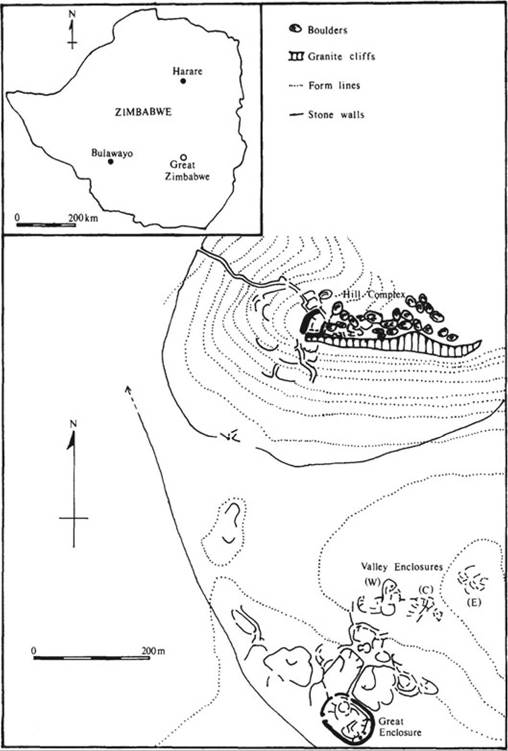
Fig.
13.2 Site map of great Zimbabwe. Source Collett et al. (1992, p. 141)twentieth century, some researchers (notably the archaeologist Randall MacIver in 1906) have questioned whether the site was even created by Africans Collett et al. (1992, p. 140). To this day, the site of Great Zimbabwe is still treated with distant reverence by the local population, as a hallowed but forgotten place Fontein (2006).
This study demonstrates how the Canonical Theory of politogenesis Cioffi-Revilla (2005) provides a viable generative explanation for the process of formation, consolidation, and abandonment of polities in the Zambezi Plateau. The punctuated process of sociopolitical phase transitions, typical of polity cycling (e.g., Marcus 1998, 2012), is explained by modeling the dynamic interplay among leaders and
id="Picutre 97" class="lazyload" data-src="/files/uch_group78/uch_pgroup313/uch_uch7323/image/image097.jpg">
Fig. 13.3 Great wall enclosure at Great Zimbabwe. Source “Zimbabwe wall” by Ulamm. Licensed under public domain via Wikimedia commons
society members (individuals and groups) experiencing fluctuating conditions of leadership and loyalty during recurring times of stress affecting the local community. In this paper, we present an ABM that implements in code the “fast” and “slow” processes of the Canonical Theory to demonstrate how and why a society can evolve from a simple community, such as that which existed in the Zambezi Plateau in the first millennium CE, through the progression of larger and more complex polities shown by archaeology. Larger and more complex polities were generated through a recursive, iterative process of collective action successes and failures by individuals and groups, as explained by the Canonical Theory.
13.2