Islamic resistance: Hizb'allah, Hamas and Laskar Jihad
Unlike their co-religionists in Iran and Afghanistan, the majority of Islamists have not been able to establish a state. They have neither functioned within a revolutionary context nor adopted extreme doctrinal positions.
Instead a large number of Islamist movements have emerged within the context of conflict. They fall into the militant category in the sense that they use force but their armed struggle is not necessarily directed against a particular regime which they see as illegitimate. Rather, they have taken on the role of the defender of a particular community. The conflict which has probably given rise to the largest number of Islamist movements is the Arab-Israeli conflict. While all Islamist organizations born from this conflict share the desire to deal a decisive blow against Israel and while they all tend to be anti-American in the sense that they oppose Washington’s unconditional support for Israel, they differ in terms of ideology, tactics and strategy, as well as the specific aims they hold with respect to their own Arab societies. This can best be illustrated by looking at Hamas and Hizb’allah.The Islamic Resistance Movement or Harakat al-Muqawama al-Islamiya (Hamas) is a Palestinian Islamist organization which emerged in the early months of the first Palestinian intifada in 1987—91. Its origins are rooted in the Gaza branch of the Muslim Brotherhood, which operated under the name of the Islamic Association, al-Mujamma al-Islami and focused on religious and social activities. Until 1987, Israel, in an attempt to divide and rule the Palestinians under its occupation, encouraged the Islamic Association’s work in the field of education, health care, social welfare and charity. However, the outbreak of the intifada and Israel’s iron-fist response transformed the Islamic Association into a politicomilitary organization, Hamas.
Jihad was defined no longer in terms of internal struggle but as physical warfare, and the focus shifted from the welfare of family and community to establishing an Islamic state.intifada (Arabic: shaking off) Name given to the Palestinian uprising against Israeli occupation which began on 9 December 1987 and lasted until the signing of the 1993 Oslo Accords between the PLO and Israel.
The doctrine of Hamas is one of Islamic nationalism, meaning that it functions within the context of defined nation-state boundaries, those of Palestine. It does not have transnational aims such as creating an Islamic state in the Fertile Crescent or all of the Middle East but instead seeks the liberation of Palestine and its transformation into an Islamic state. Unlike the PLO’s definition of Palestine, which is based on historical claims and thus allows a two-state compromise in which Israel and Palestine can co-exist, Hamas’s definition of Palestine is based on Islamic waqf (endowment). In simple terms, this means that as the land is endowed by God, humans have no right to give it away, effectively ruling out compromise. The strategy adopted to achieve this aim involves armed struggle, including suicide bombings, to secure its territorial ambitions, and socio-political activity to secure Islamization. Hamas thus poses a twofold challenge: first, to Israel as a result of its commitment to liberate all of Palestine through jihad, which effectively means replacing the Jewish state with an Islamic Palestine, and second, to the secular PLO leadership which it ultimately hopes to supersede.
Palestine Liberation Organization (PLO) Founded by Nasser in 1964, it comprises the Palestine National Council as its supreme body, the Palestine Executive Committee for everyday affairs, and the Palestine Liberation Army. Initially chaired by Ahmad Shuqairy and after the 1967 war by Yasser Arafat. In 1989, the PLO Central Council nominated Arafat as Palestinian president with the PLO assuming the role of government in exile until the 1993 Oslo Accords.
This dual aim has placed Hamas in the dilemma of balancing maximalist military and ideological aims against the accommodationist imperatives of internal Palestinian political considerations. The result has been a dynamic in which Hamas has, at times, co-operated with the PLO against Israel, such as during the first and second intifada, the latter of which erupted in September 2000. At other times, however, such as during the Israeli-Palestinian peace process, Hamas has worked against the PLO, coming out in opposition to Oslo and subsequent agreements. Moreover, during both periods of co-operation and non-cooperation, Hamas has never stopped competing for the hearts and minds of the Palestinian people, as it ultimately believes that the PLO is not capable of liberating Palestine.
Another product of the Arab-Israeli conflict is Hizb’allah, which shares with Hamas the desire to liberate Palestine and to introduce Islamization. However, as a Lebanese Islamist organization, Hizb’allah’s liberation struggle has been primarily aimed at liberating southern Lebanon from Israeli occupation, coupled with a desire to liberate Jerusalem and return it to Islamic rule. Similarly, the target of Islamization is Lebanon, although it is clear that Hizb’allah started out with a broader revolutionary agenda which has moderated into an Islamic nationalist and reformist one.
Hizb'allah (the Party of God) emerged in 1982 in reaction to the Israeli invasion of Lebanon. Unlike Hamas which is Sunni, Hizb'allah is one of the few Shi'a Islamist movements. The Shi'a link, as well as the fact that Iranian revolutionary guards had a hand in its establishment as part of the policy of ‘exporting the revolution', influenced Hizb'allah's early ideology in no uncertain terms. Hizb'allah's doctrine was Islamic revolutionary in the Iranian mode. It was uni- versalist rather than nationalist. It transcended the virtually non-existent borders of the equally non-existent state of Lebanon which had been racked by civil war since 1975, invaded and occupied by Syrian troops since 1976, turned into an operational base and state-within-a-state by the Palestinian resistance movement, invaded by Israel in 1978 and again invaded and occupied by Israeli forces in 1982.
Like Iran, Hizb'allah also drew heavily upon the Shi'a discourse of dispossession and martyrdom. Ultimately, it sought to contribute to a greater Islamic revolution which would engulf, first, the Middle East, and then the rest of the Islamic world.Hizb'allah's aims have clearly moderated since its establishment. It is no longer universalist but Islamic nationalist. It is no longer revolutionary but reformist. Two key factors have contributed to this transformation. The first was the end of the Lebanese Civil War with the 1989 Tai'f Accord which allowed the state to reestablish itself. Hizb'allah had the choice between adjusting to this new national reality or placing itself fundamentally at odds with the Lebanese regime and its Syrian guarantors. Adjustment was the more attractive option as Hizb'allah was curtailed neither in its socio-political activities nor in its continued military confrontation with Israel. In fact, Hizb'allah benefited greatly as it now competed for elections and had representatives in the government. It could bring policy more in line with Islamic values and also had access to resources for its community projects, which included a wide range of social, health, welfare and educational institutions. The second key factor, which not only allowed for this moderation but encouraged it, was the transition of Iran into a post-revolutionary phase with the death of Khomeini. ‘Export of the revolution' was no longer the top priority of the Iranian foreign policy agenda and Hizb'allah thus did not have to fear disrupting a well-functioning relationship which was still crucial to its other main goal, liberating southern Lebanon from Israeli occupation.
While Hizb'allah's domestic strategy ‘went political', its strategy in the Arab— Israeli conflict remained militant, relying heavily on guerrilla warfare. It aimed at pushing Israeli troops out of Lebanon by making the occupation too costly to maintain financially and in human terms. As part of this strategy Hizb'allah targeted not only Israeli soldiers but also all symbols of occupation.
It attacked Israel's ally, the South Lebanese Army, as well as putting pressure upon Israeli villages across the border by shelling them with short- and medium-range rockets such as katyushas. It also attacked Israeli and American interests abroad, as manifested in the 1992 and 1994 bombings in Argentina and the 1996 Khybar Towers bombing. While Hizb'allah in military organizational terms is not that different from Hamas, as both are cellular in structure, it has made full use of its links with Iran and Syria which have enabled it to acquire standard military equipment, placing it more on a par with Israel and thereby reducing the need for suicide bombings. Not surprisingly, Hizb'allah attributed the Israeli withdrawal from southern Lebanon in May 2000 to the effectiveness of its strategy.Hizb'allah, despite its rhetoric of liberating Jerusalem, concentrated its military efforts on the liberation of southern Lebanon from Israeli occupation. When Israeli troops withdrew, Hizb'allah did not pursue the retreating forces across the border. It also did not launch concerted attacks on Israeli settlements in northern Galilee. Instead, Hizb'allah focused on the one piece of disputed territory — the Sheba'a farms. Thus it is also clear that, with respect to the Arab-Israeli conflict, Lebanon has clearly served as the definitive context for Hizb'allah's military actions.
The Arab-Israeli conflict is, of course, not the only conflict to produce Islamic resistance. Another interesting case study is Indonesia, the world's largest Muslim country, which was racked by conflicts in the wake of the fall of Suharto's authoritarian New Order in May 1998. One of these conflicts on the spice island of Ambon led to the emergence of Laskar Jihad (Holy War Troops). Laskar Jihad was officially formed in January 2000 in response to the Indonesian government's failure to act to suppress the violent social conflict which had erupted between Muslims and Christians in Ambon in January 1999.
(It was officially dissolved in October 2002, a week before the Bali bombing.) Its aims, like those of Hamas and Hizb'allah, were, on the one hand, conflict related and, on the other, Islamization.Like Hamas and eventually Hizb'allah, Laskar Jihad falls into the Islamic nationalist category. Not only did it recognize state boundaries and function within them but it also assigned itself the role of protector of the unity and integrity of the Republic of Indonesia. This role was directly linked to its interpretation of the conflict in Ambon, which it saw as a separatist conflict instigated by Christians who sought to expel local Muslims and to turn the southern Maluku islands into an independent Christian republic. Defending the Muslim community and preventing separatism were pursued through armed jihad. Laskar Jihad was effectively a paramilitary organization, emulating the structure of the Indonesian army. It was arranged into battalions, companies, platoons and squads supported by special forces, intelligence and logistics. Its strategy was determined by the internal nature of the conflict and the fact that small arms, home-made explosives and traditional weapons, such as long knives, spears and poisoned arrows, characterized much of the fighting. It took on the form of ‘communal cleansing' typical of other internal civil war or ethnic conflict situations.
Laskar Jihad's aims, however, encompassed more than Ambon. Territorially its paramilitary presence was extended to other conflict areas, especially those faced with a real or perceived separatist challenge such as Poso, Papua and Aceh. Ideologically, it was not just protecting Muslims and Indonesia's unity and integrity but also Islamizing society and the state. Laskar Jihad relied on a social rather than political strategy. It refrained from setting up a political party as it saw politics in Indonesia as inherently corrupt and immoral and believed that its own values would be tainted by association. Instead it offered educational, social welfare and health services through which it promoted its salafi interpretation of Islam. It is in this area of doctrine and philosophy that the Arab influence, in this case Saudi and Yemeni, was most obvious, revealing that, while the emergence of
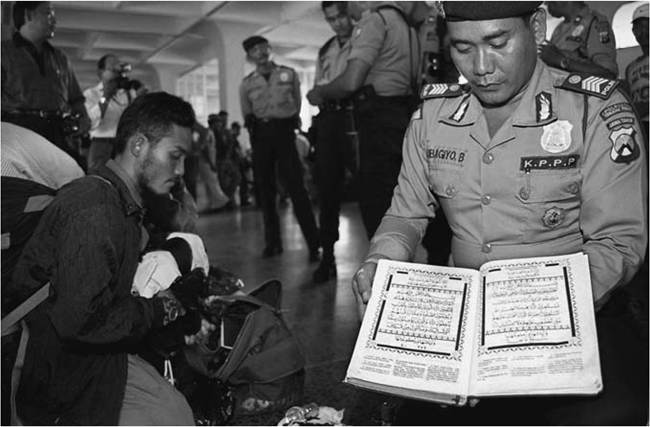
Plate 19.1 Surabaya, Indonesia, May 2000. Indonesian police display the Holy Quran found among the belongings of a member of the militant Muslim Laskar Jihad group (which vowed to launch a Jihad (holy war) against Christians in the Indonesian Spice Islands) before his departure from the Surabaya seaport, East Java, 10 May 2000. Several hundred Muslim militants left for Ambon in the strife-torn Maluku. (Photo: Yudhi Pardi/AFP/Getty Images)
Islamist movements is case specific and while the majority function within given state boundaries and are Islamic nationalist in nature, there are transnational ideological influences.
Transnational Islamism, international jihadism, global Islamism and the al-Qaeda phenomenon
Islam's concept of community is determined by faith rather than territory. Similarly, the political power required to protect and govern the relations of the community of believers, the umma, has no territorial definition. Thus the Islamist concept of the state is a universal one which arguably stands at odds with the existing state system and even the existing world order. While all Islamist movements support this ideal in purely abstract philosophical terms, most very clearly recognize the existing nation-state boundaries and have worked within them. Some, however, have gone beyond pure Islamic nationalism, leading to three trends developing in the twentieth century: transnational Islam, international jihadism and global Islamism.
Transnational Islamist movements are not a recent phenomenon. In fact, the oldest Islamist organization, the Muslim Brotherhood or Ikhwan al-Muslimim, falls into this category. Established in 1928 by Hassan al-Banna in Egypt, it now
has branches in seventy countries spanning the Middle East and Central and South-East Asia as well as Europe and the United States. All branches share a salafi philosophy and the aim of establishing an Islamic state, but each has also very clearly adjusted to given nation-state contexts. For instance, in Egypt and Jordan the Muslim Brothers have members in parliament who lobby for the incorporation of Islamic values into politics and the legal system, while in Europe and the USA they focus on education, family and community.
Jemaah Islamiyya (JI) (Arabic: Islamic Community)
Southeast Asian Islamist Organization established by Indonesians Abdullah Sunkar and Abu Bakar Ba’ashir in 1995. JI seeks to establish a Southeast Asian Islamic state encompassing Indonesia, Malaysia, Singapore, Brunei, southern Thailand and the southern Philippines through militant means.
see Chapter 22
A different type of transnational Islam is represented by organizations such as Hizbut Tahrir and Jemaah Islamiyya (JI) which also have branches internationally, but these have often been more closely linked and are actively pursuing ‘unification’ projects. For instance, JI in the South-East Asian states of Malaysia, Indonesia, Singapore and the Philippines has been working not only for Islamization of these individual states but also towards unifying them into a greater Islamic state — Negara Islam Nusantara. Similarly, in Central Asia, Hizbut Tahrir is seeking to unify the Ferghana valley states of Uzbekistan, Tajikistan and Kyrgyzstan in a ‘revival’ of the Caliphate of Ferghana.
Yet another form of transnational Islam has come in the shape of foreign policy, particularly that of Saudi Arabia and Iran. Iran’s explicit aim to ‘export the revolution’ triggered a Saudi-Iranian hegemonic struggle. While Iran focused on Shi’a minorities and supporting revolutionary movements in Arab states, Saudi Arabia went down the educational route, funding and establishing a vast network of Islamic schools and foundations through which it proselytized salafi Islam. Saudi Arabia’s wealth and the support of America, which equated Saudi victory with Iranian defeat, ensured that the ‘export of education’ became probably the most successful - and arguably the most destructive - element of the Wahhabi kingdom’s foreign policy. While few have paid much attention to it, its long-term effects have become increasingly visible in the extent to which local Islamic practices, particularly in non-Arab Muslim societies, have been infused not only with salafism but also with Arabization. Indonesia is a case in point.
The second trend, international jihadism, was triggered by the 1979 Soviet invasion of Afghanistan. It evolved from two separate but interlinked dynamics, one internal and one external. The internal Muslim dynamic was solidarity within the Muslim world with the Afghan mujahedeen. For the first time this solidarity transcended political statements and financial contributions, for individual Muslims from the Middle East and South-East Asia and even Muslims living in the West volunteered to join the armed struggle. The external dynamic came in the form of concerted efforts by the United States and Saudi Arabia to recruit Muslim volunteers, particularly from North Africa, to aid in the war with the Soviets. Saudi-backed CIA training camps in Egypt, and later in Afghanistan itself, served as a means to achieve a victory over Soviet imperialism.
The war in Afghanistan provided a generation of young Muslims with a sense of purpose and military skills, thus giving new meaning to jihad. The 1989 Soviet withdrawal was nothing less than an Islamic triumph over a superpower. It restored Islam’s place in history and the mujahedeens self-esteem; it confirmed their belief that armed struggle was superior to any political strategy, and when the volunteers returned to their countries of origin these were the lessons they carried with them. The Afghan experience served to radicalize Islamist movements. For example, graduates from the Afghan War used their newly acquired skills in a ruthless campaign against Copts and foreign tourists in Egypt between 1992 and 1997. They also contributed to the splits and militarization of the Islamist movement in Algeria after 1991. Moreover, volunteers from all parts of the Muslim world joined Islamic struggles in other countries such as Bosnia, Chechnya, Somalia, Sudan, Indonesia and Palestine.
The third trend, global Islamism, emerged in the context of increasing globalization, financial interdependency and new technologies which have made the world a smaller place. The consequent ‘proximity’ resulted in closer international co-operation and free flow of information, on the one hand, but it also increased the North-South divide, emphasized the prosperity gap between the small number of industrialized nations and the rest of the world, as well as casting questions of socio-economic justice, humanity and dignity in a new light. The challenge of how to manage the rapid pace of change and how to respond to these uncertainties gave rise to popular reactions grounded in the search for meaning and identity. In the non-Muslim world this resulted in a resurgence of a ‘back to basics’ type of nationalism and xenophobia. In the Muslim world it strengthened the search for Islamic authenticity and community. The availability of the Internet also allowed for the emergence of new ‘imagined’ Islamist communities, bypassing the nation-state boundaries, the establishment ulama and traditional Muslim education, and uniting the ideologically like-minded. Salafi movements, in particular, have taken advantage of the technology to form global networks.
al-Qaeda (Arabic: Base) Islamist umbrella organization established by Osama Bin Laden drawing upon the network of international jihadists established during the Afghan War to support the mujahedeen. Founded as early as 1988, al-Qaeda emerged into the public eye in 1990.
Al-Qaeda is in many ways a product of these combined developments. It was established in the context of the end of the Afghan War and the dispersion of the international jihadists. Osama Bin Laden, who had fought with the mujahedeen and whose money aided the Islamic welfare institutions set up to channel American and Saudi funds into Afghan operations, returned home to Saudi Arabia. There he set up al-Qaeda which drew upon international jihadism, but initially functioned within the Islamic nationalist paradigm. It sought internal reform, criticizing the Saudi royal family’s policies and corruption, but also offered to protect the Muslim holy sites and the Saudi state’s boundaries when Iraq invaded Kuwait in August 1990. The Saudi regime’s inability to deal with any kind of criticism resulted in the rejection of Bin Laden’s offer, followed by house arrest and his escape to Sudan in 1991. Throughout all this he watched the buildup of American forces in Saudi Arabia, seeing them as ‘infidel forces’ invited on to ‘holy soil’ by a ruling family who no longer deserved to be seen as believers. This labelling of the Saudi regime as kafir puts Bin Laden clearly in the khawarij category.
In 1994, in an effort to clip Bin Laden’s wings, Saudi Arabia revoked his citizenship and stripped him of some of his financial assets. However, Bin Laden and al-Qaeda were neither contained nor controlled but had shifted outside state boundaries and transformed themselves into a global network with shifting territorial bases, cells in a large number of Muslim countries and a globalized support community which ranged from the technophobe fundamentalist Taliban at one extreme to the new ‘imagined’ Islamist Internet communities at the other.
The expulsion from Saudi Arabia was clearly a turning point in the evolution of al-Qaeda’s doctrine from an Islamic nationalist challenge to Wahhabi legitimacy in Saudi Arabia to a global Islamist challenge to the one remaining superpower which, according to Bin Laden, sought the destruction of Islam. In this context he initially demanded the expulsion of ‘infidel forces’ from Saudi soil. He then added to his list of grievances the UN sanctions on Iraq, which he saw as American-inspired, and Washington’s support for Israel, both policies which resulted in the killing of Muslims. For Bin Laden, American policies in the Middle East were no less than a declaration of war on God and the Prophet Muhammad.
Al-Qaeda’s strategy clearly falls into the militant category as demonstrated by the 1992 attempt to kill American soldiers in Somalia, the 1993 attempt to blow up the World Trade Center, the 1995 Riyadh car bombing, the 1995 assassination attempt on Egyptian President Hosni Mubarak, the 1998 bombings of the US embassies in Kenya and Tanzania, the 2000 attack on the USS Cole in Yemen, and the destruction of the World Trade Center on 11 September 2001. Al-Qaeda is believed to have 3,000—5,000 members, organized in cell structures which are thought to be active in Afghanistan, Pakistan, Saudi Arabia, Yemen, Sudan, Uzbekistan, Egypt, Syria, Lebanon, Jordan, Palestine, Algeria, Libya, Eritrea, Somalia, Bosnia, Chechnya, Indonesia, the Philippines, Malaysia, Germany, Britain and the United States. It is also feared that it may be able to draw upon an even larger support network of veterans of the Afghan War, international jihadists, and other Islamists who trained in Afghanistan under the Taliban, together numbering 50,000-70,000.
The exact relationship between Islamist groups and al-Qaeda, however, remains unclear. While many American policy-makers tend to see close links, scholars of political Islam maintain that Bin Laden’s links with other groups have been overstated. They have found it more useful to see al-Qaeda as a franchise or an idea inspiring other Islamists. While it may have provided individual militants with training and finance, the fact remains that, unlike Bin Laden, the vast majority of Islamist groups continue to function in a very specific local context with very specific aims, under a leadership for whom engagement and compromise are possible. Al-Qaeda is a fundamentally different phenomenon and thus poses a new challenge to states and to the international community as a whole. This is further complicated by its populist appeal which is truly global in nature, tapping into feelings shared by the majority of Muslims worldwide, namely that as nations and people they have been treated without fairness, equality, justice, honour or dignity.
see Chapter 22