Japan as an economic superpower
Group of 7 (G-7)
The Group of 7 was the organization of the seven most advanced capitalist economies — the United States, Japan, Canada, Germany, France, Italy and Britain — founded in 1976.
The G-7 held and continues to hold annual summit meetings where the leaders of these countries discuss economic and political issues.The years from 1972 to 1989 saw Japan become a major player in international politics in consequence of its economic power. Moreover, as a model of how to achieve prosperity, it provided inspiration to the newly industrializing states in Asia. During this period Japan became one of the key powers in the Group of 7 (G-7) and emerged as the largest provider of foreign aid to the Third World. However, its success came with a price, for the trade friction with the United States worsened, and it was faced with continuing calls from Washington for it to take a much greater share in the Cold War and the policing of the international system.
The LDP’s immediate reaction to the ‘Nixon shocks’ and the growth of domestic discontent was to recognize the need for the country to change direction once again. Facing both external setbacks and domestic opposition, in 1972 Sato resigned and was replaced by a figure more attuned to the times, Kakuei Tanaka. In foreign affairs Tanaka sought to take a more independent line than Sato. In 1972 he opened diplomatic relations with the PRC and sought to emulate Nixon’s achievements by encouraging detente in the troubled Japanese—Soviet relationship. A further spur to this spirit of independence came in 1973 with OPEC’s decision during the October War to raise oil prices. This sudden move revealed Japan’s alarming reliance on the Middle East for its energy requirements and led to a drive to improve relations with the oil producers, which included adopting a pro-Arab stance on Middle Eastern issues.
This marked the start of a new policy of ‘omni-directional diplomacy’ in which Japan sought to move beyond the Cold War paradigm and to secure its economic standing by widening its diplomatic links and encouraging international stability. One key aspect in this campaign was its effort to increase its provision of overseas development aid (ODA) to developing countries, and particularly those on which Japan relied for its raw material imports. The most important recipients of Japanese ODA were the member states of the Association of South-East Asian Nations (ASEAN), which provided a key market for Japanese goods, supplied vital raw materials, including oil, and stood astride the communications route with the Middle East. ASEAN was keen to reciprocate Japan’s interest and during the premiership of Takeo Fukuda from 1976 to 1978 the first Japan—ASEAN forum met to discuss economic ties and Fukuda became the first foreign visitor to an ASEAN summit. The late 1970s also saw an improvement in relations with the PRC. In 1978 a peace treaty was finally signed between the two countries and Japan became a major investor in Deng Xiaoping’s modernization campaign.
While Japan was able to create better ties with the Third World and to cement its economic security, its relations with the United States entered a difficult period. In the economic field, the basic problem was that, compared with its competitors, Japan was too successful. The Japanese economy weathered the difficulties engendered by the oil-price hikes of 1973 and 1979 better than its rivals, and the result was that its trade surpluses with the United States and the European Community (EC) began in the early 1980s to spiral out of control. This process was assisted by the fact that the first Reagan administration allowed the dollar to increase in value, thus making Japanese goods more competitive than ever in the American market. In 1985 the United States decided that the dollar should be devalued, and a mechanism to ensure this was arranged by the major economic powers in the Plaza Accord.
Unfortunately, such was Japanese productivity by this stage that even this move made little difference to its inroads into the American economy, particularly as companies such as Toyota and Nissan ran subsidiary producers in the United States. By the late 1980s therefore there was increasing pressure from Congress on the American executive to take tougher action against Japanese exports and foreign direct investment.In the field of security too, Japan’s relations with the United States remained strained. From the late 1970s Japan deepened its security relationship with the United States in response to the Soviet Union’s increasing capacity to project its maritime power into the Pacific. In 1978 the ‘Guidelines for Japan—US Defence Co-operation’ were adopted which spelt out the division of labour should there
detente
A term meaning the reduction of tensions between states. It is often used to refer to the superpower diplomacy that took place between the inauguration of Richard Nixon as the American president in 1969 and the Senate’s refusal to ratify SALT II in 1980.
Organization of Petroleum Exporting Countries (OPEC) The organization founded in 1960 to represent the interests of the leading oil-producing states in the Third World.
see Chapter 21
see Chapter 15
Association of South-East Asian Nations (ASEAN) Organization founded in 1967 by Indonesia, Malaysia, the Philippines, Singapore and Thailand to provide a forum for regional economic cooperation. From 1979, and the Third Indochina War, it took on more of a political and security role. Membership increased with the accession of Brunei in 1984, Vietnam in 1995, Burma in 1997 and Cambodia in 1999.
Third World
A collective term of French origin for those states that are part of neither the developed capitalist world nor the communist bloc. It includes the states of Latin America, Africa, the Middle East, South Asia and South-East Asia. Also referred to as ‘the South’ in
contrast to the developed ‘North’.
European Community (EC)
Formed in 1967 with the fusion of the European Economic Community (EEC, founded in 1957), the European Atomic Energy Community (EURATOM, also founded in 1957), and the European Coal and Steel Community (ECSC, founded in 1952). The EC contained many of the functions of the European Union (EU, founded in 1992). Unlike the later EU, the EC consisted primarily of economic agreements between member states.
Plaza Accord
The agreement reached by the G-5 (G-7 minus Canada and Italy) finance ministers at the Plaza Hotel in New York in 1985 to raise the value of the yen and the Deutschmark and to lower that of the dollar. The accord helped to lead to the Japanese ‘bubble economy’ of the late 1980s.
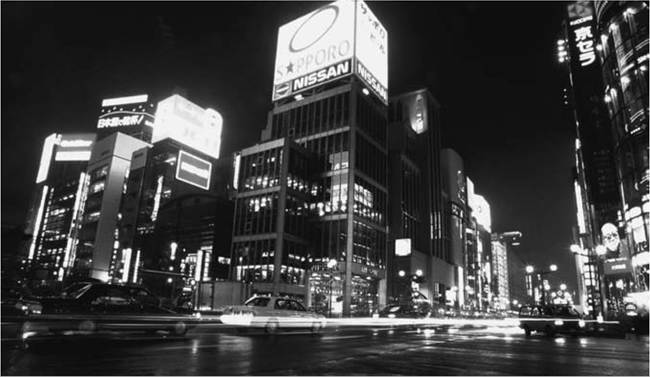
Plate 14.1 Tokyo, Japan, 1998. Neon lights in the Ginza area, Tokyo's most famous shopping and entertainment district. (Photo: Brad Rickerby/Getty Images)
be an armed attack on Japan. This was followed in 1983 by a Japanese commitment to undertake maritime patrols up to 1,000 kilometres into the Pacific Ocean. The prime minister by this time, Yasuhiro Nakasone, shared the anti-communist attitude of Ronald Reagan, and was keen to meet American demands for increased Japanese defence spending and greater co-operation in the development of defence technology, including the ‘Star Wars’ project. However, Nakasone had to tread carefully to avoid reawakening Japan’s antipathy to security issues, and his effort to raise Japanese defence spending above 1 per cent of gross national product (GNP) yielded only temporary success. As a result, the United States maintained its doubts about whether Japan was pulling its weight.
It was at this point in the 1980s that the Americans accused Japan of having taken a ‘free ride’ on the back of the American security commitment in East Asia. As a result, a number of commentators in both Japan and the United States began to urge that now was the time for the country to revise the constitution, to rearm and become a ‘normal state’. In other words that Japan should now put its guilt about the Pacific War to one side and translate its economic might into political power and play a full role within international politics. This, however, was not to prove easy, for the pacifism engendered by the disasters of 1945 was still strong in Japan, as were memories of the 1960 crisis over revision of the Security Treaty. Knowing that the Japanese public was suspicious of this new direction, the political elite was duly cautious, and thus, although there was much rhetoric about constitutional revision and rearmament, little progress was made.