Peace, Peacemaking and the First Civilizations
The roles peace and peacemaking played in the ancient cultures that arose around the fertile valleys of the Tigris and Euphrates Rivers have just begun to be unraveled. It is not only peace that is lost in war in what is now Iraq, where the first historic cities, states and civilizations emerged c.
3500 BCE, but history itself. At the threshold of history, peace is still to be grasped as evolving, though in an even more cyclical sense than in prehistory. Changing conditions and participants - actively recorded for the first known time - shaped peace and peacemaking, which in turn altered conditions and participants, and so on. Studying the history of peace in this evolutionary way reveals as much about the origins of civilizations as their ongoing traits. Such a comprehensive perspective on Mesopotamian (“between rivers”) peace practices can be drawn from the French historians of the Annales School. Integrating geography, social sciences and historiography, they saw warfare as only one of many factors contributing to the overall makeup of an era (sic), focusing instead on long-term structural and cultural changes. This perspective is valuable in exploring the transformation from geographically isolated, culturally homogenous home bases and villages to economically interconnected, culturally heterogeneous cities that sponsored states and made possible civilized peace: an ideal, a means to an end and an end in itself. Inasmuch, civilized peace was concurrently the raison d’etre of Mesopotamian states as well as the prerequisite and underlying motive for their wars.The identifying traits of Mesopotamian villages before 3500 BCE are their subsistence-level surpluses, economic autonomy, little differentiation between town and country, communal property, local gods and despotic rule. In contrast, the city of Mari’s archives (fl. 2900-1750 BCE), for example, point to economically and politically interdependent centers characterized by overall material abundance due to irrigation; distinctions of class, occupation, place of origin, as well as public and private property; trade networks; organized religions; and shifting cooperative and defensive alliances.
The meanings of peace and peacemaking at the cusp of village and city life are captured by its first known word in a written Indo-European language, Hittite. In village contexts, making and maintaining peace meant to protect, guard and keep things or people safe as well as defending them against internal and external dangers, meanings equally applicable to the subsistence peace of home bases. In city contexts, however, peace and peacemaking took on the added meanings of being tolerant, observing agreements, laws and customs, keeping oaths and heeding advice, meanings which apply unevenly to home bases and villages, if at all.The village-linked meanings of peace are predominantly reactive and protectionist; those specifically tied to cities, proactive and integrationist. A clear sign of this fundamental change in peace and peacemaking can be found in the earliest evidence of urban imperatives for peace in its Hittite sense, cylinder seals, the imprints of which were used to authenticate documents and reproduce standardized statements. Cylinder seals were unnecessary and unused in village life, in which verbal agreements between close relations were adequate to prevent and resolve conflicts. In cosmopolitan city life, however, written agreements tendered by cylinder seals were necessary tools in legitimizing and preserving ties between parties whose relationships were much less secure. That is, shared identities and interests of tight-knit village communities were sufficient to safeguard kin-group solidarity and non-kin affiliations, also essential to sustaining peaceful coexistence in cities. But the meanings of urban peace embodied in cylinder seals were crucial survival and subsistence strategies of Mesopotamian cities and their citizens insofar as they facilitated cooperation and averted war between individuals and groups with different identities and interests. Without these social and collective functions being expressed in a permanent way, fulfilled legitimately on previously agreed upon terms, it is doubtful that Mesopotamian cities could have borne the more abstract formations of states and civilizations.
A graphic entry point into the coterminous worlds of peace and war in Mesopotamia can be found in the earliest mosaic yet unearthed, set on a trapezoidal stone (presented on the following page). The archaeologists who discovered the mosaic while excavating graves in the Sumerian city of Ur identified it as a standard, carried like a banner before the state’s army. This function explains the “war side” (above), in which donkeydrawn chariots charge over fallen enemies, spearmen in helmets and cloaks seize prisoners, and captives are brought before a centralized authority figure. By making clear what would happen to enemies if battles were won, or to allies if lost, this fearsome sight may have been part of “the earliest and crudest means to avoiding war,” deterrence: the prevention of aggression by threat of retaliation.26 The high value of the materials and workmanship involved suggests that the mosaic was emblematic of Sumerian economic and political prowess in
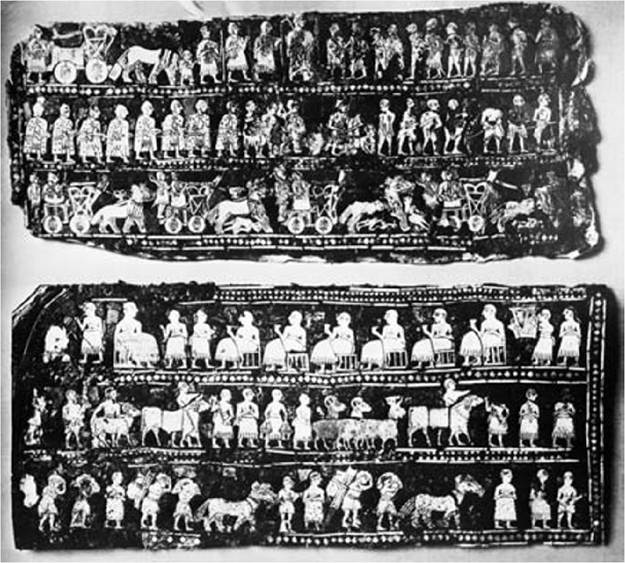
The Mosaic of Ur, c. 2650 BCE
Mesopotamia at the time. Sumerians were, after all, the first to found cities like Ur, the cornerstones of Mesopotamian states, which were nearly always ruled by one male leader. Such a leader is symbolized by the centralized authority figure on the war side but conspicuously absent from the “peace side” (below), portraying a lively banquet with leisurely attendants serenaded by lyres, enjoying each other’s company and the gifts of the rivers, such as grains, sheep, goats and fish. This pointed detail launches one of the oldest debates in peace studies, whether “war helps to make states, states make war, and therefore states are in part, and always must be, war machines.”27 Archaeologists since the mosaic’s discovery have interpreted its function as the sound box of a musical instrument, a credible rationale for the peace side. Either as a centerpiece at a feast or a rallying point in battle, this reassuring sight and its possible sounds likely were a strong reminder of the shared experience and vision of the civilized peace Sumerians considered worth celebrating and fighting for.
The mosaic’s mixed messages regarding the relationships between states, war, civilization and peace echo across two millennia of Mesopotamian history and beyond. Namely, that the constructive ideal of civilized peace, lived or striven for, may paradoxically be the only force capable of sustaining as well as counteracting the destructive actualities of state warfare. In any case, the mosaic’s juxtaposition of state warfare and civilized peace is the earliest evidence of the two being put into close material and conceptual proximity, inaugurating one of the longest running analytical traditions in the history of peace. Like villages before them, “no city can exist if it does not draw on surpluses of food, and in most cases this comes from the surrounding land;” it was the hydraulic revolution of irrigation that converted the sporadic, subsistence-level surpluses of Mesopotamian villages into the material abundance needed to sustain their cities, states and civilizations.28 War was comparatively rare in Mesopotamia before the hydraulic revolution, and so the advent of irrigation tends to be seen as spurring integrations of military or police forces (a distinction which tended to be blurred) into local political systems, though only at minimal levels, when at all. But before two or more cities would go to war, other cities often attempted to diffuse the situation, resulting in unexpected unions between the cities concerned. If this juncture is taken as the starting point of regional state systems, as some historians of the period concur, then the peace-oriented concept of neutrality and role of moderator must be recognized as primary channels of intercity relations and statehood.
Intra-city peace and prosperity were primarily predicated upon links between land and social structures, or geo-social configurations, significantly more complex than in villages. Sumerian land was divided into that belonging to the state, given temporarily to officials as part of their salaries and rented out.
Babylon, which succeeded Sumerian hegemony, had three classes: those to whom the leader granted full liberty and all privileges of citizenship; those who, though free, were subject to legal restrictions related to land; and those who had no rights or freedoms, or slaves. As one’s place in the social order was synonymous with one’s place in the land, one’s obligations towards and benefits from state warfare or civilized peace were entrenched in the earth. Geo-social configurations were top peacekeeping priorities in Mesopotamia because they kept conflicts of interest in check by balancing (or not) public and private needs. Nowhere is the import of this balance to peace and prosperity more clear than in the rises and falls of Babylon’s religious centre, Nippur. The city flourished in peace for centuries by balancing between being an integrative public place and a social space delimited by distinctions based on private property. Granting land to government officials as salaries led to the privatization of public property, the principal cause of the city’s decline into the disorder of civil war. When the balance was restored through geo-social engineering, Nippur’s peace and prosperity returned. At the other end of the public-private spectrum, the Jewish prophet Isaiah (c. 700 BCE) protested to his fellow Mesopotamians: “woe to those who join house to house/ who add field to field/ until there is no more room.”29 Latifundization, creations of progressively larger public estates by dispossessing private landowners usually tied to an increase in social stratification, was as potent a sign of cities’ decline as over-privatization. The Assyrian and Persian states began declining after systematically expunging farmers from their lands, who were frequently sold into slavery to recover their debts in order to assuage their life-threatening poverty.Researchers studying social stratification agree that with it comes a form of structural violence which can compromise peaceful coexistence, such as systemic inequality and injustice, and on this point Mesopotamian cities are no exception.30 Textual evidence suggests that the distinctions between slave/free and native/foreign may have a common origin.
While slaves and foreigners were denied many of the privileges of civilized peace citizens took for granted, native freemen could enjoy them in full. Yet, slaves and foreigners were often conscripted or otherwise forced to participate in state warfare regardless of their non-citizen status, creating a dangerous double standard states depend upon like a thorny crutch. The crippling effects over-privatization, latifundization and structural violence had on the welfare of Mesopotamians were similar. Balanced geo-social configurations offset them in the short term by sustaining the material abundance necessary to the very existence of cities, states and civilization. In the long term, only by balancing public and private needs did Mesopotamians enjoy peace, prosperity and technological advances unrivalled in the world at the time. Snippets of economic theory show that they knew equitable economic policies are directly related to domestic peace. Rulers attempted to prevent civil war by issuing edicts, like one by a king of Babylon (c. 1600 BCE) which declared certain loans illegal and some taxes temporarily suspended. A millennium earlier, a ruler issued similar edicts just two years after he came to power. He sought to restore prosperity by prohibiting the exploitation of the poor, ending oppressive taxes and limiting state regulation of the economy, described as necessary in wartime but detrimental in times of peace.In the Sumerian tradition, leaders’ activities “concentrated upon the works of peace,” already discussed, and “the building of temples;” one complemented rather than contradicted the other.31 By far the largest buildings in Mesopotamia were steppe temples, or ziggurats, religious and administrative centers of cities and states. The organized religions they represented created new justifications for war, but also new possibilities in peacemaking. Secular life and religious life were apparently inseparable, as officials combined “what we would see as priestly and civil authority.”32 Yet, organized religions contributed to the history of peace in their own right. Leaders customarily doubled as religious and political, leveraging their war- and peacemaking powers. Leaders backed military campaigns with the joint forces of Church and State, but they also prevented and resolved conflicts in the same way. Another major consequence of expanding inter-city relations was that local gods, who had reigned supreme for centuries, now had to contend other religious beliefs, practices and figureheads. Peacemaking among competing organized religions frequently took the form of two or more local gods being fused into one regional god either at once or over time, as in the prominent god Ahura-Mazda. As long as regional authority rested with the religious and political representatives of Ahura-Mazda, local beliefs could go on as they had for centuries.
Degrees of religious amalgamation ranged from all-inclusive religious synthesis, known as syncretism, to worshiping one god without denying others, or henotheism, which generally outproportioned syncretism in Mesopotamia. When they failed preemptively, such procedures could further post-war peace. Typical of these religious peace processes, Assyrian armies would return religious objects to the citizens of a conquered city, and post-war peace terms were finalized by oaths evoking both Assyrian and non-Assyrian gods. Following anthropologist Claude Levi-Strauss, who proposed that a civilization’s myths can serve as allegorical maps of its social structures and cultural assumptions, multiple versions of the same Mesopotamian myths can be read as reflecting the pacific fluidity syncretic and henotheistic peace processes imply. For instance, many editions of Enuma Elish (c. 1200 BCE), the era’s most widespread cosmogony, from different places and in a variety of languages have been found, each adapted to local traditions, indicating that a conscious effort was made to foster common regional identities through rather than against local ones. An earlier narrative loosely based on a Babylonian ruler, Gilgamesh (c. 2700 BCE), was passed down orally in the region for seven hundred years before it was set in stone with local variations. The moral of Gilgamesh is that violence, whether structural or outright, by rulers like the story’s namesake, leads inevitably to their downfall. Conversely, those who live and lead peacefully can avert disasters as great as floods, as did Utnapishtim, the man Gilgamesh takes as his mentor but from whom he does not learn.
In Mesopotamia, then, “king and god reinforced each other’s legitimacy,” if legitimacy is taken to mean the perception that power is moderately exercised according to moral and cultural norms.33 Socio- historical studies show that the legitimacy of leaders generates socially cohesive group loyalty and collective identity so that, statistically, warfare occurs less frequently in the earlier than in the later stages of states, when the legitimacy of leaders is less likely to be fully intact. The centripetal propensity of political legitimization was of particular importance to the peace and peacemaking of the early large-scale empires in Mesopotamia. For example, at its zenith, the Persian Empire founded by Cyrus II (r. c. 559-30 BCE) covered roughly 6 million kilometers in size, enclosed about 35 million people and lasted for more than 200 years. In order to maintain peace in such vast territories and among such a diversity of people, leaders like Cyrus sought legitimacy in meaningful and effective ways. This meant affirming “strength in peace and war, by his justice in upholding a fair and benevolent law, and by sharing and investing the enormous capital at his disposal to the benefit of his poorer subjects.”34 The issuance of coins by the state was also developed as a way to reduce transactional friction and for non-violently “asserting its fiscal if not political independence,” the designs of which could serve as propaganda for takes on civilized peace.35 But implementing these plans and public relations campaigns for the prosperity upon which peace depends were inadequate on their own.
Overextended empires without effective political systems and leaders who promised more than they could deliver often fell in civil war or by invasion, precluding any kind of peace. Governmental decentralization, balancing regional authority and local autonomy, was one way leaders of larger and more complex states maintained peace and power legitimately. To this end, the Persian Empire was divided into twenty administrative districts, each of which kept its own surpluses, records and police force. Persian rulers earned the loyalty of foreign subjects by leaving their traditions intact, making selective non-interference another legitimate cross- cultural peacekeeping option. Post-war political integration was perhaps the surest path to peacemaking taken by Cyrus. Not only did he adapt Persian practices to foreign customs, he cultivated natives capable of wielding power on his behalf. Cyrus is also credited with being the first known ruler to enlarge his holdings not by attacking neighbors, but by being attacked by them. The cliches that the best offense is the best defense, and that preparing for war is the best way to prepare for peace, can thus in retrospect be validly applied as far back as the first civilizations.
More than a thousand years before Cyrus was Hammurabi (c. 18101750 BCE), first emperor of the Babylonian Empire he founded. An early study claims that “peace and prosperity prevailed during his reign,” though more recent research confines this preponderantly peaceful period to the first two decades Hammurabi ruled.36 He improved agricultural practices, balanced geo-social configurations and put equitable economic policies. The god Marduk’s syncretic and henotheistic ascendancy has also been attributed to Hammurabi. The earliest known non-military uses of military personnel are his army’s expeditions aimed not at defeating enemies, but at collecting materials for ziggurats. Successes in these respects prompted the military expansion of the second half of his reign, but conquests complete he continued to rule according to peaceful principles. Hammurabi set forth these principles in his famous Code of Laws (c. 1780 BCE), carved on black stone monuments eight feet in height and strategically placed across his empire. The importance of Hammurabi’s legislation lies in its codification of Mesopotamian legal tradition rather than in the originality of its content. While literacy was far from common, all Babylonians were subject to the Code, which broadly regulated society and prescribed specific punishments for particular crimes. Laws cover theft and bodily harm, pastoral practices, as well as the rights of women, children and slaves, among other issues, which invaluably contributed to the future history of peace by influencing “all subsequent legislation.”37