PENETRATING AND GOVERNING COLONIAL SOCIETY
For a governor and leading officials around him in a colonial capital city, the challenge of consolidating power was defined rather differently. Here the problem was to gain compliance not across seas but across land: specifically, how to govern people living hundreds of miles away and unconnected by road or other means with the outside world.
An administration that eventually covered the entire territory had to be assembled. Agents had to be recruited and assigned to distant outposts to show the flag, keep the peace, settle local disputes, interpret new legal codes, recruit labor, supervise road construction, stimulate production for the international market, and the like. The cost of this operation could be high, and it was usually borne by the colony itself. Hence the imperative to mobilize its natural and human resources for taxable development. A political risk of extending public sector institutions throughout a colony was that development was socially destabilizing and some forms of resource mobilization (notably forced labor) deeply unpopular. If the desired goal was stable, legitimate government, the means employed to get there could push the goal out of reach.A related challenge in constructing the protostate was how to bridge racial and cultural distance. The demographic composition of colonies was enormously varied. But differences and inequalities among groups were more visible, numerous, and generally more pronounced than in the metropole. A striking feature of many colonial societies was not only the number of distinct groups but also the range of reasons given for drawing distinctions among them. If one imagines a territory whose population reflects the colonial world’s diversity, group identity was based on
• race: inhabitants came from Europe, from the continent where the colony was located, and from one or more other continents from which third parties migrated;
• race and power: the dominant race (European) vs.
subordinate races (all others)— this was the fundamental cleavage between colonizer and colonized;• racial descent: people wholly descended from a continental “stock” vs. those of mixed race;
• place of birth and territorial affinity: metropole-born Europeans temporarily residing in the colony vs. people born in the colony who regarded it as home;
• legal status: free or slave;
• political status: those with voting rights and/or metropolitan citizenship vs. those without them;
economic function: for example, third parties serving as intermediaries between Europeans and indigenous groups;
class: those with property and high income vs. poor people lacking property; attributes distinguishing indigenous groups from each other: language, religion, homeland, livelihood, social customs, and precolonial political history.
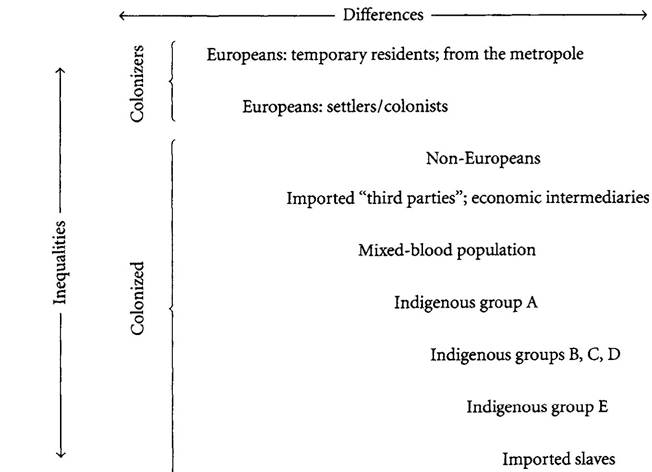
Figure 12.1 maps this composite society. It locates groups along a horizontal axis of difference—race, religion, language, geographical location, and so forth—and a vertical axis of inequality—power, income, wealth, and status. As may be seen in the figure, group differences and inequalities were systematically linked, Europeans typically clustering in the highest property and income categories, third-party groups in the middle, indigenous people and imported slaves at the bottom. In the colonial situation a group was definedby socially acknowledged characteristics setting it apart from others and simultaneously slotted in a hierarchy in which the rank ordering of groups was more or less fixed.
Of course, not all colonies possessed all groups noted in figure 12.1. But in most there was sufficient heterogeneity to pose problems for anyone charged with governing the entire population. The challenge was to penetrate diverse groups and control their behavior in spite of knowing little about their social structure, values, and opinions of Europeans. Heterogeneity presented opportunities as well as obstacles for rulers. If differences and inequalities could be manipulated by pitting groups against each other, rulers could keep the populace subdued and deflect resentment that might otherwise be directed at themselves.
Efforts to control more people and more aspects of people’s lives produced violent backlashes. The rebellions noted in chapter 13 often occurred at early stages of power consolidation, when it became clear that the European presence was not temporary and that subjugation had serious costs, including taxation and forced labor. But the government had ready responses to rebellion. The key to victory was swift, decisive applications of force. Rulers took out the most advanced weapons available, stored in armories for just such emergencies, and turned them on warriors whose arsenal was far inferior. The government mobilized groups not involved in the revolt, gave them arms, and turned them loose on rebel forces. A central player in consolidating British rule over India, Gen. Frederick [Lord] Roberts, wrote of the Great Mutiny of 1857-58 that “Delhi could not have been taken without Sikhs and Gurkhas; Lucknow could not have been defended without the Hindustani soldiers who so nobly responded to Sir Henry Lawrence’s call, and nothing that Sir John Lawrence might have done could have prevented our losing, for a time, the whole of the country north of Calcutta, had not the men of the Punjab and the Dejerat remained true to our cause.”4
FIGURE 12.1.
CLEAVAGES IN COLONIAL SOCIETY
Once rebellion was crushed its leaders were punished in settings that signaled in unmistakable terms to the populace what would happen to anyone contemplating treason in the future. The two most significant resistance movements in colonial history were the Tupac Amaru Rebellion in Peru and Upper Peru (1780-83) and the Great Mutiny in India. Reasons for their failure are discussed in chapter 13. Here I note that Tupac Amaru II was drawn and quartered in the Cuzco public square and that Indian sepoys condemned by court martial were tied over the barrel of a gun and, to the roll of drums, blown to pieces.
The point is not that Europeans were more cruel than the rebels but that their retaliatory cruelty was given a public face to forestall future outbreaks. In some cases punishment was visible and collective, as when bna settlers massacred and expelled rebellious Pequot Indians (1636) or when German troops led by Gen. Lothar von Trotha pushed thousands of Hereros into the Kalahari Desert to perish of starvation and thirst (1905).5In areas wracked by war or anarchy prior to European rule, imposition of order was often greeted with relief by colonial subjects. As personal security increased and freedom of movement throughout a colony became possible, many people acknowledged that in these respects the new rulers made a positive difference. Here, coercion became a basis for legitimacy rather than serving, as it usually did, as a method of retaining illegitimate rule.
The search for collaborators in time of peace was just as marked as the decisive application of force against rebels. The two tasks were intimately linked when nonEuropeans were recruited to police and border-defense forces. A common practice was to favor poor, low-status groups with reputations for martial prowess. Their loyalty could be counted on because recruitment raised their income, social status, and power. Examples include Ambonese in the Dutch East Indies; Sikhs, Pathans, Gurkhas, and Baluchis in post-1857 India; Karens in Burma; Hausa, Tiv, and Kanuri in Nigeria; Temne in Sierra Leone; Kamba and Kalenjin in Kenya; Acholi and Langi in Uganda; Azande and Batetela in the Belgian Congo’s early years; and Berbers in Morocco.6
On the public sector’s civilian side non-European collaborators were essential as linguistic intermediaries, interpreters of the customs and beliefs of local people, spies who identified and kept tabs on troublemakers, low- and middle-level government functionaries working at low cost, and proxies carrying out the dirty work of colonialism by collecting tribute and hut taxes and rounding up forced-labor brigades. By taking on unpopular assignments they became targets of anger that might otherwise have been directed at European overseers.
Collaborators in turn could count on certain benefits, including high income by local standards, exemption from forced labor, high status associated with bureaucratic office, permission to grow crops normally reserved for Europeans, and opportunities to use official positions for illicit personal enrichment. Colonial governments offered compensation packages whose benefits to collaborators were designed to outweigh the costs.When indigenous polities survived into the colonial era and their rulers were willing to work with Europeans, a policy of ruling through traditional authorities had much to recommend it. Indirect rule was adopted in the Americas by the Spanish, who worked through caciques and kurakas; by the Dutch in the East Indies; by the French in Vietnam, Morocco, Saharan Algeria, Tunisia, Guinea, and Tchad; and by the British in India (which had more than 560 princely states), Malaya, Borneo, Nigeria, the Gold Coast, Uganda, and many other places. By retaining elements of preexisting polities, colonial rulers focused local energies on local issues and away from matters affecting the colony as a whole. Indirect rule was particularly useful in the early stages of power consolidation, when few Europeans were available for local-level assignments. The legitimacy indigenous rulers carried over from an earlier era could be symbolically transferred to the colonial regime through participation in the regime’s structures and rituals. Europeans could not forget that traditional rulers were prime candidates to lead anticolonial movements. This risk was reduced by giving them positive incentives to cooperate. A steady, generous income and support against other claimants to the throne helped turn potential enemies into cooperative subordinates.
How could rulers use a colony’s racial and cultural pluralism to undercut challenges from below? Three techniques were widely employed: insulation, competition, and stratification. Keeping groups separated from each other made it less likely that they would unite in opposition.
As people from many areas migrated to cities, governments passed regulations creating quarters segregated by race and on occasion by religion and ethnic identity as well. A common pattern was to recruit certain groups for specialized tasks on the basis of stereotypes colonizers believed to be valid. Thus, “martial race” X came to predominate in the military, “clever group” Y was favored for clerical posts, and “strong, hard-working, docile group” Z was heavily represented on road gangs. Even though members of X, Y, and Z worked for the same employer, their interaction was limited by structural and functional differentiation within the public sector. Geographic insulation was another approach, as when Britain administered northern and southern portions of the Anglo-Egyptian Sudan and Nigeria for decades as virtually separate entities. A policy that initially reflected preexisting distinctions between north and south in these huge territories had the effect of accentuating regional cleavages as time went on.But diverse groups could not be indefinitely insulated from each other, if only because economic and social changes induced by European rule produced unprecedented interactions, especially in growing urban centers. When this occurred a strategy was to make group relations competitive rather than cooperative. Government was aided here by its role as a major employer. Groups which in precolonial times had neither opportunity nor inclination to interact now came together as competitors for scarce, prestigious, high-paying posts within the same sector. When one group held an advantage in job recruitment because of its greater access to primary or secondary schools, other groups often reacted by founding schools for their young people. The result was a larger cadre of Western-educated people than colonial rulers considered politically safe. Still there was something reassuring about colonized peoples competing to enter a sector the rulers themselves controlled. Winners in this competition were not likely to join with the losers to oust foreigners paying their salaries.7
Given the substantial economic inequalities in colonial society and their close correlation with the divide separating colonizer from colonized, rulers faced the possibility of class-based revolt. This risk was reduced if non-European society was itself highly stratified. In many instances colonial policy recognized existing inequalities and then reinforced them. Thus in Ruanda-Urundi Germans and Belgians favored aristocrats among the minority Tutsi over Hutu peasants for access to schooling and government posts. In Senegal a school was founded for the sons of chiefs.
When special benefits were conferred on a group by assisting its next generation, that group had strong incentives not to challenge the status quo.
European rule, being a quintessentially male activity, enabled colonized men to become more dominant over women than in the precolonial period. When a district officer needed collaborators or wanted to find out about local customs, he almost invariably turned to fellow males, who he assumed held dominant positions among their people. Armed with the formidable power to interpret one’s society to an ignorant foreigner, an indigenous man found it in his interest to describe traditional gender roles in ways most favorable to males. Likewise European anthropologists, the vast majority of them men, obtained information primarily from male informants. Colonial regulations concerning the right to use and own land, grow and sell cash crops, and so forth, were often strongly biased against indigenous women.8 In a sense, men forged an unspoken coalition under colonialism, their common gender transcending the racial differences and power inequalities separating them. To the extent that this coalition gave colonized men special benefits, it may have reduced the will to rebel within the gender category most likely to do so.
In other instances colonial policy helped construct a new stratification system. People of mixed blood in Portugal’s American, African, and Asian colonies; freed slaves in phase i plantation colonies; Indians in Fiji, Kenya, Uganda, Trinidad, and Guyana; Lebanese in French West Africa; Chinese in Malaya and the Dutch East Indies—these groups were not only allowed but actively encouraged to occupy niches in the colonial economy below Europeans and above the indigenous or slave majority. If they specialized in retail trade and banking, the nature of their work and their apparent monopoly of certain jobs made them intensely unpopular among groups at the low end of the hierarchy. The result was triply advantageous to colonial rulers: important economic functions were performed by specialists; the colonized were at odds with one another; and intermediate groups looked upward to government for protection from those below them.
In short, colonial policies reinforcing existing group insulation limited the capacity of colonized people to form a united opposition front. Policies encouraging competition for scarce resources lowered the will of colonized people to form a united front. Policies reinforcing existing inequalities and creating new ones limited both the capacity and will of subject peoples to organize. The cumulative result was a remarkably stable system of rule.