PREFACE
The Greek language is one of only three, among those now spoken and written anywhere in the world, that can boast a continuous written tradition stretching back for more than three thousand years.
The others are Chinese and Hebrew. The collective heroes and heroines of the story told in this book are all those people who have spoken and written the Greek language throughout the long centuries of its recorded evolution.During that time, Greek was used at first to keep bureaucratic records, then to preserve for posterity the heroic epics, the Iliad and the Odyssey of Homer, that have been read with wonder by every generation since. It was the language of the world’s first fully alphabetic system of writing. It was in Greek that the foundations for modern philosophy and science were laid and, later, that the apostles of Christianity would disseminate the new religion through the New Testament. The original Greek text of the Gospels is still read aloud in Orthodox churches around the world. Evolving as all human speech does over time, Greek in its present-day form is the official language of the Hellenic Republic and one of the two official languages of the Republic of Cyprus.
The Greeks of the title and the pages that follow are to be understood as speakers of the Greek language. The story of these Greek speakers will turn out to be a story about identity—or rather, about identities, in the plural. Greek speakers have been adept, ever since we first get to know them through their earliest writings, at asking questions and interrogating themselves. The answers they have come up with have differed greatly over the centuries, according to cultural changes and changing historical circumstances. Throughout history, Greeks have created types of societies and political systems very different from one another. If they have continuously inhabited the same southeastern corner of Europe and the eastern Mediterranean, they have also, at different times, put down roots in many different places.
Again and again, they have proved resourceful at reinventing themselves. They have fought against different enemies, traded with different partners around the world, worshipped different gods, even called themselves by different names. We call them ‘Greeks’, and their land ‘Greece’, in English today because the ancient Romans first encountered a local tribe of Greek speakers whom they called, in Latin, Graeci. In their own language in ancient times, these people were known as ‘Hellenes’ and their land as ‘Hellas’, as they have been known once again since the early nineteenth century. But they have also, at different times, been Achaiwoi (Achaeans) and Romaioi or Romioi (pronounced Romyi), meaning literally ‘Romans’.This book asks: What can we learn from the accumulated experience of those who have spoken and written this language, during three and a half thousand years, about how identities are created, perpetuated, and modified or reinvented over time? We all rely on perceptions of the past to establish our own identity in the present. In a world ever more threatened by the clash of mutually exclusive, monolithic identities, we might all do well to reflect, on a more informed basis than we often do, on the ways in which these identities come to be formed and also adapted as the world around us changes. The story of the Greeks, based on their own words, that can be traced all the way back to the earliest period of recorded history, sheds light on this process rather than on any single identity, seemingly fixed and given at any one time.
The story that follows will be rather different from anything you have ever read about Greeks or Greece before. For one thing, it is not the story of a place. ‘Greece’, or ‘Hellas’, was only ever a rather imprecise geographical term in the ancient world. There was never a political entity of that name until 1821, when Greek subjects of the Ottoman Empire raised the flag of revolution and declared their independence. The frontiers of the Greek state as we know it today mostly date from as recently as 1913.
To confine the story to these narrow geographical limits would be to leave out precisely the dimension of Greek history that this book is designed to highlight, namely, its global reach.Also, it is not the story of a single ‘Greek civilisation’. For most of us, unless we are booking a holiday or doing business, when we think of ‘Greeks’, what comes to mind first is likely to be the artistic and scientific achievements of a group of city-states led by Athens and Sparta around two and a half thousand years ago. The story of that civilisation, that we still call ‘classical’, has been told many times. And deservedly so—because it really was the origin of much of the arts, sciences, politics, and law as we know them throughout the developed world today. In these pages we will often observe this process in action, and sometimes also probe the mechanisms that enabled these achievements to penetrate so far beyond their starting point. Suffice it for now to remind ourselves how many words current in the globalised languages of today, particularly in scientific terminology, come from Greek and refer to things that the Greeks were the first either to create or to define: democracy, politics, philosophy, drama, even crisis and epidemic, to name just a few. Many more, based on Greek roots, have been invented in modern times to refer to inventions unknown to the ancients: telephone, technology, photon are examples. Another is pandemic—a real ancient Greek word given an entirely new meaning in many languages in modern times.
But there is far more to the story of the Greeks than that. Rather than focus on a single civilisation, however foundational for the rest of the world, in this book I will be looking at a whole interconnected series of civilisations. Long before the classical period came the Greek-speaking civilisation that today we call ‘Mycenaean’. The Mycenaeans were Bronze Age warriors. But they were also traders who amassed great quantities of gold and built fortresses that later generations thought could only have been the work of giants.
Their world ended suddenly, about three thousand three hundred years ago. Nobody knows for certain why. But the modern theory of ‘systems collapse’, that has been devised to explain how this and other world civilisations came to disappear, is one that we will encounter again, in the rise and fall of later civilisations in which Greek speakers had an important part to play.The ‘classical’ civilisation began many centuries after the Mycenaean had ended. That world of competing city-states, in its turn, came to an end when the city-states came under the control of the powerful Greek-speaking kings of Macedonia. The most famous of those kings, known to history as ‘Alexander the Great’, conquered the whole of the Middle East, as far as the frontiers of India today. With that conquest began a new era that we know as ‘Hellenistic’, when Greek first became a world language, in much the same way as English is often said to be today.
Later still, it was the turn of Greeks to be conquered, as the power of Rome expanded. Greek speakers living under the Roman Empire produced their own, quite distinct version of what we call Roman civilisation. Indeed, the whole eastern half of that empire, reaching from the Adriatic Sea in the west to the River Euphrates in the east and as far south as Aswan in Egypt, used Greek, not Latin, as its common language. After that came Christianity and with it an entirely new centralised, monotheistic Greek-speaking civilisation that for the best part of a thousand years was the envy of the West. Nowadays we call that civilisation ‘Byzantine’, or ‘Byzantium’. Lastly, Greeks in more recent times have played distinguished and distinctive parts in forging the most complex society that has ever existed—the global civilisation that we enjoy today, with all of what the founder of psychoanalysis and devoted classicist Sigmund Freud once famously termed its ‘discontents’.
When we look at Greek history through this perspective and tease out the multiple ways in which Greeks have interacted with all manner of outsiders over more than three millennia, we reach the remarkable conclusion that Greeks have got just about everywhere.
Today, the Greek language, the art and archaeology of many different periods of the Greek past, Greek philosophy, literature, and the ancient Greek contributions to science, medicine, law, and politics are studied in schools and universities from Chile to China, from Norway to New Zealand, from Siberia to South Africa. All over the world, during the last three centuries, architects of grand buildings, both public and private, have given a new lease of life to the soaring marble columns and lofty pediments that the Greeks once devised for the temples of their gods. In different ways, the heirs of those ancient Greeks have been interacting, for centuries, with all manner of people, all over the known or accessible world of their time.That is why this book is called a ‘global history’.
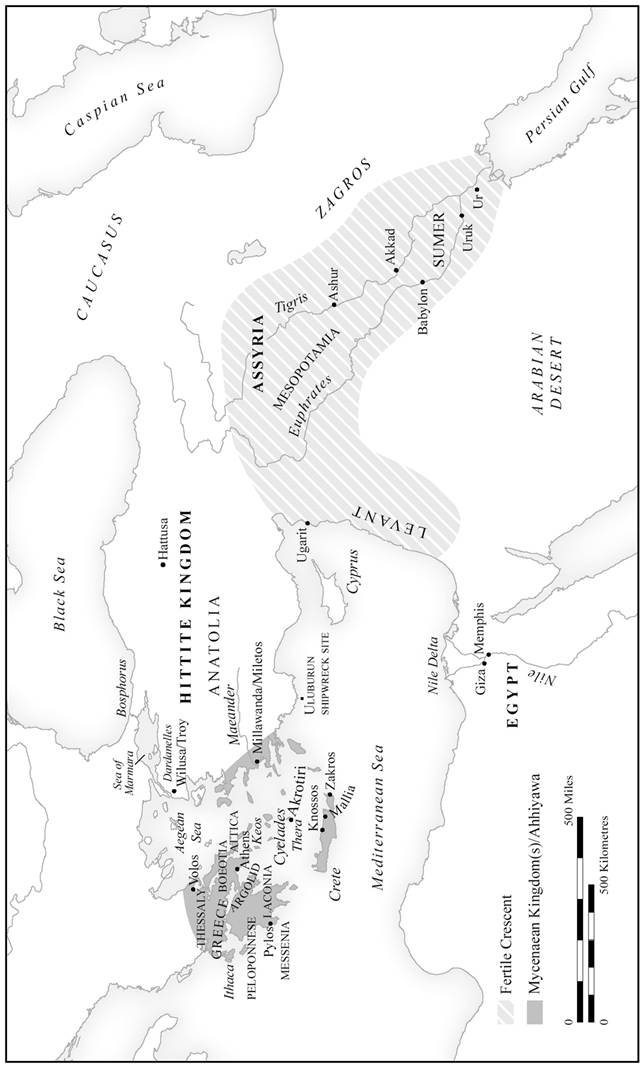
1. The eastern Mediterranean and the Fertile Crescent in the Late Bronze Age
More on the topic PREFACE:
- Preface
- Preface
- Preface
- Preface
- Preface
- Preface
- Preface
- Preface
- Preface
- Preface
- PREFACE
- Preface
- Preface
- Preface
- Preface
- PREFACE
- Preface