Ravages Committed by Soldiers and Brigands Alike
Well known is the fact that, as gifts to the fund of human wisdom, Chinese proverbs are practically uncountable. We therefore should not be surprised to find any one of them reinforced by numerous like-minded sayings and idioms.
Rare it is, however, to encounter one of these maxims that is directly traceable to a single set of concrete historical events - indeed, a specific series of unified instances of luan - but such is the case for the ‘ravages committed by soldiers and brigands alike’ (bingxianfeihuan).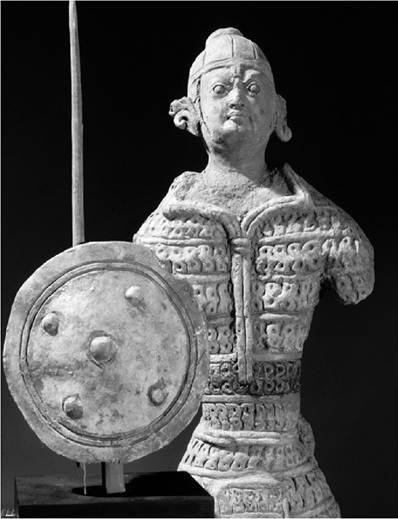
Figure 2.1 A model of a soldier discovered in a shrine at Mingoi, a remote outpost on the northern Silk Road where units of Taizong militia protected China's precious trade routes.
The official History of the Song (Songshi) informs us of how the regime in the late eleventh century, at a time still fairly early in its tenure, had to grapple with the predations of a particular renegade borderland official - most likely a semi-sinicised border tribesman in the service of the Song in the far northwest, in what is now the Turpan (also Turfan; Chinese: Tulufan) area of modern Xinjiang province, and thus at a considerable remove from the then primary capital of the dynasty at Kaifeng. In the Chinese, this ingrate nonChinese official was very aptly named Guizhang (Devil's Badge) and he is remembered in history only for his singularly conspicuous act of luan. We are first informed that: ‘On 10 March 1076, when Zongge Staff Supervisor (shoul- ing) Guizhang invaded Five Bellows Valley (Wumougu) [for the purpose of pillaging and plundering], Submitted Tribes Officer (fanguan) Linzhan Nezhi and others engaged him in battle and dealt him a great defeat.'[69] We subsequently, however, learn of Guizhang’s persistence when we are apprised via the same source that: ‘On 28 December 1076, when Guizhang attacked Minzhou, Prefect (zhizhou) Chong E and others defeated him at Iron Wall (Tiecheng).’[70] Yet, with this final suppression of the nearly year-long mayhem inflicted by a rogue functionary of the Song state, we finally learn of a most unexpected result for his followers: ‘On 12 January 1077, it was imperially decreed that: “[Upon condition of their disbandment,] the soldiers and brigands of Guizhang who had crossed over into Minzhou would be given cash and that, upon their return, those commoners who had been forced to follow along in the service of these armies would be pardoned as blameless for their transgressions.”’[71] Thus, with the turn of the year, whereas the defeated bandit leader Guizhang was fittingly beheaded, his disbanded bandit supporters - not unlike the loyal prefect Chong E who is credited with delivering the culprit’s head to court - were contrastingly rewarded, if with nothing more than clemency for their misdeeds.
To the extent that we are able to view these wholly dissimilar outcomes from the standpoint of the untold numbers of victims of Guizhang’s borderland assaults, we should find it hardly surprising that such a cynical expression as the ‘ravages committed by soldiers and brigands alike’ would have emerged expressly in connection with this unseemly historical event.We can glean much from the story of Guizhang and one of the more prominent themes on which it sheds light is the heightened wariness and trepidation - when compared to Tang precedents - pervading dealings between the Song dynastic state and foreigners. However, for our present purposes, unavoidable for us is how effectively the example of Guizhang illustrates and underscores the implicit perils of the newly emergent medieval Chinese armies, staffed principally through a service model consisting of a combination of payment to recruit and retain professionals and conscription for the purpose of incorporating everyone else. Grant we must that the forces of Guizhang had been illegitimate, not even constituting a cohesive but treacherous splinter regiment of the imperial armies that had opposed and defeated them; they instead represented, at best, a mixture of disloyal government troops and opportunist local marauders. However, on the basis of the shocking imperial decree just cited, we can hardly doubt that the destitute and dispossessed victims of Guizhang’s rampage would have seen the recruitment principles - namely, spoils at their expense for the few and forcible conscription of those like themselves imposed upon the many - as shared in common by his army and that of the imperial state. For this reason, over time, civilian cynicism towards and disapprobation of the legitimate army became rife, such that it often became regarded as hardly different or distinguishable from the bandit brigades of yet another opportunist warlord.
Unsurprisingly, from the perspective of the poorest and therefore most vulnerable of the expanded class of commoners during the Song period, because the onus of its fulfilment fell heaviest upon them as a group, conscription rather than payment was the more virulently savaging of what in the course of time became viewed as two complicit evils.
Whereas it did tend to induce corruption, paying soldiers was a requirement of professionalisation, which had been ongoing since the mid eighth century, at any rate. Moreover, at least theoretically, conscripts were paid too. However, the remuneration for conscripts was often notoriously irregular and it could suddenly, depending on the whims of their commanders, become non-existent. More tragic by far in the popular mind was the brutal reality of conscription as a captive condition.Compounding this condition of captivity for those conscripted members of the Song army was a host of attendant brutalities. Not the least among them consisted of the fact that the abuse that was routinely meted out to them by their superiors could often rival that risked in combat with or capture by the enemy. This violence that conscripts suffered daily at the hands of those ostensibly charged with ensuring their well-being drove many of them to contemplate as well as attempt either defection to less punitive posts or outright desertion. These defections and desertions were guarded against by additional tactics in coercion that guaranteed conformity and compliance, and one of the more novel but widespread of the devices employed - applied collectively for the purpose of identification and quite understandable in an age prior to universally standardised uniforms and identification tags - was tattooing. Extant anecdotes contemporary with the time, such as the following one recorded by the raconteur Zhuang Chuo (fl. 1078-1143), expose us to the kind of victimisation that could be associated with this demarcating practice during Song times, which anciently - in the form of the branding of the forehead and face - had been a codified punishment exclusively reserved for criminals and those who might have offended a given ruler:
When [the emperor] Gaozong [r. 1127-62] crossed the [Yangzi] River heading south, [the generals] Han [Shizhong] [1089-1151] and Liu [Guangshi] [d. 1142]
were both waging frontier campaigns.
Only the army of Zhang Jun [10861154] regularly accompanied the court. From among the young, stout, and big and tall among his soldiers, [Zhang] selected troops and, upon having them tattooed from buttocks to feet, called them [his] ‘decorated legs'. In former times, [only] drifters at the capital used to sport tattoos like these. However, nowadays military commanders follow this practice, which also prevents their troops from fleeing to [seek refuge in] other armies. These tattoos are employed as a means of verification, but they cause much suffering and are also expensive and thus the people all resent them.[72]To be sure, in the telling, Zhuang Chuo's account verges on the tragicomic. Nevertheless, we also keenly sense that there was little that was funny about the experience for those who were forced to undergo the indignity of this stigmatising process and live out the rest of their lives marked by its humiliation. Moreover, with its allusion to the expense involved, surely one of the more intriguing aspects of this report is the high probability that those who were forced to endure the tattooing were at least sometimes made responsible for bearing the cost of inflicting this painful permanent form of branding upon themselves. To this fact may be added that the bearer of these identifying tattoos immediately decremented himself economically. We know this to have been the case because, via yet another in the litany of imperial regulations imposed during the crisis year of 1127, differentials in pay among regular troops became in part officially based on clarity of skin, with those enlisting with clear complexions (baishen) receiving full pay and those who had modified their tattoos to conform with transferral to a different army unit - with the alteration method of choice being mutilation by slicing (gaila) - receiving only half-pay, along with re-enlisting defeated soldiers and surrendered bandits.[73]
Yet we should not think of the relationship between the imperial armies of Song times and the citizenry they were sworn to protect as entirely being reduced to non-existent expectations.
In times of grave exigency, the military more than occasionally functioned as the lifeline of the people. Our initial informant Shao Bo provides us with the account of a massive flood that struck the capital and its environs, stating in part:In the sixth month of the summer of 1118, a torrential flood ensued as the capital endured great rains for ten [straight] days. As the Bian and Zhang tributaries [of the Yellow River] overflowed, all walls and gateways became blocked with mud... The [capital] outskirts themselves in all four directions became like rivers, such that it was not known which [routes] to follow in escaping; those that were recognisable were known to be so by being marked with the emblem of the army.[74]
However, for every account in the historical records of the Song period of its beneficence displayed towards the populace, there seem to be several countervailing documents attesting to the unbridled callousness of the military. As we should expect, as in the foregoing cases of those recorded by Shao Bo and Zhuang Chuo, most of the impugning testimonials are non-official in nature, for they are included within the anecdotal corpuses of private authors. Yet we may elect to regard the freedom of these particular writers from having to protect the image of the military as actually giving credence to their claims. Without the burden of having to cooperate in projecting any sanitised version of its functioning, eyewitness doxographers like Shao and Zhuang, writing privately and without commission instead of at the behest of the court, were thus enabled to portray the military as the externally and internally punitive arm of the Song state that it so invariantly really was.