Religious Violence in the People's Republic
The communists would continue their fraught relationship with religion after 1949, the year they declared victory in their war with the Nanjing regime and founded the People's Republic of China.
This new era would initiate new challenges both for and by religion. While technically the new regime proclaimed its commitment to uphold the freedom of religious belief, the complicated history of foreign mission and religious militarisation ensured that this promise would come with numerous and moving caveats. The first hint of a crisis came late in 1949, when local governments began preparing to move against groups they considered politically suspect, most notably a teaching called the Way of Penetrating Unity (Yiguandao). By June of the following year, directives for a national campaign against the group were being coordinated at a national level, and by the beginning of 1951 a coordinated propaganda drive was unleashed. The suppression of the Way of Penetrating Unity coincided with a series of other events, including a drive to demonise and expel the Catholic missionaries (Protestants were generally spared charges of criminality, but were nevertheless repatriated a few years later), and a national campaign to ‘Suppress the Reactionaries' (zhenya fangeming) that reflected the radicalisation of the Korean War.[77]The violence of this suppression was both actual and symbolic. The campaign set the tone for the place of religion in the People's Republic: it ridiculed the religious beliefs of the Way of Penetrating Unity, but accompanying film and newspaper propaganda (Figure 2.6) also levied against it stock charges of theft, rape and treason for supposedly having collaborated with the Japanese occupation. This campaign probably resulted in 2-3 million killed. Many of the campaigns victims were prominent religious figures, but recalling the cost of attempts by the early Soviet Union to suppress the Russian Orthodox Church, the Chinese Communist Party did not publicise the violence.
Only a small number of devotees were tried as ‘class enemies', and formally sentenced to death - 263 out of nearly 42,000 members in one county near Tianjin - although in reality many more would die as a result of overwork and privation while in the ‘custody of the masses'.[78] The Party was especially keen to ensure that the campaign would not be perceived as a general purge against religion. Buddhist and Protestant leaders were recruited or misquoted to add their criticism to the campaign, specifically that groups such as the Way of Penetrating Unity were traitors both to the nation and, more tellingly, to the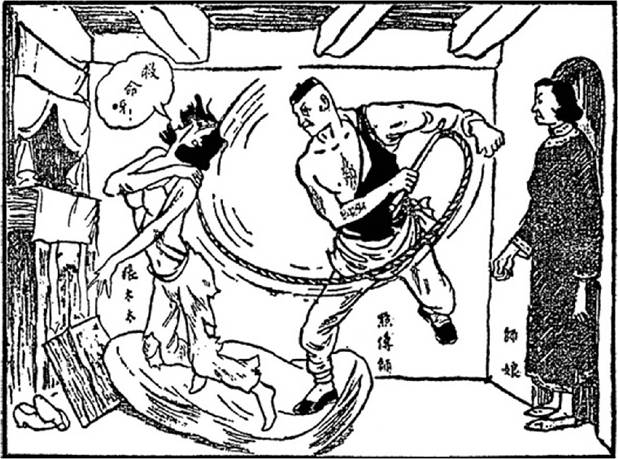
Figure 2.6 Propaganda serial depicting the crimes of the Way of Penetrating Unity. In this scene, the wife of a hapless convert is beaten (and eventually killed) by a religious leader. The scowling woman at the right is Sun Suzhen, wife of the teaching's founder. Xinsheng Wanbao, April 1951.
real purpose of religion. A theme seen as early as the Ming anti-sorcery statute, charges were levied primarily against leaders, who counted among their crimes the wilful deceit of their gullible followers. The suppression of the Way of Penetrating Unity not only expelled the group (as well as a number of smaller groups), but also was an important expression of stylised violence. Similar campaigns would be repeated both against the remainder of the group itself (long after the movement had been broken, old members continued to be brought out and publicly ‘struggled' as an act of political theatre), and against other class enemies, both real and imagined.
Along China's ethnic frontiers, religion represented a stratum of entrenched interests to be tamed or pulverised. In places like Inner Mongolia and Tibet, lamaseries were often the largest landholders, and had for centuries been vital centres of wealth and economic activity. The greatest problem with the lamas, or the Muslim leaders in places like Xinjiang, was not their religion as such, but rather their considerable political authority, one that appealed specifically to non-Chinese populations in regions where the new government was conspicuously weak.
Even having granted nominal self-rule to ethnic ‘autonomous regions' within the sovereign state of the People's Republic, it was very unlikely that the new government would leave these competing structures intact. From the early 1950s, cadres began identifying and removing troublesome leaders, often on pretence of criminal or lewd behaviour, although, as with the campaign against the Way of Penetrating Unity, care was taken to avoid the appearance of a general purge. The fears of the state were made reality in 1959, when a wave of ethnic uprisings near Tibet escalated into protests and eventually a full revolt in Lhasa. The Chinese People's Liberation Army quickly and brutally suppressed the poorly armed rebels, many of whom were in fact monks, burning and looting numerous monasteries and prompting the flight across the Himalayas of the Dalai Lama and roughly 80,000 monks and ethnic Tibetans.Conversely, it is not implausible to consider that communism itself, and in particular the personality cult that developed around Mao Zedong in the 1960s, became the de facto national religion. It is easy to discern phenomenological similarities between Maoism and the external characteristics of religion: central reliance on a sacred text (the Quotations of Mao Zedong, popularly known as the ‘Little Red Book'), rituals of worship, ecstatic devotion and an intense drive to proselytise. We might then ask in what ways the history of religious utopianism shaped expectations of the communist ‘high tide', and in particular whether it provoked or predestined the violent extremism of events like the Great Proletarian Cultural Revolution (the actual movement lasted only from 1966 to 1969, but is often taken to include the years until Mao Zedong's death in 1976). One point of similarity is with prevailing patterns of utopianism. Like the various incarnations of religious millenarianism, Maoism clearly represented a culmination of sacred time, and, like the Yellow Cliff Teaching or the Boxer movement, placed paramount importance on ideological purity.
Viewed in this way, the extremism of the Cultural Revolution period, with its routine victimisation and outright murder of those labelled as enemies of the revolution, as well as internecine struggles between groups of ideologically charged youths, was perhaps the most destructive episode of religious violence of China's twentieth century.[79]The years following Mao's death were marked by an emphasis on economic growth, political stability, and strong determination to avoid the ideological extremism of previous decades. This policy shift included the gradual rehabilitation of religion, a process that began in 1982, with the promulgation of the document ‘Basic Viewpoint and Policy on the Religious Question during Our Country's Socialist Period' (also known as Document 19). This document departed from an earlier orthodoxy by stating that religion could in fact be a socially progressive force, particularly in the cultures of national minorities such as the Muslim Hui and Buddhist Tibetans and Mongolians. By the 1990s, religion was making what appeared to be an overt return to public life. Conspicuous state support for accepted religion (which is allowed within the confines of politically controlled ‘patriotic associations' of five religions: Buddhism, Islam, Daoism, and Protestant and Catholic Christianity) was again on the rise. More tellingly, formerly banned popular festivals were again being organised, often on a very large scale.[80]
This apparent resurgence was halted with the onset of the campaign against Falungong (Dharma Wheel Practice) in 1999. Falungong had formed during the early 1990s as a school of qigong (meditation and concentration exercises), and spread during the national qigong craze, ending the decade with a nationwide following and a desire for formal recognition. In April 1999, approximately 10,000 practitioners staged a peaceful protest outside the government compound at Zhongnanhai in Beijing, so alarming President Jiang Zemin that he took a personal interest in the eradication of the movement.
Beginning that summer (which, perhaps not coincidentally, marked the ten-year anniversary of the Tiananmen massacre), the Chinese government initiated a coordinated series of arrests and detention of Falungong leaders, along with a massive propaganda campaign that (reminiscent of the 1951 campaign against the Way of Penetrating Unity) labelled the group as both criminal and superstitious, a danger both to China and to socialism. The veracity of the Chinese government's claims aside, the group has proven extremely difficult to dislodge. Not only has Falungong retained a core following inside China, it has also spread overseas, out of the grasp of the Chinese government. The repression of the group inside China has been characterised by violence, both the brutal treatment of followers subjected to government rehabilitation, and the reported self-immolation by Falungong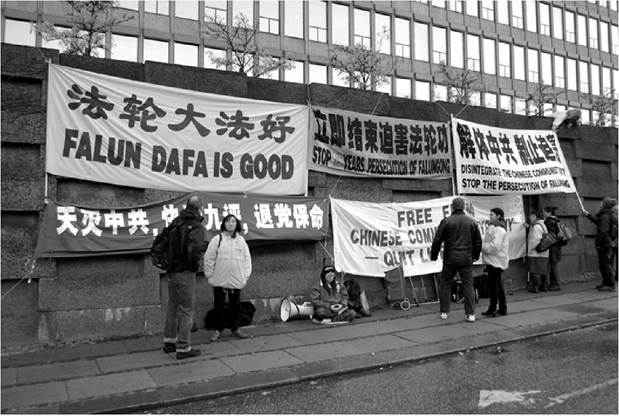
Figure 2.7 A 2011 protest by members of Falungong in Copenhagen.
protestors that state sources say demonstrates the inhumanity of the group's brainwashing. (Falungong itself says that such events were staged.) The overseas following of Falungong has lobbied relentlessly for censure of the Chinese government based specifically on the brutality of this persecution (Figure 2.7). Materials displayed and distributed at the group's protests and public petition drives highlight charges of forced labour, organ harvesting, torture and mass murder, often accompanied by graphic displays of beaten, injured and mutilated bodies. These items sometimes feature more prominently than does the teaching of the group itself, suggesting the degree to which persecution has become central to the group's identity.
It is not implausible that official hostility towards Falungong was driven by the same fears and attitudes that motivated the earlier imperial regimes to ban the propagation of ‘perverse' religion. Beyond Falungong specifically, well-placed scholars in China have put forward the opinion that even seemingly benign New Religious Movements are dangerously incompatible with modern society.[81] Such attitudes were seemingly justified with the rise of a small but virulent strain of teachings such as the True Jesus (Zhen Yesu) Church. Also known as the Eastern Lightning (Dongshan), this group is an extreme offshoot of Pentecostal Christianity, and teaches that Jesus has been reincarnated in China as one of the group's female leaders. Despite being banned, the group is extremely aggressive in its proselytisation, and exerts tight control over its members, as evinced by the 2014 bludgeoning to death of an unwilling convert in a McDonalds restaurant in the coastal city of Yantai. In response, the Chinese security apparatus made approximately 1,000 arrests, and sentenced to execution at least five of the perpetrators.