Sacrifice: Self
Early Spanish chroniclers observed that the Maya pierced and cut themselves with a variety of implements, including obsidian blades, thorns and stingray spines (Figure 25.1).1 Historical accounts and images from the Classic period show that blood was dripped onto paper and collected in ceramic vessels (Figure 25.2).
Alternatively, straw, paper or some other material was inserted into the wounds to collect the vital fluid. The Maya perceived blood as embodied with vital essences, the substance of one's souls (the plural is intentional, as multiple entities coexist within the Maya body).[991] [992] In ancient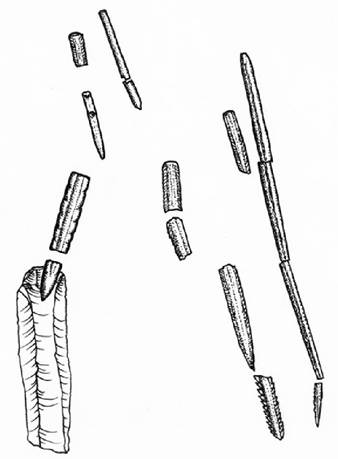
Figure 25.1 Bloodletting kit from Piedras Negras Burial 82 with obsidian blade (left) and stingray spines (right).
times, the blood, bodies and very beings of the nobility, particularly the kings and queens, were perceived to be of a special quality. Described by the adjective k'uhul, these beings were akin to that of the gods, k'uh.3 Therefore, noble blood was especially potent in rituals of conjuring, as testified on an array of images depicted on stone sculptures and painted vases.4 Nevertheless, stingray spines, obsidian blades and other bloodletting implements have been found in a range of archaeological contexts, from
Souls (Austin: University of Texas Press, 2010); Evon Z. Vogt, Tortillas for the Gods: A Symbolic Analysis of Zinacanteco Rituals (Norman: University of Oklahoma Press, 1992); Gary H. Gossen, ‘Animal Souls and Human Destiny in Chamula', Man 10 (1975), 448-61.
3 Stephen D. Houston and David Stuart, ‘Of Gods, Glyphs, and Kings: Divinity and Rulership among the Classic Maya', Antiquity 70 (1996), 289-312; Stephen Houston, David Stuart and Karl Taube, The Memory of Bones: Body, Being, and Experience among the Classic Maya (Austin: University of Texas Press, 2006), p.
79.4 Ian Graham and Eric Von Euw, Corpus of Maya Hieroglyphic Inscriptions, vol. iii, pt 1, Yaxchilan (Cambridge, MA: Peabody Museum of Archaeology and Ethnology, Harvard University, 1977); Ian Graham, Corpus of Maya Hieroglyphic Inscriptions, vol. iii, pt 2, Yaxchilan (Cambridge, MA: Peabody Museum of Archaeology and Ethnology, Harvard University, 1979); Ian Graham, Corpus of Maya Hieroglyphic Inscriptions, vol. iii, pt 3,
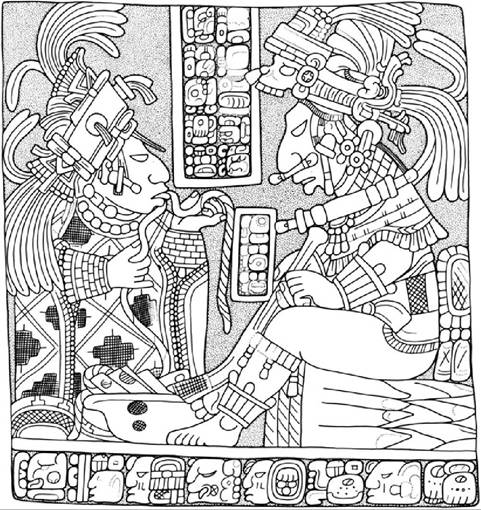
Figure 25.2 Yaxchilan Lintel 17 depicting Lady Mut Bahlam (left) guiding a rope through her pierced tongue and Bird Jaguar (right) with a piercing implement in hand, both situated around a bowl with blood splattered paper.
royal tombs and elite ritual deposits to non-elite households and marketplaces, suggesting that to some degree all members of Maya society may have practised bloodletting. Chronologically, bloodletting implements have been found at archaeological sites throughout Mesoamerica and the ritual is among the earliest sacred rites depicted in Preclassic art, including the famed murals at San Bartolo, Guatemala.5
Piercing generally targeted the skin and cartilage including the earlobes, lips and cheeks, and the foreskin of the penis. Blood was also let from the tongue. In part, these choices reflect convenience - they are anatomical
Yaxchilan (Cambridge, MA: Peabody Museum of Archaeology and Ethnology, Harvard University, 1982).
5 Karl A. Taube et al., The Murals of San Bartolo, El Peten, Guatemala, part 2, The West Wall (Barnardsville: Boundary End Archaeology Research Center, 2010). features that will produce copious amounts of blood yet their wounds can be stopped and will heal over time. Nevertheless, by targeting the mouth, ears and genitalia the Maya were also acknowledging that these are the very structures through which spiritual essences entered and exited the body. 6
Classic Maya texts identify bloodletting as ch'ahb, a term that is sometimes translated as ‘to do penance' and also ‘to be pious' or ‘to punish'.[993] [994] These readings draw inspiration from Spanish chroniclers of the conquest who frequently referred to auto-sacrifice and other offertory rites as acts of ‘penance'.[995] Penance is, of course, one of the seven sacraments of Catholicism and is undergone when one needs to atone for past wrongdoings.
For sixteenth-century Spaniards, that atonement involved a broad swathe of behaviours, including those that emphasised bodily discomfort and even pain, including fasting, wearing cilices and self-flagellation. Spanish chroniclers (and contemporary observers) apparently saw superficial parallels between their penitential acts and the indigenous ritual practices of fasting, sexual abstinence and bloodletting. However, the underlying theology of Catholic penance and indigenous selfsacrifice was fundamentally different and there is little to suggest that bloodletting and similar acts were motivated by a desire to seek redemption for past transgressions. Rather, indigenous acts of offering and sacrifice, including bloodletting, reflect a broader worldview that emphasises the importance of duty, obligation and burden, to one's fellow humans and especially to the gods and other supernatural beings. This concept is well captured in Sahagun's chronicle of the Aztecs, the Florentine Codex, which refers to bloodletting and related acts as ‘debt-payment' as opposed to ‘penance'.[996]Colonial and contemporary use of the Mayan ch'ab further clarifies the meaning of the Classic period ch'ahb. The sixteenth-century Motul Dictionary defines ch'ab.t as ‘criar algo de nada, que es propia de dios' (to create something from nothing, that which belongs to god) and most other Yucateco Mayan dictionaries define ch'ab as ‘to create'.[997] In Tzotzil ch'ab is ‘to end (as in argument, court case, war, pain)' and similarly ch'abal means ‘estar silencioso' (to be silent) in Tzeltal.11 Today, Tzeltal shamans are known as ch'abajom and, as Pedro Pitarch explains, their songs are ch'abajel ‘because the main function of the shamans is to silence the huge noise produced by spirits, as well as to extinguish the intense heat - that is, fever - released by their emotions of anger and rancor'.12
Today, Tzeltal and other Maya shamans make offerings of alcohol, incense and candles, and occasionally animals, in order to appease and placate the supernatural.[998] [999] [1000] The preferred incense today and in antiquity is the tree resin referred to in Spanish (from the Nahuatl) as copal.
In a number of Mayan languages another term, kik, is used for blood and incense implying a conceptual continuity between the two. Spanish chroniclers indicate that copal was sculpted into the form of different offerings, the resin serving as a representation or substitution of the animal or human that was represented.[1001] [1002] [1003] Such modelled copal has been found in the cenote at Chichen Itza.15 Ancient iconography attests to the importance of incense and other burnt offerings and a wide array of censers and related fire paraphernalia are found throughout the Maya world. In modern times the supernaturals are understood to sustain themselves on incense, other burnt offerings, music and other sensory stimuli. In antiquity blood was one of the chief substances upon which the supernaturals fed and there is a complex range of imagery that illustrates that many Maya gods were blood drinkers.16Although the Maya no longer make sacrifices of themselves or others, endurance, self-restraint and discomfort remain vital to indigenous religious experience. Such practices relate to a broader concern with controlled bodily comportment as the ultimate physical expression of the self. Especially important was the control of emotion during these acts of endurance, as evident in the dispassionate visages of Maya lords and ladies engaged in bloodletting. In ancient times, pain and discomfort were a vital component of many rites of passages, including the deformation of infant heads and especially the modification of the teeth at the transition to adulthood. Among the Maya, the first bloodletting, yax ch'ahb, was a celebrated rite of passage for royals, as depicted on a panel from the site of Dos Pilas, Guatemala. Although we do not know the age of the youth, he is depicted as a child of perhaps 6 to 8 years judging by his size in the image.17
A similar first bloodletting is referenced on an unprovenanced Early Classic period Maya stela now in the collection of the Princeton University Art Museum (the so-called Hauberg Stela).
The text describes a yax ch'ahb tu k'uhil, the ‘first bloodletting for the god'.18 The stela depicts the aquatic form of the Maya Sun God (GI) (or perhaps a human impersonator thereof) clutching an object covered in scales from which spews a stream of blood and three disembowelled figures, flames erupting from their abdomens. The stream of blood flows past the supernatural being's mouth, his shark-tooth incense see Gary H. Gossen, TellingMaya Tales: Tzotzil Identities in Modern Mexico (New York: Routledge, 1999), p. 18. For discussion of the symbolism of supernatural blood drinking see Karl A. Taube and Stephen Houston, ‘Masks and Iconography', in S. Houston et al. (eds.), Temple of the Night Sun: A Royal Tomb at El Diablo, Guatemala (San Francisco: Precolumbia Mesoweb Press, 2015); Stone and Zender, Reading Maya Art, p. 53.17 For bodily comportment and the expression of the self, see Houston et al., Memory of Bones, pp. 76-81; Charles Golden and Andrew K. Scherer, ‘Territory, Trust, Growth and Collapse in Classic Period Maya Kingdoms', Current Anthropology 54 (2013), 397417. On the control of emotion see Stephen D. Houston, ‘Decorous Bodies and Disordered Passions: Representations of Emotion among the Classic Maya', World Archaeology 33 (2001), 206-19. On the relationship between body modifications and the development of self see A. K. Scherer, ‘Head Shaping and Tooth Modification among the Classic Maya of the Usumacinta River Kingdoms', in V. Tiesler and M. C. Lozada (eds.), Head Transformations in Native Mesoamerica and the Andes: Identity, Power, and Embodiment (Albuquerque: University of New Mexico Press, in press); Stephen Houston, ‘A Splendid Predicament: Young Men in Classic Maya Society', Cambridge Archaeological Journal 19 (2009), 149-78; Pamela L. Geller, ‘Altering Identities: Body Modification and the Pre-Columbian Maya', in R. Gowland and C. J. Knusel (eds.), Social Archaeology of Funerary Remains (Oxford: Oxbow Books, 2006), pp. 279-91.
18 Houston et al., Memory ofBones, p. 93.A full interpretation of the stela is beyond the scope of the chapter. For recent discussion see Karl Taube and Stephen D. Houston, ‘Lidded Bowl with the Iguana-Jaguar Eviscerating Humans', inD. Finamore and S. D. Houston (eds.), The Fiery Pool: The Maya and the Mythic Sea (New Haven: Peabody Essex Museum/Yale University Press, 2010), pp. 250-3; Taube and Houston, ‘Masks and Iconography'. incisor embedded in the stream, implying he is consuming the offering. The precise relationship between text and image is unclear but the basic sense is that the first bloodletting described in the text, presumably for a young Maya prince, was enacted in parallel to the primordial sacrifice depicted on the stela. In this manner, royal bloodletting was likened to divine sacrifice.
The scene on the Hauberg Stela resonates with a broader trope in Mesoamerican spirituality whereby gods and other supernatural beings are not only consumers of human blood but sacrificers themselves. Creation is understood to have been wrought through sacrifices of the gods and the images of those gods in the living world. Maya lords and ladies were obliged to repeat these generative acts in their own sacrifices and ultimately serve as sacrifice themselves at the time of their deaths. Such myths are diverse and varied but one persistent theme is the slaying and dismemberment of a great beast with crocodilian attributes from which the earth is rendered (the scaled object on the Hauberg Stela may be a representation of part of this beast). Another common myth involves the self-immolation of a sickly youth who, after days of making offerings of his own blood and other goods, bravely throws himself into a fire to rise again as the current sun. Postclassic period myths of both the Aztec and the Maya further emphasise how this solar god himself requires blood offerings and human sacrifice in exchange for his lifegiving heat and flame. In all contexts of supernatural sacrifice, the emphasis is on duty, obligation, bravery and other forms of morally correct action.
The Postclassic myths of solar sacrifice emphasise a link between sacrifice, the sun, creation and the very passage of time. The Pre-Columbian Maya understood time as segmented, comprised of episodes of varying sizes that repeat themselves or, perhaps better, transition from one to the next. The smallest unit was the count of days, interpersed by periods of darkness (night). Darkness is a time of instability in Mesoamerican thought, likened to the primordial time before creation. Larger blocks of time are also understood to transition through periods of darkness. For the Maya, especially important was the winik haab' or k'atun, as it was more commonly known, a period of time roughly equivalent to twenty years in our calendar. For the Maya, temporal transitions were times of sacrifice and they perceived a link between time and corporal offering. We see the connection, for example, in the earliest depictions of Maya day signs, which are shown as bloody severed heads.[1004]
At the time of the conquest, the Spanish identified priests among the Maya as men who had devoted their lives to the service of communication with the supernatural and thus were frequently involved in acts of sacrifice. The Spanish foot soldier Bernal Diaz del Castillo reported Maya priests as having ‘long hair reeking with blood, and so matted together that it could never be parted or even combed out again, unless it were cut'. Aztec priests are similarly described and illustrated as men with unwashed long hair, matted with blood and filth, and even sprouting vegetation. Similar garb is shown in Classic period Maya imagery, as costume elements worn by Maya lords and ladies who bear the title of ch'ajoom, literally a person of incense, and the full figure glyph incorporates these costume elements. The implication is that one of the principal duties of Maya kings, queens and other lords was to serve as ritual specialists and directly engage the supernatural through acts with which the ch'ajoom title is associated: censing, bloodletting, fire-making and child sacrifice. Notably, no textual references to ch'ajoom nor to any of its attendant imagery are related to the sacrifice of adult captives taken in war. Rather the imagery suggests that the work of ch'ajoom was to make offerings of blood and fire in part to placate and appease supernatural entities (not unlike modern Tzeltal ch'abajoom) and perhaps also to petition their aid in acts that we might gloss as witchcraft or sorcery.[1005]
Aside from locating the implements used in bloodletting, auto-sacrifice is difficult to identify in the archaeological record. However, pots containing severed fingers and avulsed teeth are probably also deposits left by men and women engaged in ritual acts of personal injury. Like spilt blood, these body parts were perhaps intended for supernatural consumption and again serve as testimony to the importance of pain and endurance in Maya ritual practice. Imagery from the Classic period also indicates that the Maya participated in violent, staged melee combats as a form of sacrificial offering. Some of these contests seem to have taken place at the ball courts, ceremonial entrances to the underworld. Much like the tinku fights waged today by indigenous people of South America, the blood, pain and injury that resulted from these fights were probably understood as offerings for otherworldly beings.[1006]