Scholars, Philosophers, and Sufis
10-505 AH
632-1111 CE
So far i have been recounting political events at the highest levels as Muslim civilization evolved into the civilization of the middle world.
Big stories were unfolding, however, below that highest level, and none was bigger than the development of Muslim doctrine, and the social class it generated, along with the opposing and alternative ideas it engendered.
Looking back, it’s easy to suppose that Mohammed left his followers exact instructions for how to live and worship, complete in every detail. How complete they were, however, is difficult to gauge. What’s pretty certain is that, in his lifetime, Mohammed established the primacy of five broad duties, now called the five pillars of Islam:
shahadah, to attest that there is only one God and Mohammed is his messenger;
salaat (or namaz), to perform a certain prayer ritual five times every day;
zakat, to give a certain percentage of one’s wealth to the poor each year; sawm (or roza), to fast from dawn to dusk during the month of Ramadan each year; and
hajj, to make a pilgrimage to Mecca at least once in a lifetime, if possible.
Notice both the simplicity and “externalness” of this program. Only one of the five pillars is a belief, a creed, and even that is given in terms of an action: “to attest.” The other four pillars are very specific things to do. Again, Islam is not merely a creed or a set of beliefs: it is a program every bit as concrete as a diet or an exercise regiment. Islam is something one does.
The five pillars were already part of life in the Muslim community by the time of Mohammed’s death, but so were other rituals and practices, and any of them may have been parsed somewhat differently back then. The fact is, when Mohammed was alive, there was no need to fix the details inflexibly because the living Messenger was right there to answer questions.
Not only could people learn from him every day, but through him they might receive fresh instructions at any time.Indeed, Mohammed did receive revelations continually, not just about general values and ideals but about practical measures to take in response to particular, immediate problems. If an army was approaching the city, God would let Mohammed know if the community should get ready to fight, and if so, how. If Muslims captured prisoners and after the battle was over wondered what to do with them: Kill them? Keep them as slaves? Treat them as members of the family? Set them free? God would tell Mohammed, and he would tell everyone else.
It’s well known that Muslims face Mecca when they pray, but this was not always the case. At first, in fact, Muslims performed their prayers facing Jerusalem. At a certain point in the maturation of the community, however, a revelation came down instructing them to shift direction, and it has been Mecca ever since.
And it will always be Mecca from now on, because Mohammed is gone and there will never be another Messenger, which means that no one will ever again have the authority to change the direction of prayer. In short, while Mohammed was alive, the Islamic project had an organic vitality. It was constantly in the process of unfolding and evolving. Any element of it might change at any time.
But the moment Mohammed died, Muslims had to ask themselves, “What exactly are we supposed to do? How are we supposed to do it? When we pray, should we hold our hands up here or down lower? In preparing for prayer, must we wash our feet all the way to the shins or would just to the ankles be enough?”
And, of course, there was a lot more to being a Muslim than the five pillars. Beyond individual duties such as fasting, alms, and the testament of faith, there was the social aspect of Islam, a persons obligations to the community, the good-citizenship behaviors that fed into making the community an instrument of Gods will.
For example, there was certainly a proscription against drinking. Certainly Muslims had some obligation to defend the community with their lives and fortunes when necessary in the obligation famously called jihad. In general, making sacrifices for the communal good devolved upon every Muslim because the community might not otherwise endure, and to many if not most Muslims, the community was the template of a new world, charged with an obligation to set a continuous example of how all people should live. Anyone, therefore, who contributed to the health of the community was doing God’s work, and anyone who fell short was misbehaving. But what contributed to the health of the community? And how much contribution was enough?Once Mohammed died, Muslims had to bring their obligations into focus and get the details down in writing to secure their faith from drift, divergence, and the whims of the powerful. That’s why the first two khalifas collected every scrap of Qur’an in one place and why the third khalifa created that single authorized edition.
But the Qur’an did not explicitly address many questions that cropped up in real life. As a matter of fact, most of the Holy Book spoke in very general terms: Stop sinning; behave yourself; have a heart; you will be judged; hell is an awful place; heaven is wonderful; be grateful for all that God has given you; trust in God; obey God; yield to God—such is the gist of the message one gets from much of the Holy Book. Even where the Qur’an gets specific, it is often open to interpretation.
And “interpretation” portended trouble. If everyone were allowed to interpret the ambiguous passages for themselves, their conclusions might diverge wildly. People would move apart in as many different directions as there were people, the community would fragment, and the world might swallow up the pieces and who was to say the great revelation would not then vanish as if it had never been?
THE SCHOLARS
Clearly Muslims had to come to unified agreements about the ambiguous passages and do it fast, while the original excitement still burned in communal memory.
No one in that early time wanted to offer a personal interpretation of the Truth backed only by his or her reason. If reason were enough, revelation would never have been needed. Certainly, none of the early khalifas laid claim to any such authority. They were devout people who refused to tamper with instructions from God. Their humble modesty was precisely what made them great. They wanted to get the instructions exactly right in letter and spirit—and by “right,” they meant, “exactly as God intended.”From the start, therefore, Muslims tried to rely on their memories of the Prophet to fill in any gaps in the Qur’an’s guidelines. It was Omar who really set the course here. Whenever a question came up for which no explicit answer could be found in the Qur’an, he asked, “Did Mohammed ever have to deal with a situation like this one? What did he decide?”
Omar’s approach got people motivated to collect everything Mohammed had ever said and done, quotations and anecdotes known to Muslims as hadith. But many people had heard Mohammed say many things. Which ones were credible? Some quotations contradicted other quotations. Some people might have been making stuff up. Who could tell? And some, it turned out, hadn’t actually heard a quotation themselves, but had it only on good authority—or so they claimed, which of course raised the question, who was the original source? Was that person reliable? What about the other people who had transmitted it? Were they all reliable? What, finally, constituted a “good authority?”
Omar, as I mentioned, established a body of full-time scholars to examine such questions, thereby establishing a consequential precedent: before Islam had a standing army of professional soldiers, it had a standing army of professional scholars (called “people of the bench” or sometimes “people of the pen”).
Hadith, however, proliferated faster than any small group of scholars could control. New ones were constantly coming to light. By Umayyad times, thousands of remembered statements, quotations, and decisions of Mohammed’s were floating around.
Combing through this jungle and determining which ones were authentic provided employment for an ever- greater number of scholars. The court funded this sort of work, but so did rich men eager to earn merit in God’s eyes. Independent scholars applied themselves to the great task on their own time, as well. If they gained enough fame, they attracted students and patrons. Informal groups of this type ripened into academies, sometimes as adjuncts to the waqfs mentioned earlier.The word hadith is sometimes translated as “sayings,” but that term can be misleading. The sayings of Mohammed are not like the sayings of Shakespeare or Einstein or the local wit. They’re not remembered for their felicity of phrasing. No one would bother to record the sayings of the local wit, or even of Shakespeare, unless they were witty, pithy, or profound, but with hadith, what counts is the fact that Mohammed actually said them. It’s true that some hadith have an epigrammatic quality. One can admire the economy of the admonition: “Food for one is enough for two, food for two is enough for three....” But many hadith come off as ordinary, even casual, statements. They might have been remarks Mohammed tossed off in the course of daily life. One hadith reports the Prophet telling a fellow who had a sparse beard and had shaved those few scant hairs that he should not have shaved his beard. This comment from anyone else would have been forgettable and forgotten, but anything Mohammed said might offer one more clue about how to live a life pleasing to God.
Since the authenticity of a hadith was absolutely crucial, the authentication of hadith developed into an exacting discipline. At its core, it consisted of nailing down the chain of transmission and testing the veracity of every link. A hadith was only as good as the people who transmitted it. The chain of transmission had to extend to someone who knew the Prophet personally. Only then could a purported hadith be taken seriously. Ideally, it would trace to one of Mohammed’s close companions, and the closer the companion the more sound the hadith.
In addition, every person who transmitted it after that had to enjoy an impeccable reputation for piety, honesty, and learning.I heard that once the great scholar Bukhari was investigating the chain of transmission for a particular hadith. He found the first link credible; the second man passed muster too; but when Bukhari went to interview the third man in the chain of transmission, he found the fellow beating his horse. That did it. The word of a man who beat his horse could not be trusted. That hadith had to be discarded.
In short, to gauge the credibility of the people who transmitted a hadith, a scholar had to know a great deal about them and about their times. A scholar also had to know the circumstances in which a hadith was spoken so that its intention might be judged from context. The “science of hadith” thus generated an elaborate discipline of critical historiography.
Some seven or eight decades after Mohammed’s death, scholars across the Muslim world began compiling sifted collections of hadith grouped under specific topics, which functioned as organized statements of Islamic doctrine and as reference works on Islamic living. If you wondered, for example, what Prophet Mohammed had to say about diet, or clothing, or warfare, you could look it up in such a book. The enterprise began in late Umayyad times, but it matured in the Abassid era, and new collections kept emerging for centuries. (In fact, just last year, a distant Afghan acquaintance sent me a handwritten manuscript he was hoping I would translate into English. It constituted, he said, a new set of hadith he himself had collected—after fourteen centuries.)
Even though new hadith kept emerging, however, six collections achieved canonical status by the end of the third century AH. These complemented the Qur’an and came to constitute a second level of authority on the dos, don’ts, shoulds, and shouldn’ts of Muslim life.
Yet even the Qur’an and hadith together failed to give a definitive answer to every real-life question, as you can imagine. Sometimes, therefore, it was necessary for someone to make an original decision about a disputed situation. Given the legalistic spirit of Islam, Muslims conceded this right of original decision making only to scholars who had thoroughly absorbed Qur’an and hadith and had mastered the “science of hadith,” the discipline of authentication. Only such folks could be sure their rulings did not contradict some point set forth in the revelations.
Even qualified scholars were to make decisions based strictly on qiyas or analogical reasoning, the method Khalifa Omar used to discover the punishment for drinking (and to make many other rulings). That is, for each unprecedented contemporary situation, scholars had to find an analogous one in classical sources and derive a judgment parallel to the one already made. And if ambiguities arose about the way to apply qiyas, the matter was settled by ijma, the consensus of the community—which really meant the consensus of all the recognized scholars of the time. Such a consensus could guarantee the veracity of an interpretation because Prophet Mohammed had once said, “My community will never agree on an error.”
If a scholar had exhausted Qur’an, hadith, qiyas, and ijma, then and only then could he move on to the final stage of ethical and legislative thinking, ijtihad, which means “free independent thinking based on reason.” Scholars and judges could apply this type of thinking only in areas not derived directly from revelation or covered by established precedents.
And over the centuries, even those cracks grew narrower, because once an eminently qualified scholar weighed in on some subject, his pronouncements also joined the canon. Scholars who came later had to master not just Qur’an, hadith, authentication, qiyas, and ijma, but also this ever-growing corpus of precedents. Only then were they qualified to exercise ijtihad!
In this way, an architectonic code took shape by the end of the third century AH, a set of proscriptions and prescriptions, obligations, recommendations, and warnings, guidelines, rules, punishments, and rewards covering every aspect of life from the grandest social and political questions to the minutest minutiae of daily life such as personal hygiene, diet, and sexual activity. This bill of particulars marks out the shana. The word comes from a cognate meaning “path” or “way,” and shari’a refers to something bigger than “Islamic law.” It is the whole Islamic way of life, which is not something to be developed but something to be discovered, as immutable as any principle of nature. All the specific legal points elaborated by scholars and jurists are markers that reveal this “path to Allah,” the way stones, signs, and guideposts might show a traveler where the path is amid the brambles and brush of a wilderness.
On the Sunni side, four slightly different versions of this code took shape, and the Shi’i developed yet another one of their own, similar to the Sunni ones in spirit and equally vast in scope. These various codes differ in details, but I doubt that one Muslim in a thousand can name even five such details.
The four schools of Sunni law are named for the scholars who gave them final shape. Thus, the Hanafi school was founded by Abu Hanifa, from the Afghanistan area (though he taught in Kufa, Iraq); the Maliki school, by the Moroccan jurist Ibn Malik (though he worked and taught in Medina); and the Shafi’i school, by Imam al-Shafi’i of Mecca (though he settled finally in Egypt.) The last to crystallize was the Hanbali school, founded by the rigidly uncompromising Ahmed Ibn Hanbal, about whom I will say more later in this chapter.
The schools promote slightly different methods of deriving rulings, which has led to minor variations in the details of their laws, but ever since Abbasid times all four have been considered equally orthodox: a Muslim can subscribe to any of them without taint of heresy. Developing and applying this code in all its versions was itself a gigantic social enterprise that spawned and employed an entire social class of scholars known as the ulama—the title is simply the plural of alim, which means “learned one.”
If you had a reputation for religious scholarship—if you were, that is, a member of the ulama—you might be invited to participate in the administration of a waqf. You might teach students, or even run a school. You might work as a judge, and not just one who heard particular cases, but a judge who issued rulings on broad social issues. In the khalifate, your scholarly status might well lead powerful officials to seek your advice, even though the government and the ulama tended to butt heads, being separate (sometimes even competing) loci of power. The ulama defined the law, controlled the courts, ran the educational system, and permeated Muslim social institutions. They had tremendous social power throughout the civilized world, the power to muster and direct the approval and disapproval of the community against particular people or behaviors. I emphasize social power, because in Muslim society, which is so community oriented, social pressure—the power of shaming—might be the most powerful of all forces, as opposed to political power, which operates through procedural rules, control of money, monopoly control of the instruments of force, and so on.
Let me emphasize that the ulama were not (and are not) appointed by anyone. Islam has no pope and no official clerical apparatus. How, then, did someone get to be a member of the ulama? By gaining the respect of people who were already established ulama. It was a gradual process. There was no license, no certificate, no “shingle” to hang up to prove that one was an alim. The ulama were (and are) a self-selecting, self-regulating class, bound entirely by the river of established doctrine. No single alim could modify this current or change its course. It was too old, too powerful, too established, and besides, no one could become a member of the ulama until he had absorbed the doctrine so thoroughly that it had become a part of him. By the time a person acquired the status to question the doctrine, he would have no inclination to do so. Incorrigible dissenters who simply would not stop questioning the doctrine probably wouldn’t make it through the process. They would be weeded out early. The process by which the ulama self-generates makes it an inherently conservative class.
THE PHILOSOPHERS
The ulama, however, were not the only intellectuals of Islam. While they constructed the edifice of doctrine, another host of thoughtful Muslims were hard at work on another vast project: interpreting all previous philosophies and discoveries in light of the Muslim revelations and integrating them into a single coherent system that made sense of nature, the cosmos, and man’s place in all of it. This project generated another group of thinkers known to the Islamic world as the philosophers.
The expansion of Islam had brought Arabs into contact with the ideas and achievements of many other peoples including the Hindus of India, the central Asian Buddhists, the Persians, and the Greeks. Rome was virtually dead by this time, and Constantinople (for all its wealth) had degenerated into a wasteland of intellectual mediocrity, so the most original thinkers still writing in Greek were clustered in Alexandria, which fell into Arab hands early on. Alexandria possessed a great library and numerous academies, making it an intellectual capital of the Greco- Roman world.
Here, the Muslims discovered the works of Plotinus, a philosopher who had said that everything in the universe was connected like the parts of a single organism, and all of it added up to a single mystical One, from which everything had emanated and to which everything would return.
In this concept of the One, Muslims found a thrilling echo of Prophet Mohammed’s apocalyptic insistence on the oneness of Allah. Better yet, when they looked into Plotinus, they found that he had constructed his system with rigorous logic from a small number of axiomatic principles, which aroused the hope that the revelations of Islam might be provable with logic.
Further exploration revealed that Plotinus and his peers were merely the latest exponents of a line of thought going back a thousand years to a much greater Athenian philosopher named Plato. And from Plato, the Muslims went on to discover the whole treasury of Greek thought, from the pre-Socratics to Aristotle and beyond.
The Abbasid aristocracy took great interest in all of these ideas. Anyone who could translate a book from Greek, Sanskrit, Chinese, or Persian into Arabic could get high-paying work. Professional translators flocked to Baghdad. They filled whole libraries in the capital and in other major cities with classic texts translated from other languages. Muslims were the first intellectuals ever in a position to make direct comparisons between, say, Greek and Indian mathematics, or Greek and Indian medicine, or Persian and Chinese cosmologies, or the metaphysics of various cultures. They set to work exploring how these ancient ideas fit in with each other and with the Islamic revelations, how spirituality related to reason, and how heaven and earth could be drawn into a single schema that explained the entire universe. One such schema, for example, described the universe as emanating from pure Being in a series of waves that descended to the material facts of immediate daily life—like so: 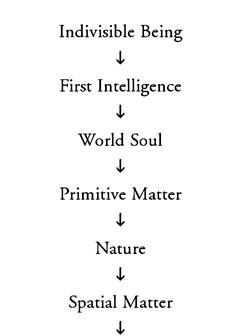
Elements
Minerals, Plants, and Animals
Plato had described the material world as an illusory shadow cast by a “real” world that consisted of unchangeable and eternal “forms”: thus, every real chair is but an imperfect copy of some single “ideal” chair that exists only in the realm of universals. Following from Plato, the Muslim philosophers proposed that each human being was a mixture of the real and the illusory. Before birth, they explained, the soul dwelt in a realm of Platonic universals. In life, it got intertwined with body, which was made up of matter. At death, the two separated, the body returning to the world of all matter while the soul returned to Allah, its original home.
For all their devotion to Plato, the Muslim philosophers had tremendous admiration for Aristotle, as well: for his logic, his techniques of classification, and his powerful grasp of particularities. Following from Aristotle, the Muslim philosophers categorized and classified with obsessive logic. Just to give you a taste of this attitude: the philosopher al-Kindi described the material universe in terms of five governing principles: matter, form, motion, time, and space. He analyzed each of these into subcategories, dividing motion, for instance, into six types: generation, corruption, increase, decrease, change in quality, and change in position. He went on and on like this, intent on parsing all of reality into discrete, understandable parts.
The great Muslim philosophers associated spirituality with rationality: our essence, they said, was made up of abstractions and principles, which only reason could access. They taught that the purpose of knowledge was to purify the soul by conducting it from sensory data to abstract principles, from particular facts to universal truths. The philosopher al-Farabi was typical in recommending that students begin with the study of nature, move on to the study of logic, and proceed at last to the most abstract of all the disciplines, mathematics.
The Greeks invented geometry, Indian mathematicians came up with the brilliant idea of treating zero as a number, the Babylonians discovered the idea of place value, and the Muslims systematized all of these ideas, adding a few of their own, to invent algebra and indeed to lay the foundations of modern mathematics.
On the other hand, their interests directed the philosophers into practical concerns. By compiling, cataloging, and cross-referencing medical discoveries from many lands, thinkers like Ibn Sina (Avicenna to the Europeans) achieved a near-modern understanding of illness and medical treatments as well as of anatomy—the circulation of blood was known to them, as was the function of the heart and of most other major organs. The Muslim world soon boasted the best hospitals the world had ever seen or was to see for centuries to come: Baghdad alone had some hundred of these facilities.
These Abbasid-era Muslim philosophers also laid the foundations of chemistry as a discipline and wrote treatises on geology, optics, botany, and virtually all the fields of study now known as science. They didn’t call it by a separate name. As in the West, where science was long called natural philosophy, they saw no need to sort some of their speculations into a separate category and call it by a new name, but early on they recognized quantification as an instrument for studying nature, which is one of the cornerstones of science as a stand-alone endeavor. They also relied on observation for data upon which to base theories, a second cornerstone of science. They never articulated the scientific method per se— the idea of incrementally building knowledge by formulating hypotheses and then setting up experiments to prove or disprove them. Had they bridged that gap, science as we know it might well have sprouted in the Muslim world in Abbasid times, seven centuries before its birth in western Europe.
It didn’t happen, however, for two reasons, one of which involves the interaction between science and theology. In its early stages, science is inherently difficulty to disentangle from theology. Each seems to have implications for the other, at least to its practitioners. When Galileo promoted the theory that the earth goes around the sun, religious authorities put him on trial for heresy. Even today, even in the West, some Christian conservatives counterpose the biblical narrative of creation to the theory of evolution, as if these two are competing explanations of the same riddle. Science challenges religion because it insists on the reliability and sufficiency of its method for seeking truth: experimentation and reason without recourse to revelation. In the West, for most people, the two fields have reached a compromise by agreeing to distinguish their fields of inquiry: the princi- pies of nature belong to science, the realm of moral and ethical value belongs to religion and philosophy.
In ninth and tenth century Iraq (as in classical Greece), science as such did not exist to be disentangled from religion. The philosophers were giving birth to it without quite realizing it. They thought of religion as their field of inquiry and theology as their intellectual specialty; they were on a quest to understand the ultimate nature of reality. That (they said) was what both religion and philosophy were about at the highest level. Anything they discovered about botany or optics or disease was a by-product of this core quest, not its central object. As such, philosophers who were making discoveries about botany, optics, or medicine did not hesitate to pronounce on questions we moderns would consider theological and quite outside the purview of, say, a chemist or a veterinarian—questions such as this one:
If a man commits a grave sin, is he a non-Muslim, or is he (just) a bad Muslim?
The question might seem like a semantic game, except that in the Muslim world, as a point of law, the religious scholars divided the world between the community and the nonbelievers. One set of rules applied among believers, another set for interactions between believers and nonbelievers. It was important, therefore, to know if any particular person was in the community or outside it.
Some philosophers who took up this question said Muslims who were grave sinners might belong to a third zone, situated between belief and unbelief. The more rigid, mainstream scholars didn’t like the idea of a third zone, because it suggested that the moral universe wasn’t black-and-white but might have shades of gray.
Out of this third-zone concept developed a whole school of theologians called the Mu’tazilites, Arabic for “secessionist,” so called because they had seceded from the mainstream of religious thought, at least according to the orthodox ulama. Over time, these theologians formulated a coherent set of religious precepts that appealed to the philosophers. They said the core of Islam was the belief in tawhid'. the unity, singleness, and universality of Allah. From this, they argued that the Qur’an could not be eternal and uncreated (as the ulama proclaimed) because if it were, the Qur’an would constitute a second divine entity alongside Allah, and that would be blasphemy. They argued, therefore, that the Qur’an was among Allah’s creations, just like human beings, stars, and oceans. It was a great book, but it was a book. And if it was just a book, the Qur’an could be interpreted and even (gasp) amended.
Tawhid, they went on to say, prohibited thinking of Allah as having hands, feet, eyes, etc., even though the Qur’an spoke in these terms: all such anthropomorphic references in the Qur’an had to be taken as metaphorical language.
God, they went on to say, did not have attributes, such as justice, mercy, or power: ascribing attributes to God made Him analyzable into parts, which violated tawhid—unity. God was a single indivisible whole too grand for the human mind to perceive or imagine. What human beings called the attributes of God only named the windows through which humans saw God. The attributes we ascribe to Allah, the Mu’tazilites said, were actually only descriptions of ourselves.
From their conception of Allah, the Mu’tazilites derived the idea that good and evil, right and wrong, were aspects of the unchanging reality of God, reflecting deep principles that humans could discover in the same way that human beings could discover the principles of nature. In short, this or that behavior wasn’t good because scripture said so. Scripture mandated this or that behavior because it was good, and if it was already good before scripture said so, then it was good for some reason inherent to itself, some reason that reason could discover. Reason, therefore, was itself a valid instrument for discovering ethical, moral, and political truth independently of revelation, according to the Mu’tazilites.
This is where this quarrel among theologians has implications for the development of science, a mode of inquiry that depends on the application of reason without recourse to revelation. The Mu’tazilites were talking about reason as a way of discovering moral and ethical truths, but in this time and place, the principles of human conduct and the principles of nature all belonged to the same big field of inquiry: the quest for absolute truth.
The philosopher scientists generally affiliated themselves with the Mu’tazilite school, no doubt because it validated their mode of inquiry. Some of these philosophers even rated reason above revelation. The philosopher Abu Bakr al-Razi blatantly asserted that the miracles ascribed to prophets of the past were legends and that heaven and hell were mental categories, not physical realities.
You can see how beliefs such as these would put the philosophers and the ulama at odds. For one thing, the precepts of the philosophers implicitly rendered the ulama irrelevant. If any intelligent person could weigh in on whether a law was right or wrong, based on whether it made rational sense, why would anyone need to consult scholars who had memorized every quotation ever ascribed to Prophet Mohammed?
The ulama were in a good position to fight off such challenges. They controlled the laws, education of the young, social institutions such as marriage, and so on. Most importantly, they had the fealty of the masses. But the Mu’tazilites had advantages too—or rather, they had one advantage: the favor of the court, the imperial family, the aristocrats, and the top officials of the government. In fact, the seventh Abbasid khalifa made Mu’tazilite theology the official doctrine of the land. Judges had to pass philosophy tests and would-be administrators had to swear allegiance to reason, in order to qualify for office.
Then the Mu’tazilites and their supporters went further: they began using the power of government to persecute people who disagreed with them.
Which brings me back to Ahmed Ibn Hanbal, founder of the Hanbali school of law, the last of the orthodox schools to develop, and the most rigidly conservative of them all. Ibn Hanbal was born in Baghdad in 164 AH, just thirty-six years after the Abbasid dynasty began. He came of age amid the disillusionment that must have permeated certain strata of society when people realized that Abbasids were going to be just as worldly as the Umayyads. He captured the imagination of the crowds by preaching that Islam had gone wrong and that the world was headed to hell unless the community corrected its course. The only hope of salvation, he said, lay in scraping away all innovations and going back to the ways of the first community, the Medina of Prophet Mohammed’s time. Above all, he declared uncompromisingly that no one could know what was right or wrong on their own. They could guarantee their soul’s safety only by following in the footsteps of Mohammed and trusting strictly to revelation. The other schools of Islamic law gave analogical reasoning (qiyas) a high place as a way to discover how the shari’a applied to new situations, but Ibn Hanbal drastically demoted such methods: rely only on Qur’an and hadith, he said.
He was hauled into the imperial court and made to debate a leading theologian on the question of whether the Qur’an was created or uncreated, an issue that contained the whole question of the role of reason in moral inquiry. The philosopher hit Ibn Hanbal with logic, the scholar struck back with scripture. The philosopher tied him up in knots of argument, Ibn Hanbal burst free with invocations to Allah on high. Obviously, no one could really “win” a debate of this sort because the debaters did not agree on terms. When Ibn Hanbal refused to disavow his views, he was physically beaten, but it didn’t change his mind. He was clapped into prison. Still he clung to his principles: never would he let reason trump revelation, never!
So the authorities ratcheted up the pressure. They beat Ibn Hanbal until his joints popped out of their sockets, bound him in heavy chains, and tossed him into prison for several years. Ibn Hanbal refused to renounce his views. As you might guess, the well-publicized abuse failed to discredit his ideas but instead gave them a certain prestige. Common folks, who already resented the Abbasids for their wealth and pomp, grew restive now; and when the masses grew restive, even the mighty Abbasids had to pay attention because almost every time a khalifa died, a scuffle broke out to determine his successor, a scuffle in which either side might use the passions of the crowd as artillery. When the aging, aching Ibn Hanbal was released from prison, reverent crowds greeted him and cheered him and carried him home. Seeing this, the imperial court developed some reservations about Islamic philosophy and the Greek ideas from which it derived. The next khalifa demoted the Mu’tazilites and heaped honors upon Ibn Hanbal, which signaled the waning prestige of the Mu’tazilites, and with them the philosophers. And it signaled the rising status of the scholars who maintained the edifice of orthodox doctrine, an edifice that eventually choked off the ability of Muslim intellectuals to pursue inquiries without any reference to revelation.
THE SUFIS
Almost from the start, however, as the scholars were codifying the law, some people were asking, “Is this all the revelation comes to in the end— a set of rules? Because I’m not feeling it. Is there nothing more to Islam?” Instructions from God on high were all very well, but some people longed to experience God as a palpable living presence right now, right down here. What they wanted from the revelations was transformation and transcendence.
A few of these people began to experiment with spiritual exercises that went way beyond the requirements of duty. They read the Qur’an incessantly or spent hours reciting the names of Allah. In Baghdad, for example, there was a man named al-Junayd who habitually performed four hundred units of the Muslim prayer ritual after work every day. In reaction, perhaps, to the luxurious lifestyles of Muslim elite, some of these seekers embraced voluntary poverty, living on bread and water, dispensing with furniture, and wearing simple garments made of rough, uncarded wool, which is called suf in Arabic, for which reason people began to call these people Sufis.
They professed no new creed, these Sufis. They were not out to launch another sect. Sure, they opposed worldly ambition and corruption and greed, but so did every Muslim, in theory. The Sufis differed from the others only in saying, “How do you purify your heart? Whatever the exactly correct gestures and litanies may be, how do you actually get immersed in Allah to the exclusion of all else?”
They began to work out techniques for eliminating distractions and cravings not just from prayer but from life. Some spoke of engaging in spiritual warfare against their own meanest tendencies. Harking back to a hadith in which Mohammed distinguished between a “greater” and a “lesser” jihad, they declared that the internal struggle to expunge the ego was the real jihad, the greater jihad. (The lesser jihad they identified as the struggle against external enemies of the community.)
Gradually a buzz got started about these eccentrics—that some of them had broken through the barriers of the material world to a direct experience of Allah.
In Basra, for example, lived the poet Rabia al-Basri, whose life is now laced with legend. Born in the last years of Umayyad rule, she was a young woman when the Abbasids took over. As a little girl, she had been traveling somewhere with her family when bandits hit the caravan. They killed her parents and sold Rabia into slavery. That’s how she ended up in Basra as a slave in some rich man’s household. Her master, the stories say, kept noticing a luminous spirituality about her that made him wonder.... One night, when she was lost in prayer, he observed a halo surrounding her body. It struck him suddenly that he had a saint living in his house, and awe took hold of him. He set Rabia free and pledged to arrange a good marriage for her. He would get her connected to one of the best families in the city, he vowed. She had only to name the man she wanted to marry, and he would open up negotiations at once.
But Rabia said she could not marry any man, for she was already in love.
“In love?” gasped her recent master. “With whom?”
“With Allah!” And she began to pour forth poetry of such rapturous passion that her former owner became her first and lifelong disciple. Rabia entered upon a life of ascetic contemplation, mystic musings that frequently erupted into a love poetry so intensely emotional it sounded almost carnal, except that the “lover” she addressed was Allah:
O my own Lord, the stars glitter
and the eyes of men are closed.
Kings have locked their doors.
Lovers are alone with their beloved ones...
And here L am alone with You.1
How much poetry she poured forth, I don’t know. The canon that survives is slight, but in her day, her fame was great: many journeyed to Basra just to see Rabia for themselves. Many came away convinced that she had found the key to union with Allah. To her, the key was not fear but love, utterly abandoned, reckless, and unlimited love.
Easy enough to say but how could one actually fall into such love? Hungry seekers hung around with the charismatic mystic herself, hoping to catch her passion like a fever. Some did catch it, they said, which of course brought more seekers to her gates. I don’t call them students, because no books were involved, no scholarship, no study. Rabia of Basra did not teach. She simply radiated, and people in her vicinity changed. This became the pattern in Sufism: direct transmission of techniques leading to enlightenment from master to mureed, as would-be Sufis were called.
Until this time, most Muslim mystics were “sober” Sufis, rigorously devoted to rituals and recitation. Their devotions focused on fear (of God). Rabia Basri put love at the center and helped spawn a long tradition of “God-intoxicated Sufis.” Let’s be clear, though: all of these people were Muslims first and Sufis next. I state this caveat simply because today lots of people call themselves Sufis when they’re really just singing and dancing themselves into a state of euphoria. The Sufis were not after a mere emotion. They weren’t trying to get high. Their spiritual practices began with the known devotions of Islam and then added more on top.
People flocked to Sufis with a definite goal in mind. They hoped to “get somewhere.” Working with a Sufi master smacked of learning a methodology. Indeed, what Sufis did came to be labeled the tariqa, the “method.” Those who entered upon the method expected to move through distinct stages to annihilation of their egos and immersion in God.
The jurists and the orthodox scholars did not look kindly on the Sufis, especially the God-intoxicated variety. The language employed by these saints began to sound a bit heretical. Their claims grew ever more extravagant. Common folks began to ascribe magical powers to the most famous Sufis. The hostilities came to a head in the late tenth century GE with a Persian Sufi named al-Hallaj.
Hallaj means “cotton carder.” This was his father’s profession, and he too started out in the family trade; but the longing for union with God sank talons into his heart, and he abandoned his home to search for a master who would initiate him into Sufi secrets. At one point, he spent an entire year standing motionless in front of the Kaba, never uttering a sound. One year! Imagine the attention this might have drawn to him. Later, he went traveling to India and to Central Asia, and everywhere he went he spouted poetry and gave strange speeches, and he attracted countless followers.
But the sober Sufis began to back away from him, because Hallaj was saying things like, “My turban is wrapped around nothing but God.” And again, “Inside my clothes you’ll find nothing but God.” And finally, in case someone didn’t get his point, “I am God.” Well, actually, he said, “I am Truth,” but “Truth” was famously one of the ninety-nine names of God and given Hallaj s recent history, no one could miss what he was getting at.
This was too much. The orthodox scholars demanded action. The Abbasid khalifa wanted to appease the scholars so they would get off his back about the philosophers. He therefore had Hallaj clapped in prison for eleven years, but Hallaj was so lost to the world by this time, he didn’t care. Even in his cell he kept spouting his God-intoxicated utterances, sometimes associating himself with Jesus Christ, and often mentioning martyrdom. One thing was for sure: he recanted nothing. Finally, the orthodox establishment decided they had run out of options. They would have to pressure the state to apply the time-tested, never-fail method of discrediting a message: kill the messenger.
The authorities did not just execute Hallaj. They hung him, cut off his limbs, decapitated him, and finally burned his corpse. Oddly enough, it didn’t work. Hallaj was gone, but Sufism continued to proliferate. Charismatic individuals kept emerging, hundreds of them, maybe thousands, all across the civilized world. Some were “sober” Sufis like Junayd and some were the God-intoxicated variety, like Rabia Basri and Hallaj.
In sum, by the mid-eleventh century, Muslims were hard at work on three great cultural projects, pursued respectively by scholar-theologians, philosopher-scientists, and Sufi mystics: to elaborate Islamic doctrine and law in full; to unravel the patterns and principles of the natural world; and to develop a technique for achieving personal union with God. Yes, the three groups overlapped somewhat, but overall they pulled in competing directions, and their intellectual disagreements had high and sometimes bloody political and financial stakes. At this juncture, one of the intellectual giants of world history was born of Persian-speaking parents in the province of Khorasan. His name was Abu Hamid Muhammad al-Ghazali.
By his early twenties, Ghazali had already earned acclaim as one of the foremost ulama of his age. No matter how many hadith you knew, he knew more. In his day, some ulama had elaborated a theology to compete with that of the Mu’tazilites. The Asharite school, as it was called, insisted that faith could never be based on reason, only on revelation. Reason’s function was only to support revelation. Asharite theologians were constantly squaring off against prominent Mu’tazilites in public debates, but the Mu’tazilites knew fancy Greek tricks for winning arguments, such as logic and rhetoric, so they were constantly making the Asharites look confused.
Ghazali came to their rescue. The way to beat the philosophers, he decided, was to join them enough to use their tricks against them. He plunged into a study of the ancients, mastered logic, and inhaled the trea- rises of the Greek. Then he wrote a book about Greek philosophy called The Aims of the Philosophers. It was chiefly about Aristotle. In the preface, he said the Greeks were wrong and he would prove it, but first—in this book—he would explain what Greek philosophy was all about so that readers would know what he was refuting when they read his next book.
One has to admire Ghazali’s fair-mindedness. He didn’t set up a straw man for himself to knock down. His account of Aristotle was so lucid, so erudite, that even hard-core Aristotelians read the book and said, “Aha! Now at last I understand Aristotle!”
Ghazali’s book made its way to Andalusia and from there into Christian Europe, where it dazzled those few who could read. Western Europeans had pretty much forgotten classical Greek thought since the fall of Rome. For most, this was their first exposure to Aristotle. Somewhere along the way, however, Ghazali’s preface had dropped out, so Europeans didn’t know Ghazali was against Aristotle. Some, indeed, thought he was Aristotle, writing under a pen name. In any case, The Aims of the Philosophers so impressed Europeans that Aristotle acquired for them an aura of imposing authority, and later Christian philosophers devoted much energy to reconciling church doctrines with Aristotelian thought.
Meanwhile, back in Persia, Ghazali had written his follow-up to The Aims of the Philosophers, a second seminal volume called The Incoherence of the Philosophers. Here, Ghazali identified twenty premises on which Greek and Greco-Islamic philosophy depended, then used syllogistic logic to dismantle each one. His most consequential argument, to my mind, was his attack on the notion of cause-and-effect relationships among material phenomena. No such connections exist, according to Ghazali: we think fire causes cotton to burn, because fire is always there when cotton burns. We mistake contiguity for causality. Actually, says Ghazali, it’s God who causes cotton to burn, since He is the first and only cause of all things. The fire just happens to be there.
If I’m making Ghazali sound ridiculous here, it’s only because I’m not as fair-minded as he was with Aristotle. I disagree with him. Not everyone does. Ghazali’s case against causality was resurrected in the West, by the eighteenth-century Scottish philosopher David Hume; and in the 1970s, I read essentially the same argument made again by the American Zen Buddhist Alan Watts, who likened cause and effect to a cat walking back and forth past a narrow slit in a fence. If we’re looking through the slit from the other side, Watts said, we keep seeing first the head of the cat and then the tail, which doesn’t mean the head causes the tail. (Actually, I think it does, in a sense, but I won’t get into that here.)
Take it however you will, the argument against causality undermines the whole scientific enterprise. If nothing actually causes anything else, why bother to observe the natural world in search of meaningful patterns? If God is the only cause, the only way to make sense of the world is to know God’s will, which means that the only thing worth studying is the revelation, which means that the only people worth listening to are the ulama.
Ghazali allowed that mathematics, logic, and even the natural sciences could lead to true conclusions, but wherever they conflicted with the revelations, they were wrong. But if science is right only when it reaches the same conclusions as revelation, we don’t need science. All the truth we need we can get from the revelations.
Some of the philosophers struck back. Ibn Rushd (known to Europeans as Averroes) wrote a riposte to Ghazali called The Incoherence of the Incoherence, but it did little good: when the smoke cleared, Ghazali had won the day. From his time forward, Greek-based Muslim philosophy lost steam and Muslim interest in natural science foundered.
Ghazali won tremendous accolades for his work. He was appointed head of the prestigious Nizamiya University in Baghdad, the Yale of the medieval Islamic world. The orthodox establishment acknowledged him as the leading religious authority of the age. Ghazali had a problem, however: he was an authentically religious man, and somehow, amid all the status and applause, he knew he didn’t have the real treasure. He believed in the revelations, he revered the Prophet and the Book, he was devoted to the shari’a, but he wasn’t feeling the palpable presence of God—the very same dissatisfaction that had given rise to Sufism. Ghazali had a sudden spiritual crisis, resigned all his posts, gave away all his possessions, abandoned all his friends, and went into seclusion.
When he came out of it many months later, he declared that the scholars had it right, but the Sufis had it tighter: The Law was the Law and you had to follow it, but you couldn’t reach Allah through book learning and good behavior alone. You needed to open your heart, and only the Sufis knew how to get the heart opened up.
Ghazali now wrote two more seminal books, The Alchemy of Happiness and The Revival of the Religious Sciences. In these, he forged a synthesis between orthodox theology and Sufism by explaining how the shari’a fit in with the tariqa, the Sufi method for becoming one with God. He created a place for mysticism within the framework of orthodox Islam and thus made Sufism respectable.
Before Ghazali came along, three intellectual movements were competing for adherents in the Islamic world. After Ghazali, two of those currents had come to an accommodation and the third had been eliminated.
I don’t say the philosophers acknowledged that Ghazali had proved them wrong and as a result shriveled up and died. Nor do I even say that public opinion turned against the philosophers because Ghazali had proved them wrong. Public opinion rarely believes or disbelieves anything based on proof. Besides, hardly anything in philosophy is ever definitively proven right or wrong.
I say, rather, that some people wanted to turn away from philosophy and natural science in this era. Some already regarded reason as dangerous trickery leading only to chaos, and Ghazali gave such people the ammunition they needed to look respectable, and even smart while they were denouncing philosophy and reason.
In the years that followed, more and more people turned in this direction. The assumption that many shades of gray exist in ethical and moral matters allows people to adopt thousands of idiosyncratic positions, no two people having exactly the same set of beliefs, but in times of turmoil, people lose their taste for subtleties and their tolerance for ambiguity. Doctrines that assert unambiguous rules promote social solidarity because they enable people to cohere around shared beliefs, and when no one knows what tomorrow may bring, people prefer to clump together.
Sometime during this period, the status of women in Islamic society seems to have changed as well. Various clues suggest to me that in the early days of Islam, women had more independence and a greater role in public affairs than they had later on, or than many have in the Islamic world today. The Prophets first wife Khadija, for example, was a powerful and successful businesswoman who started out as Mohammed’s employer. The Prophet’s youngest wife Ayesha led one major party during the schism that followed Othman’s death. She even commanded armies in the field, and no one seemed surprised that a woman would take on this role. Women were present at the iconic early battles as nurses and support staff and even sometimes as fighters. In the battle of Yarmuk, the chronicles tell of the widow Umm Hakim fighting Byzantine soldiers with a tentpole for a sword.2 Also, details about some of the battles come from women bards, who observed the fighting and composed poems about it, essentially acting as war correspondents.
Women must also have been present at crucial community meetings in those early days, since the fact of their public arguments with Khalifa Omar are recorded—and yet Omar appointed a woman to administer the market in Medina.3 Besides all this, women figure prominently among the scholars of early Islam. In the first century after the Hijra, women such as Hafsa, Umm al-Darda, Amra bin Abdul Rahman, and others rose to eminence as authorities on hadith. Some were famous calligraphers. They and others taught classes, took in students of both sexes, and gave public lectures.
Clearly, these women were not shut out of public life, public recognition, and public consequence. The practice of relegating women to an unseen private realm derived, it seems, from Byzantine and Sassanid practices. Among the upper classes of those societies, women were sequestered as a mark of high status. Aristocratic Arab families adopted the same customs as a way of appropriating their predecessors’ status. The average Muslim woman probably saw her access to public life markedly reduced in the fourth century AH (that is, after about 1000 CE) or at least that’s what the tone of scholars’ remarks on gender roles imply. The radical separation of gender roles into nonoverlapping spheres accompanied by the sequestration of women probably froze into place during the era of social breakdown that marked the latter days of the Abbasid khalifate. The same forces that squeezed protoscience out of Islamic intellectual life, the same forces that devalued reason as an instrument of ethical and social inquiry, acted to constrict the position of women.
Ghazali devotes one-fourth of his oeuvre, The Revival of the Religious Sciences, to a discourse on marriage, family life, and the proper etiquette for the sexes. Here, he says that a woman “should remain in the inner sanctum of her house and tend to her spinning; she should not enter and exit excessively; she should speak infrequently with her neighbors and visit them only when the situation requires it; she should safeguard her husband in his absence and in his presence; she should seek his pleasure in all affairs.... She should not leave his home without his permission: if she goes out with his permission, she should conceal herself in worn-out clothes... being careful that no stranger hear her voice or recognize her personally.... She should... be ready at all times for (her husband) to enjoy her whenever he wishes.”4 Ghazali also discusses men’s obligations to their wives, but add up all his remarks and you can see that he’s envisioning a social world divided strictly into public and private realms, with women restricted to the private one and the public realm reserved exclusively for men.
Anxiety about change and a longing for stability tend to deepen traditional and familiar patterns of society. In the Muslim world, these included patriarchal patterns inherent not just in Arabic tribal life but also in pre- Islamic Byzantine and Sassanid societies. Ghazali’s ideas proved persuasive in his time and in the centuries following his death because this was a period of rising disorder, a time of anxiety that cast a pall over civilized life, a time of instability that came finally to a horrifying crescendo.