Sources
Body as Register in Gunchujo, or ‘Report of Loyal Military Service’
Warriors joined wars in order to receive compensation. Reward land stood for more than material benefits; it included the reputation and pride attached to the family's name.
The process to receive rewards was never simple, whether as new rights or as reconfirmation of existing rights. But this war, with the shifting alliances at multiple levels, compounded the issues involved in merit recognition, not to mention a fair assessment of a warrior's service. If an ideal war is ‘organized and coherent violence conducted between established and internally cohesive rival groups', this war was its opposite.[1041] To ease the confusion, the gunchujo or ‘report of loyal military service' came into use. The combatant initiated the report by registering the wounds carved on his and his comrades' bodies, which officials checked for accuracy and gravity. The report documented the degree to which the body had been utilised to serve the lord and helped to evaluate the man's performance in terms of reward worthiness.[1042]The ‘report of loyal service’ is a sober and matter-of-fact document. Couched in the language ofloyalty, it tendered the warrior’s injuries to the lord’s view. But the sense of loyalty that underscored the document was often temporary, for many reward-aspiring fighters would defect to a better prospect. The nature of landholding rights, which required confirmation by a higher authority, partly explains the reason for this tendency. In medieval Japan, rewards took the form of shiki (a percentage of rights to a parcel with corresponding responsibilities). Shiki was not territory that one could take over but a cluster of negotiable and transferable rights pertaining to land. One parcel often had multiple built-in shiki, variously held by aristocrats, warriors and cultivators.
Each shiki was independently transferable, divisible, alienable and often saleable. Importantly, shiki rights were legally sealed, confirmed and reconfirmed by a legitimate higher authority as the need arose. While the warriors’ shiki reward was based on the recipient’s ‘merit’, no guideline defined the content of ‘merit’ or ‘deservedness’, except the vague language of ‘serving loyally’. The gunchujo was intended to solve the ambiguity in merit management by transcribing the location, quantity and quality of injuries on the combatants’ bodies as intelligible indicators of merit or signs ofloyalty. The visible signs of violence were reconfigured as calculable markers for merit recognition and, eventually, land rights.The gunchujo system benefited both the fighters, who fought for rewards, and the lords, who needed to prevent chances of defection. Reward as an idea bound and obligated the lord to his followers, and the followers, who risked their lives, rightfully sought documentation of their work. The Taiheiki (Records of Grand Pacification), the military tale to be discussed below, orchestrates this point. It narrates that a warrior joined Go-Daigo’s force ‘none other than to receive rewards based on merit in fighting’. Although we do not know if this man submitted a gunchujo, disappointment was likely: ‘Once Go-Daigo succeeded and a temporary order returned, an untold number of those who served him loyally waited to be awarded. But with the exception of those originally belonging to the imperial court, there have been none who received rewards.’[1043]
A sample gunchujo from the Kumagai house archive, dated shortly before the bakufu’s fall, illustrates how a warrior in the bakufu camp documented the bodily injuries incurred during ‘loyal military service'. The author, Kumagai Naotsune, apparently navigated the complexity of war wisely and succeeded in keeping his land intact; he managed to receive confirmation of his rights serially from the bakufu, Go-Daigo and Ashikaga.[1044]
A long-term retainer of the bakufu, Naotsune was a man of stature, with ancestral lands to preserve and vassals (servants) to protect.
His legendary ancestor had fought against the Taira in the Genpei War. The following, recording the battle against Go-Daigo's general, illustrates the process which systematically recorded, measured and certified the palpable evidence of battlefield violence. Through this process, combatants and lords collaborated to transform bodily injuries into a register of calculable economic benefits. (The original document is to be read vertically from right to left: Figure 27.1.)[endorsement by officials in different hands]
Jokei [kao signature][1045] Sukekiyo [kao signature]
I [Naotsune] hereby submit.
Regarding those who received wounds.
Kumagai Koshiro Naotsune - right leg: two places inside and outside, shot [by an arrow] through the bone; under right arm, shot through the armour; outside the left thigh, same as above; total four places
‘deep' [inspector's notation]
Flag carrier, Naka Heizo Onoko - right knee joint, one place; outside the right thigh, two places; inside the right thigh, one place, left ankle, shot through the bone; total five places ‘shallow' [inspector's notation]
Naotsune, on the 25th day of the second month (1333), made a drive against the Kusunoki Fortress, launched an attack on the moat on the side of the front gate, buried the moat with several tens of shields and dirt and rocks, engaged in numerous battles, and fulfilled loyal service. Moreover, on the intercalary second month, sixth day, we ran up once again to this fortress - it is called ‘Chihaya' - established a scaffold at the moat on the side of the front gate, and engaged in several bouts and excelled in loyal service. Moreover, on the first of this month, Naotsune took the lead in climbing to the centre
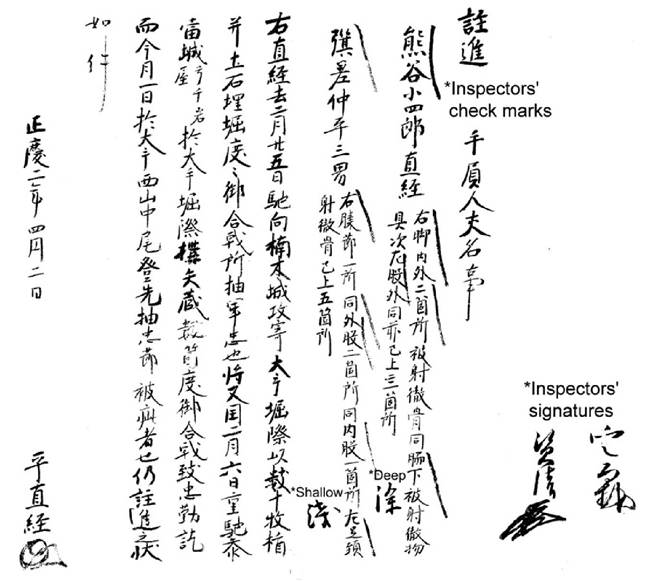
Figure 27.1 Report of loyal military service (gunchujo) by Kumagai Naotsune, 1333.4.2. Explanation in English added to the original copy (eishabon).
slope of the hills to the west of the front gate, was wounded and excelled in loyal service. Therefore, I report thus.
Shokyo 2 [1333]. 4.2 Taira [Kumagai] Naotsune [kao signature][1046]
The signatures at bottom right (in English, at top) are those of officials who verified the location of the wounds and evaluated them. The notations of ‘deep' and ‘shallow' are added, as well as a series of check marks next to the description of each wound, suggesting the real-time process of reviewing the document against the actual body. The date and Naotsune's signature are on the last line to the left.
From Naotsune's view, ‘deep' certainly was better than ‘shallow'. The merit evaluation included the wounds of followers, here the flag carrier, reflecting the lord's requirement for additional labour, and Naotsune's effort to maximise the Kumagai house's collective merit.
The battlefield was indeed a coordinated theatre of opportunity where one raised one's profile through the disfigurement of one's self and others, in partnership with special military administrators (gun bugyo), who organised inspectors and secretaries to record the dead and the wounded. The Taiheiki describes the scene of attack against the Chihaya involving Kumagai Naotsune: ‘Twelve secretaries, without resting the brush, recorded for three days and nights.'[1047] The gunchujo, prepared by the participants themselves and legitimated by their signatures and those of inspectors, served as a permanent testimonial to the martial, and in turn economic, worth of the injured male body in purposeful engagement with ‘loyal military service'. The document translated the incalculable force of violence into measured effects on human flesh.
Narrative Representations in the Taiheiki
The second source, the Taiheiki, is a narrative that covers the half century of turmoil from 1318 to 1367. It belongs to the genre scholars call ‘military tales/ records' (gunki), which began to be composed in the tenth century.
Scholars name a priest working with possible associates as possible authors. Probably composed during the war's progress and completed only a few years after the last event mentioned, the work suggests a close relationship between the narrative content and what the author(s) observed. It features 2,000 or so named historical figures and their real or imagined actions. Along with the Tale of the Heike, it ranks among the most popular and influential of all Japanese war tales into modern times.[1048]The Taiheiki's narrative is distinct from other war tales in the attention it pays to the body, body parts, injuries and mortal action. Comparison with the Tale of the Heike highlights the differences. The Heike's classic opening phrase, ‘revealed is the principle that the prosperous necessarily decline' (shoja hissui no kotowari wo arawasu)[1049] becomes ‘remaining are corpses that reveal that the prosperous necessarily decline’ (shoja hissui no kabane wo nokoseri) on the battlefield.[1050] [1051] [1052] [1053] Another instance substitutes the term ‘bone’ for ‘valley’ in describing where the ‘holes from arrows and scars from swords’ were found.11
The Taiheiki’s narrative not only is body-conscious but also is ‘impressive in its meticulous attention to minute details and forceful dynamism' in depicting the process of death ‘captured with a cool-headed eye’.12 With realism and precision, the text often includes the measurements and directions of cuts: for example, a man who was ‘cut deeply from the bottom corner of his left eye down through the right edge of his mouth including his nose’, or another who lifted up a youth by his armour-braid and ‘with one hand sliced off legs at his knees, and threw him about three bow-lengths away’.13
The accountability of dismemberment in the Taiheiki parallels that seen in the gunchujo. The Taiheiki and the gunchujo emerged from the same violent space, where its consequences must have been visible to or personally felt by those present.
The tale's author and the reports' inspectors could have been at the same scene, both with a brush, paper and plenty of ink. The anatomy of the wounded called for a meticulous attention from the gunchujo reporters and also inspired the journalistic and literary imagination of the tale’s author. Needless to say, while reports had a clear administrative purpose - to document the injuries and calculate their worth, and convert merit into shiki rights to land - the Taiheiki was a literary production, whose creative goals were complex and multi-layered. Together, however, the two forms of writing powerfully suggest a culture of war that illuminates the tangible material worth of the meritorious body in combat, along with its vulnerability and glory, undergirded by the lofty notion of a real or imagined loyalty binding the lord-vassal relationship that rested on economic exchange.The Moral Order of the Royal Domain
I have demonstrated the distinct quality of the violent images that the Taiheiki presents. I now turn to the tale’s framing concept in order to probe the meanings embedded in those images. Viewing all military tales, ‘from Masakadoki (Records of Maskado; comp. 940) to the Taiheiki’, as texts subjected to the ideological framework of a symbolic structure, Yuichi Otsu advances that they are ‘histories/stories about a shared community (kyodotai) existing in the royal domain, and which consistently narrate crises and recoveries of kingship’.[1054] [1055] In other words, military tales and the world they represent have a coherent framework shaped by a community that concerns itself with heavenly rule. All protagonists, the war’s winners and losers alike, participate in the narrative community that celebrates the symbolic authority embedded in the imperial order, standing on the moral foundation shaped in ancient China. We can readily see this in the way anecdotes of events from the Chinese classics are interspersed in texts as referential and validating models. They often serve to explain and embellish the protagonists’ specific movements by analogy and to enfold the episodes into the symbolic moral order of ‘all under heaven’.
In the contemporary vocabulary, the conflicts that the Taiheiki and other war tales narrate were more than a contest of opposing military camps; they were a condition in the heavenly moral order. Wars were identified as ran (disorder) or hen (change), both terms describing an aberration in the ideal realm balanced by the elements of heaven, earth and humans. Ran most poignantly addressed a crisis where the orderly realm was disrupted by turmoil, confusion, unrest and destruction at all levels of society. Hen, also inauspicious, described a departure from cosmic stability, an ideal condition in the Confucian concepts of universal order centred around the North Star, which was the emperor. 15
The concept of ran presumed ‘order’ in imperial authority, which possessed the prerogative and responsibility of overseeing the celestial calendar and designating era names. Because of this, particular cases of ran were typically identified by the imperial era name during which they occurred, for example, ‘ran of the Genko era (1331-4)’, when Go-Daigo attempted his second attack against the bakufu in 1331. The War of Northern and Southern Courts, however, was an ‘internal ran (nairan) between the two courts’ or ‘disorder of “all under heaven”’ (tenka no ran), probably because each of the two imperial courts had its own era name. The other term, hen, or ‘change’, pointed more narrowly to an abnormal means of enacting a possible change in the dynastic order, for example palace intrigues initiated by insiders.
Go-Daigo’s initial scheme against the bakufu in 1324 was called ‘hen of the Shochu era (1324-6)’. Unnamed, ‘violence' did not constitute a separate conceptual category in the encompassing moral vision of ‘order’ and ‘disorder'.
The first and last passages in the Taiheiki reveal the text’s concern over the state of moral virtue. The preface suggestively expounds on the notion of virtuous heavenly rule by an enlightened ruler and upright ministers, who together maintain the righteous path.[1056] Referencing the Chinese classics, it warns against abandoning moral principles, as did Emperor Jie (1728-1675 bce), the last emperor of the Xia, China’s oldest dynasty.1[1057] The closing sentence of the Taiheiki celebrates the new generation of ‘effortless perpetuation of order’, which follows the appointment of 10-year-old Ashikaga Yoshimitsu (1358-1408) as the third shogun.[1058] Adages from the Chinese classics that extoll the moral order bookend the Taiheiki’s forty volumes.
The articulation of the problematic status of virtue distinguishes the Taiheiki from other tales. The text castigates: ‘above, the emperor betrayed imperial virtue, and below, subjects lost ministerial proprieties’.[1059] As Hiromi Hyodo emphasises, although all military tales may be about the heavenly rule, the Taiheiki differs from others in its critical attitude towards the absence of virtue in both the emperor and subject vassals.20 How did the tale represent the deeply problematic condition of moral virtue? My answer is in the tale’s innovative representations of rupture in human flesh. The sense of fissure in the moral order may have stimulated the production of the distinctively violent images. The wounded bodies symbolically bear witness to the tension in the realm, for which the emperor himself was deeply responsible. I argue that the cut-up body, which is consistently male, is a symbolic representation of disorder. The metaphor of violence encoded on men's bodies communicated an unprecedented aberration in the imperial realm. The visually striking expressions of torn limbs and cut flesh represent the macro-level disorder started, ironically, by the son of heaven. The torn bodies in the Taiheiki illuminated at the human level the manifest instability that shook the world and affected the narrative community.