Stability and revolts
With the death of Joseph Stalin in March 1953, the first chance to alleviate the tensions that had produced the division of Europe and contributed to the outbreak of the Korean War seemed to be at hand.
In the years that followed, a power struggle in the Kremlin resulted in a period of uncertainty that undoubtedly affected the conduct of Soviet policy. The ‘thaw’ of the mid-1950s that followed can thus in part be attributed to the competition within the Kremlin leadership that pitted Stalin’s former lieutenants — most importantly men like Georgi Malenkov, Lavrenti Beria, Nikita Khrushchev and Vyacheslav Molotov — against each other. By the time Khrushchev eventually triumphed in this competition, the Cold War had been transformed.Indeed, the fact that Stalin’s death occurred only two months after Dwight D. Eisenhower had taken over the White House added to collective hopes that an opportunity for reshaping the Cold War had arrived. Although the former supreme commander of NATO had campaigned for the White House on a tough foreign policy agenda that promised to roll back communist power, early signs that a detente was in the making were promising. At Stalin’s funeral in mid-March the new Soviet leader, Georgi Malenkov, announced that there were no issues that could not be decided using peaceful means. On 16 April 1953 President
Eisenhower delivered his widely quoted ‘Chance for Peace’ speech, in which he stressed the opportunities for reducing East-West tensions. Yet Eisenhower also asked the Soviets to act through ‘deeds’ and not just ‘words’. Less than a month later the ageing British prime minister, Winston Churchill, went a step further by calling for an early Great Power summit without preconditions.
Great Powers
Traditionally those states that were held capable of shared responsibility for the management of the international order by virtue of their military and economic influence.
While Churchill did not get his wish in 1953, there were several practical developments that signalled a move away from the uncompromising hostility that had characterized the early 1950s. In June 1953 the Korean armistice was concluded. In the spring of 1954 a number of key powers, including the United States, France, the USSR and the PRC, agreed to a series of agreements in Geneva that provided for the formal end of the French involvement in Indochina and, some hoped, a permanent settlement of the subcontinent’s persistent wars. In 1955 the Austrian State Treaty resolved that country’s uncertain status — unlike Germany, Austria was to be united and neutral. In addition, the Soviets withdrew their troops from bases in Finland (Porkkala) and Manchuria (Port Arthur). In 1955 the USSR also restored normal diplomatic relations with Tito’s Yugoslavia and, in 1956, abolished the Cominform. Amid all this diplomatic activity, the British, French, Soviets and Americans held a summit in Geneva in the late summer of 1955. Although lacking in practical progress on any of the contested issues (such as Germany and possible limitations on the development of nuclear arms), the Geneva summit raised hopes that the ‘spirit of Geneva’ would eventually be transformed into a launching pad for substantive agreements between East and West.
Such hopes proved illusory. Not only did the nuclear arms race continue unabated, but also the future of Germany remained a sensitive and divisive issue. Already in June 1953 the Soviets had shown that, even in the aftermath of Stalin’s death, they had no interest in relaxing their hold over East Germany. In that month Soviet and East German forces crushed spontaneous uprisings throughout the GDR. The German question thus remained a focal point of post-Stalin Soviet policy, and an issue the new Soviet leadership was unlikely to compromise upon. When West Germany was invited to join NATO a year later — after the longstanding effort to create the EDC had failed — the Soviets retaliated in 1955 by creating the Warsaw Pact.
see Map 9.1
Worse followed in 1956, when facing unrest in Hungary that threatened to result in that country’s exit from the new alliance, the Soviets resorted to strongarm tactics again by using the Red Army to crush Hungarian hopes for neutrality and democracy. At the time the Americans and their most important West European allies, Britain and France, were preoccupied with the Suez crisis. Yet it is hard to imagine that the Western response to Soviet repression in Hungary would have been much different even in the absence of the Middle East imbroglio. By protesting against Soviet activities and opening their doors to Hungarian refugees, the West effectively indicated how the division of Europe was, in their view, a de facto state of affairs not to be challenged through military means. While anti-Soviet propaganda and various measures of psychological warfare escalated, the costs of any direct intervention within the Soviet sphere were simply too high. If anything, the thaw that characterized the European Cold War in the years
Suez Crisis
The failed attempt by Britain and France in 1956 to take advantage of a war between Israel and Egypt by seizing control of the Suez Canal and bringing down the government of Gamal Abdel Nasser. It is often taken as a symbol of the collapse of European imperialism and the rise of the Third World.
de-Stalinization
The policy, pursued in most communist states and among most communist groups after 1956, of eradicating the memory or influence of Stalin and Stalinism. Initiated by the Soviet Union under the guidance of Nikita Khrushchev.
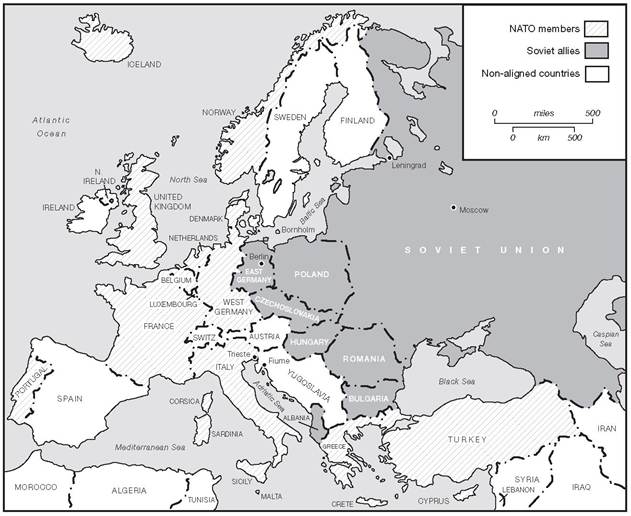
Map 9.1 The Cold War in Europe, 1955
Source: After Reynolds (1994)
following Stalin’s death thus ensured that external challenges to the legitimacy of the Soviet hold in Eastern Europe were limited to verbal condemnations. Contrary to what Eisenhower’s secretary of state, John Foster Dulles, had implied during the American presidential campaign of 1952, there would be no aggressive effort to ‘liberate’ Eastern Europe or ‘roll back’ communist power.
Not that propaganda and criticism of communist repression were necessarily insignificant; in fact, the combination of de-Stalinization and American psychological warfare may have been partly responsible for the uprising in Hungary. One of the key causes of the revolts, however, was the Soviet effort to relax the extreme suppression that had characterized the Stalin years. The Soviet leaders who vied for a position of power in the aftermath of Stalin’s death did agree upon one thing, that the personality cult and extreme repression that had characterized the pre-1953 years should not continue. Thus, once Nikita Khrushchev emerged from this power struggle as the key player, he moved to condemn Stalin’s practices in his famous ‘secret speech’ at the Soviet Communist Party Congress in early 1956 and effectively denounced the former dictator as a criminal. Khrushchev then launched the Soviet Union upon an often unpredictable era of internal reform. In the years that followed, many of those who had suffered during Stalin’s purges were released from prison camps and had their reputations restored. However, as is often the case, the promise of relaxation prompted demands for
rapid transformation and, as in Hungary, an outright revolt against communism and the Soviet Union.
In fact, perhaps the most accurate way to characterize the ‘thaw’ is to state that it represented a period of reassessment in Soviet-American relations, stabilization of the Cold War system in Europe and the emergence of competition (rather than direct military confrontation) as the key form of waging the Cold War. Talk about peaceful co-existence and competition between two systems characterized the new rhetoric emanating, in particular, from the Kremlin. Nor was it just talk, for by 1957 not only was Europe divided into two ‘geopolitical zones’ (with a few neutral countries, Austria, Finland, Sweden and Switzerland, in the middle), but the eastern and western parts of Europe had by and large become two separate economic systems.
In Western Europe the movement, encouraged with some foreboding by the United States, towards European integration gathered steam during the 1950s with the formation of the EEC in 1957. Helped by an influx of American capital and the successful working of the Bretton Woods system, the EEC’s economic success further highlighted the division of Europe, while its institutional arrangements marked the beginning of political integration. The development of Western European integration was undoubtedly one of the most fundamental ‘side effects’ of the Cold War. The various institutions, treaties and communities that knit together the basic structure of the post-Cold War European Union represented a basic shift in inter-European relations. Whereas France and Germany, for example, had previously been bitter rivals, they became, starting in the early 1950s, the two countries driving the integration process. With the signing of the Treaty of Rome in 1957, the six nations of the ECSC formed the EEC and EURATOM, which established a common market in nuclear materials (and equal access to uranium stocks). In subsequent years, the EEC states introduced further integration schemes, such as a Common Agricultural Policy, and moved towards the gradual withdrawal of all existing tariff barriers between member states. Although the process would continue throughout the rest of the twentieth century, the successful integration of Western Europe during the Cold War would succeed in uniting at least one half of the continent.
However, the EEC also exposed disagreements among West Europeans. Britain, concerned about losing the remnants of its global influence to a European body in which the French played a dominant role, preferred an arrangement limited to trade issues (that is, reduction or removal of tariffs etc.) and chose to remain outside the EEC. Instead the British, along with the Scandinavian countries, Austria and Switzerland, formed the seven-nation European Free Trade Association (EFTA) in 1960.
The success of the EEC continued, though, to expose the relative decline of the British economy, so that almost immediately after the foundation of EFTA Britain applied for membership of the EEC. The debate over the future course of European integration and Britain’s role in it continued through the 1960s when the French, under Charles de Gaulle’s presidency, twice vetoed British membership. However, the main question was not really whether European integration should take place or whether Britain should be a member; rather, the debate focused on the nature of integration. Later this debate and the success of Europe’s economic integration would lead to a number of challenges to American leadership.peaceful co-existence
An expression coined originally by Trotsky to describe the condition when there are pacific relations between states with differing social systems and competition takes place in fields other than war. The idea was vital to Soviet diplomacy particularly after the death of Stalin.
see Chapter 21
Bretton Woods
The site of an inter-Allied conference held in 1944 to discuss the post-war international economic order. The conference led to the establishment of the IMF and the World Bank. In the postwar era the links between these two institutions, the establishment of GATT and the convertibility of the dollar into gold were known as the Bretton Woods system. After the dollar’s devaluation in 1971 the world moved to a system of floating exchange rates.
The American attitude towards European integration itself shifted during the Cold War. While the Truman and Eisenhower administrations were keen supporters of European unity — political, military and economic — and pressed the British to join the EEC early on, such unequivocal support turned in the 1960s into a profound ambivalence. In part, Americans worried over the apparent French effort to drive a wedge between a resurgent Europe and the United States. In addition, Washington was concerned about the growing economic strength of the EEC which, alongside the emergence of Japan as a major economic power, had the potential to lead to trade wars and to increase the political divergence between the United States and its European partners. Ultimately, Americans worried that an independent Europe would launch an independent detente with the Soviet bloc and that the Soviets would use every opportunity to promote see Chapter 11 divisions between the Western Powers.
In Eastern Europe the Soviet Union met the challenges to its authority in East Germany, Poland and Hungary either by strengthening its grip (as in East Germany and Hungary) or by allowing some additional autonomy in internal matters (Poland). All in all, even though violent crackdowns took place, the uniformity that had been the general characteristic of the late Stalin years — together with the terror that had been the central means of achieving it — was not nearly as evident in Eastern Europe during the Khrushchev era. The Soviet Union relied increasingly on the structural arrangements, such as the Warsaw Pact and COMECON, to keep its sphere intact. However, by doing so, the Soviets were gradually faced with an increasing amount of ‘deviation’ as countries such as Romania moved to emphasize their independent policies and develop ties to the West. Whatever the repressive counteractions of the USSR, Khrushchev and the ‘thaw’ of the mid-1950s thus managed to erode even further the myth of monolithic communism. Soon it would be shattered altogether, as the Soviet see Chapter 15 Union and China moved towards confrontation.
In the end, though, the hopes for a permanent relaxation of East-West tensions in the mid-1950s proved to be misplaced, for the thaw turned out to be but a brief interlude. By the time Khrushchev confirmed his position as the head of the Soviet Union in the summer of 1957 (when he survived an attempt to topple him), the Cold War had, in effect, become a long ‘twilight struggle’ that was being fought on all fronts through a mixture of confrontation and competition.