The Americanization of the Vietnam War
Two incidents in the Gulf of Tonkin in August 1964 provided the pretext for the eventual introduction of American ground troops into Vietnam. According to the official record at the time, which was highly contested afterwards, on 2 and 4 August two American destroyers came under fire from North Vietnamese patrol boats.
Three days after the second incident, Congress passed the Gulf of Tonkin Resolution, authorizing the president to use all necessary measures to counter and prevent any further such military attacks, thus effectively giving Johnson a blank cheque to pursue a war in Vietnam.Johnson used this authority in August to launch a short, sharp attack on the DRV's naval facilities, but with the presidential election coming up in November he was wary of escalating the war any further, at least in the short term. However, after his re-election to office, and with both the military and political situation in South Vietnam deteriorating rapidly, he used his new powers in February 1965 to order the beginning of a limited bombing campaign against the DRV and the dispatch of American marines to defend the air base at Da Nang in South Vietnam. Even this escalation, however, was not enough to stem the communist flood, for by the late spring both the NLF and for the first time regular army units from the DRV escalated the ground war in the South, believing that Saigon's collapse might be imminent. Faced with the urgent need to stabilize the situation in the South, Johnson was therefore quickly forced to raise the level of American troops markedly and in July 1965 agreed to a deployment of 200,000 men. However, in order not to alarm the American people unduly or risk Congress diverting funds away from his radical domestic agenda, Johnson refused to put the United States on a war footing. Thus, the reserves were not called up and taxation was not increased.
As with most wars, the idea was that this significant commitment of American forces would achieve a quick and comprehensive victory, but this was not to be the case, for the war soon developed into a quagmire. By 1968 Johnson had committed more than 500,000 American troops to the war in South Vietnam and engaged in a massive bombing campaign against targets throughout Vietnam, as well as neighbouring Laos and Cambodia (the United States is said to have dropped three times more bombs on Vietnam between 1965 and 1973 than were dropped by all combatants during the entire Second World War). The United States also tried to bolster South Vietnam through further injections of economic aid. Overall, while not expanding the ground war to North Vietnam, because of concerns that the Chinese might enter the fray and create a situation similar to the Korean War, the United States pursued the war with few limitations after 1965.
The impact of the Americanization of the war was gruesome. Lacking clear front lines, the war quickly developed into a series of ‘search-and-destroy' missions as the American forces and the ARVN combed the countryside for suspected rebels. In the process tens of thousands of civilians died, while countless others were forced to flee their villages. The use of napalm, Agent Orange and other
see Map 12.1
Gulf of Tonkin Resolution
A resolution passed by the US Congress in August 1964 following alleged DRV attacks on American ships in the Gulf of Tonkin, which authorized the president to employ all necessary measures to repel attacks against American forces and all steps necessary for the defence of American allies in South-East Asia. Presidents Johnson and Richard M. Nixon used it to justify military action in South-East Asia. The measure was repealed by Congress in 1970.
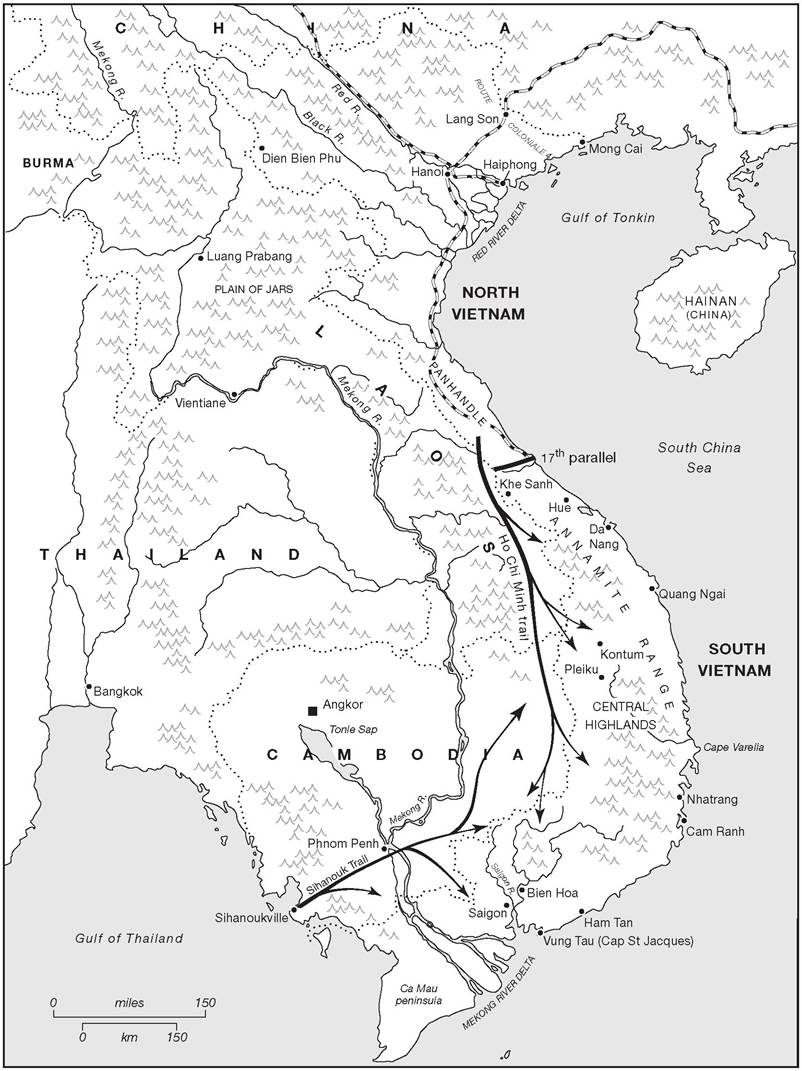
Map 12.1 The Vietnam War in the 1960s
Source: Sheehan (1990)
chemicals as a way of denying the opponents a hiding place in the jungle or access to food crops resulted in extensive defoliation (and caused damage to both combatants and civilians alike).
By 1967 the number of refugees, many placed in overcrowded relocation (or pacification) camps, grew to roughly four million, or 25 per cent of the South Vietnamese population. While the South Vietnamese regimes, headed by Generals Nguyen Cao Ky and Nguyen Van Thieu, were able to retain a fairly consistent grip on power after 1965, the American policy hardly created favourable conditions for sustainable civil government. In fact, the deadly consequences of the American intervention were in large part responsible for the ability of the North Vietnamese and the NLF to garner continued support from the South Vietnamese population. Throughout the 1960s the NLF — who had been dubbed the Viet Cong (Vietnamese communists) by Diem — also sustained its struggle through an increasing flow of supplies and men via the so-called Ho Chi Minh trail that ran from North Vietnam via Cambodia and Laos to South Vietnam. US efforts to destroy the Ho Chi Minh trail by bombing raids were surprisingly unsuccessful: between 1965 and 1967 the influx of troops from North to South grew from 35,000 to 90,000. The bombing raids and the continued presence of foreign troops in Laos and Cambodia did, however, manage to destabilize the fragile neutrality of these two countries.Ho Chi Minh trail
A network of jungle paths from North Vietnam through Laos and Cambodia into South Vietnam. Used as a military route by North Vietnam to send supplies and troops to the south.
To be sure, the United States was not the only external player shaping the events in Indochina. Throughout the period of American escalation Hanoi received increasing amounts of support from both Moscow and Beijing. As a result of the Sino-Soviet split, in fact, the North Vietnamese were able to play their two benefactors against each other and receive consistent support from both: while Soviet aid was mainly in the form of heavy military machinery (including, later on, aircraft), the Chinese provided foodstuffs, rifles and other ‘lighter’ forms of aid.
Both the Soviets and the Chinese also sent advisers to North Vietnam, albeit never in similar numbers to those dispatched by the Americans to the South. Indeed, while there is no question that the Vietnam War was to some extent a proxy war for the three major external players, the DRV was clearly more successful than the RVN in retaining its independence from its allies during the war, which, in turn, enabled it to portray itself as the embodiment of Vietnamese nationalism and paint the Saigon regime as a mere American stooge.see Chapter 15
Sino-Soviet split
The process whereby China and the Soviet Union became alienated from each other in the late 1950s and early 1960s. It is often dated from 1956 and Khrushchev’s speech to the twentieth congress of the CPSU, but this view has been challenged in recent years.
The Americanization of the Vietnam War between 1965 and 1968 had other important consequences, both for the region and for the Cold War generally. Within the region, while the lack of a clear victory meant that disquiet about the future continued to surface, the American display of resolve reassured the Thai government and arguably emboldened the army in Indonesia when it turned on the PKI in the autumn of 1965. Most important for the long term, however, was that the Johnson administration decided from 1965 to encourage the economic development of South-East Asia in an effort to contain any further spread of communism. While the war limited the resources that Washington could make available, valuable aid was supplied to countries such as Thailand, where it was used to improve infrastructure and local government. In addition, the United States in 1966 sponsored the creation of the Asian Development Bank and encouraged Japan to invest in the region. By concentrating American attention
North Atlantic Treaty Organization (NATO) Established by the North Atlantic Treaty (4 April 1949) signed by Belgium, Canada, Denmark, France, Great Britain, Iceland, Italy, Luxembourg, the Netherlands, Norway, Portugal and the United States.
Greece and Turkey entered the alliance in 1952 and the Federal Republic of Germany in 1955. Spain became a full member in 1982. In 1999 the Czech Republic, Hungary and Poland joined in the first postCold War expansion, increasing the membership to nineteen countries.Tet Offensive
The attack launched by the NLF in South Vietnam in late January and early February 1968, named after the country's most important holiday, the lunar new year. Although the offensive was not a military success for the NLF, it was a political and psychological victory as it dramatically contradicted optimistic claims by the American government that the war had already been won.
on the region, the war therefore acted as a springboard for the future prosperity of South-East Asia, although it brought precious little benefit for the countries of Indochina itself.
In the wider world, America's war in Vietnam led to much dissent. Washington's NATO allies, for example, refused to support the war effort in South-East Asia; even the British government, traditionally the closest to Washington, distanced itself from American policy. Others, most obviously (and ironically, given its past involvement) the French government of Charles de Gaulle, were openly critical. The sheer cost of the war also contributed to growing American government deficits and weakened its relative position vis-à-vis its major economic competitors. At home in the United States the massive military spending on the war cut into Johnson's ambitious social and economic programmes, collectively known as the Great Society. Thus, despite his efforts in 1965 to play down the conflict in order to defend his domestic priorities, in the end his desire to wage a successful ‘war on poverty' at home was sacrificed to what he once referred to as ‘that bitch of a war on the other side of the world'. More broadly, the American inability to subdue a seemingly far inferior opponent hurt its credibility, while its support for an obviously undemocratic regime in the South eroded America's claim of moral superiority over its Cold War adversaries.
The war also created an unprecedented, and extremely vocal, protest movement that challenged not only the Johnson administration's conduct of the war but, ultimately, the very premises of American Cold War policies. By late 1967, with close to 30,000 Americans dead, the anti-war movement, which had started on college campuses, was gathering strength throughout the United States, and a number of prominent politicians, such as the Democratic Senator Eugene McCarthy, were calling for a gradual American withdrawal. Moreover, Robert McNamara, the secretary of defence, resigned in the autumn of 1967 largely because of his disenchantment with the Vietnam policies that he had personally overseen. Still, at the end of 1967, as internal and external pressure was mounting for an American withdrawal, the Johnson administration claimed that ‘victory' in Vietnam was just around the corner.
By exposing the inflated nature of such claims the National Liberation Front's (NLF) Tet Offensive in early 1968, although a military defeat for the NLF, turned out to be a major turning point in the American phase of the Vietnam War. On 30 January 1968, the NLF initiated a series of attacks throughout South Vietnam; within days, thirty-six out of forty-four provincial capitals and five of the six major cities were under fire. Most spectacularly, the NLF attacked the American embassy in Saigon and briefly occupied parts of this symbol of US presence in Vietnam. In Hue, the old imperial capital ofVietnam located just south of the 17th parallel, the NLF, supported by large numbers of North Vietnamese troops, was even more successful. After capturing the city on 31 January, it held back an American— ARVN counter-offensive for three weeks.
The NLF had launched the Tet Offensive with two political aims in mind. Its optimum ambition was to cause the complete collapse of the Saigon regime. This it failed to do, and indeed in some ways it was the NLF itself that emerged the weaker party, for it suffered heavy casualties (approximately 40,000 Viet Cong
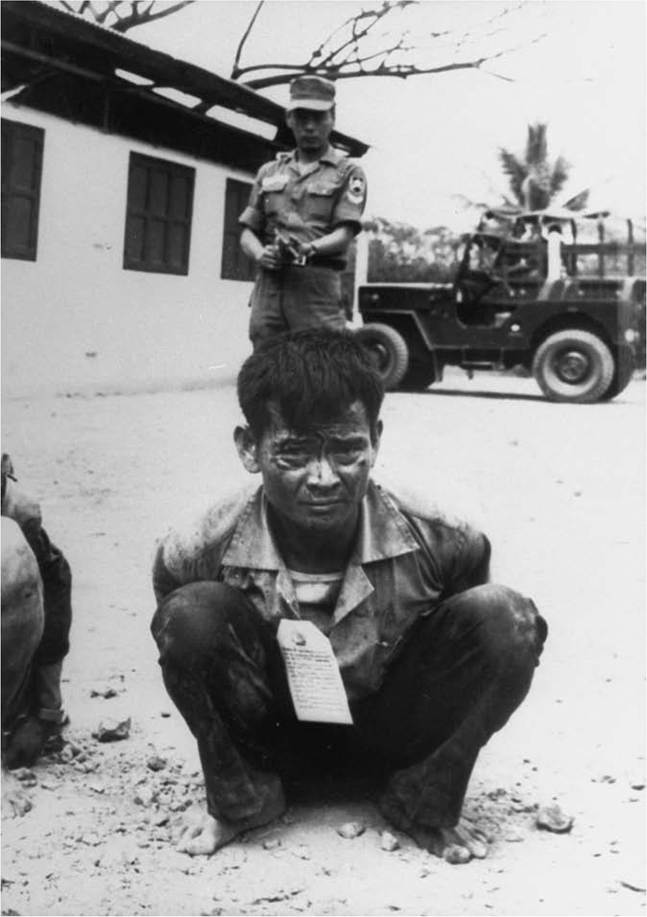
Plate 12.1 Tet Offensive, January 1968. A youthful hard-core Viet Cong squats down under the watchful eye of a Nationalist guard with rifle drawn, shortly before his interrogation following capture in attacks on the capital city of Saigon during the Tet Offensive in the Vietnam War. (Photo: Time Life Pictures/USTA/National Archives/Getty Images) guerrillas were killed in the fighting, compared with 1,100 Americans and 2,300 ARVN regulars) and saw its organization in large parts of South Vietnam virtually destroyed. However, this setback was balanced by the successful achievement of the offensive’s secondary aim, which was to reveal to the American government and people that the war was far from over. To critical politicians and most of the general public in the United States the offensive demonstrated exactly what the NLF set out to achieve: namely, it proved the hollow nature of the Johnson administration’s policy and widened the already existing credibility gap between the White House and the American people. In one fell swoop Johnson’s claims that the situation was under control and that victory was in sight were refuted; instead Tet suggested that further bloodletting would be necessary. When news leaked to the press that General William Westmoreland, the American commander in Vietnam, had requested more troops, the Johnson administration lost even more of its fragile credibility. Furthermore, the American establishment itself became jittery when it appeared that uncertainty over the war was causing a flood of gold to leave the country.
By late March President Johnson became convinced that further escalation could not be sanctioned. In a dramatic television appearance he declined to seek re-election and announced a halt to the bombing and his intention to seek a peaceful resolution of the war. A number of openly anti-war candidates, most prominently Senator Robert F Kennedy, entered the 1968 presidential race. In mid-May peace talks began in Paris after the United States had scaled down its bombing campaigns against the North. Yet, by the time Americans selected the former vice-president, Richard Nixon, as Johnson’s successor in November 1968 the war was far from over. In fact, American troop levels in Vietnam peaked at 543,000 in the spring of 1969.
Strategic Arms Limitation Treaties (SALTI and II)
The agreements between the United States and the Soviet Union for the control of certain nuclear weapons, the first concluded in 1972 (SALT I) and the second drafted in 1979 (SALT II) but not ratified.
see Chapter 11