16 The Crisis of Modernity
1357-1385 AH 1939-1966 CE
The bloodiest outburst in the history of violence started in 1939 and raged for six long years. Once again, Germany was battling France and Britain. Once again the United States came in late but decided the outcome.
Parts of the configuration had changed this time, to be sure: Russia was now the Soviet Union, the Ottomans were missing, Japan had grown mighty—but in the end, this bloodbath only finished what World War I had begun. The old colonial empires suffered death blows, and the old alignments of power became obsolete. Britain came out of the war starving, France in ruins, Germany destroyed and divided. With the gunfire fading, two new superpowers stood astride the globe, and both were soon armed with thermonuclear bombs capable of destroying the human race. The next chapter of world history would be dominated by their competition.Other narratives continued to play out, however, beneath the surface of the bipolar Cold War struggle, including the submerged narrative of Islam as a world-historical event. The hunger for independence, which had built up during the war years among virtually all colonized people, both Muslim and non-Muslim, now hit the breaking point. In Egypt, rebellion started brewing among army officers. In China, Mao’s communist insurgency began to move against Chiang Kai-shek, widely seen as a Western puppet. In Vietnam, Ho Chi Minh, who had come back from thirty years of exile to organize the Viet Minh, attacked the French. In Indonesia, Sukarno declared his country independent from the Dutch. All over the world, national liberation movements were springing up like weeds, and the ones in Muslim countries were much like the ones in non-Muslim countries: whatever else might be happening, the Islamic narrative was now intertwined with a narrative Muslims shared with others.
Geographically, many of the “nations” that the liberation movements strove to liberate were defined by borders the imperialist powers had drawn: so even in their struggle for liberation they were playing out a story set in motion by Europeans.
In sub-Saharan Africa, what the king of Belgium had managed to conquer became Congo (later renamed Zaire). What the Germans had conquered became Cameroon, what the British had conquered in East Africa, Kenya. A label such as “Nigeria” referred to an area inhabited by over two hundred ethnic groups speaking more than five hundred languages, many of them mutually unintelligible, but the world was now organized into countries, so this, too, became “a country,” its shape and size reflecting the outcome of some long-ago competition among colonizing Europeans.In North Africa, national liberators accepted the reality of Algeria, Tunisia, and Libya as countries, each one spawning a national liberation movement of its own. All three movements eventually succeeded, but at great cost. Algeria’s eight-year war of independence from France claimed over a million Algerian lives, out of a starting population of fewer than 9 million, a staggering conflict.1
Issues inherited from the days of Muslim hegemony continued to echo here and there. The persistence of the Muslim narrative manifested most dramatically in the subcontinent of India, the biggest full-fledged colony to gain independence. Even before the war, as this nascent country struggled to rid itself of the British, a subnational movement had developed within the grand national movement: a demand by the Muslim minority for a separate country. At the exact moment that India was born (August 15, 1947) so was the brand-new two-part country of Pakistan, hanging like saddlebags east and west of India. The partition of the subcontinent sent tidal waves of frightened refugees across new borders to the supposed shelter of their coreligionists. In the tumult, hundreds of thousands were slaughtered within weeks, and countless more rendered homeless, yet even this mayhem failed to settle the questions raised by “the partition.” Kashmir, for example, remained in play, for it had a Hindu monarch but a predominantly Muslim population.
Which then should it be part of, India or Pakistan? The British decided to wait and see how things shook out. Kashmir is still shaking.It was not only decolonization that came to a head after World War II, but “nation-statism.” It’s easy to forget that the organization of the world into countries is less than a century old, but in fact this process was not fully completed until this period. Between 1945 and 1975, some one hundred new countries were born, and every inch of earth finally belonged to some nation-state or other.2
Unfortunately, the ideology of “nationalism” and the reality of “nation- statism” matched up only approximately if at all. Many supposed countries contained stifled sub-countries within their borders, ethnic minorities who felt they ought to be separate and “self-governing.” In many cases, people on two sides of a border felt like they ought to be part of the same nation. Where Syria, Iraq, and Turkey came together, for example, their borders trisected a contiguous area inhabited by a people who spoke neither Arabic nor Turkish but Kurdish, a distant variant of Persian, and these Kurds naturally felt like members of some single nation that was “none of the above.”
In some places, even the separate existence of given countries remained open to question. Iraq, Lebanon, Jordan—these were still congealing. Their borders existed, they had separate governments, but did their people really think of themselves as different nations? Not clear.
In the Arab world, ever since Woodrow Wilson’s Fourteen Points, the watchword had been self-rule, but this tricky concept presumed some definition of a collective “self” accepted by all its supposed members. Nationalists throughout Arab-inhabited lands were trying hard to consolidate discrete states: Libya, Tunisia, Syria, even Egypt... but the question always came up: who was the bigger collective self? Was there “really” a Syrian nation, given that the Syria seen on maps was created by Europeans? Could there be such a thing as Jordanian nationalism? Was it true that people living in Iraq were ruling themselves so long as their ruler spoke Arabic?
The most problematic single territory for the competing claims of nationalism versus nation-statism was Palestine, soon to be known as Israel.
Before and during World War II, the Nazis’ genocidal attempt to exterminate the Jews of Europe confirmed the worst fears of Zionists and gave their argument for a sovereign Jewish homeland overwhelming moral weight, especially since the Nazis were not the only anti-Semites in Europe, only the most extreme. The fascists of Italy visited horrors upon Italian Jews, the French puppet government set up by the Germans hunted down French Jews for their Nazi masters, the Poles and other Eastern Europeans collaborated enthusiastically in operating death camps, Great Britain had its share of antiSemites, Spain, Belgium—no part of Europe could honestly claim innocence of the crime committed against the Jews in this period. Millions of Jews were trapped in Europe and perished there. All who could get away escaped in whatever direction lay open. Boatloads of Jewish refugees ended up drifting over the world’s seas, looking for places to land. A few were able to make their way to the United States and resettle there, but even the United States imposed strict quotas on Jewish immigration, presumably because a single country could absorb only so many immigrants of any one group; but just perhaps some anti-Semitism was mixed into that policy as well.The one place where the refugees could land was Palestine. There, earlier immigrants had bought land, planted settlements, and developed some infrastructure of support. Toward that slender hope of safety, therefore, the refugees headed, overcoming heroic hardships to begin building a new nation in an ancient land inhabited by their ancestors. Such was the shape of the story from the Jewish side.
From the Arab side, the story looked different. The Arabs had long been living under two layers of domination by outsiders, the first layer being the Turks, the next the Turks’ European bosses. Then, in the wake of World War I, amidst all the rhetoric about “self-rule” and all the hope aroused by Wilson’s Fourteen Points, their land was flooded by new settlers from Europe, whose slogan was said to be “a land without a people for a people without a land”3—an alarming slogan for people living in the “land without a people.”
The new European immigrants didn’t seize land by force; they bought the land they settled; but they bought it mostly from absentee landlords, so they ended up living among landless peasants who felt doubly dispossessed by the aliens crowding in among them.
What happened just before and during World War II in Palestine resembled what happened earlier in Algeria when French immigrants bought up much of the land and planted a parallel economy there, rendering the original inhabitants irrelevant. By 1945, the Jewish population of Palestine almost equaled the Arab population. If one were to translate that influx of newcomers to the American context, it would be as if 150 million refugees flooded in within a decade. How could that not lead to turmoil?In the context of the European narrative, the Jews were victims. In the context of the Arab narrative, they were colonizers with much the same attitudes toward the indigenous population as their fellow Europeans. As early as 1862, a German Zionist, Moses Hess, had drummed up support for political Zionism by proposing that “the state the Jews would establish in the heart of the Middle East would serve Western imperial interests and at the same time help bring Western civilization to the backward East.”4 The seminal Zionist Theodor Herzl wrote that a Jewish state in Palestine would “form a portion of the rampart of Europe against Asia, an outpost of civilization as opposed to barbarism.”5 In 1914, Chaim Weitzman wrote a letter to the Manchester Guardian stating that if a Jewish settlement could be established in Palestine “we could have in twenty to thirty years a million Jews out there.... They would develop the country, bring back civilization to it and form a very effective guard for the Suez Canal.”6 Arabs who saw the Zionist project as European colonialism in thin disguise were not inventing a fantasy out of whole cloth: Zionists saw the project that way too, or at least represented it as such to the imperialist powers whose support they needed.
In 1936, strikes and riots broke out among the Arabs of Palestine, serving notice that the situation was spiraling out of control. In a clumsy effort to placate the Arabs, Great Britain issued an order limiting further Jewish immigration to Palestine, but this order came in 1939, with World War II about to break out and the horrors of Nazism fully manifest to European Jews: there was no chance that Jewish refugees would comply with the British order; it would have been suicidal.
Instead, militant organizations sprang up among the would-be Jewish settlers, and since they were a dispossessed few fighting the world-straddling British Empire, some of these militant Jewish groups resorted to the archetypal strategy of the scattered weak against the well-organized mighty: hit and run raids, sabotage, random assassinations, bombings of places frequented by civilians—in short, terrorism.In 1946, the underground Jewish militant group Haganah bombed the King David Hotel in Jerusalem, killing ninety-one ordinary civilians, the most destructive single act of terrorism until 1988, when Libyan terrorists brought down a civilian airliner, Pan Am Flight 103, over Scotland, killing 270.
The horrors of Nazism proved the Jewish need for a secure place of refuge, but Jews did not come to Palestine pleading for refuge so much as claiming entitlement. They insisted they were not begging for a favor but coming home to land that was theirs by right. They based their claim on the fact that their ancestors had lived there until the year 135 CE and that even in diaspora they had never abandoned hope of returning. “Next year in Jerusalem” was part of the Passover service, a key cultural and religious rite in Judaism. According to Jewish doctrine, God had given the disputed land to the Hebrews and their descendants as part of His covenant with Abraham. Arabs, of course, were not persuaded by a religious doctrine that assigned the land they inhabited to another people, especially since the religion was not theirs.
In the aftermath of World War II, the United States led efforts to create new political mechanisms for keeping the peace, one of which was the United Nations. Palestine was just the sort of issue the United Nations was designed to resolve. In 1947, therefore, the United Nations crafted a proposal to end the quarrel by dividing the disputed territory and creating two new nations. Each competing party would get three patches of curiously interlocking land, and Jerusalem would be a separate international city belonging to neither side. The total territories of the proposed new nations, Israel and Palestine, would be roughly equal. Essentially, the United Nations was saying, “It doesn’t matter who’s right or wrong; let’s just divide the land and move on.” This is the sort of solution that adults typically impose on quarreling children.
But Arabs could not agree that both sides had a point and that the truth lay somewhere in the middle: they felt that a European solution was being imposed on them for a European problem, or more precisely that Arabs were being asked to sacrifice their land as compensation for a crime visited by Europeans on Europeans. The Arabs of surrounding lands sympathized with their fellows in Palestine and saw their point; the world at large did not. When the matter was put to a vote in the General Assembly of the United Nations, the vast majority of non-Muslim countries voted yes to partition.
Most Arabs had no personal stake in the actual issue: the birth of Israel would not strip an Iraqi farmer of his land or keep some Moroccan shop-
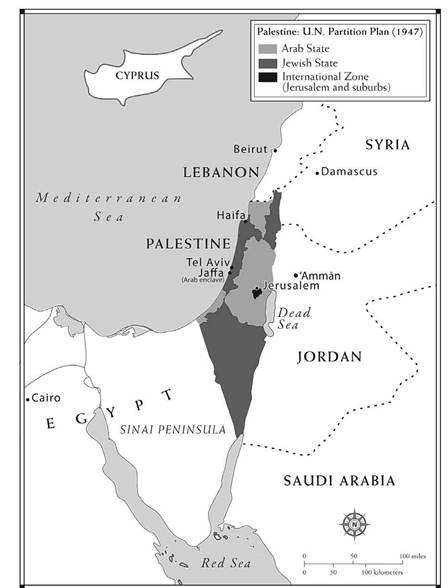
ISRAEL AND PALESTINE
keeper from prospering in his business—yet most Arabs and indeed most Muslims could wax passionate about who got Palestine. Why? Because the emergence of Israel had emblematic meaning for them. It meant that Arabs (and Muslims generally) had no power, that imperialists could take any part of their territory, and that no one outside the Muslim world would side with them against a patent injustice. The existence of Israel signified European dominance over Muslims, Arab and non-Arab, and over the people of Asia and Africa generally. That’s how it looked from almost any point between the Indus and Istanbul.
On May 15, 1948, Israel declared itself born. Immediately, Arab armies attacked from three sides, determined to crush the new country before it could take its first breath. But instead, Israel did the crushing, routing the armies of its three Arab adversaries, Syria, Jordan, and Egypt, and so it was Palestine, not Israel, that became the stillborn child. When the war ended, a war that Israel remembers as their War of Independence but that Arabs called the Catastrophe, some seven hundred thousand Arabs found themselves homeless and stateless, living as refugees in the neighboring Arab countries. The lands that were supposed to become Palestine were annexed (mostly by Jordan). The bulk of the Arab refugees collected on the West Bank of the Jordan River, where they seethed and stewed and sometimes staged small raids into the land that had once been theirs.
In the aftermath of the war of 1948, the Arabs lost the public relations battle even more drastically than they had lost their land. For one thing, some prominent Arabs publicly and constantly disputed Israel’s “right to exist.” They were speaking within the framework of the nationalist argument: Zionists wanted Israel to exist, the Arabs of Palestine wanted Palestine to exist, and since they claimed the same territory, both could not exist: the assertion of each nations “right to exist” was inherently a denial of the other nations “right to exist.” But in the shadow of the Nazis’ attempted genocide, asserting that Israel had no right to exist sounded like saying, “Jews have no right to exist.”
To make matters worse, at least one Arab notable made no bones about actually endorsing Nazi anti-Semitism. This was the Mufti of Jerusalem, who had lived in Nazi Germany during the war and now spouted racism from many pulpits including his radio broadcasts. The weight of world opinion, the tone of media reporting, and the rantings of Arabs such as this mufti subtly conflated the Arab cause with Nazism in the public mind, especially in the West. Arabs not only lost the argument about the land but in the process became the Bad Guys who deserved to lose their land. This combination of feeling wronged and feeling vilified fed a spiraling resentment that rotted into the very anti-Semitism of which Muslims stood accused.
One man who took part in the debacle of 1948 was Egyptian army officer Gamal Abdul Nasser. Nasser was born in southern Egypt, the son of a humble postman. Even as a boy, he felt keenly wounded by his country’s subservience to Europeans. At an age when most boys were starting to obsess about girls, Nasser was obsessing about his nation’s “honor.” His prospects for doing anything about it looked dim, however, until a sudden need for army officers opened up places for lower class boys in the country’s elite military schools and Nasser rode this opportunity all the way to the rank of colonel.
The Arab defeat in 1948 deepened his sense of grievance. He blamed the country’s king for it, and so he conspired with some hundred other army officers (“the Free Officers Club”) to overthrow the monarchy and set up a republic. One morning in the summer of 1952, the Free Officers struck hard and fast: a nearly bloodless coup—two casualties and the monarchy was gone.
Getting rid of the king was the easy part, though. The big step was getting the British out of Egypt. For this step, however, Nasser needed serious firepower. The Cold War being in full swing at this time, almost any emerging nation-state could get arms from one of the two superpowers, so Nasser approached the Americans; but they didn’t see Egypt as a key to “containing” Communism and mistrusted what this Arab fellow would do with weapons, so they turned him down. Nasser then went to the Soviets and from them got mountains of weaponry—which made the Americans sit up and take notice. In typical Cold War fashion, they decided Egypt was important after all. In a bid to win Nasser back, they offered to build him the world’s biggest dam, right across the Nile River at a place called Aswan, a dam that would multiply Egypt’s farmland and produce enough electricity to vault the country into the ranks of industrialized nations instantly! A breathtaking vision—the fulfillment of the secular modernist dream!
But when Nasser looked at the fine print, he saw that the aid agreement included U.S. military bases on Egyptian soil and U.S. oversight of Egypt’s finances: here was the thin end of the imperialist wedge once again entering his country’s heart. Nasser refused the aid, but could not stop dreaming of the Aswan Dam. But how could he finance the dam without selling his country to one of the superpowers?
Then he saw the answer: the Suez Canal, of course. The canal was pulling in about $90 million a year, and Egypt was getting only $6.3 million of it, roughly. Here was the money Egypt needed for its development, and it was mostly draining away to Europe! In 1956, Nasser suddenly poured troops into the Canal Zone and took over the canal.
A furor broke out in Europe. British politicians called Nasser another Hitler, a madman with a grandiose scheme of world conquest. The French press said Egyptians were too primitive to run the canal; they would disrupt global trade and wreck the world economy. These two European countries colluded with Israel in a complicated scheme to bomb Cairo, kill Nasser, and recover the canal.
Just in time, however, U.S. president Ike Eisenhower heard about the scheme and flew into a rage. Didn’t the Europeans know there was a Cold War on? Didn’t they know their little plot could deliver the whole Middle East to the Soviets? Eisenhower ordered the Europeans to give the canal back to Egypt and go home, and U.S. dominance was such that both countries (and Israel) had to obey.
Arabs saw this as a great victory for Nasser. For the next eleven heady years, Nasser was the decolonizing hero, the prophet of Arab unity, and the avatar of “Islamic Socialism,” by which he meant a classless society achieved not through class warfare, as in Marxism, but through class cooperation regulated by the principles of Islam—a vigorous “socialist” restatement of the basic secular modernist Muslim creed.
Nasser built his dam and electrified his nation. He also joined with India’s Nehru, Indonesia’s Sukarno, Sri Lanka’s Bandaranaike, and several others to forge the Non-Aligned Movement, a bloc of neutral countries intended to counterbalance the two Cold War superpowers.
Nasser’s big deeds and global stature won him countless new admirers at home, and not just in Egypt. Arabs of all classes and countries found him intoxicatingly charismatic. As a speaker, no one could touch him. When he spoke, Arabs (who heard him mostly on the radio) said they felt like he was in the room with them, addressing each person eye to eye, drawing each one into a conversation about what was to be done, as if all of them were in this thing together and every one of them mattered.
Nasser’s popularity got him to dreaming of something bigger than a sovereign Egypt—a pan-Arab nation! This was exactly what the Baath Party had been preaching in Syria. In fact, in 1958, Egypt and Syria tried to form one big country, the United Arab Republic, but Syria seceded three years later—a blow to Nasser’s prestige.
Meanwhile, the Muslim Brotherhood was still alive. In 1952, they had helped overthrow the Egyptian king but as soon as Nasser’s secular government commenced operations, they turned against him, even attempting to assassinate him. Nasser retaliated by putting the movements’ leaders in prison, where he had them tortured.
Hassan al-Banna, the founder of the Muslim Brotherhood, had been assassinated before Nassers day, but a nervous, brilliant, erratic, anxious intellectual zealot named Sayyid Qutb had taken charge of the Brotherhood in his place. Qutb’s outlook had been shaped by a curious two-year sojourn at a teachers college in Greeley, Colorado, where the Egyptian government had sent him to study U.S. educational methods. The materialism Qutb saw in America repelled him, the individualism disturbed him, the social freedoms unnerved him, and the sexual mores shocked him—the sight, for example, of young men and women square dancing together at a church social!
Qutb came home convinced that the United States was a Satanic force and had to be destroyed. He began publishing political tracts. He wrote that Islam offered a complete alternative, not just to other religions such as Christianity and Buddhism, but also to other political systems, such as communism and democracy, and he renewed the call for Muslims to rebuild one big universal Muslim community. And if that sounded like he was saying that the Muslim Brotherhood should seize power in Egypt, so be it.
Nasser clapped this man in prison: big mistake, it turned out. There in prison, garbed in the glamour of victimhood, Qutb wrote his most incendiary work, a book called Milestones. Here, he proposed a radical reinterpretation of Sayyid Jamaluddin’s pan-Islamist modernism. He revived the ancient theoretical schema of a world divided between Dar al-Islam and Dar al-Harb, the realms of (Muslim) peace and (infidel) violence. Qutb was no ranter. His prose was cool and measured; he picked his words precisely. And in this steady, lucid, unblinking language, he called on every Muslim to embrace and practice jihad, not just against non-Muslims but against Muslims who faltered in their allegiance to Islam or collaborated with the enemy.7 Under Qutb’s leadership, the Muslim Brotherhood basically declared war against the governments of Egypt, Syria, Iraq, Jordon, and Lebanon and against all the secular modernists who supported them.
Egypt had no democratic process with which to co-opt the Brotherhood’s hold on the underclass. Nasser relied instead on police power to quell demonstrations and on secret police to nip conspiracies in the bud.
Qutb and his brotherhood were all the more irritating to Nasser because he had plenty of other rivals assailing him, more daunting ones, he thought. The rulers of Syria, Jordan, and Iraq envied Nasser’s popularity, and they were doing their best to discredit him. Baath activists challenged his status among Arabs, claiming that they were the real pan-Arab nationalists. Then there were Egypt’s communists. At the height of the Cold War, given their pipeline to Soviet support, they no doubt seemed more dangerous than some cult organizing the Muslim rabble. And finally there were the frankly antirevolutionary monarchs and the tribal dynasts who still ruled some of the Arab states, and who disapproved of everything Nasser stood for.
In 1963, Nasser blundered into a proxy war in Yemen. He sent troops in only as a gesture, to show support for a socialist party that had seized power there by ousting the tribal monarchy; but as soon as Egyptian troops arrived in Yemen, Saudi Arabia began pumping money and guns to the royalists. Suddenly Nasser found himself bogged down in a quagmire of a war that dragged on without result for years.
Meanwhile, Sayyid Qutb went on preaching his doctrines from prison. Nasser decided that, frustrated though he was on other fronts, he didn’t have to put up with this gadfly. In August 1966, he did what men with too much power and too few procedural restraints often do: he had Qutb hanged—only to see him hailed as a martyr by a frighteningly far-flung network of admirers.
Just three months later, Syria and Israel got locked into a cycle of raids and counterraids back and forth across their border, which escalated for six months, growing ever more bloody. Ba’athists ruled Syria by this point. They were Nasser’s main rivals in the secular modernist camp and by going toe-to-toe with Israel, they were gaining credibility at Nasser’s expense, among Arabs generally and among the Palestinians in particular, those wretched refugees still mired in the camps.
So there was Nasser, hero of the Arab world, besieged by his own Arab Muslim masses, eclipsed by his Arab secular modernist rivals, bogged down in an endless war—with other Arabs. Clearly he needed to do something! And clearly it could not be directed against any other Arab country, group, or movement.
This is where matters stood in the spring of 1967, just before one of the most seminal events of modern history, at least as seen through Islamic eyes: Israel’s Six Day War against her Arab neighbors.