The disintegration of the Soviet bloc
The cost of the external military engagements and the growing opposition to Soviet hegemony were exacerbated by the deepening crisis of socialism as an economic system. The inability of centrally controlled socialist economies to deliver rising living standards and the failure to adopt the new technological innovations produced in the West exacerbated the need for fundamental change.
Meanwhile, pressure for the relaxation of the stringent controls over the press was building up in a number of East European countries and several internal dissident movements began to challenge the local communists' monopoly on political power. By the mid-1980s, therefore, the communist bloc in Europe — the core of the Soviet-dominated part of the international system — was facing a deep economic and political crisis.The Soviets also had to accept further unwelcome developments even closer to home. In 1980 workers in Poland led by Lech Walesa formed the Solidarity Movement and engaged in a series of strikes which undermined the authority of the country's communist leaders. Accordingly, Moscow was faced with the decision of whether or not to intervene to save the Polish regime. Coming on the heels of the unsuccessful intervention in Afghanistan, both the political and military leaders in the Soviet Union hesitated, preferring that the Polish communists themselves handled the situation, even if that meant a military takeover. The Solidarity Movement meanwhile had more than a year to organize and prepare for the showdown with the communists. When martial law was finally introduced and Solidarity outlawed in December 1981, the Polish Communist Party also lost whatever legitimacy it had. The military crackdown was roundly condemned in Western Europe, including by the powerful Italian Communist Party, which made the Polish crisis the final step in its break with Soviet and East European communism.
Solidarity Movement Polish independent trade union federation formed in September 1980, which, under Lech Walesa's leadership, soon posed a threat to Poland’s communist government. In December 1981, the Polish government banned it and imprisoned most of its leaders. However, it persisted as an underground organization and played a major role in the negotiations that, in 1989, led to the end of communist rule in Poland.
Mikhail Gorbachev, who was elected general secretary of the Soviet Communist Party in 1985, understood that major initiatives would have to be taken to improve the position both at home and abroad, but had no blueprint to implement. Instead, Gorbachev attempted to reduce tension with the United States and Western Europe in order to buy time for a reorganization of the Soviet economy. These initiatives led to a series of agreements in which the nuclear arms race was curbed, even beyond the limitations envisaged during detente. Believing Soviet communism to be in retreat internationally and under threat at home, Ronald Reagan had no hesitation in reducing the danger of nuclear war since it
glasnost (Russian: openness)
Initiated in 1985 by Gorbachev, glasnost refers to the public policy within the Soviet Union of openly and frankly discussing economic and political realities.
appeared that history, after all, was on the side of the United States. The April 1986 nuclear accident at Chernobyl and growing resistance within his own party forced Gorbachev to adopt, in 1987, more radical policies in his search for perestroika — including some form of freedom of speech (glasnost — openness). Towards the end of the decade, both the Soviet Union and the Cold War seemed to be undergoing rapid change.
The final push came from Eastern Europe. Tired of economic deprivation and political oppression, a number of dissident leaders were encouraged by Gorbachev’s rhetoric to become more vocal. His repeated assurances persuaded many reformist leaders that the Soviet Union under Gorbachev would not act, as the Soviets had done before, to defeat their political demands.
The changes started in Poland, where already in 1988 General Jaruzelski’s government realized that some kind of settlement with the banned Solidarity Movement was a precondition for much-needed Western loans and economic progress. In 1989 Jaruzelski held talks with Lech Walesa (the so-called round-table negotiations) which led to partially free elections being held in June that year. Although it was only allowed to contest a minority of seats in the Sejm (parliament), Solidarity received an overwhelming majority of the votes cast. In August 1989 Jaruzelski appointed Tadeusz Mazowiecki as the first non-communist prime minister in Eastern Europe since the 1940s.Gorbachev’s acceptance of a non-communist government in Poland opened the floodgates for political change in Eastern Europe. Just as conflict over Poland
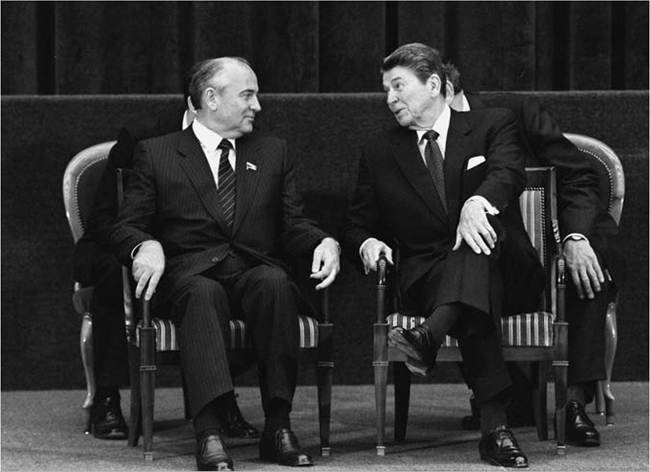
Plate 20.1 Geneva, Switzerland, November 1985. US President Ronald Reagan talks to Soviet President Mikhail Gorbachev during a two-day summit between the superpowers in Geneva. (Photo: AFP/Getty Images)
had signalled the beginning of the Cold War system in Europe, the resolution of that issue signalled its end. In the summer of 1989, round-table negotiations similar to those in Poland produced a new government in Hungary which, having been promised a half-billion-dollar West German loan, in September decided to open its borders with the West. Soon thousands of East Germans flocked to Hungary in the hope of emigrating to West Germany. By late September, the East German regime was coming under pressure from protesters who demanded reforms similar to those in Poland and Hungary. On 18 October Erich Honecker was forced to resign, and the Politburo began work on new liberal laws and instructions, especially for travel to the West. As the draft laws became known on 9 November, East Berliners began assembling at the Berlin Wall, demanding to be allowed to cross, and demoralized GDR border guards opened the barriers.
That weekend somewhere between two and three million East Germans visited West Berlin, and the wall, the paramount symbol of the Cold War, became a thing of the past.German Democratic Republic (GDR)
The German state created in 1949 out of the former Soviet occupation zone. Also known as East Germany. The GDR more or less collapsed in 1989—90 and was merged into the FRG in 1990, thus ending the post-war partition of Germany.
In Czechoslovakia the Communist Party leaders, fearful of having to face the consequences of their actions in 1968, at first tried using force to stop the demonstrators. After street battles in Prague on 17 November, the opposition responded by calling strikes and boycotts, and the journalists took over control of most of the mass media, supporting the protesters. By the end of the month, the party leaders had resigned and in December the veteran dissident writer Vaclav Havel was elected president and Alexander Dubcek, the leader overturned by the Soviets in 1968, was made chairman of the Federal Assembly. Only in Romania, which for a long time had been only half-connected to the Soviet bloc, were the changes accompanied by widespread violence. On 21 December the communist dictator Nicolae Ceausescu made a televised address to a hand-picked crowd in Bucharest, but was interrupted by protesters. Over the week that followed, armed protesters, gradually joined by the army, fought Ceausescu loyalists in the streets. Ceausescu and his wife were captured and executed on Christmas Day, 1989.
While the events in Eastern Europe were unfolding, Gorbachev insisted on absolute Soviet non-intervention (the so-called ‘Frank Sinatra Doctrine'). As he explained to his Politburo, the Soviet Union could not afford to intervene, for the financial costs and potential damage to the relationship with the West would be too high. But most importantly, Gorbachev believed that it would not be right to intervene, for he felt that just like the Soviets, the East Europeans should decide their own futures.
He attempted to use his willingness to allow change as a bargaining chip in his relationship with the new administration of George Bush, but the latter proved cautious and was unwilling to give much in return, economically or politically. Steadily, though, the relationship between the two countries did improve, especially in terms of arms control, to the point that by 1990 both sides spoke of a partnership rather than a ‘Cold War'.The American hesitancy in providing tangible support for Gorbachev's reforms made the Soviet relationship with Western Europe, and especially with West Germany, even more essential to Moscow. At the same time Helmut Kohl's government in Bonn had more to gain than any other Western country from a close relationship with Gorbachev, not least as reunification would boost the
Federal Republic of Germany (FRG)
The German state created in 1949 out of the former American, British and French occupation zones. Also known as West Germany. In 1990 the GDR merged into the FDR, thus ending the post-war partition of Germany.
North Atlantic Treaty Organization (NATO)
Established by the North Atlantic Treaty (4 April 1949) signed by Belgium, Canada, Denmark, France, Great Britain, Iceland, Italy, Luxembourg, the Netherlands, Norway, Portugal and the United States. Greece and Turkey entered the alliance in 1952 and the Federal Republic of Germany in 1955. Spain became a full member in 1982. In 1999 the Czech Republic, Hungary and Poland joined in the first postCold War expansion, increasing the membership to nineteen countries.
see Map 20.1
Christian Democrats’ domestic standing and seal Kohl's place in history. As the East German regime withered from within after the fall of the Berlin Wall, Kohl sought Soviet support for rapid reunification and was willing to offer significant economic aid in return. In 1990, Gorbachev agreed to the FRG absorbing East Germany, and approved the idea that the new reunified Germany should remain in NATO.
Gorbachev’s decision effectively sidelined those West European leaders, including the French president, Francois Mitterrand, and the British prime minister, Margaret Thatcher, who feared the consequences of a quick German reunification.However, German loans were not enough to stop the Soviet slide towards economic chaos and political instability. Encouraged by the events in Eastern Europe, the Baltic States, which had been forcibly incorporated into the Soviet Union in 1940, began a campaign for independence. A similar movement flourished in Stalin’s home state of Georgia, and violent conflicts broke out between the Soviet republics of Armenia and Azerbaijan over the control of the Nagorno-Karabakh area. As Gorbachev in early 1991 began to slow down his drive towards liberalization, Boris Yeltsin, who had been elected president of Russia, by far the biggest of the constituent republics, began to challenge his authority. In August 1991 conservatives within the Soviet Communist Party attempted to grab power in order to turn the clock back, but their coup against Gorbachev was defeated by their own indecisiveness, the army’s unwillingness to follow their orders and Yeltsin’s defence of the sovereignty of his Russian republic. The failed coup effectively brought about the end of the Soviet Union. The Baltic States broke away immediately, and one after another all the Soviet republics declared their independence, including Russia. Gorbachev remained in the Kremlin as the president of a union that had ceased to exist, until he resigned on Christmas Day, 1991. After seventy-three years of uneasy existence, the Soviet Union was no more.
Debating the end of the Cold War
The sudden end of the Cold War has produced a substantial amount of scholarly debate. Among the central questions are why and how did the post-1945 era come to such a rapid conclusion in the late 1980s, who won the Cold War, and was the ‘victory'worth its price? In general,the disagreements relate to the fact that different answers are given to one specific question: did internal or external factors play the key role in bringing down the Soviet Union and its empire?
Those stressing the external factors as central to the demise of the USSR essentially argue that the massive military expansion of the United States during the Reagan years and the president's vocal anti-communism prompted the Soviet leadership to respond in kind. However, given the dire state of the Soviet economy, its military buildup forced it to attempt to introduce internal reforms but these only revealed
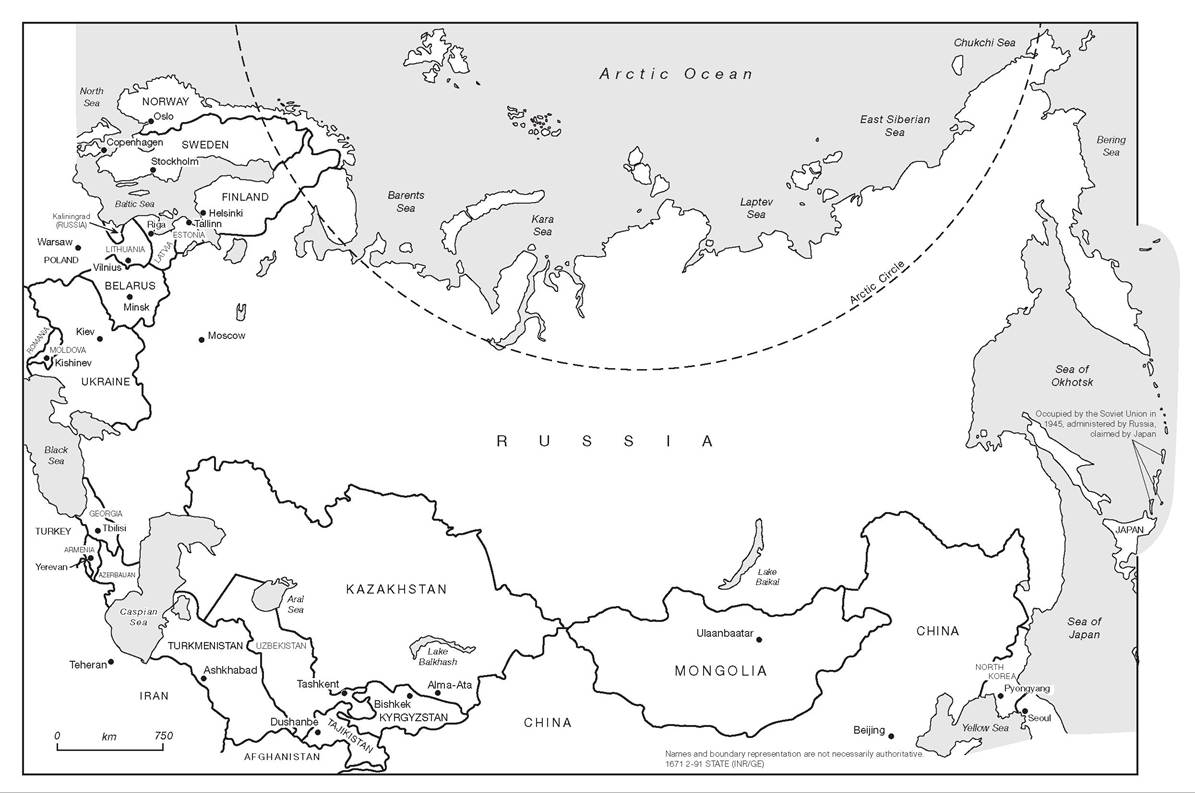
Map 20.1 States of the former Soviet Union after 1991
Source: After Lindeman et al. (1993)
the bankruptcy of the Soviet state, which then collapsed. Another argument, which also emphasizes external factors, stresses the importance of the attempt by the United States and the West generally to engage with the Soviet bloc during the detente period. It contends that, alongside the military buildup, the growing links between East and West Europeans helped to undermine the legitimacy of totalitarian rule. In addition, it has been argued that with the advent of the information age, the Soviet bloc was economically and technologically lagging further and further behind the West and this forced it to change its isolationist policies in order to tap into 'capitalist' markets and know-how. For various arguments, students should consult the essays in Odd Arne Westad (ed.), Reviewing the Cold War (London, 2000) and David Kotz and Fred Weir, Revolution from Above (London, 1997).
While all of the factors mentioned above were undoubtedly important in eroding totalitarian rule in the Soviet bloc, other observers have focused more upon the internal decline of the Soviet state. By the 1980s, the USSR and its satellites in Eastern Europe, it is argued, lacked internal political legitimacy and had been forced to accept the existence of a permanent and growing black market. Decades of mismanagement could not be cured by Gorbachev's well-intentioned reforms alone but required a complete overhaul of the system, a fact that dissident groups advocated increasingly vocally.
What about the demise of the Cold War as an international system? While it can be partly explained as a result of one side's victory over another, some analysts have pointed to the relative decline of both superpowers. Indeed, one of the best-selling titles of the late 1980s was Paul Kennedy's The Rise and Fall of the Great Powers (London, 1988), a book that essentially predicted the fall of the United States! While Kennedy was wrong in his prediction in this regard, the general point about the so- called 'imperial overreach' of the two superpowers during the Cold War still carries resonance. In a more recent book, The Global Cold War (Cambridge, 2005), Odd Arne Westad stresses the importance of the resentment caused by Soviet and American interventions in the Third World as an important cause for the demise of the USSR and the Cold War international system. Indeed, by the late 1980s, he contends that the Cold War division of the world had become increasingly irrelevant as a defining characteristic of the international system. Understanding the causes of its demise, however, provides important lessons for the twenty-first century.
While a growing number of scholars distinguish between the end of the Cold War (pointing to the events of 1989 as the most significant turning point) and the collapse of the USSR, most historians would agree that it was the collapse of the Soviet Union that finally ended the Cold War as an international system. After all, it was the existence of the Soviet Union and its challenge to the international order after 1945 that had given rise to this system. But the story of why the Soviet
Union collapsed is in itself intimately linked to many of the other events that shook the international system in the early 1990s. None of these was more closely watched than the events in the Persian Gulf.