The end of empire
Apart from the campaigns in East and North Africa, Africa largely escaped the fighting that ravaged the world between 1939 and 1945. The continent was not, however, by any means isolated from the war, for the Allied need to mobilize colonial resources to defeat the Tripartite Powers led to a number of significant developments.
The most obvious was that the loss of the raw materials of SouthEast Asia in 1941—42 necessitated the rapid expansion of production of resources such as rubber and tin in the African colonies. In addition, the war was important because it saw an even more extensive mobilization of the population than had occurred in 1914-18, some 374,000 Africans being recruited into the British armed forces alone. Those who served overseas were often changed by the experience, returning home more politically conscious than before and keen to achieve European standards of living.Recognizing that the continent was changing, some of the colonial Powers, most notably Britain and France, saw the necessity during and immediately after the war for a degree of constitutional reform that, by increasing local representation, would legitimize the drive towards economic development. In 1944 the French held a conference at Brazzaville in Equatorial Africa, at which it was agreed to end forced labour, to expand African involvement in local politics and to establish a constituent assembly in Paris that would draw up a constitution for a new French Union. Meanwhile in West Africa, Britain decided in 1946 to establish an African majority in the legislative councils of Nigeria and the Gold Coast (Ghana) and to extend the powers of these bodies.
It would, however, be a mistake to see these reforms as part of a programme that was intended to lead to independence in the near future. The French at Brazzaville made it clear that independence was not on their agenda, while in 1943 the British colonial secretary, Oliver Stanley, ruled out a transfer of power in Africa for generations to come.
Instead these political reforms were designed to perpetuate imperial control, for the colonies, both during and after the war, were seen as vital for the future prosperity and security of the metropole. Indeed, once the Second World War came to an end, the European colonial Powers diverted more resources than ever to develop their African possessions. In 1945 the Labour government in Britain passed the second Colonial Development and Welfare Act, which provided £120 million for its colonies in Africa, the Caribbean and SouthEast Asia, while in 1947 the French established the Fonds d’Investissement et de Developpement Economique et Social des Territoires d’Outre-Mer (FIDES). Between 1943 and 1957 FIDES invested $542 million in French West Africa alone, far outstripping the British effort to develop its colonies. This push for developmentdecolonization
The process whereby an imperial power gives up its formal authority over its colonies.
see Map 17.1
came about because it was believed in Britain and France that an expansion of raw material production would increase the ability of their empires to earn dollars, thus assisting the post-war recovery of their metropolitan economies. In addition, it was hoped that greater mobilization of African resources would help to maintain Britain and France as world Powers able to operate independently of the United States and the Soviet Union.
The hope that Africa would contribute to a return to prosperity and power turned out to be a chimera, not least because the very act of encouraging development led, as in the case of India before, to increasing political, economic and social unrest. Indeed, the drive for development proved to be one of the main causes of the rapid shift towards decolonization in Africa in the 1950s, for the social and economic discontent that it generated meant that those who preached the cause of liberation from colonial rule began to find a ready audience for their rhetoric.
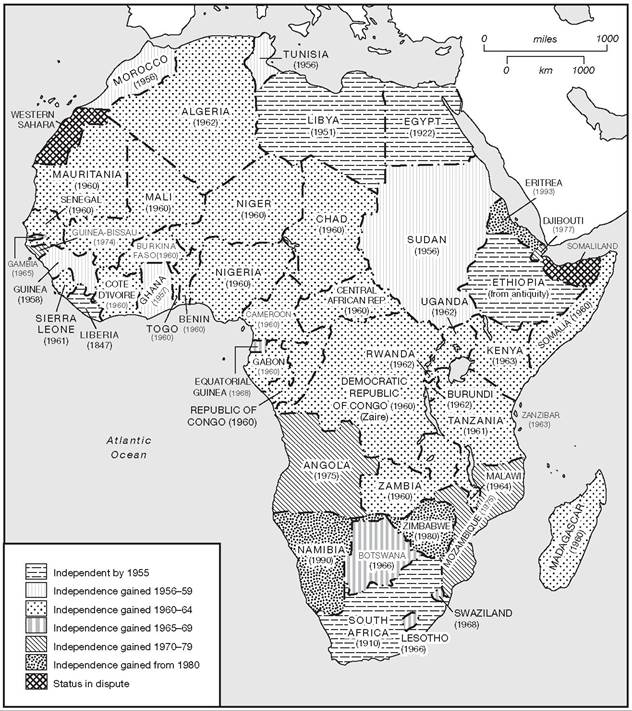
Map 17.1 Decolonization in Africa
Source: After Brown and Louis (1999)
This first became evident in February 1948 when riots broke out in Accra in the Gold Coast.
The roots of this urban unrest lay in a number of factors arising out of the push for development, such as high inflation and discontent about employment prospects, particularly among recently demobilized soldiers, and the virtual monopoly that British companies exercised over imports. The initial British reaction was to use the mailed fist and to arrest the leaders of the newly established nationalist party, the United Gold Coast Convention (UGCC), including an organizer who had recently returned from university studies in the United States and Britain, Kwame Nkrumah. However, after investigating the causes of the rioting, the British government decided that only further constitutional reform could bring about a return to stability. Accordingly, in 1949 the British introduced a new parliamentary system of government, believing that this would quieten discontent. This hope proved to be misplaced, for in 1951 Nkrumah's new political party, the Convention People's Party, which took a far more radical stance on self-government than the UGCC, won the first legislative elections. Aware that the choice lay between a rapid move towards self-government within the Commonwealth or prolonged political instability, Britain chose the former, setting the Gold Coast towards its path to independence as Ghana in 1957.Commonwealth, The
An organization of independent self-governing states linked by their common ties to the former British Empire.
The case of the Gold Coast is instructive, for it provides a classic example of the way in which many transfers of power in Africa were not planned but were forced upon the colonial authorities in a series of ad hoc retreats and compromises. In many colonies the imperial Powers had clear ideas about what they wanted to achieve, but found that circumstances forced them to make compromises acceptable to African opinion. For example, Britain desired to establish a multiracial political system both in Kenya and in the Central African Federation (an entity that brought together Nyasaland [Malawi] with Northern and Southern Rhodesia [Zambia and Zimbabwe]), but was eventually forced to abandon these plans in the early 1960s and agree to independence under African majority rule. France, meanwhile, declared in 1958 its intention to turn its empire into a French Community which would allow the Equatorial and West African colonies to become states that controlled their own domestic affairs but co-operated with Paris over foreign affairs, security issues and overall economic policy.
This bold initiative was, however, fatally undermined when Guinea voted against joining the Community and soon after Senegal and French Sudan (Mali) opted for full independence, leading to a general exodus which France had little choice but to accept. The Belgian Congo too was affected by this pattern of events. In January 1959, following riots in Leopoldville (Kinshasa), Belgium announced its intention to transfer power in four years' time, but the mounting pressures in the colony forced it to truncate this to a period of eighteen months, granting independence in June 1960.Reinforcing this trend was the fact that where the colonial Powers did attempt to resist nationalism through the use of force, the results were often disastrous. The most obvious example of this was the French effort to defeat the challenge posed by the Front de Liberation National (FLN) in Algeria between 1954 and 1962. The fact that Algeria contained a large number of European settlers and that it was constitutionally part of France meant that, as far as the government in Paris was concerned, its status was not negotiable. It therefore reacted to the FLN's war of national liberation with a savage campaign of repression. However, while France was able to stem the tide militarily, the political costs of the conflict proved very damaging and gradually sapped its spirit of defiance. A key element in this was that the FLN was very effective in presenting its cause to international opinion as symbolic of the Third World's struggle against colonialism. Accordingly, France's effort to force the Algerians into submission generated much international criticism, for it was made to appear as though it was attempting to hold back an irresistible moral force. French efforts to win back its esteem and to isolate the FLN, such as its decision in 1956 to grant independence to Morocco and Tunisia, proved to be in vain, for in the end there was no alternative to full Algerian independence. Eventually, realizing the damage that had been caused to French prestige and unity, in 1962 President de Gaulle consented in the Evian agreement to a transfer of power.
Bretton Woods
The site of an inter-Allied conference held in 1944 to discuss the post-war international economic order. The conference led to the establishment of the IMF and the World Bank. In the postwar era the links between these two institutions, the establishment of GATT and the convertibility of the dollar into gold were known as the Bretton Woods system. After the dollar's devaluation in 1971 the world moved to a system of floating exchange rates.
In the light of its agony in Algeria, it is not surprising that France largely avoided resisting African nationalism elsewhere. Indeed, Algeria generally heightened European sensitivities to the costs of ‘holding on', for no state wished to find itself in the same morass. For example, the hard-line policy that the Conservative government of Harold Macmillan followed over Kenya and the Central African Federation was dealt a fatal blow in 1959 when there was public outcry over the revelation that the police in both colonies had acted with unnecessary brutality. In addition, Algeria was important because the FLN's ties with the leading Third World states and its occasional flirtations with the communist bloc confirmed to both the colonial Powers and the United States that it was better to make concessions over self-government in the short term than to risk radical or pro-Soviet national liberation movements taking power in the long term. The other side of the coin was that, for their part, nationalist governments and movements in the Third World played on the fears of the colonial Powers and their American patron by lauding the FLN, seeking ties with the Afro-Asian movement and hinting at the possibility of finding a sympathetic voice in Moscow or Beijing. They were therefore able to manipulate the Cold War for their own benefit.
Apart from the costs of resistance, one other factor played a key role in African decolonization, namely that as the capitalist world economy flourished under the umbrella of the Bretton Woods system, the imperial Powers found themselves less reliant on trade with their colonial possessions.
Not surprisingly, this sapped their will to spend precious resources on areas that were now a drain on rather than a benefit to the metropolitan economy. Moreover, there remained the broad hope that the granting of independence in good time would involve a political transfer of power but not necessarily a change in economic ties, and that the large European trading concerns, such as Britain's United Africa Company, would therefore continue to flourish.The result of the above pressures was that by 1966, when Botswana became independent, the majority of the territories that made up Africa had become sovereign states, the only significant exceptions being those colonies controlled by Portugal, the anomaly of Southern Rhodesia and South-West Africa (Namibia),
which remained under the rule of South Africa. However, while this was a victory for the cause of self-determination, it came at a price, for now the new states faced the difficult task of plotting both their individual and collective fortunes. This involved a vast array of issues, including not just economic development and constitutional reform, but also whether there should be a move towards regional federations and perhaps eventually a united government of Africa.
self-determination
The idea that each national group has the right to establish its own national state. It is most often associated with the tenets of Wilsonian internationalism and became a key driving force in the struggle to end imperialism.