The Indian Ocean ranks among the most long-lived spaces of historical memory and the present burst of historiographical attention to this ocean should be interpreted in this context.
The key terms driving recent histories of the Indian Ocean are said to be: ‘porousness, permeability, connectedness, flexibility, and the openness of spatial and temporal boundaries and borders’.1 Such terms reflect how present-day Indian Ocean historians like crossing the boundaries of national and regional units (especially, Africa, the Middle East and Asia, which arose out of nationalist or Cold War politics in the twentieth century), replacing them with the Indian Ocean as a more resonant cartography.
They also reflect how recent histories of the Indian Ocean have crossed temporal thresholds, inherent in such labels which were once applied to this sea: ‘Islamic Sea’, ‘The Early Modern Indian Ocean’ and ‘British Lake’. However, this revisionist pluralism - across space and time - in histories of the Indian Ocean is in keeping with this sea’s narration over the longue duree.Over the centuries, narrators of the Indian Ocean have come from myriad cultural perspectives, East and West. The chapter begins with the claim that this historiography of the Indian Ocean has no clear beginning, nor has it operated in a linear track, by way of geography, temporality or method. Despite this long-term fluidity, over the centuries and now once again, there have been those who have sought to define and contain the Indian Ocean as a whole. Yet as this chapter demonstrates, their efforts have had to come to terms with layered inheritances and forgotten histories, disconnected locales and the pull of adjoining waters. In other words, despite attempts to move towards structuralism or an ‘Indian Ocean history school’, such endeavours have not stood in these [93]
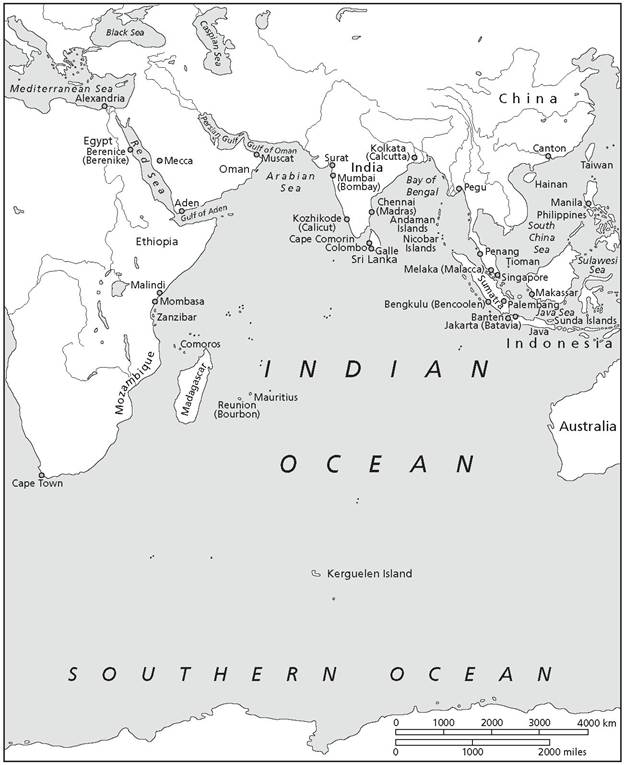
Map 1.1 The Indian Ocean
waters, as is shown in sections below, on trades and labourers, environments and knowledges, and modern formations.
As historians shift between finding a singular Indian Ocean ‘system’, environmental pattern or social formation and breaking all of these up into competing Islams or distinct environmental belts, or indeed, moving beyond slavery versus indenture, relinking this sea to the Atlantic and Pacific, and reinserting race, legality, and state-making, the way ahead must surely lie in embracing the many historiographical Indian Oceans. To the key terms cited above might then be added their opposites. The chapter attends then to this question: why has the Indian Ocean seen structures, peoples, ideas and things shifting between porous and bounded incarnations in historical time as well as in historical tellings of this sea? It begins with the history of histories and geographies of the Indian ocean.