The Mediterranean Sea looms large in the Western world, and thus also in Western historiography.
It is the Ur-sea. This is true for several reasons. First, it is the birthplace of Greco-Roman, and thus European, civilisation.1 Second, the successful navigation of the sea stretches very far back in human history, to thousands of years before the beginning of the Christian era, and the written and archaeological record is abundant.
This distinguishes the study of the Mediterranean from the fields of Pacific and Atlantic history. Finally, from the early medieval period Europeans formed an idea of themselves and of Europe in opposition to Islam, and it is the Mediterranean which purportedly served as the watery frontier, ‘the historic dividing line separating two groups conceived of as opposites’.[431] [432] Nevertheless, the Mediterranean is a frontier that has been routinely crossed by both sides and, at times, the Europeans have found it expedient to advocate for Mediterranean unity, rather than enmity. The current refugee crisis, in which (mostly) Muslim refugees have been crossing from the southern and eastern shores to the northern shores of the inland sea, with many thousands dying in the attempt, is but the latest iteration of a very ancient Mediterranean dynamic: it is a frontier but one that is routinely crossed.The division of the sea into its Muslim and Christian halves has been an essential framework for writing about the history of the Mediterranean. The early twentieth-century Pirenne thesis, although by now the subject of sustained critique, remains one of the best known paradigms in medieval history; it argued that it was the arrival of the Muslim armies in the Mediterranean in the seventh century that destroyed the unity of the
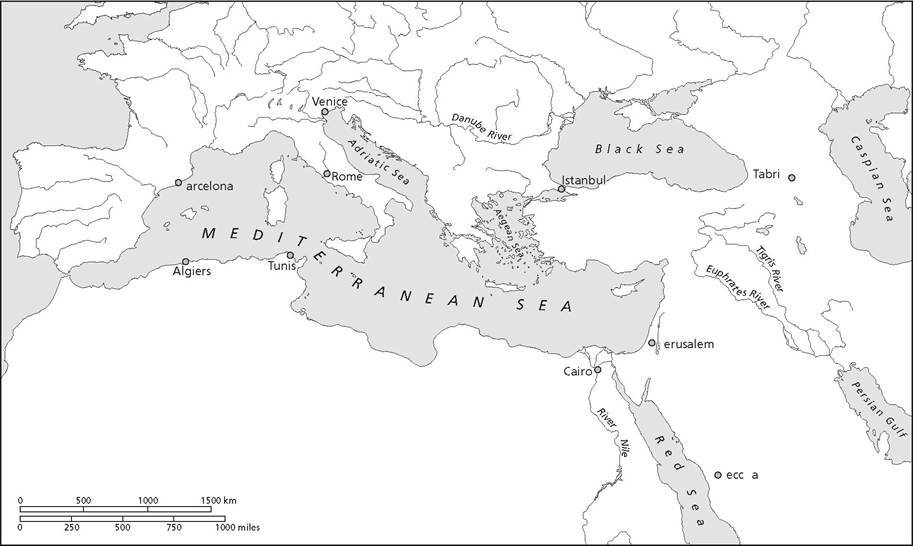
Map 5.1 The Mediterranean Sea
Roman world.
A more recent trend in writing about the Mediterranean seeks to downplay, if not entirely ignore, religious divides in favour of an environmental approach that emphasises the essential unity of the region. This was the thesis of Fernand Braudel’s magnum opus La Mediterranee et le Monde Mediterraneen à l'epoque de Philippe II, published in 1949. Between the northern and southern limits of the cultivation of the olive tree, Braudel argued, the repetitions and cycles of environmental time structured human experience in more consequential ways than the supposed ruptures and breaks brought on by the rise and fall of empires and the eruptions of religious conflict. The afterlife of Braudel’s book (the English translation of which appeared only in the early 1970s) was rather peculiar. Although widely hailed as a major accomplishment of the Annales school of historical writing, it did not inspire a new field of Mediterranean studies and sat for a long time in splendid isolation.[433]Since the 1990s this has changed. There has been both a general uptick in scholarly interest in the Mediterranean, alongside a more focused return to Braudel, with the goal of grappling with his legacy. Work in the latter vein has attempted to tackle two major criticisms of La Mediterranee, namely the charge of environmental determinism and the relative unimportance of human actors in Braudel’s narrative.[434] Peregrine Horden and Nicholas Purcell’s massive The corrupting sea: a study of Mediterranean history, published in 2000, is a landmark in the field and a self-proclaimed response to Braudel. Against Braudel’s emphasis on a unified Mediterranean environment, they posit instead extreme fragmentation, the Mediterranean as a possibly endless series of microecolo- gies.[435] But they share the Braudelian vision of a world connected by the sea itself, perhaps even more than Braudel, since the distinctive ecologies of the Mediterranean make autarky an impossibility.
It is interesting that, although Horden and Purcell are deeply interested in the Mediterranean environment, in their view it is not the environment that drives change but rather the decisions made by local actors to diversify agriculture in order to mitigate risk. In the words of one reviewer: ‘All social and economic history, the authors argue, should be placed squarely in the context of relations of production, rather than in transitory technological or environmental changes.’[436] To foreground relations of production is, of course, to foreground social relations and power.[437] By so doing, the authors are well within the mainstream of environmental history today, which rejects environmental determinism.Other post-Braudelian works on the Mediterranean continue the emphasis on human agency, sometimes pushing it even further. The editors of Mediterranean diasporas: Politics and ideas in the long nineteenth century write that, instead of the more usual focus on trade and economic history, ‘the originality of this volume lies in the fact that it sees the Mediterranean, first and foremost, as a place of intellectual communication’.[438] Peter Miller, editor of The sea: Thalassography and historiography, took the unusual approach of excavating the history of Braudel the administrator, rather than Braudel the scholar. Looking at Braudel’s tenure at the VIe section of Ecole des Hautes Etudes, it turns out that the projects he encouraged and the people he admired all had a very human-centred approach to history: ‘This Braudel was not the one for whom human life was mere “froth on the waves”.’[439] All of the chapters in the Miller volume insist on the intersection of cultural and economic history, a closing of the divide between materialist and cognitive accounts of the past.
In writing about the environmental history of the Mediterranean, historians like Horden and Purcell are able to draw on a long tradition of scholarship on the classical and medieval world to help them make their claims. For example, they would not have been able to take on, and to refute, arguments about the nature of Greek and Roman agriculture - its supposedly primitive nature, for example, according to Moses Finley - were it not for the fact that these topics have figured so prominently in the Western historical tradition. Here we see how the treatment of the Mediterranean as an environmental and ecological unit is connected to the much older tradition of historical writing about the Mediterranean, discussed in the opening to this chapter, which finds its origins in the significance that Mediterranean Antiquity holds for European history.
More on the topic The Mediterranean Sea looms large in the Western world, and thus also in Western historiography.:
- Mens Rea
- Profanations: religious vs secular in the Temple of Western modernity
- Peasant Historiography