The Red Sea has long been perceived as a place, a concept and a mythical arena.
The idea of the Red Sea has inhabited the minds of Jews, Christians and Muslims who, for many centuries, have conjured up evocative images of the miraculous biblical account of the parting of the Red Sea and its crossing.
Arguably, these are among the most visually arresting scenes in monotheist scriptures. From the historian’s perspective, the Red Sea seems to present a fundamental paradox: though, since prehistoric times, it has been one of the busiest and most important sea lanes on the globe, a singular maritime space and among the first seas to be mentioned in recorded history, it has long been perceived a transitional space and a sea without a history of its own.Oceans and seas have always captured the human imagination. Seas have reputations, and the dry, blazingly hot and generally inhospitable environment of the Red Sea basin’s littorals has usually unwittingly cast it in a negative light. In his 2010 bestselling epic on the Atlantic, Simon Winchester wrote about those inland seas which seem ‘strangely still, starved of any readily apparent vitality’. Together with the Coral Sea and Sea of Japan which ‘are somehow stripped of any true kind of oceanic liveliness’, the Red Sea, Winchester continues, ‘bathed in its ocher fog of desert sand, seems perpetually half dead’.1 Just like deserts that can be imagined as seas, the Red Sea is an example of an aquatic space that historians and other writers have, on the whole, tended to represent as a sort of desert (in a negative sense) - an empty space, an ahistorical place, and an area of deprivation to be promptly traversed on the way to the more propitious areas located beyond it.
Those accounts that have treated the Red Sea as a historical subject mostly view it from a macro-historical perspective as a transitional space, a maritime corridor in the long-distance trade between the Mediterranean and the Indian Ocean and as a border separating Africa from Arabia.
The [497]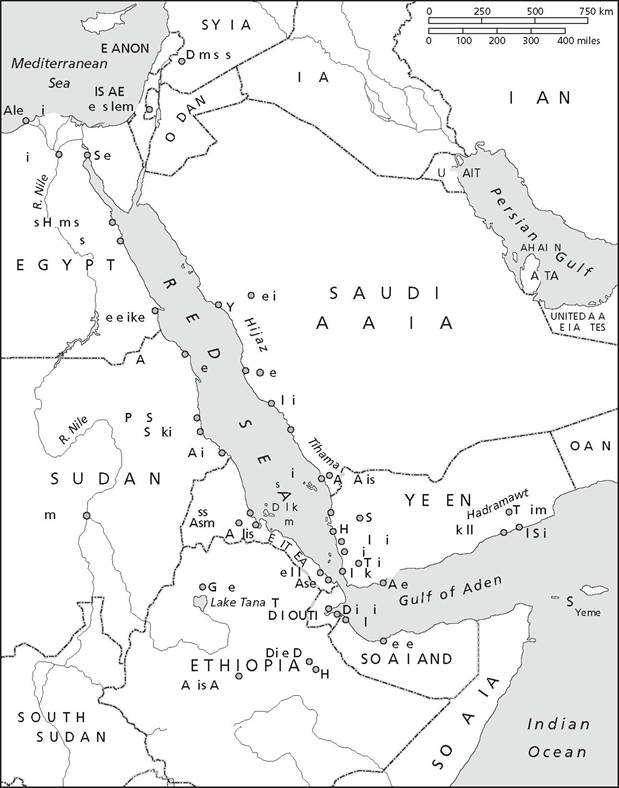
Map 6.1 The Red Sea
history of the Red Sea, in this view, has been exclusively defined by its functional relationship to the Mediterranean and the Indian Ocean - an indispensable hyphen between the two, at times serving as an interface, or a bridge, at others as a barrier. Emblematic of this non-lieu representation is the oft-cited phrase referring to the Red Sea as ‘an extreme example of a sea on the way to somewhere else’.[498] Such attitudes are also mirrored in accounts of Mediterranean and Indian Ocean history, which mention the Red Sea only in passing, if at all. In his famous study of the Mediterranean, Fernand Braudel said very little about the Red Sea, which he basically saw as located within the continuum of warm deserts extending from western Africa to Arabia and Iran (a so-called ‘Greater Sahara’), and described in his chapter on the boundaries of the ‘Greater Mediterranean’.[499] Negative perceptions or mere disregard for a historical Red Sea per se die hard. For example, the omission of an entry on the Red Sea in the four-volume Oxford, encyclopedia of maritime history published as late as 2007 is perplexing.[500]
Why has the Red Sea as a historical space and place not attracted enough scholarly attention? One reason is the way that knowledge has been produced about this area. Rooted in the meta-geographical division of the world into continents and sub-continental regions, the African/Middle Eastern Studies divide has thwarted a more integrative approach to this region and has unwittingly masked the Red Sea as an in-between space, separating Africa from the Middle East.[501] In turn, this has obscured the animated historical connections, circulations and exchanges across the Red Sea area. Different area studies research centres, funding programs, journals and conferences did little to promote alternative conceptions of space.
The division of fields of enquiry on the basis of this logic goes even further to separate the northern African Red Sea shores - mainly Egypt, but sometimes the Sudan (attached to Middle Eastern studies) from the Horn of Africa (attached to African studies). In sum, the Red Sea falls through different conceptual grids and areas of expertise: Egypt is usually studied as part of the Arab world and the Middle East, the Sudan somewhere in between the Middle East and Africa, and Ethiopia is sometimes isolated within its own rich, yet rather insular, tradition of Ethiopian studies rooted in Oriental philology and Semitics.A similar argument about the fragmentation of knowledge production, diffusion and accessibility could be made about the division of the Red Sea littorals among nine modern nation-states, if we are to include the Gulf of Aqaba and the Gulf of Aden (which we should): Israel, Jordan, Saudi Arabia, Yemen, Egypt, Sudan, Eritrea, Djibouti and the self-declared Republic of Somaliland, a list of nation-states that includes some of the poorest and richest countries in the world and a region that is today associated with poverty, conflict and overall instability. Most of these nation-states have their political and economic centres in their interiors and - conveniently oblivious to a more dynamic transregional view of the past - have developed national histories that perceive the Red Sea littorals as peripheral and marginal. The politicisation of nation-state- centred narratives about history and culture have also obscured the cultural hybridity and cosmopolitanism that has characterised Red Sea port towns and littorals throughout history.