The South China Sea has been one of the busiest waterways in global history; its pedigree is ancient, even as its modern geopolitical importance remains undisputed.
Few oceanic spaces have generated as much conflict as a region per se than this particular body of water. Yet the history of connection, both via trade and via political contacts, between China and the various polities of Southeast Asia has been more steady and influential than any more recent history of geostrategic unease.
Ancient tribute missions travelled across the placid waters of the South China Sea for some two thousand years, and there was a constant stream of vessels putting the worlds of East and Southeast Asia in conversation with one another, through the transmission of ideas, materiel and people. Most of this traffic moved with the natural rhythms of weather - the seasonal monsoons pushing boats north and south, each at their proscribed time of year - until steam travel began in earnest in the mid-nineteenth century. A number of scholars have described the dynamics of this system in holistic terms, giving us an idea of the mechanics of oceanic connection over several thousand kilometres of open water.1 The present chapter aims to look at these patterns over the longue duree, and queries what kind of place the South China Sea was for most of its history, before the contemporary era made it a byword for international conflict.The first part of this chapter looks at the earliest and medieval connections across this vast body of water, as medieval China, in particular (especially in the T’ang and Sung periods) became aware of the tropical polities of Southeast Asia, and started to produce records about their relative size and location at the far bottom of the South China Sea. This [359]
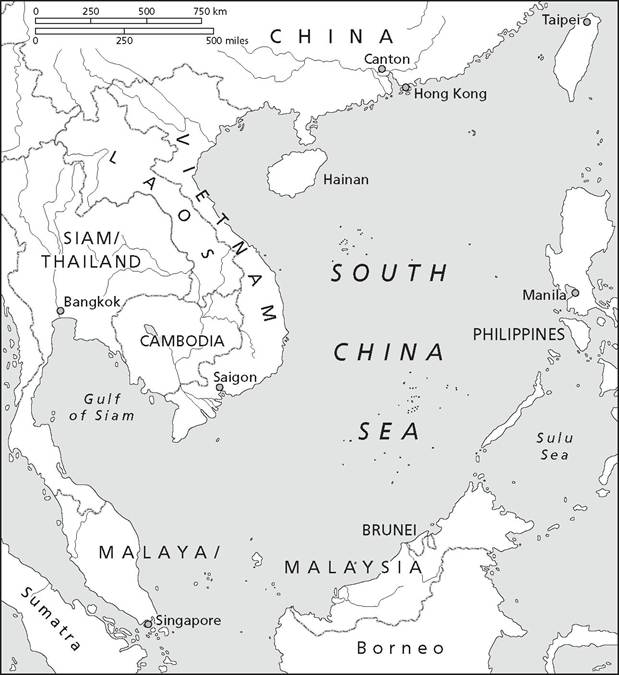
Map 4.1 The South China Sea
contact eventually became routinised into ‘tribute-trade’, a particular pattern of interaction that China forged with most of its neighbours, whether these were territorial or oceanic in nature.
The second part then queries the changing dynamics of what (in a Western context) we might call the early modern South China Sea, as a larger retinue of actors started to pass through this space, and shape its destiny through their presence. Arabs, Persians, Japanese and other sea-faring peoples all contributed to this history, but it was the arrival of Europeans in a number of national guises - Portuguese, Spanish, Dutch, French and English - that would have the most impact, although this was not felt immediately, but rather after the initial ‘contact period’. The penultimate part describes the new template that developed as a result of this quickening of contact, as more and more people scattered around the South China Sea were brought into its widening economic embrace, particularly through the trade in environmental products. The ecology of the South China Sea changed as a result of this trade, but so did political configurations. Finally, the last part looks at the new arrangements that came about as a result of political conquest and incorporation, as the lands surrounding the South China Sea began to be claimed by various actors, and spheres of influence were carved into what formerly had been a freewheeling, liquid space.