The surface waters and winds of the Southern Ocean drive constantly, without interruption by land, from the west around the Antarctic continent.
The Antarctic convergence zone dramatically bounds the cold waters of the Southern Ocean at its northern edge, and encloses a marine ecosystem characterised by fewer species than warmer climes and simple, short, ecological relationships among its animal and bird inhabitants.
The ocean experiences great seasonal variations, for in winter the water’s surface freezes into a great extent of sea ice that substantially retreats each summer. A handful of small islands are dotted through the ocean, minuscule but essential points of passage for seals and birds. The ocean began to take on its modern structure with the slow tectonic opening of the passages between the Antarctic, South American and Australian continents between forty and twenty million years ago, which saw the establishment of the Antarctic Circumpolar Current and the thermal isolation of Antarctica leading to the slow growth of its massive ice sheet.[830]The Southern Ocean has seen significant human activities since the eighteenth century. As recently as the 1960s and 1970s, however, ‘Southern Ocean’ was an uncertain and inconsistently applied name for the cold ocean that surrounds Antarctica. European explorers first began to enter into the physical zone of the ocean in the eighteenth century, and in the years since the ocean has been variously named the ‘Antarctic seas’, the ‘Antarctic ocean’, the ‘southern seas’, the ‘southern oceans’, ‘The Icy Sea’, or as the southerly extent of the Atlantic, Indian or Pacific Oceans. Sometimes these names for the ocean were applied to the exclusion of others, at other times alongside each other; sometimes these designations were bounded by natural features, sometimes by arbitrary latitudes and longitudes. Indeed, the Southern Ocean’s name
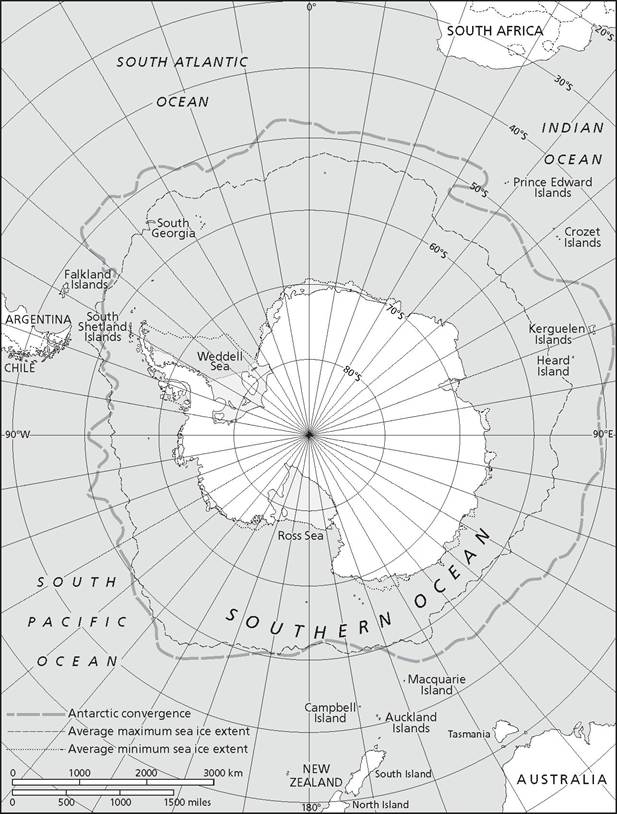
Map 11.1 The Southern Ocean
today remains contested, as it is, for example, the popular term among Australians for the waters that wash Australia’s southern shores.
The shifting names of the ocean articulate more than definitional debates, but speak to its history.
Since the beginning of European overseas expansion the ‘southern oceans’ have denoted a larger region, a great zone of exploration and imagination. With the rationalisation of terrestrial space through discoveries and changing politics in the modern era, there came greater demand for specificity. Since the 1970s, the cold waters surrounding the Antarctic continent, bordered to the north by the Antarctic Convergence, have generally been known as the Southern Ocean in most languages. Greater scientific certainty of biological, oceanographic and atmospheric conditions, and geopolitical developments have seen a stabilisation of the name - though there remains friction in the nomenclature between countries, and between scientific and popular usage.As an ocean with littorals not conducive to permanent settlements, the Southern Ocean’s history is perhaps less encompassing than other great and more settled basins. Though often caught up in grander imperial and geopolitical strategic projects, it has not often been central to them. Nevertheless, the ocean has been a deliberate destination, and engagement with it has been concerted and tenacious. Organised chronologically, this chapter considers the ocean’s history within three major themes. First, it explores the ocean as a site of exploitation, resources and commerce, principally the waves of sealing, whaling and fishing. Second, it considers the ocean as an object of geographical, scientific and environmental thinking and sensibilities. And third, this chapter explores the persistent questions of the ocean’s place in international and global order, not only in diplomatic forums but also in the less formal internationalisms of science and civil society. Each of these themes is linked, for each of the major activities in, and about, the ocean are inseparable and mutually constitutive.