There was a time before Atlantic history.
Two hundred million years ago, in the early Jurassic, no waters formed either barriers or bridges among what are now the Americas, Europe and Africa. These landmasses comprised a single supercontinent of Pangea until tectonic shifts gradually pushed them apart.
The movement continues to this day, as the Atlantic basin expands at about the same rate that the Pacific’s contracts: roughly two centimetres a year. The Atlantic Ocean, at an average of about 4,000 kilometres wide and 4 kilometres deep, is not as broad or profound as the Pacific, the Earth’s largest ocean by far, although its multi-continental shoreline is greater than that of the Pacific and Indian Oceans combined.1 The Atlantic is now but a suburb of the world ocean. Despite the best efforts of international organisations to demarcate it precisely,2 the Atlantic is inextricably part of world history, over geological time as well as on a human scale.There was Atlantic history long before there were Atlantic historians. There were histories around, the Atlantic, along its shores and within its coastal waters. There were histories in the Atlantic, on its islands and over its open seas. And there were histories across the Atlantic, beginning with the Norse voyages in the eleventh century and then becoming repeatable and regular in both directions from the early sixteenth century onwards, long after the Indian and Pacific Oceans had become so widely navigable.3 For almost five centuries, these memories and experiences
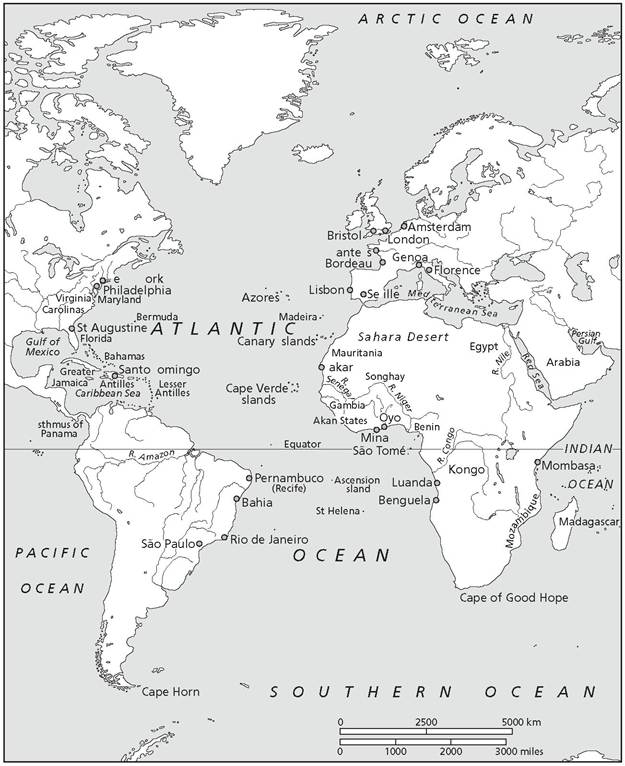
Map 3.1 The Atlantic Ocean
comprised the history of many Atlantics - north and south, eastern and western; Amerindian and African;[274] enslaved and free; Spanish and Portuguese;[275] British, French, Dutch, creole and hybrid[276] - but not yet a single Atlantic history.
More comprehensively Atlantic histories began to appear in the late nineteenth century; later, various species of political and geo-political Atlanticism flourished after the two world wars, but it would take until the latter part of the twentieth century for self-identified Atlantic historians to come onto the scene. Only in the early part of our own century did Atlantic history briefly emerge as a discrete field of study before oceanic history and global history engulfed it once more.[277]In retrospect, Atlantic history appears to have peaked in the early 2000s. ‘We are all Atlantic historians now’, I provocatively declared in 2002, a notorious line usually quoted without its sceptical codicil: ‘or so it would seem from the explosion of interest in the Atlantic and the Atlantic world as subjects of study among historians of North and South America, the Caribbean, Africa and western Europe.’[278] Within less than a decade, almost thirty collective volumes on Atlantic history had appeared alongside countless articles, theses and monographs (and not just by his- torians).[279] In the words of one friendly critic at the time, Atlantic history was ‘not merely trendy, but... clearly winning the day’.[280] It challenged the methodological nationalism that had informed professional historywriting since at least the late nineteenth century. It transcended national boundaries and largely ignored territorial frontiers. It stressed mobility and circulation and focused on exchange and hybridity, integration and communication. It treated the ‘creation, destruction and re-creation of communities as a result of the movement, across and around the Atlantic basin, of people, commodities, cultural practices, and ideas’.11 And it did so in a context defined by empires as well as states and within the perspective of developing political economy.[281] [282] At its most ambitious, Atlantic history joined distinct regions and expanded conventional chronologies into narratives of large-scale change over three or four centuries. During these boom years, what was good for Atlantic history seemed to be good for oceanic history more generally, and even for transnational history tout court. However, every boom risks a bust. Atlantic history’s ascendancy was palpable but short-lived. The cause was less exhaustion than a certain repetition within the field along with increasing competition from without. Scholarly production of Atlantic histories hardly ceased but the field’s adolescent energy waned and it was increasingly challenged as an historiographical inspiration. Its greatest booster and entrepreneur, Harvard historian Bernard Bailyn, noted in 2015 that Atlantic history had ‘developed so swiftly that by 2010 some Atlantic historians had become Atlantic world weary and the basic idea was becoming passe’.[283] Supranational areas of study experienced their own growth spurts. New global histories, as well as other oceanic histories, began to overshadow and even to subsume Atlantic history. Atlantic world-weariness led to the sobering conclusions that the field had ‘fallen on hard times’, that it ‘certainly ha[d] not lived up to the promises of its early supporters’ and that ‘this ocean was not necessarily more influential than local, regional or global factors in the everyday lives of many inhabitants of Africa, America and Europe’.[284] A new consensus was emerging. We were not all Atlantic historians now. We never had been. Probably, we never would be.[285] At its zenith, Atlantic history sat mostly in splendid isolation. Its reigning vision was holistic but somewhat hermetic. It encompassed intercontinental and transoceanic connections but it was in denial about its eclectic ancestry and drew little sustenance from other oceanic histories. ‘How had the idea of Atlantic history developed?’, Bailyn asked in 2005. ‘Not in imitation of Fernand Braudel’s concept of Mediterranean history’, he replied, nor did he believe it was an extension of imperial history or the product of the history of encounters and exploration.[286] Now that Atlantic history is no longer even first among equals, it is clear that both the Mediterranean and the Indian Ocean challenge the Atlantic for chronological priority as maritime zones and as spaces of historical memory.[287] There is also a stronger case that the Pacific Ocean had been generating historical inspiration for decades before Atlantic history briefly asserted its predominance.[288] And it is more obvious than ever that the historiographies of other seas and oceans - the Red Sea and Black Sea; the Baltic and South China seas; the Southern Ocean and the Arctic Ocean - owe little debt to the historiography of the Atlantic.[289] Atlantic history is poised to become a consumer rather than a producer of models for other oceanic histories. Accordingly, this chapter attempts to show what those models have to offer Atlantic historians, in a post-Atlantic world of plurality and proliferation.