AGREEMENT DURATION
While few have studied agreement duration, the recent development of conflict management data provides a preliminary picture of the nature of settlement durability and allows us to establish an understanding of the factors that lead to lasting peace.
We provide, for the first time, an overview of the four most important data sets on conflict resolution and their associated summary statistics in Table 29.1. These data sets flow from very different conflict management research agendas and thus have fundamentally different approaches. The major differences between these data sets include: the actors considered as conflict managers, the actions identified as conflict management, and the measures of success. This variation clearly has implications for the results that will come from analysis on each of these data sets. A description of each data set and summary statistics for important agreement duration and outcome type measures are discussed below.An agreement is only a “final” agreement ex post. Ex ante, an agreement’s duration and permanence are unknown; seemingly weak treaties can be enduring, while settlements anticipated to be conclusive may fail almost immediately. It is critical to use data sets that include both brief agreements that fizzle and long-lasting agreements in order to develop an understanding of how conflict resolution efforts work. As a result, we do not include common conflict data sets like the Correlates of War and Militarized Interstate Dispute data, since they only identify so-called “final agreements” that are coded as such ex post once an agreement lasts long enough for renewed fighting to be considered a new dispute. This lack of inclusiveness is not a comment on these data sets' quality as conflict data, but addresses their utility as conflict management data sources.
Table 29.1 Summary of conflict management data
| Data Source | Definition of Success | Definition OfManagement | Definition of Conflict Manager |
| Third Party Interventions and Militarized Interstate Disputes | Short-term Outcome: Successful, Unsuccessful Long-term Outcome: Successful, Unsuccessful | Verbal, Diplomatic, Judicial, Administrative, Military | State, Coalition of States, IGO, NGO |
| International Crisis Behavior | Impact on Crises Abatement: Delayed, No Effect, Marginal Effect, Important Effect, Most Important Effect | Discussion, Fact-finding, Good offices, Condemnation, Call for action, Mediation, Arbitration, Adjudication, Sanctions, Observer group, Military force | Superpower, Regional or Security Organization, Global Organization |
| Ceasefires | No New COW War for the Dyad | Mediation, Guarantee | Sovereign States |
| International Conflict Management | Durability of Outcome: Less than 1 week, 1 week, 2 weeks, 3 weeks, 4 weeks, 5 weeks, 6 weeks, 7 weeks, 8 weeks + Management Outcome: Unsuccessful, Ceasefire, Partial Agreement, Full Settlement | Negotiation, Mediation, Arbitration, Referral to International Institution, Multilateral Conference | Individual, State, IGO, Regional Organization |
The International Conflict Management (ICM) data set was compiled with a focus on international conflict management mechanisms, with the conflict management effort being the unit of analysis (Bercovitch 2000).
The data define international conflict as an “organised and continuous militarized conflict, or a demonstration of intention to use military force involving at least one state” (Bercovitch 1998, 6). This definition yields 333 disputes from the 1945-2000 postWorld War II period. Conflict management includes negotiation, mediation, arbitration, referral to international institutions, and multilateral conferences. Management represents the actions of individuals, states, and international and regional organizations, taken to resolve an international conflict. The data, described in Table 29.2, offer two methods for measuring conflict management outcomes. The first variable is a categorical measure of any agreement, which includes outcomes of unsuccessful, ceasefire, partial agreement, or full settlement (Bercovitch and Gartner 2006b). The second is the length of time the agreement lasts, ranging from under a week to over eight weeks (Gartner and Bercovitch 2006).One sees that the distribution of the duration of outcomes shown in Table 29.2 is U-shaped. The most common outcome is those that last eight weeks or more, with 1042 observations in this category. The second most common category is those that end quickly, with 243
Table 29.2 Summary statistics for International Conflict Management outcome variables1
| Durability of Intervention Outcome | ||
| Outcome Variable | Frequency | Percent |
| Less than 1 week | 243 | 15.20 |
| 1 week | 72 | 4.50 |
| 2 weeks | 59 | 3.69 |
| 3 weeks | 27 | 1.69 |
| 4 weeks | 109 | 6.82 |
| 5 weeks | 7 | 0.44 |
| 6 weeks | 25 | 1.56 |
| 7 weeks | 15 | 0.94 |
| 8 weeks or more | 1042 | 65.17 |
| Total | 1599 | 100 |
| Intervention Outcome | ||
| Offered only | 242 | 4.84 |
| Unsuccessful | 2543 | 50.82 |
| Ceasefire | 394 | 7.87 |
| Partial Agreement | 1502 | 30.02 |
| Full Settlement | 323 | 6.45 |
| Total | 5004 | 100 |
1 This includes totals from all actions defined by the ICM data set as management: negotiation, mediation, arbitration, referral to international institutions, and multilateral conferences.
agreements lasting less than one week. Those agreements in the middle number from seven observations (those agreements lasting five weeks) to 109 observations (those lasting four weeks). The range in this variation is at least partially due to the measurement of agreement durability being censored at eight weeks or more. However, the distribution also reveals the importance of considering variation in the life of an agreement, as many fail to last even a week.
There is also variation in the types of agreements established. Although most (2543 observations) management efforts are unsuccessful and do not lead to an agreement of any type, there is more variation than a dichotomous measure of successful or unsuccessful captures. Of those cases for which an agreement is established, many (1502 observations) are only partial agreements and very few (323 observations) result in full settlements.
Third Party Interventions and Militarized Interstate Disputes (TPI) data address 1178 interventions in MIDs from 1946 to 2000 (Frazier and Dixon 2005). It categorizes third-party intermediary actions into five categories: verbal expression, diplomatic approaches, judicial processes, administrative, and military. In addition to containing information on the methods of management, the data set includes information on the short-term and long-term outcomes of the management effort. It also identifies the third parties, which include states, coalitions of states, international governmental organizations, and nongovernmental organizations. The data are described in Table 29.3. Many (117) of the agreements that were successful in the short term were not successful in the long term.
International Crises Behavior (ICB) contain information on 334 international crises, 32 protracted conflicts, and 975 crisis actors from the end of World War I through 2002 identified by the International Crisis Behavior data project (Brecher and Wilkenfeld 1998). ICB data includes information on regional and global organizations and major powers that intervene, along with information on the dispute and the conflict.
The ICB Data Viewer is an updated interactive version of the data and summaries originally publishedTable 29.3 Summary statistics for Third Party Interventions and Militarized Interstate Disputes outcome variables1
| Short-Term Outcome of Intervention | ||
| Outcome Variable | Frequency | Percent |
| Successful | 328 | 41.57 |
| Inconclusive | 25 | 3.17 |
| Unsuccessful | 387 | 49.05 |
| Don't Know | 49 | 6.12 |
| Total | 789 | 100 |
| Long-Term Outcome of Intervention | ||
| Successful | 211 | 26.74 |
| Inconclusive | 53 | 6.72 |
| Unsuccessful | 469 | 59.44 |
| Don't Know | 56 | 7.10 |
| Total | 789 | 100 |
1 This includes all actions the TPI dataset defines as management: Verbal expression, diplomatic approaches, judicial processes, administrative, and military.
as part of A Study of Crisis by Michael Brecher and Jonathan Wilkenfeld (1998). The ICB data include management actions by superpowers, great powers, regional, global, and security organizations. Actions include discussion without resolution, factfinding, good offices, condemnation, call for action, mediation, arbitration, adjudication, sanctions, observer group, and emergency military forces.
Outcomes from these efforts include: (1) whether the activity delayed the termination; (2) had no effect on the termination; (3) was an important contributor to the termination; or (4) was the most important contributor to termination of the conflict. The data are described in Table 29.4. Superpower involvement is the most likely factor to escalate a crisis (in 48 of the observations). Mediators, on the other hand, are frequently the most important contributors to resolving the crises.The Ceasefires (CF) data contains information on 48 ceasefires in international wars from 1946 to 1998, each representing a dyadic ceasefire between principal belligerents in a Correlates of War interstate war (Fortna 2004b). Each case has multiple observations over time, running from the ceasefire or the end of the previous time period, until the end of the calendar year, a substantial change in agreement terms, or another war between the same belligerents, whichever comes first. These data include information on the ceasefires and how long they lasted, the situations between the belligerents at the time of the ceasefire, and changes over time, along with detailed information on the content of agreements. If the period does not end with a new COW war for the dyad, the agreement is considered successful. Third-party activities included in the data are mediation (third-party involvement as mediator of the ceasefire, exercising restraint, acting as patron for one side) and third-party guarantees (third party provides explicit or well-understood guarantee of peace). The data are described in Table 29.5. The majority of the observations do not include third-party involvement,
Table 29.4 Summary statistics for International Crisis Behavior outcome variables1
Great Power Involvement Effect on Timing of Crisis Abatement
| Outcome Variable | Frequency | Percent |
| No GP activity | 10 | 13.51 |
| GP delayed termination | 17 | 22.97 |
| GP had no effect | 12 | 16.22 |
| GP more rapid termination | 35 | 47.30 |
| Missing | 0 | 0 |
| Total | 742 | 100 |
Superpower Involvement Effect on Timing of Crisis
| Abatement | ||
| No SP activity | 225 | 51.02 |
| SP escalated crisis | 37 | 8.39 |
| SP had no effect | 118 | 26.76 |
| SP more rapid termination | 58 | 13.15 |
| Missing | 3 | .68 |
| Total | 441 | 100 |
Global Organization Involvement Effect on Timing of
| Crisis Abatement | ||
| No GO activity | 8 | 1.81 |
| GO escalated crisis | 212 | 48.07 |
| GO had no effect | 5 | 1.13 |
| GO more rapid termination | 151 | 34.24 |
| Missing | 65 | 14.74 |
| Total | 441 | 100 |
Regional Organization Involvement Effect on Timing of
| Crisis Abatement | ||
| No RO activity | 102 | 23.13 |
| RO escalated crisis | 171 | 38.78 |
| RO had no effect | 7 | 1.59 |
| RO more rapid termination | 108 | 24.49 |
| Missing | 53 | 12.02 |
| Total | 441 | 100 |
Mediator Involvement Effect on Timing of Crisis
| Abatement | ||
| No Med activity | 306 | 69.39 |
| Med had no effect | 28 | 6.35 |
| Med escalated crisis | 0 | 0 |
| Med more rapid termination | 98 | 22.22 |
| Missing | 9 | 2.04 |
| Total | 441 | 100 |
1 This includes all actions the TPI dataset defines as management: Verbal expression, diplomatic approaches, judicial processes, administrative, and military.
2 The raw total for great power involvement is different from the raw totals for other methods of involvement since this includes only cases before 1939.
and these bilateral cases are the most likely to return to conflict. No observations that included third-party guarantees returned to war.
Table 29.5 Summary statistics for the
Ceasefires outcome variables1
| No Failure | Failure | Total | |
| No Third Party | 529 | 13 | 542 |
| Mediation | 274 | 8 | 282 |
| Guarantee | 52 | 0 | 52 |
| Total | 855 | 21 | 876 |
1 This includes all actions the Ceasefire dataset defines as management: mediation (involvement as mediator of the ceasefire, exercising restraint, acting as patron for one side) and guarantee (provides guarantee of peace).
Variation on a theme
The variations in each data set have substantial implications for assessing conflict management outcomes. Figure 29.2 graphs the percent of successful management efforts by data set, using the strictest definition of success included in each data set, and employing a definition of conflict management that includes any type of third-party actions. We use percentages of successful management efforts to compare the data since each data set has different units of analysis.
The International Conflict Management data set (ICM) has by far the lowest percentage of successful management efforts (6.45% of observations are successful), where success is defined as establishing a full settlement. The International Crisis Behavior data (ICB) has the next strictest definition of successful management, where mediation is the most important factor in the timing of settlement duration (which is the case for 11% of the observations). The Third Party Interventions and Militarized Interstate Disputes data (TPI) find 26.74% of the management efforts included are successful in the long term. Finally, the Ceasefires data (CF) has the most liberal definition of success, with 97% of the agreements examined never failing.
This enormous variation in management outcome is a product of how the data sets define success, conflict, and management, along with the varied units of analyses and different time periods examined. Note that we are not arguing that one data set, or even that one approach or unit of analysis, is the “correct” one. Each of these research agendas,
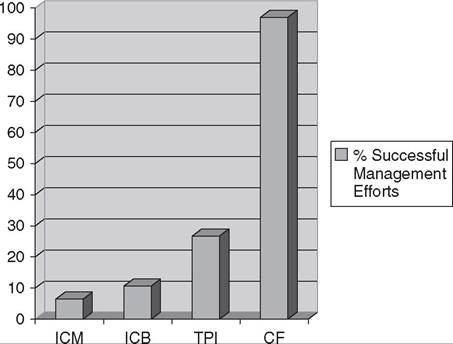
Figure 29.2 Overview of successful management efforts by data set
with their theories and data, provide a different and valuable perspective on the conflict management process. We are suggesting, however, that these data require scholars to:
(1) recognize that no data set is the final word and keep in mind their varied approaches;
(2) employ multiple data sets when possible; and (3) realize that these resources contribute to, and are the result of, a dramatic increase in the scientific study of dispute resolution (Bercovitch and Gartner 2006a).
Variations in durability: the breakup of Yugoslavia and the Egypt/Israeli conflict
The necessity of considering the longevity of an agreement in assessing the effectiveness of third-party management and understanding when a conflict is resolved is well-illustrated by the cases of the break-up of Yugoslavia and the conflict between Israel and Egypt. The war in the Balkans is one of the most common disputes found in the International Conflict Management data set, with 91 mediated settlements (Bercovitch and Gartner 2006b). In the Yugoslavian Civil War, over 35% of the settlements lasted less than one week and 14% lasted just one week. Many settlements were broken within 24 hours of coming to an agreement. Thirty-five percent of the settlements lasted eight weeks or more. With almost half of all settlements lasting one week or less, this case illustrates the importance of analyzing the likelihood of a settlement being short-lived. Simply classifying any management effort that resulted in some sort of an agreement as “successful” would grossly misrepresent the effect that various conflict management efforts had on settling the dispute by lumping all of these agreements together - no matter how short-lived (for an analysis of Yugoslavian Civil War agreement duration, see Gartner and Bercovitch 2006).
The Yugoslavian conflict was mediated by the United Nations, the European Union, and the United States. Most of the settlement attempts before 1995 now appear largely ineffective. These agreements were followed by the more successful Dayton PeaceAccords signed in December 1995, which is seen by some as a suboptimal compromise with a continued lack of resolution for many of the dispute's issues (Cousens 2002). The outcome of the Dayton agreement was a separation of the conflict parties through the dissolution of Yugoslavia. Although this settlement halted the violence, it did not resolve the conflict, as is seen by the renewed conflict and subsequent intervention in Kosovo. Some claim that the accords were unsuccessful at creating a durable peace because they did not provide an institutional framework, as was accomplished by the settlements in other ethnically divided societies such as South Africa and Northern Ireland (Greenberg et al. 2000).
The case ofYugoslavia, with multiple shortlived peace agreements, contrasts with the conflict settlement process involving Israel and Egypt. The treaty between Israel and Egypt was signed on March 26, 1979, following the 1978 Camp DavidAccords. The main features of the treaty were the mutual recognition of each country by the other, the cessation of the state of war that had existed since the 1948 Arab-Israeli War, and the withdrawal by Israel of its armed forces and civilians from the Sinai Peninsula which Israel had captured during the 1967 Six-Day War. The agreement notably made Egypt the firstArab country to recognize Israel officially (Jordan would follow suit in 1994). The peace treaty was signed after Egyptian President Anwar Sadat's landmark visit to Israel in 1978. Even after the Camp David agreements, a treaty was not certain since Egypt was under intense pressure from Arab countries not to sign a separate settlement.
A separate Israeli-US Memorandum of Agreement, concluded on the same day as the Camp David agreement between Israel and Egypt, lays out the US commitment to Israel in case the treaty is violated, the role of the UN and the future supply of military and economic aid to Israel. The United States also helped organize a peacekeeping mission along the Egyptian-Israeli border, which still maintains a rotating infantry task force. The treaty also created a Multi-National Force and Observers funded by Egypt, Israel, the United States, Germany, Japan, and Switzerland. The presence of third-party guarantors is an important determinant in the agreement's longevity. The groundbreaking peace paved the way for subsequent Israeli negotiations and treaties with Jordan and the Palestinians. Although relations between Cairo and Jerusalem have not been warm, they share what is considered a “cold peace” and the treaty between Israel and Egypt has lasted almost 20 years.All agree a cold peace is better than a hot war.