Christianity
When all the different Christian denominations are combined, Christianity is the single largest religious faith in the world (Ahuja, 2008). Ideals such as autonomy, preservation of relationships, justice, forgiveness, fairness, and vengeance all prevail in shaping Christian beliefs and ethics, and thus Christian approaches to conflict (Ahuja, 2008; Croucher, 2011b; Johannessen, 1990; May & Sharratt, 1994).
When discussing approaches to conflict, I am referring to an individual’s conflict style. Blake and Mouton (1964) identified five general styles people tend to adopt when confronted with conflict: (1) dominating (high concern for self and low concern for others), (2) integrating (high concern for self and others), (3) compromising (moderate concern for self and others), (4) obliging (low concern for self and high for others), and (5) avoiding (low concern for self and others; Croucher, 2011a; Leung & Kim, 2007; Rahim, 1983; Zhang, 2007). Depending on an individual’s interpretation of biblical verses and the significance he or she places on the Old and New Testaments, Christians’ approach to conflict differ vastly.Violence and Vengeance. The Old Testament has 39 books, while the New Testament has 27 books. The Old Testament includes numerous books that dictate how one should live one’s life (Genesis, Exodus, Leviticus, Deuteronomy, etc.). These books often depict a violent and vengeful God, who is not very patient or kind. In Exodus 2:29-30,2 we see
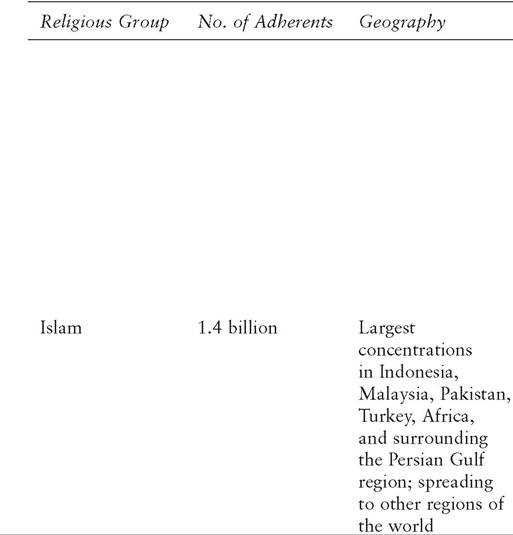
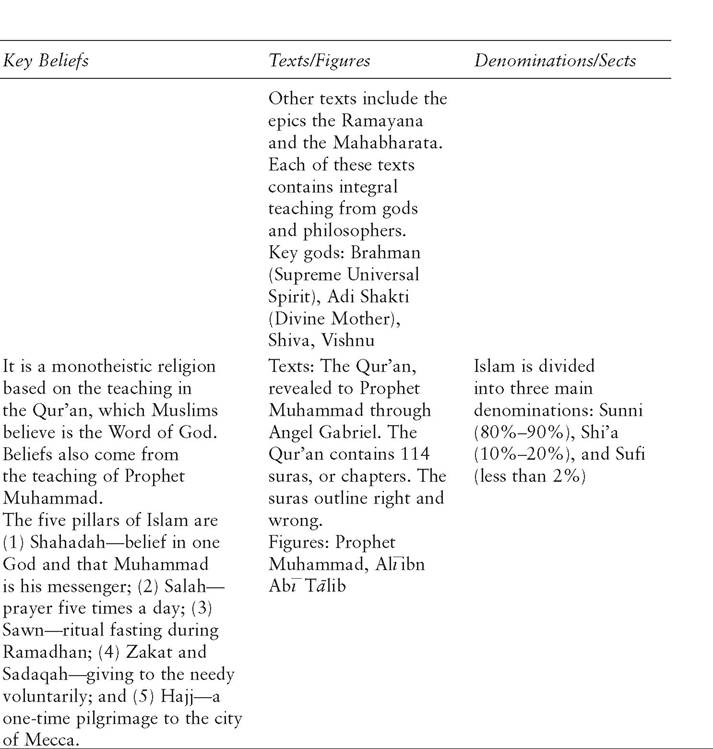
Table 21.1 Comparison Between Christianity, Hinduism, and Islam
| Religious Group | No. of Adherents | Geography | Key Beliefs | TextsZFigures | DenominationsZSects |
| Christianity | 2.2 billion | Global, with fewer concentrations in Southeast Asia | Monotheistic religion based on the teachings of Jesus Christ. Some important beliefs include the following: (1) God is Trinitarian, that is, consisting of three persons— the Father, the Son, and the Holy Spirit; (2) Jesus is the Son of God (the Messiah sent to save the world by his death on the Cross); (3) Jesus was resurrected from the dead and ascended into Heaven; (4) Jesus will return to judge the living and the dead; (5) individuals can be saved from sin through Jesus’s sacrifice; and (6) there is a heaven and a hell. | Texts: Christianity is based on the Bible, which Christians believe is the Word of God. The Bible is divided into the Old and New Testaments. The Old Testament has 39 books, and the New Testament has 27 books. Each book is a lesson on how to live a Christian life. Figures: Jesus Christ, Virgin Mary, Joseph, the 12 Apostles, Martin Luther, various popes | Christianity is divided into various denominations. While these are many, all denominations have in common the worship of Jesus Christ. Some Christian groups are Catholics, Anglicans, Protestants (Baptists, Methodists, Episcopalians, Lutherans, etc.), Eastern Orthodox Christians, and Unitarians |
| Hinduism | 900 million | Main concentrations in India, Nepal, Mauritius, Guyana, Fiji, Bhutan, Suriname, Sri Lanka, and Bangladesh | It embodies a wide range of beliefs and traditions that are very personal and philosophical. While many call it polytheistic (focusing on multiple gods), this is an Overgeneralization. Important beliefs include (1) the eternal nature of the soul, (2) the importance of karma, (3) seeking awareness of God, (4) daily rituals to a God, and (5) pilgrimages. | Texts: The Vedas, a collection of four texts from ancient India written in Vedic Sanskrit are the oldest scripture in Hinduism. Hindus claim these texts are not of human origin but from sruti, “what is heard.” The texts focus on rituals, teaching, philosophy, and reincarnation. | Academics divide Hinduism into four main groups based on the primary deity worshipped: Vaishnavas (worship Vishnu), Shaivites (worship Shiva), Shaktas (worship Shakti), and Smartas (accept all major deities) |
(Continued)
Table 21.1 (Continued)
the vengeful nature of God as he laid waste to the firstborns of Egypt:
At midnight the Lord struck down all the firstborn in Egypt, from the firstborn of Pharaoh, who sat on the throne, to the firstborn of the prisoner, who was in the dungeon, and the firstborn of all the livestock as well.
Pharaoh and all his officials and all the Egyptians got up during the night, and there was loud wailing in Egypt, for there was not a house without someone dead.In Leviticus 20:9, we see a God who recommends death, instead of negotiation/dis- cussion, for disagreeing with or cursing one’s parent: “If anyone curses his father or mother, he must be put to death.” There are multiple instances in this book particularly that call for punishment by death for disagreement or a difference of some sort, instead of forgiveness or some other kind of negotiation. In Deuteronomy 13:1-5, tolerance for prophets or individuals preaching other faiths is not allowed:
If a prophet, or one who fortells by dreams, appears among you and announces to you a miraculous sign or wonder, and if the sign or wonder of which he has spoken takes place, and he says, “Let us follow other gods” (gods you have not known) “and let us worship them,” you must not listen to the words of that prophet or dreamer That prophet
must be put to death, because he preached rebellion against the Lord your God.
What these passages, and many others in the Old Testament, portray is a jealous, violent, and proud God. When it comes to dealing with conflict/disagreement, this God teaches believers to dominate situations to the extreme. The overwhelming majority of Christians quickly point out that modern Christianity has outgrown the Old Testament in many ways and that only extremely devout Christian fundamentalists (strict interpretivists of the Bible) claim that Christians must follow the teachings of the Old Testament (R. D. Putnam & Campbell, 2010). However, what these books in the Old Testament do is lay down rules for conducting day-to-day life for fundamentalist Christians. When considering conflict, these books do not suggest that Christians should compromise, accommodate, and/or avoid conflict. On the contrary, as God dominates in conflicts, some Christians could interpret these books as teaching that people should dominate and enact revenge on those with whom they are in conflict.
Most Christians today do not subscribe to this argument; most of them argue that the life experiences and teachings of Christ and his disciples offer the best lessons for Christians (R. D. Putnam & Campbell, 2010). These experiences and teachings are provided in the New Testament.Forgiveness, Compromise, and Love. The books of the New Testament record the life and teachings of Jesus Christ and the experiences and thoughts of his disciples (Matthew, Luke, John, Ephesians, James, etc.). As these books generally tell the story of Christ and his disciples, there is an overall more positive tone compared with the Old Testament. Ideals such as autonomy, preservation of relationships, justice, forgiveness, and fairness are propagated in these books through the Christ stories. The New Testament teaches that the resolution and management of conflict is a key Christian goal. Paul wrote in Ephesians 4:3 that “being diligent to preserve the unity of the Spirit is the bond of peace.” Paul also said, “If possible, so far as it depends on you, be at peace with all men” (Romans 12:18). Christ taught in Matthew 5:9 that the peacemakers are blessed.
Clearly, the importance of resolving and managing conflict is significant in the New Testament, a major shift from the Old Testament. The books in the New Testament also provide suggestions for conflict negotiation. In Philippians 2:4, Paul recommends that we consider the interests of all parties involved in a conflict: “Do not merely look out for your own personal interests, but also for the interests of others.” In Galatians 6:1, Paul stressed the significance of accommodating/ compromising in conflicts: “Brethren, even if a man is caught in any trespass, you who are spiritual, restore such a one in a spirit of gentleness.” A final paramount principle espoused in the New Testament is forgiving individuals with whom one is in conflict. Christ instructed believers to pray to God in this way: “Forgive us our debts, as we also have forgiven our debtors” (Matthew 6:12).
How much weight Christians place on the Old and the New Testament affects their interactions with others and their approaches to conflict. If they are more fundamental in their beliefs and strict interpretivists of the Bible, they are more likely to judge individuals through the principles of the Old and New Testaments but more through the Old Testament. Thus, there would be more rules/obligations one must live by in life and hence harsher consequences for one’s actions. Croucher (2011b) asserts that individuals who follow a more fundamentalist approach to Christianity (strict interpretation of the Bible) are more likely to evaluate ethical situations (which can often lead to conflict) as either/ or and leave little room for negotiation/com- promise. However, individuals who approach Christianity from a nonfundamentalist perspective are more likely to look at ethical situations more openly and leave room for negotiation and compromise. Strictness of interpretation or level of religiosity, often based on an individual’s reading of the Old and New Testaments, determines whether a Christian approaches conflict from a rule-based perspective or from a more free-will, forgiving, and just perspective (Croucher, 2011b; Hall, 1997; Johannesen, 1990; Pojman, 2005). Religiosity among Christians significantly influences their approach to conflict (Croucher, 2011a;
Croucher & Cronn-Mills, 2011; Croucher, DeMaris, Holody, et al., 2011; Croucher et al., 2010; Polkinghorn & Byrne, 2001); more religious Christians are more likely to want to control conflicts and less likely to want to collaborate or avoid conflicts. This trend comes from a stricter interpretation of Christian principles and the Bible.