CONSTRUCTIVE COMMUNICATION RESEARCH
Given its relatively young age and the fact that its two foundational works were published in Portuguese (Gomes de Matos, 1996 and 2002a), the constructive communication approach has experienced somewhat more diffusion in Brazil, but it is slowly being made known in English.
For two examples, see Gomes de Matos (2001) in which his pedagogy of positiveness is applied to diplomatic communication, and Gomes de Matos (2005), in which uses of peaceful language are discussed and exemplified. Empirical research on the effects of such approaches is still to be conducted, but it seems to hold promise for an understanding of some of the challenges facing language users when being asked to explore the Friendly-to-Unfriendly Communication Continuum, through the use of contrastive metaphors, as illustrated in this chapter. Gomes de Matos’ 2002 book on communicative peace was reviewed in English by Rector (2003, pp. 529-531). According to the University of North Carolina linguist, “the book is a new step in the development of linguistic theory” and “it constitutes an interdisciplinary work, intertwining philosophy, psychology, and social sciences.”The reviewer adds that Gomes de Matos “suggests a method for achieving a positive and humane communication for peace” and “teaches how to be positive and avoid being offensive or destructive.”
A more recent, brief appraisal in English, of the constructive communication approach can be found in a linguistic introduction to Portuguese, by Berkeley linguist Azevedo (2004, p. 290): “Research on negative language has led some scholars to make a case for intentional use of positive language as a strategy to improve communication, and ultimately, one would hope, human relations. Whether such efforts can be effective as a tool for social change is an open empirical” question (Gomes de Matos, 1996, 2002).
Implications for educating for peaceful language use in educating for human rights and responsibilities—one of the still little-explored dimensions—has to do with what I call the right to communicative peace, the right every person should have to learn to communicate peacefully for the good of humankind.
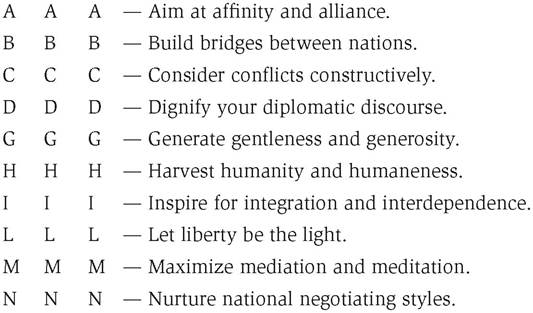
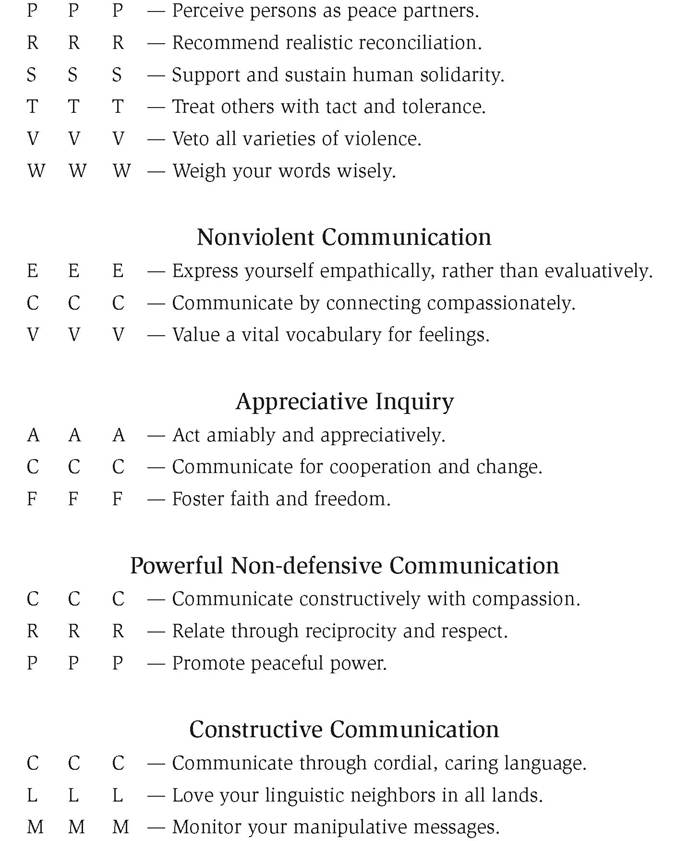
In such spirit, a plea of mine was the subject of a message by the president of the International Communication Association (Craig, 2003, p. 2), in which my formulation is described as an in-depth integration of three fundamental human rights, namely, the right to live in peace, the right to learn, and the right to communicate. Here is my updated version of that interpretation, with the addition of the notion of conflict resolution: human beings should have the right/responsibility to learn to communicate peacefully in varied societal contexts, especially in challenging, life-threatening situations. The right to communicate constructively is much neglected in schools and other forms of education. This neglect is detrimental to social life and is in need of change. In such spirit, let’s make the humanizing force of language a frequent rather than an occasional feature of communicative use. Accordingly, a plea is made herein for organizations committed to helping persons, groups, communities, and nations (re)solve conflicts/disputes to invest more in interdisciplinary research aimed at integrating knowledge about peaceful uses of languages into programs such as, for example, Columbia University’s Peace Education Program, which sustains an International Institute of Peace, founded in 1982 by ever inspiring peace educator Betty Reardon (Jenkins, 2005, p. 209). An emphasis on peaceful communication in such initiatives would reflect the assumption of the need for transformative communicative change leading to the preparation of citizens as peaceful users of languages, a systematic practice conspicuously absent from school curricula in Brazil, for instance, and presumably in most other countries.To provide a concise view of some implications of the approaches dealt with in the preceding section, I will resort to my THRIL (threefold repetition of the initial letter) technique, inspired by the long-cherished literary tradition of alliteration, still underexplored in communicatively vital contexts such as conflict resolution.
What follows are four sets of alliteration through which key concepts/insights from each approach are presented. Readers are urged to apply their alliterative talents to their readings in the CR field: it may prove both entertaining and provocative. By creating such alliteration, you make dual use of your meaningmaking marvel—your mind: (1) you try as best you can to accurately translate some of the philosophy underlying each approach and (2) you challenge your ability to be concise, thus enhancing memorability. To illustrate how such a practice of making meaningful, memorable messages can be used effectively in political science contexts, here is a set, created for a lecture given to students of international relations at a local college, Faculdade Integrada do Recife. Only some letters have been selected for inclusion:
As a creative practice, alliteration has much to offer inquiring minds in all domains of human knowledge, especially those that call for language- peace-and-conflict awareness, a much needed trio in today’s increasingly turbulent world. In closing, may I say communicative peace be with you, so that in your language-based conflicts and disputes, you act as true humaniz- ers, humanists who are imbued with the ideals of human rights, justice, peace and dignity and who, with a keen sense of global social responsibility, apply such values for the improvement of the human communicative condition everywhere.