From National Liberation to Personal Empowerment
The NGOs responsible for implementing child trauma relief projects in Palestine today have their roots in the voluntary associations that have sustained Palestinian civil society for the better part of a century.
The earliest precursors were the charitable institutions such as clinics, orphanages, and aid societies that developed during the early part of the twentieth century, in much the same vein that voluntary societies like the Salvation Army operated in Europe and the USA during that time. Some of these organizations had their roots in awqaf, Islamic charitable foundations, as well as grassroots Muslim charity associations. However, many Protestant Christian organizations also carried out their “civilizing mission” in the Holy Land, an enduring example being the still active International YMCA in Jerusalem. Many similar local and internationally supported charitable organizations still exist (Jarrar 2005), with children’s health and educational services continuing to be a major function of these organizations. However, these associations largely served Palestine’s growing urban population. Following the nakba or “catastrophe” of the 1948 war and the forced displacement of over 800,000 Palestinians from their land, Palestinian refugees coming from rural areas relied on extended familial networks (hamula) and village associations for their material and cultural survival (Rothenburg 1990). Eventually, support from international humanitarian organizations like the American Friends Service Committee, and later the UN Relief and Works Agency, provided institutional forms of support to refugees, with refugees themselves taking a leading role in organizing and expanding this support.It was the Israeli invasion of 1967, however, and the need to provide sustainable sources of medical and social services, that eventually led to the formulation of activist aid networks linking together cities, villages, and refugee camps (Jarrar 2005).
Compensating for the lack of services provided by the occupying authority, these voluntary societies began receiving funds from the Jordanian-Palestinian Joint Committee in 1978 (Craissati 2005). Grassroots volunteer organizing was seen as a form of active steadfastness, or sumud muqawim, that sustained Palestinian survival under occupation, alongside passive forms of sumud (steadfastness), such as the preservation of cultural traditions (Nassar and Heacock 1990; Craissati 2005). The rearticulation of grassroots volunteer activism in political terms was grounded in the direct experiences of the occupation and was given voice by a new generation of politically conscious, university-educated Palestinians who sought to challenge the “traditional, nationalistic and elitist patterns of development through the mobilization of the poor, especially in the villages” (ibid, p. 187).Following a brief period of popular mobilization, the newly energized volunteer base splintered into multiple factions. Leftist political groups took the lead in grassroots volunteer organizing, receiving substantial solidarity support from socialist and communist parties in Europe (Hammami 2000, p. 16). Despite political factionalism, these grassroots organizations played a crucial role in sustaining the momentum of the First Intifada, beginning in 1987 (Craissati 2005; Gordon 2008; Hammami 2000). Young people played a leading role in organizing and demonstrating as part of this popular uprising (Peteet 1991). Neighborhoods, schools, and universities were transformed into sites of political organizing, as Palestinian children and youth became highly visible symbols of resistance. This youthful resistance posed a challenge not only to the then 20-year old Israeli military occupation but also to the aging and exiled Palestinian political leadership.
The challenge that the intifada posed to the Israeli occupation as well as the authority of the Palestinian Liberation Organization led to attempts by the Israeli government and the PLO to quell the uprising.
Political negotiations were initiated, eventually culminating in the 1993 Oslo Accords, and the subsequent creation of the Palestinian Authority. With the possibility of a Palestinian state in sight, civil society organizations began early preparations for an eventual shift to state-building activities, coinciding with a global neoliberal trend of private expansion into welfare service provision (Shawa 2005). As bilateral “peace funds” began rolling in from the West, replacing the leftist solidarity donations that Palestinian organizations had traditionally received, there was increasing pressure, and incentive, for NGOs to become “professionalized.” This led to increasing estrangement between professional NGO workers and the grassroots upon which they had once relied for support (Hanafi and Tabar 2005, pp. 25-26). As Jad (2007, p. 628) similarly observes, “this ‘NGOisation’ of the national agenda in Palestine” transformed “a struggle to realise self-determination and sovereign statehood into ‘projects’ for donor funding, in which donors play a vital role in choosing their local interlocutors.” However, as Hanafi and Tabar (2005) emphasize, Palestinians NGOs are not the mere pawns of international donors but play a role in shaping donor agendas and asserting a relative amount of control over the ways in which funds are distributed and utilized.Nevertheless, many feel that the professionalization of Palestinian NGOs has led to a process of overt depoliticization of Palestinian civil society (Shawa 2005). Although many Palestinians have rejected the politics-as-usual of the dominant political factions, NGOs, fearing that an overtly political agenda would jeopardize international funding, have failed to provide the viable political alternative that some hoped they would. During the height of the Second Intifada (2000-2005), many viewed internationally funded NGOs as out of touch with the needs and opinions of the majority of Palestinians - continuing to hold workshops and trainings while Palestinian cities were being bombed (Allen 2002; Jad 2007).
However, in response to this massive violence there was also a massive resurgence of grassroots voluntary organizing. Largely youth-led networks of grassroots local and international volunteers - such as the Palestinian Medical Relief Committees and the International Solidarity Movement - once again mobilized to provide emergency assistance and other social services to areas cut off by checkpoints and military closures, while also serving a political advocacy role. This coincided with a massive increase in direct international humanitarian assistance from organizations like Medecins Sans Frontieres, which also played a role in political advocacy internationally (Fassin and Rechtman 2009).However, since the death of Yasser Arafat in 2004, the electoral victory of Hamas in 2006, and the subsequent US-backed Fateh takeover of the Palestinian Authority in the West Bank, splitting it from the Hamas-governed Gaza Strip, international humanitarian funding has taken on two different functions. In the West Bank, international aid has once again taken on a state-building and consolidation function, whereas in Gaza aid takes the form of crisis-driven, emergency programming. As can be illustrated in the chart below measuring humanitarian aid flows to Palestinian over the past decade, aid money peaked first in 2001 in response to the violence of the Second Intifada beginning in September of 2000, and then peaked again in 2009. The peak in 2009 was not a response to the attack on Gaza in 2008, but rather represents the $650 million of state-building assistance pledged by the international community at the Paris Donors Conference in 2008, where then Prime Minister Salam Fayyad presented his Palestinian Reform and Development Plan. At the heart of this plan was intensified cooperation between the Palestinian Authority and Israel, which allowed for loosened restrictions on travel and building within Palestinian Authority controlled areas of the West Bank, facilitating renewed state-building efforts and infrastructure repair, funded by international donors.
Thus, rather than responding to a humanitarian crises, current aid flows to Palestine are intended to stave off such crises by buttressing the legitimacy and authority of the West Bank government (Fig. 1).The influx of humanitarian aid money to the Palestinian Authority during a time of relative calm reveals the utility of aid as a technique of governance and the function of humanitarian aid in the calculus of Israeli security. In Gaza, under Israeli blockade and bombardment, humanitarian assistance has been used to prevent a full-blown humanitarian crisis that might prompt the international community to pressure Israel to end its siege and attacks. In other words, humanitarian
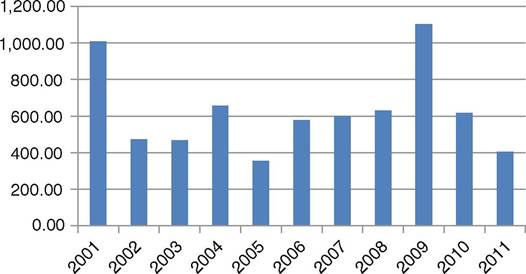
Fig. 1 International humanitarian aid flows to Palestine in US$ millions (Source: GlobalHuma- nitarianAssistance.org)
aid in Gaza could be said to serve as a form of biopower, keeping the besieged population alive long enough to continue to besiege it. Meanwhile, humanitarian projects in the West Bank could be viewed as serving a depoliticizing governmental function. However, the effects of these projects are indeterminate and open to reappropriation by the Palestinian community organizations that carry them out and the young people who participate in them. The following section provides a critical analysis of trauma relief projects in Palestine, followed by accounts from Palestinian community workers and young people and how they understand trauma and resiliency as it relates to resistance against occupation.
4
More on the topic From National Liberation to Personal Empowerment:
- From National Liberation to Personal Empowerment
- Contents
- Harker C., Horschelmann K. (Eds.). Conflict, Violence and Peace. Springer,2017. — 456 p., 2017
- Trauma and Liberation Psychology
- Context
- SHAPING STATE-ETHNIC RELATIONS